
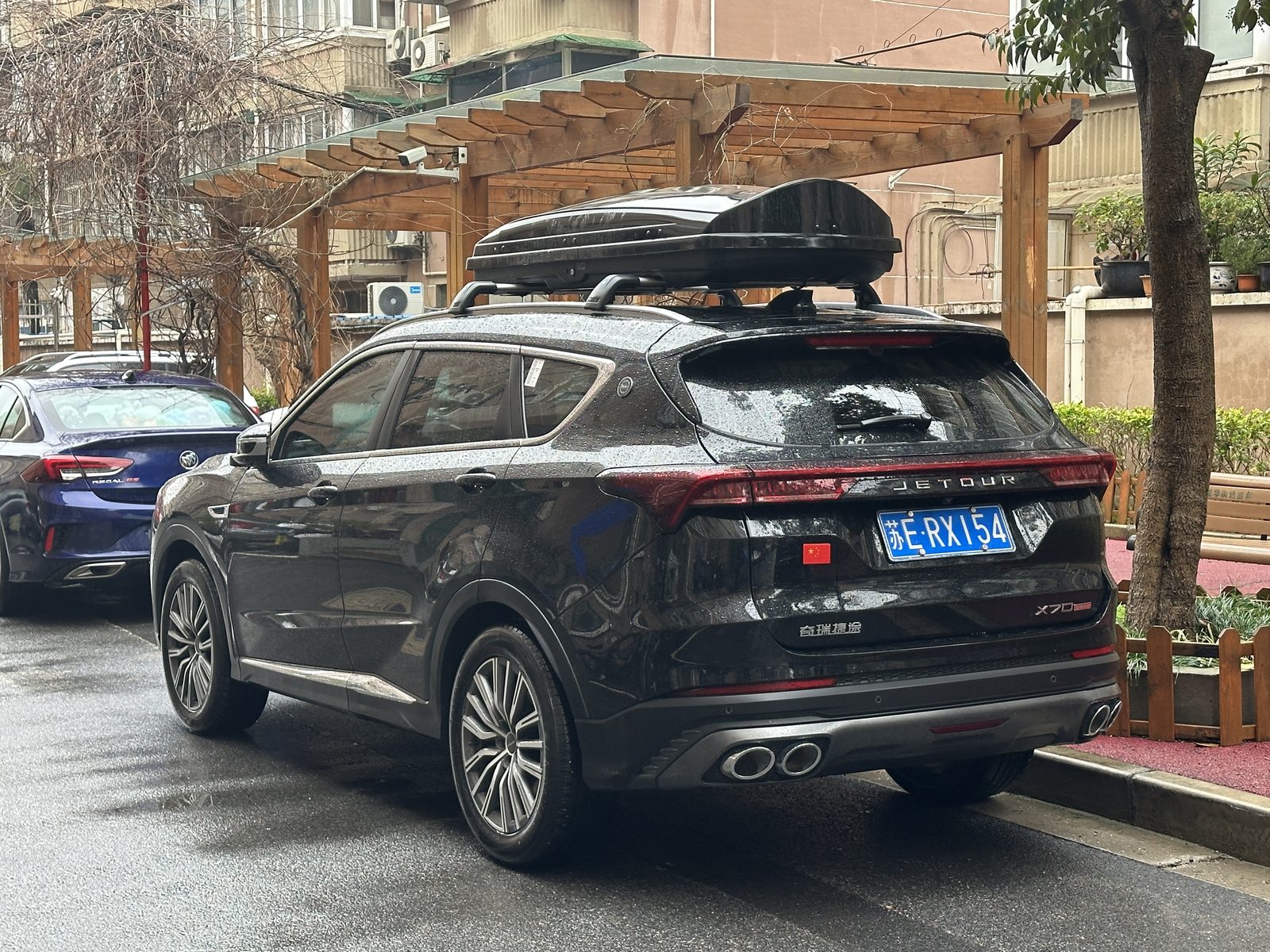
The Jetour X70 Plus is a five- or seven-seat family SUV from Chery’s Jetour brand, sold in Algeria and Côte d’Ivoire with a 1.5T or 1.6T petrol engine and front-wheel drive. The name covers more than one car: export listings quote 115 kW, 125 kW and 135 kW versions of the 1.5T, a 1.6T with 140–145 kW, two overall lengths and two wheelbases. Before you compare quotes, identify the model year and the engine code on the certificate, because the brochure name alone does not tell you which version you are buying.
That is the practical problem with this model. Two importers can both advertise a “2026 Jetour X70 Plus 1.5T 7-seat” and be selling cars with different power outputs, different gearboxes and body panels that do not interchange. The checks below are the ones that separate a clean order from a repair bill.
👉 Tell us the destination port and the seating layout your buyers need — we will confirm which X70 Plus version is available and send the specification sheet for that exact unit. Ask us on WhatsApp · Browse current stock →
Quick answers:
- Which engine is the current one? The 2026 China-market X70 Plus uses a 1.5TGDI with 135 kW and 290 Nm, paired with a 7-speed DCT. Older export stock uses a 115 kW 1.5T with a 6-speed DCT, and some markets sold a 1.6T.
- How many seats? Five or seven, in the same body. The third row is best for children and short trips.
- Is it all-wheel drive? No. The export versions reviewed here are front-wheel drive only.
- Is it left-hand drive? Yes for Algeria and Côte d’Ivoire. South Africa sells a right-hand-drive X70 Plus, which is not the car for either market.
- What is the biggest specification trap? Length and wheelbase. Export sheets quote 4,724 mm and 2,720 mm; the 2026 China model quotes 4,749 mm and 2,745 mm. Both are called X70 Plus.
What is the Jetour X70 Plus, and why does it look different in different markets?
The Jetour X70 Plus is the larger, more equipment-heavy member of the X70 family, a different product from the boxy Jetour T2. It is a monocoque crossover with a transverse engine, independent rear suspension and a cabin aimed at families: three rows in the seven-seat version and a boot that is useful only when the third row is folded.
The nameplate has run through several model years and at least one facelift, and Jetour sells it through regional distributors rather than one global specification. That is why the same badge appears with different lights, different screens and different engines depending on the market. The Arabic GCC page on Jetour’s global site lists the X70 Plus with a 2,720 mm wheelbase, five or seven seats, 20-inch wheels and a 62-inch panoramic roof. The Balkan distributor’s specification sheet lists the same 2,720 mm wheelbase but pairs it with a 1.5T and a 1.6T. The 2026 model launched in China is longer. None of these pages is wrong; they describe different builds.
For a buyer in Algiers or Abidjan, the useful question is not “what is the X70 Plus?” but “which build is in the quote?” Chinese model names versus export names explains why the same car can carry several names and specifications abroad.
Which X70 Plus engine should you order: 1.5T, 1.5T high-output or 1.6T?
The X70 Plus export range has three petrol answers, and they are not interchangeable.
| Version | Power | Torque | Gearbox | Where it appears |
|---|---|---|---|---|
| 1.5T base | 115 kW (156 PS) | 210 Nm on the Balkan sheet; Chinese listings often quote 230 Nm | 6-speed DCT | Older export stock, “Comfort” trims in Algeria |
| 1.5T high-output | 135 kW (184 PS) | 290 Nm | 7-speed DCT | 2026 China model; advertised by Algerian importers as the 184 hp version |
| 1.6T | 140–145 kW (187–197 PS) | 275–290 Nm | 7-speed DCT | Some export markets and older flagship trims |
The 115 kW engine is the price-sensitive choice. It moves a seven-seat family car adequately when empty, but it works harder on a full load, on long inclines or with the air conditioning running in a 40 °C Algerian summer. The 135 kW 1.5T is the better match for a seven-seat car in both target markets: more torque low down, a seven-speed gearbox and the same fuel tank.
The 1.6T is the odd one. Jetour’s Balkan specification sheet lists it at 140 kW and 275 Nm, while the same page’s header and several export brochures quote 145 kW and 290 Nm. If a quote says “1.6T 145 kW”, ask for the engine code and the certificate rather than accepting the headline number. The 1.6T is a fine engine, but it is older export stock and parts ordering depends on which version you actually receive.
One more distinction matters: a 125 kW / 270 Nm 1.5T with a 7-speed DCT exists in the South African facelift. It is a right-hand-drive market specification. Do not let a supplier substitute it into a quote for Algeria or Côte d’Ivoire, where the car must be left-hand drive.
Why do X70 Plus listings show two different lengths and wheelbases?
Because there are two bodies in circulation under one name. The export and pre-facelift sheet gives 4,724 mm overall length and a 2,720 mm wheelbase. The 2026 China-market car gives 4,749 mm and 2,745 mm. Width and height stay at 1,900 mm and 1,720 mm in both.
The 25 mm difference sounds trivial until you order floor mats, a boot liner, side steps or body panels. It also tells you which generation you are looking at when the photos are ambiguous. Algerian importer listings already mix the two: some quote 4,722 mm with a 2,745 mm wheelbase, which is a combination neither official sheet uses. That is a listing error, not a third body, and it is a good reason to check the certificate of conformity before paying a deposit.
A remote inspection is the cheapest way to catch this. Ask for photographs of the VIN plate, the engine bay label and the certification label, then compare them with the documents. Our guide to inspecting a car before paying covers the photo set to request.
Is the 7-seat X70 Plus worth it for family buyers?
The seven-seat X70 Plus is worth it when the third row is occasional. The package is about 4.7 metres long, so the third row is a children’s row or a short-trip row, not a place for three adults on a long route. With all seven seats up, boot space falls to roughly 90–95 litres, enough for soft bags. Fold the third row and the five-seat boot is about 440 litres; fold the second row as well and the car becomes a small van.
For a dealer, the seven-seat version widens the customer base in both Algeria and Côte d’Ivoire, where extended families travel together. It also adds weight and cost, and the third-row trim and belts are extra parts to stock. The five-seat version is lighter, simpler and usually the better fleet choice.
Check three things on a seven-seat unit: that the third-row seats fold flat and latch, that the seat belts are present and dated correctly, and that the spare wheel or repair kit is included. These are common omissions on export units that have been moved between dealers.
What should Algerian buyers check before ordering an X70 Plus?
Algerian buyers usually meet this car through an importer or a licensed dealer rather than a private parallel import, so the first check is the seller, not the car. Ask which entity holds the import file, who will be named on the customs document, and who honours the warranty after delivery. A dealer who cannot show the customs paperwork is reselling someone else’s import.
Then check the version:
- Model year and engine code. A 2026 car should have the 135 kW 1.5T and the 7-speed DCT. A “new” 2025 or older unit may have the 115 kW engine and the 6-speed DCT. Both are legitimate; they are not the same product.
- Length and wheelbase on the certificate. Match them to the body you inspected.
- Cooling and air conditioning. Ask for the refrigerant type and confirm the system was tested, not just installed. Algerian summers punish a weak condenser.
- Dust protection. Confirm the air filter part number and the service interval for dusty conditions. A cabin filter is cheap; a choked evaporator is not.
- Fuel quality. Ask the supplier for the minimum octane rating of the exact engine, then compare it with what is sold near the buyer. Do not assume that a China-market tune and an export tune have the same requirement.
- Parts for the facelift. Headlights, bumpers and grille differ between generations. Confirm which parts catalogue the importer uses.
The paperwork side is standard but unforgiving: commercial invoice, certificate of origin, conformity certificate, bill of lading and customs declaration. Our China car export documents checklist lists the set, and how a bill of lading is released explains why you should not pay the balance against a photocopy.
What should buyers in Côte d’Ivoire check before ordering?
Abidjan importers advertise both five- and seven-seat 2026 X70 Plus units, usually sourced from China. The version checks are the same as in Algeria, with three local additions.
First, confirm the drive side. Côte d’Ivoire is left-hand drive, and the South African X70 Plus is right-hand drive. A right-hand-drive unit does not match the market and will create registration problems, however good the price looks.
Second, confirm what the quote includes. A “CIF Abidjan” price covers freight and insurance to the port; an FOB price does not. On a 4.7-metre SUV the difference is material, and it changes who pays for marine insurance and who carries the risk if the vessel is delayed. FOB, CFR and CIF explained sets out the split, and RoRo versus container shipping explains why a single unit often moves as a shared container.
Third, prepare the car for the coast. Abidjan’s humidity and salt air are hard on underbody steel and electrical connectors. Ask for cavity wax and underbody protection before shipment, check that the drain channels are clear, and inspect the paint for transit damage at the port rather than a week later. Port storage and demurrage charges are worth understanding before the vessel arrives, because a missing document can turn a clean delivery into a daily bill.
For either market, if you are buying a single unit rather than a container load, shipping options for one car covers the practical choices.
How does the X70 Plus compare with the Jetour T2?
The X70 Plus and the Jetour T2 are both Jetour SUVs, but they serve different buyers. The X70 Plus is the family car: five or seven seats, front-wheel drive, a softer ride and a lower entry point in the range. The T2 is the boxy, five-seat lifestyle model with a 2.0T and an available all-wheel-drive layout in some markets.
If your buyers need seven seats or carry three rows of family, the X70 Plus is the only one of the two that fits. If they want the off-road look, a higher driving position and all-wheel drive, the T2 is the better answer. Our 212 T01 versus Jetour T2 comparison explains where the T2 sits against a proper body-on-frame off-roader, which is useful if customers are cross-shopping the two.
There is also a naming trap: the X70, X70 Plus and X70 L Plus are different products. The X70 L Plus is advertised in Abidjan alongside the X70 Plus, at a different size and equipment level. Order by the exact name and the exact certificate, not by the word “X70”.
Which documents and checks protect an X70 Plus order?
A clean X70 Plus order has four paper checks and two physical checks.
The paper set is the commercial invoice, the packing list, the certificate of origin and the conformity or emission certificate. The invoice must show the VIN, the engine number, the model year and the exact trim name. The certificate of origin must match the invoice. The conformity certificate must name the destination market or at least the emission standard the destination accepts. If any of these documents describes a different car from the one in the photos, stop.
The physical checks are the VIN plate and the engine bay label. Photograph both, and compare them with the invoice and the bill of lading. Then check the odometer and the tyre dates; a “new” car with 200 km and 2023-date tyres has been sitting somewhere.
Payment terms deserve the same attention. A deposit against a proforma invoice is normal; the balance should be released against documents that prove shipment, not against a promise. Letters of credit versus T/T explains the trade-off, and what a forwarder quote should itemise helps you spot a freight price that will grow after booking.
If you are inspecting in person, what to check at a Guangzhou inspection is the checklist we use. If you are buying remotely, insist on a walkaround video with the VIN visible, a cold start and a scan of the dashboard.
Frequently asked questions about the Jetour X70 Plus export version
Is the Jetour X70 Plus front-wheel drive only?
The export versions reviewed here are front-wheel drive. The X70 Plus is not offered with all-wheel drive in the specifications we checked for Algeria and Côte d’Ivoire. If a listing claims AWD, ask for the certificate and the rear differential photos.
How many seats does the X70 Plus have?
Five or seven, depending on the trim. The body is the same; the seven-seat version adds a third row and different second-row hardware. Boot space with all seven seats up is roughly 90–95 litres.
Which X70 Plus engine is best for Algeria?
For a seven-seat car, the 135 kW 1.5T with the 7-speed DCT is the better match. The 115 kW 1.5T is adequate for five-seat, lightly loaded use and usually costs less. The 1.6T is acceptable only when the certificate and parts support are clear.
Is the X70 Plus right-hand drive in Africa?
Not in Algeria or Côte d’Ivoire. Both are left-hand-drive markets. South Africa’s X70 Plus is right-hand drive and should not be supplied to either country.
What is the difference between the X70 and the X70 Plus?
The X70 Plus is the larger, more equipped version of the X70 family, with a different body and trim range. The X70 L Plus sold in Côte d’Ivoire is a separate variant again. Parts and body panels are not interchangeable across all three, so order by the exact name.
Can I import one X70 Plus as an individual buyer?
Yes, but the compliance work is the same as for a dealer: a conformity certificate for the destination, a clean title and export documents, and a shipping method that matches the car’s size. This guide covers the single-unit route.
👉 Ready to compare a specific X70 Plus unit? Send us the destination port, the seating layout and the model year on the certificate. We will confirm the engine version and the documents before you pay a deposit. Ask us on WhatsApp · See current stock →
Sources: Jetour global official X70 Plus model page (Arabic GCC), accessed November 2026 — 2,720 mm wheelbase, five/seven seats, 20-inch wheels, 62-inch panoramic roof, feature list. Jetour Balkans official distributor X70 Plus specification page, accessed November 2026 — 1.5T 115 kW/210 Nm/6DCT, 1.6T 140 kW/275 Nm/7DCT (page header also states 145 kW/187 hp), 4,724 × 1,900 × 1,720 mm, 2,720 mm wheelbase, 57 L tank, 7.6/8.1 L/100 km, 180/185 km/h. Jetour South Africa official X70 Plus page and CarMag launch report, November 2026 — facelift 125 kW/270 Nm/7DCT; the official page’s older table still quotes 115 kW/230 Nm/6DCT. Chinese-market 2026 X70 Plus launch coverage (Yiche, Autohome, Lianzhong Auto), April 2026 — 1.5TGDI 135 kW/290 Nm/7DCT, 4,749 mm length, 2,745 mm wheelbase, five/seven seats. Algerian importer listings (Yazid China, Sinocarz, Algerie Auto Export, Chnawa Auto), November 2026 — 2026 1.5T 184 hp/7DCT and 156 hp Comfort versions, mixed 4,722–4,749 mm dimensions. Ivorian importer listings (Ivoirecar, Voitures Chinoises), November 2026 — five- and seven-seat 2026 units offered. Boot volumes (about 94 L with seven seats up and about 438 L in five-seat form) are from Autohome’s Chinese specification table only. Importer listings were used to confirm market presence, not as specification authority. Specifications vary by model year and market; the certificate of conformity for the actual unit is the final reference. Photo: JustAnotherCarDesigner / Wikimedia Commons, CC0.