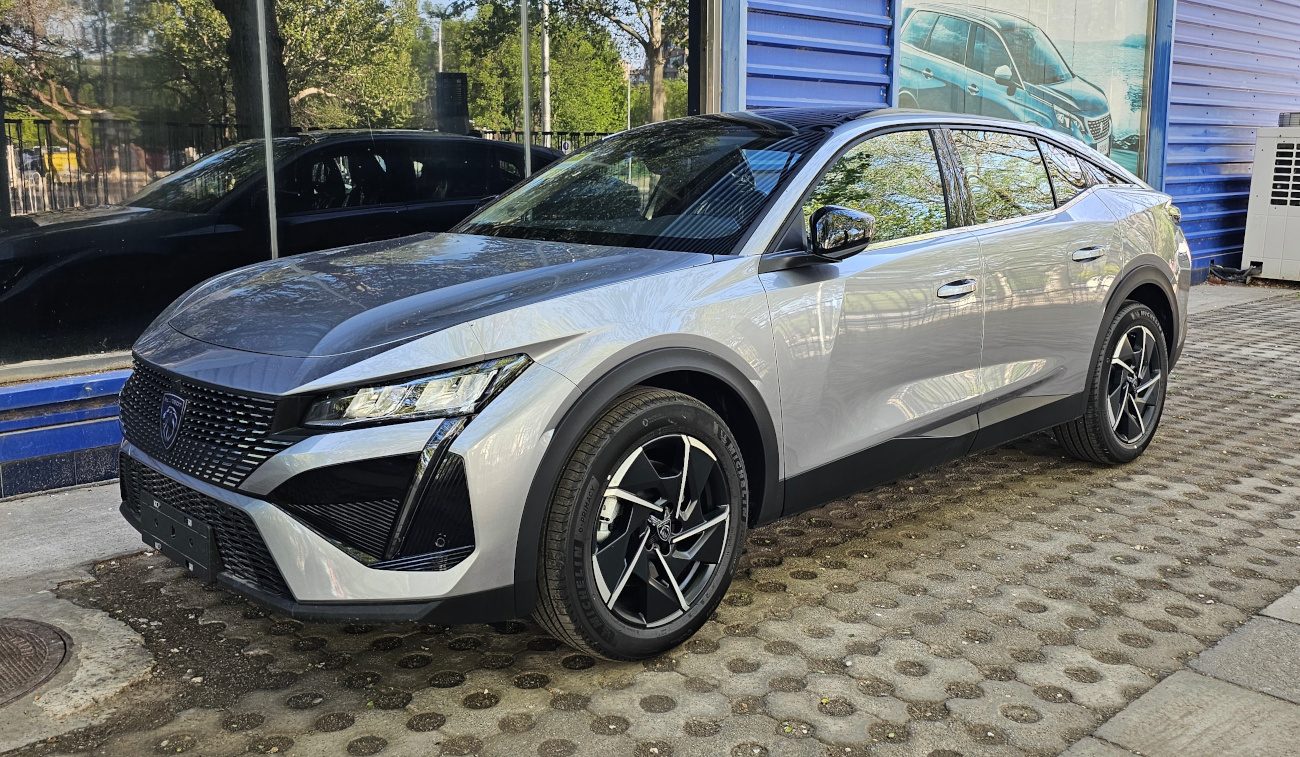
Two different Peugeot models are sold in China under the 408 badge, and only one of them is the car most overseas buyers have seen in a European showroom. The Chinese 408 is a four-door saloon, 4,750 mm long, with a 1.5T petrol engine and a six-speed automatic. The Chinese 408X is the China-built version of the Peugeot 408 fastback sold in Europe, 4,705 mm long, with a 1.6T and an eight-speed automatic. A quotation that says only “Peugeot 408” does not tell you which of the two is in the container.
That matters because the two cars share almost nothing you can swap: different body, different engine displacement, different gearbox, different wheelbase. They also carry different export status. The 408X is the model Dongfeng Peugeot Citroën has publicly exported to Southeast Asia; the 408 saloon is a China-market car. If you are buying for Algeria, Côte d’Ivoire, the Gulf or Central Asia, the first question to settle is not price or colour. It is which 408 the supplier is quoting.
👉 Tell us the destination port and whether your buyer wants the fastback or the saloon — we will confirm which version is available and send the specification sheet for that exact unit. Ask us on WhatsApp · Browse current stock →
Quick answers:
- Are the Peugeot 408 and 408X the same car? No. The 408 is a China-only saloon. The 408X is the Chinese name for the Peugeot 408 crossover/fastback (model code P54) sold in Europe.
- Which one is exported from China? The 408X has a confirmed export channel through DPCA to Vietnam and Malaysia. The 408 saloon is a domestic-market model.
- What engines do they use in China? The 408 uses a 1.5T with 127 kW and a 6-speed automatic. The 408X uses a 1.6T with 129 kW and an 8-speed automatic.
- Is the Chinese 408X the same as the 2026 European 408? Not quite. Europe facelifted the 408 in January 2026 with a new front end, a plug-in hybrid and the electric e-408. Chinese media report that facelift is not planned for the Chinese 408X.
- Is there a right-hand-drive version? No. Both Chinese cars are left-hand drive only.
What is the difference between the Peugeot 408 and the Peugeot 408X?
The Peugeot 408 is a three-box saloon developed for the Chinese market, while the Peugeot 408X is the same five-door fastback crossover that Peugeot sells in Europe as the 408. The saloon is the older nameplate: its current generation has been on sale since 2014 and was updated for the 2027 model year on 6 November 2026, with a single 360THP trim and the 1.5T engine. The 408X arrived in China in 2023, when Dongfeng Peugeot added the X to the name so buyers would not confuse it with the saloon still in the showroom.
The proportions explain why the confusion is easy. The saloon is 45 mm longer overall (4,750 mm against 4,705 mm) but its wheelbase is 57 mm shorter (2,730 mm against 2,787 mm). The 408X is 39 mm wider and 14 mm taller. One is a booted saloon with a 455-litre trunk; the other is a liftback with a 536-litre boot that opens with the rear glass.
| Specification | Peugeot 408 (China) | Peugeot 408X (China) | Peugeot 408 (Europe, 2026) |
|---|---|---|---|
| Body | Four-door saloon | Five-door fastback crossover | Five-door fastback crossover |
| Length / width / height | 4,750 / 1,820 / 1,488 mm | 4,705 / 1,859 / 1,502 mm | 4,687 / 1,848 / 1,478–1,487 mm |
| Wheelbase | 2,730 mm | 2,787 mm | 2,787 mm |
| Engine | 1.5T four-cylinder, 127 kW (173 PS), 255 Nm | 1.6T four-cylinder, 129 kW (175 PS), 250 Nm | 1.2 three-cylinder mild hybrid, 107 kW (145 PS) combined; 1.6 PHEV; e-408 |
| Gearbox | 6-speed automatic (Aisin) | 8-speed automatic (Aisin) | 6-speed dual-clutch (mild hybrid) |
| Drive | Front-wheel drive | Front-wheel drive | Front-wheel drive |
| Boot | 455 L | 536 L (1,611 L with seats folded) | 536 L |
| Suspension | MacPherson front, torsion beam rear | MacPherson front, torsion beam rear | MacPherson front, torsion beam rear |
| Steering | Left-hand drive | Left-hand drive | Left-hand drive |
The table is the short version. The longer version is that these are two different products that happen to share a number, and the differences below the skin are bigger than the badge suggests. The same naming problem runs through the BYD range and catches importers who order from a price list instead of a specification sheet.
Is the China-built Peugeot 408X the same car as the Peugeot 408 sold in Europe?
The China-built 408X is the same P54 model as the European Peugeot 408, built in Chengdu since January 2023, but it is not the same specification as the facelifted European car on sale in 2026. Peugeot builds the 408 in Mulhouse, France, since 2022 and in Chengdu since 2023. The wheelbase is identical at 2,787 mm, and the 18 mm length difference between the Chinese and European figures comes down to bumper and market specification rather than a different platform.
The bigger difference is the face and the powertrain. Peugeot unveiled a facelifted 408 for Europe in January 2026 with a split-headlamp front end, a full-width light bar and illuminated PEUGEOT lettering at the rear, plus a 1.2 mild hybrid, a 1.6 plug-in hybrid and the electric e-408. Chinese automotive media reported in 2026 that the facelift is not planned for the domestic 408X, which continues with the pre-facelift body and the 1.6T petrol engine.
For an importer this is practical, not academic. If your buyer saw the new European 408 at a motor show or on Peugeot’s international site, the Chinese 408X they receive will have the older front end and no hybrid option. That is not a defect; it is a different model year and market. It does mean the photographs in the offer sheet need to be of the actual unit, not the European press images. GCC-spec and China-spec cars differ in the same way, and the same discipline applies here.
Which engines does the Chinese Peugeot 408 use?
The Chinese Peugeot 408 uses a 1.5-litre turbocharged four-cylinder petrol engine producing 127 kW (173 PS) and 255 Nm between 1,750 and 4,500 rpm, paired with an Aisin six-speed automatic and front-wheel drive. The 2027 model year, launched on 6 November 2026, is sold in a single trim called 360THP Pro, with a 12-inch instrument display, a 10-inch centre screen and a 360-degree camera. The engine runs on 92 RON fuel and the WLTC combined figure is quoted at about 6.1 L/100 km.
The 408X uses a different engine: a 1.6-litre turbocharged four-cylinder with 129 kW (175 PS) and 250 Nm, matched to an Aisin eight-speed automatic. Its WLTC figure is quoted at 6.35 L/100 km, it also runs on 92 RON fuel, and it is front-wheel drive with a torsion-beam rear axle.
The outputs look almost identical on paper — 127 kW against 129 kW — which is exactly why buyers mix them up. The displacement, the gearbox and the torque curve are not the same, and neither are the service parts. Earlier generations of the Chinese 408 were sold with 1.2T, 1.6T and 1.8-litre engines, so a used listing for a “408 1.6T” may be an older saloon rather than a 408X. Ask for the model year and the engine number, not just the badge.
Europe’s 2026 line-up adds a third set of answers that China does not offer: the 1.2 mild hybrid with 145 PS combined, the 1.6 plug-in hybrid with a combined 240 PS, and the e-408 with 213 PS and a 58.2 kWh battery. None of those powertrains is part of the Chinese 408X range.
Which Peugeot 408 can you actually export from China?
The Peugeot 408X is the one with a documented export programme from China, while the 408 saloon has no official export channel that we could verify. DPCA, the Dongfeng–Stellantis joint venture, exported the Chengdu-built 408X to Vietnam, where it launched on 22 October 2023, and announced Malaysia as the next market. Stellantis’ China chief operating officer said at the time that the Chengdu plant supplies the model as CKD kits for Southeast Asia, under the “Made by DPCA, sold globally” strategy.
The 408 saloon is a different story. The current T9-generation car was developed for China and is not part of Peugeot’s European range. The first-generation 408 was assembled or sold in Malaysia, Russia and Argentina, but that does not carry over to the car on sale today. If a trading company offers you a current 408 saloon for export, treat it as a domestic-market vehicle: the paperwork, the homologation and the parts support all need checking, and there is no factory export programme behind it. The document checklist for a China-sourced car applies in full here.
Both cars are sold in China in left-hand drive only, and we found no right-hand-drive version in the Chinese range; a buyer in a right-hand-drive market should stop at this point rather than ask for a conversion.
How do you tell the Peugeot 408 and 408X apart on a quotation or certificate?
The Peugeot 408 and 408X can be separated on a quotation by four fields: the model name, the body style, the engine and the gearbox. A 408 saloon will read 1.5T with a 6-speed automatic; a 408X will read 1.6T with an 8-speed automatic. If the offer says “408 1.6T”, ask whether it is a 408X or an older saloon, because both descriptions exist in the Chinese market.
The checklist we use:
- Model name and model year. 408 and 408X are different vehicles. 2026 and 2027 model years are different builds.
- Body. A separate boot lid means the saloon; a rear glass that lifts with the tailgate means the 408X.
- Engine. 1.5T (127 kW) in the saloon, 1.6T (129 kW) in the 408X.
- Gearbox. Six speeds in the saloon, eight in the 408X.
- Dimensions. 4,750 mm and a 2,730 mm wheelbase for the saloon; 4,705 mm and 2,787 mm for the 408X.
- Documents. Ask for the certificate of conformity or export certificate, the engine number and photographs of the actual unit, including the VIN plate.
The VIN prefix does not help: both cars are built in China and start with L. The paperwork does. A remote inspection before payment is cheaper than correcting a misdescribed order, and inspecting the car in person in Guangzhou settles the question in an afternoon.
What should buyers in Algeria, Côte d’Ivoire and the Gulf check before ordering a Chinese Peugeot 408?
Buyers in Algeria, Côte d’Ivoire and the Gulf should check four things beyond the model name: emissions compliance, fuel quality, parts availability and warranty support. Both Chinese cars are certified to China VI emissions standards, which is not automatically the same as the homologation your market requires. Check the destination country’s import rules before the car is shipped, not after it lands.
Fuel is the second item. Both engines are direct-injection turbos tuned for 92 RON fuel. In markets where fuel quality varies, ask the supplier for the recommended octane and service interval, and plan for shorter oil-change intervals if the car will run on lower-grade fuel.
Parts are the third. The 408X shares its platform and many mechanical parts with other models on the same architecture, but body panels and lights are specific to the P54. The 408 saloon’s body parts are China-market items. Before you commit to a volume order, confirm that the consumables and the most commonly damaged panels are available in your market or from your supplier, and at what lead time.
Warranty is the fourth. A car bought through a parallel export channel is not automatically covered by the local Peugeot distributor. Ask the distributor in your market whether it will service the car and honour the warranty, and get the answer before you sign. We do not claim brand authorization or an official dealership relationship, and any supplier who does should be able to show you the paperwork.
On the commercial side, FOB, CFR and CIF decide where your responsibility starts, the payment method decides how much risk sits with the bank, and marine insurance decides who pays if the car is damaged on the way. Shipping options for a single car are different from a container programme, and the 408X’s export history in Southeast Asia is a useful reference for what a factory CKD flow looks like.
For buyers comparing this car with other China-built options, the Jetour X70 Plus guide covers the seven-seat SUV alternative for Algeria and Côte d’Ivoire, the Nissan Navara Pro guide covers the pickup segment, the Hongqi HS5 covers Central Asia and the Middle East, and the Yangwang Altior launch in Abu Dhabi shows how a new Chinese model reaches Gulf buyers. The Russia and Central Asia market picture is worth reading before you plan volumes.
Is there a right-hand-drive or plug-in hybrid Peugeot 408 from China?
Peugeot does not offer a right-hand-drive or plug-in hybrid 408 in China. Chinese domestic sales of both the 408 and the 408X are left-hand drive only, and the Chinese 408X is sold with a single petrol powertrain, the 1.6T with the 8-speed automatic. The plug-in hybrid and the electric e-408 belong to the European range built in Mulhouse; they are not part of the Chinese line-up, and Chinese media report that the facelift that introduced them is not planned for the domestic 408X.
A buyer who needs right-hand drive should look at other supply chains, not at a converted Chinese car. A buyer who needs a plug-in hybrid or an EV should look at a different model rather than expect the 408X to be upgraded.
Which Peugeot 408 should you order?
Order the 408X if your buyer wants the European 408 fastback shape, and accept that the Chinese car is the pre-facelift body with a 1.6T and an 8-speed automatic. Confirm the unit with photographs and the certificate before payment, and set expectations on the front-end design and the absence of a hybrid option.
Order the 408 saloon if your buyer wants a low-cost C-segment sedan for fleet, taxi or family use, and accept that it is a China-market car with no factory export programme. Check parts and service support first; the saloon’s body parts are not shared with the European range.
Order neither if the requirement is right-hand drive, a plug-in hybrid or an EV. In those cases the Chinese 408 range does not have an answer, and a different model or a different source market does.
If the real requirement is a family SUV rather than a fastback, the Jetour X70 Plus is the closer comparison. If it is a petrol sedan with a longer track record in export channels, look at what your market already services before choosing the 408 saloon. Version-by-version buying guides are the right format for this kind of decision, because the badge alone does not identify the car.
FAQ
Is the Peugeot 408 sold in China the same as the Peugeot 408 sold in Europe?
No. The Chinese 408 is a China-only four-door saloon with a 1.5T engine and a 6-speed automatic. The European 408 is a fastback crossover; its Chinese equivalent is the 408X, which uses a 1.6T and an 8-speed automatic.
What is the Peugeot 408X?
The 408X is the Chinese-market name for the Peugeot 408 fastback crossover (model code P54). Peugeot builds it in Mulhouse, France, and in Chengdu, China. The X distinguishes it from the older 408 saloon that is still sold in China.
How much power does the Chinese Peugeot 408 have?
The current Chinese 408 saloon produces 127 kW (173 PS) and 255 Nm from its 1.5T engine. The 408X produces 129 kW (175 PS) and 250 Nm from its 1.6T engine.
Does the Peugeot 408X come with a manual gearbox?
No. The Chinese 408X is sold with an 8-speed automatic. The 408 saloon uses a 6-speed automatic.
Can I buy a right-hand-drive Peugeot 408 from China?
No. Both the 408 and the 408X are sold in China in left-hand drive only, and we found no right-hand-drive version.
Is the China-built Peugeot 408X exported to other countries?
Yes. DPCA has exported the Chengdu-built 408X to Vietnam, where it launched in October 2023, and to Malaysia, with CKD kits supplied from China for Southeast Asia.
What is the difference in size between the Peugeot 408 and 408X?
The 408 saloon is 4,750 mm long on a 2,730 mm wheelbase. The 408X is 4,705 mm long on a 2,787 mm wheelbase, and is 39 mm wider and 14 mm taller.
Sources: Dongfeng Peugeot’s 2027 model-year 408 launch coverage (Autohome, Yiche, Sina, November 2026; China VI, 1.5T 127 kW/255 Nm, 6AT, 4,750/1,820/1,488 mm, 2,730 mm wheelbase); Dongfeng Peugeot 408X 2026 model-year launch coverage (Bitauto, Sina, Donews, June 2025; 1.6T 129 kW/250 Nm, 8AT, 4,705/1,859/1,502 mm, 2,787 mm wheelbase); European Peugeot 408 facelift coverage (PCauto, Sina, Autohome, January–June 2026; 1.2 mild hybrid 145 PS, 1.6 PHEV 240 PS combined, e-408 213 PS/58.2 kWh) and ADAC Autokatalog 408 1.2 Hybrid 145 data (4,687 mm length, 2,787 mm wheelbase); Wikipedia entries “Peugeot 408” and “Peugeot 408 (crossover)” for model codes, production locations (Mulhouse 2022, Chengdu January 2023) and export markets; Gasgoo and Yiche reports on DPCA exporting the 408X to Vietnam (launch 22 October 2023) and Malaysia. Dimensions and power figures are quoted as published by the sources above. The 1.2 mild-hybrid combined output is from ADAC’s catalogue only, and the 408 saloon’s 455-litre boot figure is from the Autohome configuration table only. China VI is the Chinese emissions standard and is not claimed to equal Euro 6. No China guide prices are quoted. Photo: Navigator84 / Wikimedia Commons, CC BY-SA 4.0.