
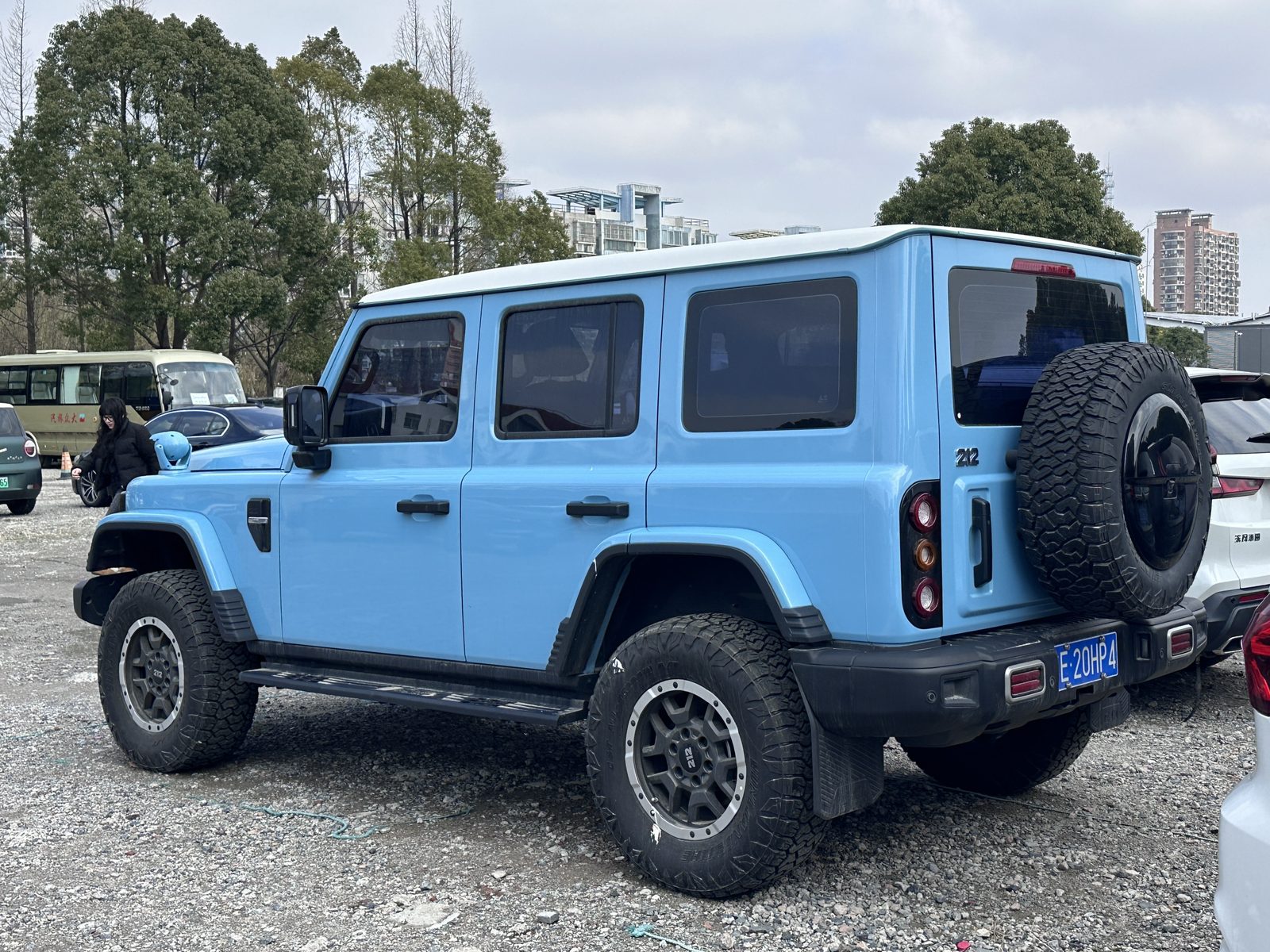
The 212 T01 is a boxy, body-on-frame 4×4 (with solid axles at both ends, according to the Zhichepai spec table), built in China and offered with a 2.0T petrol engine (185 kW, 410 N·m) or a 2.0T diesel (125 kW, 415 N·m), both with an 8-speed automatic. The trims split into two bodies: a shorter, lower entry body with 235 mm of ground clearance, and a taller, wider body with 256 mm. If your buyers want a hard-use off-roader that is easy to modify, the choice between those two bodies and between petrol and diesel is the whole decision.
👉 Need a quote? Ask us on WhatsApp · Chinese model names vs export names
What is the 212 T01 and who buys it?
The 212 T01 is a five-door, five-seat SUV with a ladder frame, a part-time four-wheel-drive system and a five-link solid-axle suspension front and rear. It is a different kind of vehicle from the unibody crossovers that dominate most export orders, which is why it gets compared with traditional off-road names rather than with the cars in our top Chinese SUVs and EVs for export list.
It sells in China under the 212 name, and overseas media usually write “BAW 212 T01”. Two trim names get translated in different ways: the Chinese “长风” appears as Changfeng or “Long Wind”, and the Chinese “高地” as Highland. We use the Changfeng spelling here because that is what export buyers will see in English-language listings.
The buyers who ask about it tend to be in markets where a ladder-frame truck-style SUV is normal: Gulf and wider Middle East buyers who want a desert and dune vehicle, Central Asian buyers with unpaved mountain roads, and East African buyers with long gravel routes. If you work in those regions, also read our notes on Chinese cars in Russia and Central Asia and importing to Ghana for how the wider market looks.
Which engines does the 212 T01 offer, petrol or diesel?
The 212 T01 offers a 2.0T petrol and a 2.0T diesel, both mated to an 8-speed automatic and a part-time 4WD system. The two engines are not close in output.
| Item | 2.0T petrol (N20TG) | 2.0T diesel (4F20TC53) |
|---|---|---|
| Max power | 185 kW | 125 kW |
| Max torque | 410 N·m | 415 N·m |
| Fuel | 92-octane petrol | Diesel |
| Claimed top speed (2026 models) | 170 km/h | 155 km/h |
| Fuel tank | 80 L | 80 L |
| Emissions standard (China) | China VI | China VI |
The petrol is the stronger engine on paper by a wide margin in power, while the diesel matches it on torque and the diesel is the one to pick when low-speed pulling matters. The diesel also adds weight: the 2026 diesel Changfeng lists a 2,390 kg kerb weight against 2,265 kg for the petrol Changfeng.
The diesel became available in December 2025, according to the launch coverage, so it has a shorter track record in the field than the petrol. If your market has a strong preference for diesel because of fuel availability, that matters more than the power gap. If it does not, the petrol is the easier sell.
Fuel quality is the practical issue to check before you commit. The diesel is built to a China VI emissions standard, and the petrol asks for 92-octane. Confirm what your market’s fuel and emissions rules allow before you order, and ask us for the current engine specification of the exact trim, because export-market versions can differ from the China-market specification.
How do the 212 T01 trims differ?
The trims fall into two groups by body, and the body decides the clearance and the size.
| Trim (2026 unless noted) | Fuel | Length x width x height (mm) | Min. ground clearance | Kerb weight |
|---|---|---|---|---|
| METTA Badain Jaran | Petrol | 4,740 x 1,945 x 1,991 | 256 mm | 2,265 kg |
| METTA | Petrol | 4,740 x 1,945 x 1,936 | 234.6 mm | 2,265 kg |
| Highland (facelift) | Petrol | 4,811 x 1,945 x 1,999 | 256 mm | 2,265 kg |
| Changfeng | Petrol | 4,749 x 1,945 x 1,999 | 256 mm | 2,265 kg |
| Changfeng diesel | Diesel | 4,749 x 1,945 x 1,999 | 256 mm | 2,390 kg |
| Inspector | Petrol | 4,705 x 1,895 x 1,936 | 235 mm | 2,150 kg |
| Mechanic | Petrol | 4,705 x 1,895 x 1,936 | 235 mm | 2,150 kg |
All trims share a 2,860 mm wheelbase, an 80-litre tank, a full-size spare, ventilated front discs and a 12.3-inch screen. The Highland is the longest at 4,811 mm. Earlier model years also exist on the market (a 2025 diesel and Inspector, 2024 Mechanic and Explorer), and some of those older bodies use different tyres, so match the model year on any stock offer.
Two things stand out. First, the wide, tall bodies (Changfeng, Highland, METTA Badain Jaran) give 256 mm of clearance and wear 285/70 R17 tyres, while the Inspector and Mechanic sit at 235 mm on 265/70 R17. Second, the 2026 METTA is an in-between case: a 1,936 mm height with 234.6 mm of clearance but the wider 1,945 mm body.
Which 212 T01 trim should an export buyer pick?
The best match depends on the buyer’s use, and there is no single best trim.
- Rental, fleet and entry orders: the Mechanic and Inspector are the lighter, lower-clearance entries. They have the smallest body and the lowest weight, and they suit buyers who want the 212 look and the ladder-frame hardware without paying for the bigger body.
- Desert, dune and rough-track use: the Changfeng petrol, with 256 mm of clearance and the larger tyres, is the sensible core of an order for Gulf and Central Asian buyers.
- Long-distance, low-speed, fuel-constrained routes: the Changfeng diesel, if your fuel supply and local rules favour diesel and your buyers accept the lower top speed and power.
- Higher-spec orders: the Highland and METTA Badain Jaran share the larger body and 256 mm clearance; the equipment lists differ by model year, so confirm the exact list for the stock on offer before you promise anything to a buyer.
Do not build an order around one trim. For a first container or a first few units, take two trims and see which one your buyers ask for.
What does the 212 T01 offer for off-road use?
The 212 T01 has a part-time 4WD system, solid axles with five-link suspension front and rear, and 256 mm of ground clearance on the larger body. Some trims list nitrogen-charged shock absorbers. Reports on the diesel Changfeng also describe an upgraded transfer case and a strengthened front axle tube. Chinese technical documents quoted by CarNewsChina and Autohome give a wading depth of up to 850 mm, and Autohome gives 910 mm with the optional snorkel.
Solid axles are a strength for modification and for repair in remote places. Buyers who lift a vehicle, fit larger tyres or add a winch generally find a ladder frame and solid axles easier to work with than a unibody with independent suspension. The trade-off is road manners: a vehicle like this rides and corners differently from a crossover, and buyers expecting a soft, quiet family car may be disappointed.
We do not quote approach and departure angles here. Published figures for the diesel Changfeng disagree between sources, so we would rather leave them out than print a number we cannot confirm.
How does the 212 T01 compare with the Tank 300 and other hard-core 4x4s?
A direct comparison needs matched trims and current figures, and the Tank 300 was refreshed in July 2026, so we are not publishing a head-to-head table in this guide. In general terms, the 212 T01 is a more traditional ladder-frame, solid-axle design, and its China-market starting price is lower than the better-known rivals in this class. The better-known rivals offer bigger dealer networks and brand recognition in several export markets, which can matter more than hardware to some buyers.
If you are weighing it against a pickup instead, read our Dongfeng Rich 6 vs Nissan Navara comparison and BYD Shark 6 vs Toyota Hilux for how we think about off-road buyers who want a workhorse.
What should importers check before ordering the 212 T01?
Check these points before you order a container or even a single unit:
- Steering side and market specification. Ask which steering layout and which equipment list apply to the stock on offer.
- Emissions and fuel. The engines are built to China VI. Check your destination’s rules and local fuel quality, especially for the diesel.
- Model year. The same trim name appears across 2024, 2025 and 2026, with different body sizes and tyres.
- Option packages. Items such as a roof light, sunroof, snorkel, locking differentials and a tow package are listed as options on some trims. Confirm which are fitted on the units you are buying.
- After-sales and parts. A smaller brand outside China means you must plan the spare-parts supply yourself. See our notes on how to vet a supplier and traps to avoid when importing.
- Warranty. The China-market warranty is three years or 60,000 km. Whether it applies to export units is a separate question to settle with the seller.
- Shipping. A vehicle of this height and weight affects loading. Read RoRo or container and how many cars fit in a container before you plan the shipment.
- Paperwork and payment. Use the export documents checklist, LC vs T/T and marine insurance as your baseline.
If you want to see the vehicle before you commit, visiting Guangzhou is the cleanest way, and the Nansha terminal guide explains how the cars leave.
We do not hold export qualifications or brand authorisation, and we do not publish prices in this guide. Ask us on WhatsApp for current availability and a quote on the exact trim.
FAQ
Does the 212 T01 come in diesel?
Yes. The 2.0T diesel produces 125 kW and 415 N·m with an 8-speed automatic, and it was launched in December 2025. The petrol 2.0T produces 185 kW and 410 N·m.
What is the ground clearance of the 212 T01?
The larger-bodied trims (Changfeng, Highland, METTA Badain Jaran) list 256 mm of minimum ground clearance. The Inspector and Mechanic list 235 mm, and the 2026 METTA lists 234.6 mm.
Is the 212 T01 a unibody SUV?
No. It has a body-on-frame (non-unibody) structure with solid axles and five-link suspension at both ends.
What does Changfeng mean on the 212 T01?
It is the English rendering of the Chinese trim name 长风, also written “Long Wind”. It identifies the larger-bodied trim with 256 mm of clearance, offered in petrol and diesel.
Which 212 T01 trim is best for the Middle East?
For desert use, the petrol Changfeng with 256 mm of clearance and the larger tyres is the usual starting point. A buyer who prefers diesel can look at the diesel Changfeng. Order two trims first and let your buyers decide.
Can I buy a single 212 T01?
See buying one car from China for the shipping options for a single unit.
Sources: Zhichepai specification table for the 212 T01 (trims, dimensions, ground clearance, kerb weight, tyres, engine output, top speed, warranty, suspension type), Autohome launch coverage of the 2026 Changfeng petrol and diesel, Phoenix (ifeng) launch report of 12 December 2025 for the diesel Changfeng, CarNewsChina (16 November 2025) for body-on-frame construction, the 185 kW / 410 N·m petrol engine, the 8-speed automatic and the part-time 4WD system, and CarNewsChina and IT Home coverage of the July 2026 Tank 300 refresh. Checked November 2026. All figures are China-market specifications and can differ on export units. Only from Zhichepai: solid-axle five-link suspension, top speeds, tyre sizes, kerb weights, the 234.6 mm clearance of the 2026 METTA, the three-year / 60,000 km warranty and the nitrogen-shock listing. Only from Autohome: the 910 mm wading depth with snorkel. Only from one launch report (ifeng): the upgraded transfer case and strengthened front axle tube. Approach and departure angles are omitted because sources disagree (36 and 39 degrees for departure; 40 and 43 degrees for approach). Fuel consumption is omitted because reports differ. Photo: JustAnotherCarDesigner / Wikimedia Commons, CC0.