
If you are buying cars from China and someone quotes you “shipping per unit”, you are being quoted the wrong way round. Ocean freight is charged per container, not per car. So the real question is never “what does it cost to ship one car” — it is “how many cars can I get into one container, and am I paying for empty space?”
This guide answers that, using the loading method we actually use out of Nansha.
The short answer
A 40ft high cube container holds three to four cars when a steel racking frame is used. Four is achievable with compact and midsize cars — two on the floor, two lifted and tilted above them. A very common alternative is three: two flat on the floor and one angled on the rack above. Tall SUVs and pickups usually bring it down to two or three. Without any frame, a 40HC holds two. A 20ft container generally takes one car, or two with a frame and small models.
That is the whole economic argument in one line: the frame can double what you get for the same ocean freight bill — and the ocean freight bill is written per box, not per car.
Container sizes you will be quoted
Three box types come up in car export. The internal dimensions below are the standard ISO figures — individual boxes vary slightly by owner and age, so your forwarder’s actual box may differ by a few centimetres.
| Container | Internal L × W × H | Cars without frame | Cars with racking frame |
|---|---|---|---|
| 20ft GP | ≈ 5.90 × 2.35 × 2.39 m | 1 | 2 with small models |
| 40ft GP | ≈ 12.03 × 2.35 × 2.39 m | 2 | 3–4, height dependent |
| 40ft HC (high cube) | ≈ 12.03 × 2.35 × 2.69 m | 2 | 3–4 (4 with compact/midsize) |
The number that matters is the 2.69 m internal height of the high cube. That extra 30 cm over a standard 40ft is the difference between stacking cars and not stacking them, which is why almost all of our container loads go out in 40HC.
How four cars actually fit: the racking frame
Here is one of our own loads, photographed inside the box before the doors were closed:
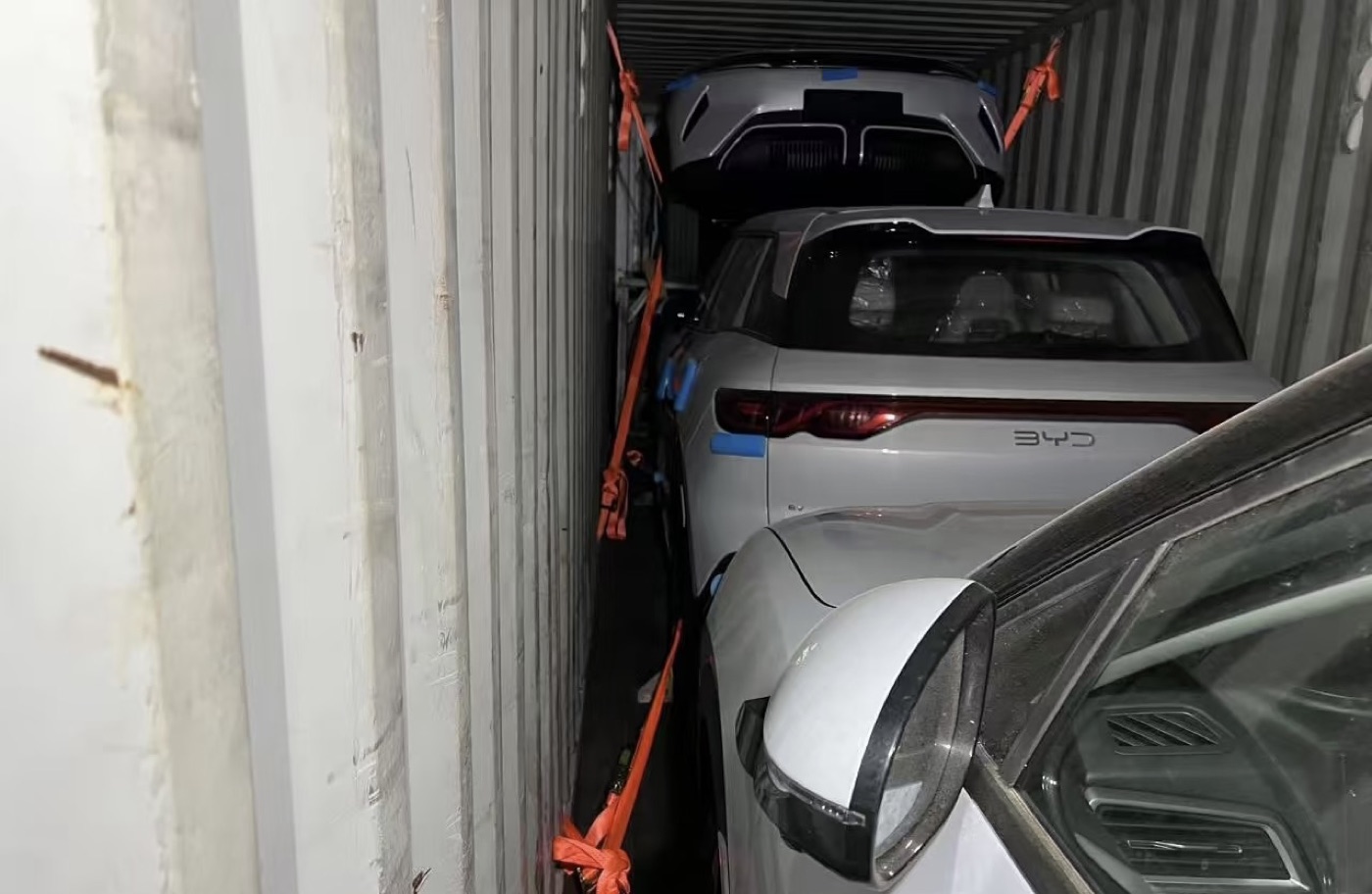
Three things in that photo explain the whole method.
1. The upper car is tilted, not flat
This is the part people get wrong when they do the arithmetic at home. A sedan stands roughly 1.45–1.50 m tall. Two of them flat is about 3.0 m — which does not fit under a 2.69 m ceiling. Stacking only works because the frame lifts the upper car and angles it, so the two cars overlap diagonally instead of sitting squarely on top of one another. Look at the rear of the upper car in the photo and you can see it sitting nose-down across the car below.
2. The frame carries the weight, not the car below
The upper vehicle rests on a steel rack bolted to the container’s own lashing points. No load passes through the roof of the lower car. This is why a frame is not optional for stacking — putting one car on another is not a thing anyone in this trade does.
3. Every car is lashed at four corners
The orange straps in the photo run to the container’s lashing rings. Wheels are chocked, the handbrake is off, and fuel is run down to a low level. A car that shifts at sea will damage itself and everything around it, and marine insurance will ask whether it was properly secured.
What actually decides your number: the cars themselves
“Four cars in a 40HC” is a working rule, not a law of physics. Your real number falls out of the dimensions of the specific models you bought. Length decides how many fit end to end; height decides whether the second deck is possible at all.
Take three cars from our current stock, roughly to scale:
| Model | Approx. length | Approx. height | Loading behaviour |
|---|---|---|---|
| BYD Seagull (city EV) | ≈ 3.78 m | ≈ 1.54 m | Very easy — short enough that four fit comfortably |
| Audi Q3 (compact SUV) | ≈ 4.40 m | ≈ 1.62 m | Standard four-car load in a 40HC |
| Toyota Highlander (large SUV) | ≈ 4.89 m | ≈ 1.73 m | Tight — tall SUVs often drop the load to three |
The pattern is simple: tall SUVs and pickups are what break a four-car plan, not long sedans. Two full-size SUVs stacked can exceed the 2.69 m ceiling even tilted, so a mixed load — one SUV below, one sedan or small EV above — is often what gets you back to four units.
This is also an argument for telling us what you want before you finalise the list. If you are buying four cars anyway, choosing a combination that loads cleanly can save you a whole container. It is worth reading the model comparisons first — the trim you pick changes the dimensions: our Jetour T2 1.5T vs 2.0T and Audi A3 vs Q3 comparisons both cover versions that sit differently in a box.
Full container vs shared container: where the money goes
Two ways to move cars in boxes, and the cost logic behind them is completely different.
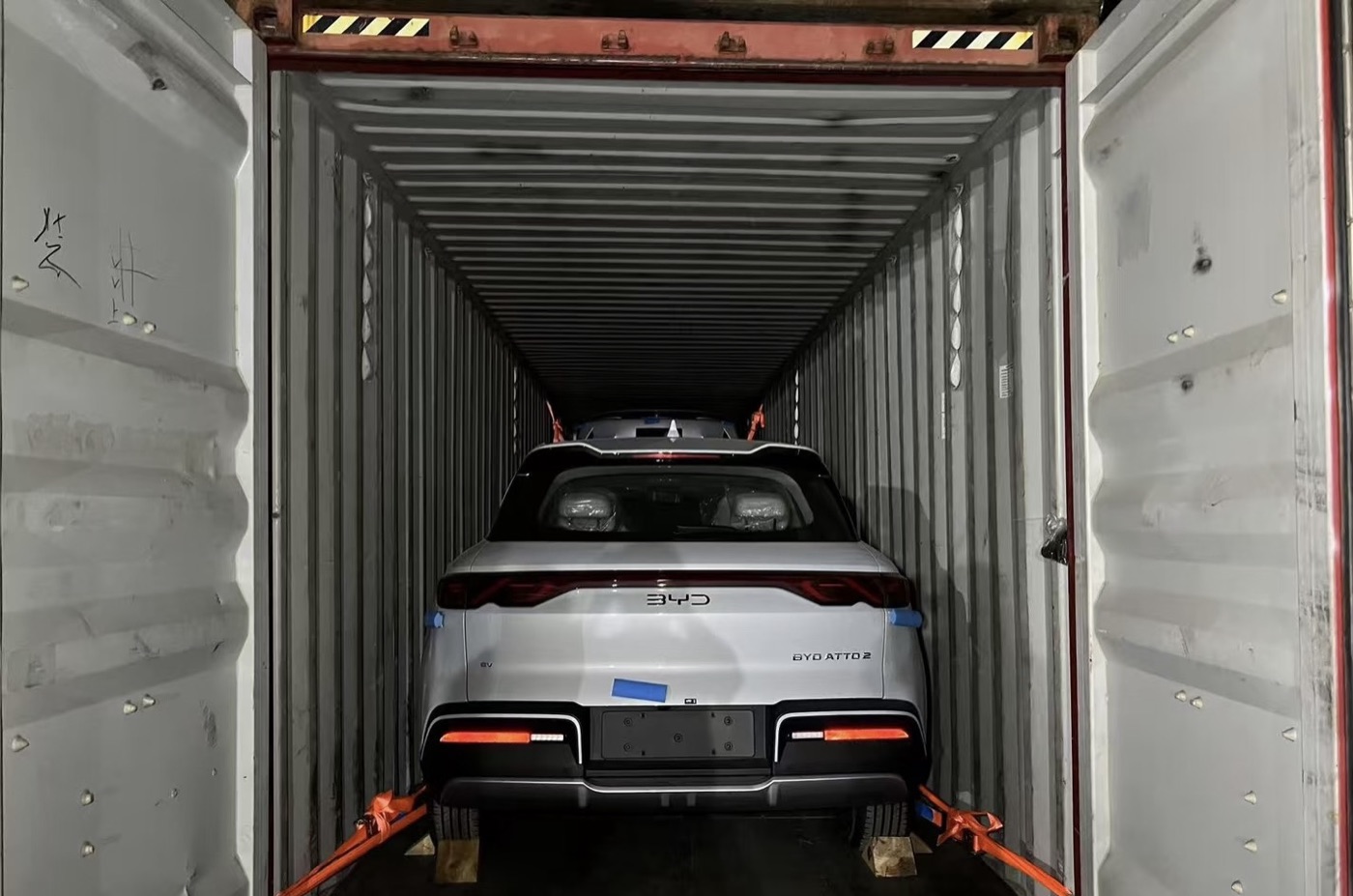
Full container (FCL) — you book the whole box
You pay for the container as a unit. Ocean freight, terminal handling at both ends, documentation — these are largely per-box charges that do not change whether you put two cars in or four. Load it properly and you split one freight bill four ways. Load it half empty and you are shipping air at the same price.
Shared container — you split a box with other buyers
In this trade “sharing” almost always means consolidation: several buyers’ cars combined into one container, each paying a share. It solves a real problem — you only want one or two cars — but it introduces costs and risks that a full container does not have:
- Consolidation and de-consolidation fees. Someone has to load a mixed box at origin and break it apart at destination. That handling is charged, and it eats into the freight you saved.
- You move at the slowest person’s pace. The box does not sail until it is full. If a co-loader is late paying or late delivering their car, your car waits in the yard.
- Customs is shared. At the destination the container is one shipment with several owners. A problem with someone else’s paperwork can hold up the whole box — including your car.
- More handling means more risk. Every extra load and unload is another chance for a scratch, and sorting out who caused it is harder when three parties are involved.
So the rule is simple
If you can fill a container, fill it. The per-unit cost of a well-loaded 40HC is the lowest number available to you, and the shipment stays entirely under your control — one bill of lading, one customs entry, one party responsible.
We are not going to print freight rates here, because rates move with the season, the route and the carrier, and a number published today would mislead you next month. What does not move is the structure: freight is charged per box, so units per box is the lever you control. For route-level detail — ports, transit times and the full cost stack — see our guide on shipping cars from China to Africa.
Why a half-empty container costs you twice
The obvious cost is the wasted space. The second one is less obvious and usually bigger.
If you ship two cars in a box that could have taken four, your landed cost per car carries roughly double the freight component. That number goes straight into your retail price. In markets where imported cars compete hard on price, being a few hundred dollars per unit above a competitor who consolidated properly is the difference between selling in a fortnight and sitting on stock for a quarter.
For dealers, this is the whole argument for buying in fours rather than ones and twos — the freight maths rewards it directly. Plug-in hybrids are a common four-unit order for exactly this reason: see the Qin PLUS DM-i vs Seal 05 DM-i comparison, or our note on hybrids into Nigeria.
When a shared container is still the right call
We are not going to tell you to buy four cars you do not need. Sharing genuinely makes sense when:
- You are buying your first car from us and want to see how we work before committing to a bigger order. Perfectly reasonable — plenty of long-term customers started with one unit.
- You need one specific car quickly and cannot wait to assemble a full load.
- Your capital is tied up and four cars at once is simply not on the table this month.
In those cases we will tell you honestly what the per-unit difference looks like, and you decide. What we will not do is quietly ship you a half-empty box at full-container prices.
What we handle at our end
Loading is the last step of a chain that starts much earlier, and the earlier steps are where the money is actually won or lost:
- Inspection before loading. Every unit is checked and photographed before it goes into the box — see our inspection and condition report process. A fault found in the yard is a small problem; the same fault found at destination is an expensive one.
- Combination planning. If you are taking multiple units, we will tell you which mix loads to four and which drops you to three before you commit.
- Loading photos. You get pictures of your cars inside the container before the doors close, like the one above. That is your record of how the cars went in.
- Documents. Bill of lading, invoice, packing list and export paperwork prepared against the actual load.
You can browse what is currently in stock, look at new cars available to order, or just tell us what you are after and we will work out the loading plan with you.
FAQ
How many cars fit in a 40ft container?
Three to four, with a steel racking frame in a 40ft high cube. Four is realistic with compact and midsize cars — two on the floor, two tilted above. Three is the common configuration when the cars are larger: two flat and one angled on the rack. Tall SUVs and pickups often cap it at two or three. Without a frame a 40HC takes two, and a standard 40ft (2.39 m internal height instead of 2.69 m) struggles to stack at all — which is why high cubes are the default for vehicle loads.
How many cars fit in a 20ft container?
One without a frame. Two is possible with a racking frame and small city models, and even then it is tight. For anything beyond a single unit, a 40HC is normally the more economical box.
Is it cheaper to ship four cars in one container than two cars in two containers?
Substantially, yes. Ocean freight and most terminal charges apply per container, not per car, so four units in one box split those costs four ways instead of two boxes each split two ways. The exact saving depends on the route and the season, which is why we quote it per shipment rather than publishing a figure.
Can you stack cars on top of each other in a container?
Not directly — the weight has to go through a steel racking frame anchored to the container’s own lashing points, never through the roof of the car underneath. The upper car is also tilted rather than sitting flat, because two cars stacked squarely will not clear a 2.69 m ceiling.
Will my car be damaged in a shared container?
Properly lashed cars travel well either way. The added risk in a shared box is not the sea passage, it is the extra handling — loading and unloading a mixed container means more movements, and if something is scratched it is harder to establish who is responsible. That is one of the practical reasons we prefer full containers where the volume justifies it.
Can I ship spare parts or personal goods with the cars?
Rules vary by destination country and some ports are strict about goods loaded inside vehicles. Ask us before you plan on it — an undeclared box of parts in a boot can hold up a whole container at customs.
Do you arrange the shipping, or only sell the car?
Both. We handle sourcing, inspection, loading and export documentation, and we book the freight. You receive the car at your port. See our services for the full scope.
Before you book anything
Loading efficiency only matters if the cars themselves are right. Confirm the manufacturing date of every unit against your country’s age limit, get the VIN before you pay a deposit, and insist on photographs of the specific car rather than a catalogue image — our guide to the seven traps in buying used cars from China covers what to check and how.
If you already know roughly what you want, send us the models and your destination port and we will come back with a loading plan and a quote — including whether your list fills a box or leaves you paying for air.