
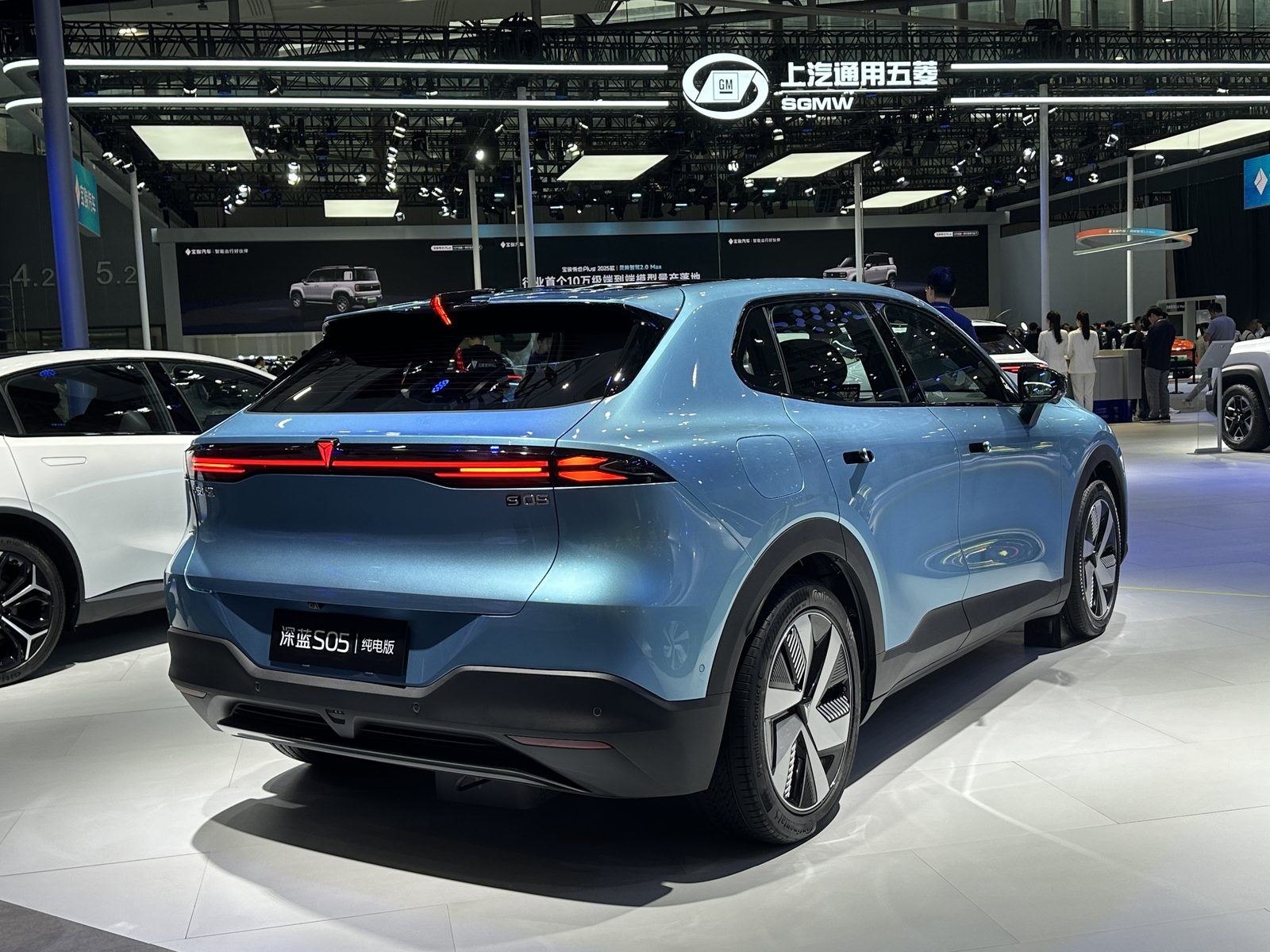
The Deepal S05 and the BYD Sealion 06 EV are both five-seat, rear-wheel-drive electric crossovers from China, but they are bought for different reasons. The S05 is a 4,620 mm compact with a 2,880 mm wheelbase, 520 or 620 km CLTC range and a range-extender option; the Sealion 06 EV is a 4,810 mm mid-size SUV with 605 or 710 km CLTC range and 237 kW DC charging. The S05 is also the one with an official export channel: Changan sells it in the UAE and Saudi Arabia and builds it in Thailand for right-hand-drive markets, while BYD has announced no export programme for the Sealion 06.
The export channel often decides the deal before the spec sheet does: a car with a local dealer has a parts chain and a resale value the customer can check, while a China-only model is a parallel import.
👉 Tell us the destination port and the version you have in mind — we’ll confirm what is available now and quote it. Ask us on WhatsApp · Browse current stock →
Quick answers:
- Which is bigger? The Sealion 06 EV: 4,810 mm long against 4,620 mm. The S05 has the longer wheelbase, 2,880 mm against 2,820 mm.
- Which goes further? The Sealion 06 EV: 605–710 km CLTC against 520–620 km for the S05.
- Which charges faster? The S05 reaches 30–80% in about 15 minutes on its 3C pack; the Sealion 06 EV peaks at 237 kW DC. Both need a charger that can supply that rate.
- Which suits Ethiopia? The Sealion 06 EV on range, the S05 on price and availability. Both are BEVs, and Ethiopia’s import rules favour electric cars.
- Which suits the Gulf and Central Asia? The S05 in range-extender form, because the REEV is the version actually on sale there.
What is the difference between the Deepal S05 and the BYD Sealion 06 EV?
The Deepal S05 is a compact C-segment SUV with a rear motor and a choice of battery-electric or range-extender power. The BYD Sealion 06 EV is a mid-size SUV on BYD’s e-Platform 3.0 with a rear motor, two larger Blade packs and no engine. Both are five-seat, rear-wheel-drive cars, which is where the similarity ends.
| Spec | Deepal S05 EV | BYD Sealion 06 EV |
|---|---|---|
| Class | Compact SUV | Mid-size SUV |
| Length × width × height | 4,620 × 1,900 × 1,600 mm | 4,810 × 1,920 × 1,675 mm |
| Wheelbase | 2,880 mm | 2,820 mm |
| Drive | Rear-wheel drive | Rear-wheel drive |
| Motor | 200 kW (2026 update; 175 kW earlier) | 240 kW / 270 kW |
| Battery | 56.12 / 68.82 kWh LFP | 69.07 / 82.73 kWh LFP |
| CLTC range | 520 / 620 km | 605 / 710 km |
| 0–100 km/h | 6.28 s / 6.48 s | 6.8 s / 7.2 s |
| DC charging | 3C, 30–80% in about 15 min | 237 kW, 30–80% |
| Boot | 492 L + 159 L front trunk | 757 L |
| Seats | 5 | 5 |
| Range-extender option | Yes (1.5 L generator, 27.28 kWh) | No (the DM-i is a separate model) |
The S05 went on sale in China in October 2024 and was updated on 6 August 2026, when the rear motor moved from 175 kW to 200 kW, the battery options settled at 56.12 and 68.82 kWh, and LiDAR appeared on the top trims. The Sealion 06 EV arrived in March 2026 as BYD’s new mid-size SUV in the Ocean range, with a 237 kW charging peak that is high for a family SUV.
How much room do you get in each car?
The Sealion 06 EV is the bigger car outside and in the boot, but the S05 turns its short body into rear-seat space that competes with cars a class above. The 2,880 mm wheelbase is 60 mm longer than the Sealion 06’s despite the S05 being 190 mm shorter overall.
| Measurement | Deepal S05 EV | BYD Sealion 06 EV |
|---|---|---|
| Boot, rear seats up | 492 L | 757 L |
| Front trunk | 159 L | not quoted |
| Seats | 5 | 5 |
The 757-litre boot is the Sealion 06’s clearest advantage, and it matters for airport transfers and anyone carrying luggage for five. The S05 answers with 492 litres plus a 159-litre front trunk, which covers cables and small bags but not the missing 265 litres.
For ride-hailing and city fleets, the numbers flip. A shorter car is easier to park and cheaper to ship, and the long wheelbase gives fare-paying passengers the legroom they notice. Our comparison of EVs for Addis Ababa ride-hailing sets out why wheelbase and charging speed matter more than boot volume in that use case.
Which one goes further on a charge?
The Sealion 06 EV goes further: 605 km or 710 km CLTC from a 69.07 kWh or 82.73 kWh Blade pack. The S05 quotes 520 km or 620 km CLTC from 56.12 kWh or 68.82 kWh. Both use LFP chemistry, both are rear-wheel drive, and both figures are on the Chinese CLTC cycle, which reads higher than WLTP or a real-world highway figure. Expect roughly 70–80% of the CLTC number in mixed driving, less at a steady 120 km/h with the air conditioning on.
| Deepal S05 EV | BYD Sealion 06 EV | |
|---|---|---|
| Battery options | 56.12 / 68.82 kWh | 69.07 / 82.73 kWh |
| CLTC range | 520 / 620 km | 605 / 710 km |
| Consumption (CLTC) | not quoted | 12.7 / 13.3 kWh/100 km |
The S05’s 3C pack takes 30–80% in about 15 minutes at a compatible charger, which is quicker per kWh than most cars in its class and close to the Sealion 06’s 237 kW peak in practice. The Sealion 06’s advantage is headroom: 237 kW is a higher ceiling, so on a 200 kW-plus public charger it will add range faster over a long leg.
Neither number survives a weak grid: in Addis Ababa, Dubai or Almaty the charger you find is usually a 60–120 kW DC unit, and both cars sit well below their peak. Size the battery for the daily route. If it is 300 km a day with a depot charger, the 520 km S05 is enough; if it is 500 km between reliable chargers, the 710 km Sealion 06 is the safer order.
The inlet decides more Ethiopian and Gulf imports than range. China-market cars ship with GB/T AC and DC inlets, and the adapter set has to be ordered with the car, not sourced later. Confirm it in writing before the car leaves the port. The same warning applies to the Atto 3 and Sealion 05 EV stock in Djibouti and to every China-market EV in this class.
Where can you actually buy a Deepal S05 outside China?
Changan sells the Deepal S05 through official distributors in the UAE and Saudi Arabia, and builds it in Thailand for right-hand-drive markets. That makes it a supported import rather than a grey one. The UAE launch came in mid-2025, four months after the larger S07. Saudi Arabia followed in late 2025 with Almajdouie as the distributor. Both Gulf markets took the range-extender version first, not the BEV.
The Thai plant matters for a different set of buyers. Changan’s Rayong factory opened in May 2025 with the S05 as its first locally produced model and serves right-hand-drive markets; Thailand, Indonesia, Singapore, Australia and South Africa are supplied from there or from China in right-hand-drive form. If your market drives on the left, the S05 is one of the few Chinese compact EVs with a factory right-hand-drive build and a parts pipeline behind it.
The version on sale in the Gulf is the range-extender, not the BEV. It uses a 27.28 kWh pack, a 160 kW rear motor and a 1.5-litre 72 kW petrol generator, for 200 km of CLTC electric range (155 km WLTC) and a combined figure that Chinese and Saudi sources quote differently — about 1,234 km CLTC in China against roughly 900 km in Saudi dealer listings. Treat total range as cycle-dependent and quote the electric range, which is the number that decides the daily fuel bill.
Can you export the BYD Sealion 06 EV?
Not through an official channel. BYD has announced no export programme for the Sealion 06, and the car is sold in China only. Any Sealion 06 EV outside China today is a parallel import. That changes what you arrange: homologation, software, maps, adapters and parts outside the dealer network.
The naming makes this harder than it should be. The export model called Sealion 6 in Australia, Europe and Southeast Asia is the Song Plus, an older SUV with a 2,765 mm wheelbase. The Sealion 06 is a different, newer car with a 2,820 mm wheelbase. The Sealion 06 and Song Plus comparison sets the two side by side, and our guide to Chinese model names versus export names covers the rest of the BYD range.
If your customer wants a Sealion with an official channel, the export Sealion 6 is the one to quote. If the customer specifically wants the 06 body and the 237 kW charging, the order has to be built as a China-market car. The Sealion 06 EV versus DM-i comparison explains why the EV is the Ethiopian choice and the DM-i is the Gulf and Central Asian one.
Which one should an Ethiopian importer choose?
The Sealion 06 EV if range and boot space come first; the S05 if availability, price and charging speed come first. Both are electric, which is the important part in Ethiopia. The country restricts imports of petrol- and diesel-only private cars and treats electric vehicles more favourably at customs, so a BEV avoids both the fuel supply problem and the classification argument. Our guide to importing electric cars into Ethiopia covers the paperwork.
On the road, the Sealion 06’s 710 km version is the long-distance car: Addis Ababa to Hawassa or Bahir Dar and back is a realistic day trip, and the extra 90 km over the S05’s 620 km version is margin against a charger that is busy or broken.
For fleet work, order the 620 km S05 unless the depot charger is reliable. The CIF Djibouti cost build-up shows how the freight and duty lines change the per-car economics, and the Sealion 05 EV versus Atto 3 comparison is the next size down if the budget does not stretch to either car.
Which one should a Gulf importer choose?
The S05 range-extender, because it is the version with a distributor behind it. The Sealion 06 EV is the better pure EV on paper but has no Gulf channel. In the UAE and Saudi Arabia, the S05 REEV is sold new through official distributors, and a buyer who walks into a showroom can compare it with the S07 and the Changan CS75 Plus.
Gulf heat and long intercity legs favour the range-extender. A 200 km electric range covers a Dubai–Abu Dhabi commute and back on one charge, and the petrol generator removes the charging stop on the 400 km run to Liwa or the 900 km run to Riyadh. The Sealion 06 EV’s 710 km CLTC range is impressive, but at 45 °C with the air conditioning at full load the real figure is closer to 500 km, and the charger network outside the cities is thinner than the map suggests.
If the order is a BEV for a city fleet, the Sealion 06 EV is still the stronger car on range and boot space, and a parallel import can work if you control the service. Check the build against the GCC specification versus China specification list before you commit: cooling capacity, refrigerant, tyre rating and underbody protection are the items that fail first in Gulf use.
Which one suits Central Asia, Algeria and Côte d’Ivoire?
The S05 range-extender: in all three markets petrol is everywhere and reliable charging is not. Almaty, Tashkent and Bishkek have growing charger networks but no intercity coverage; Algeria’s new-car channel is restricted to licensed dealers, and Côte d’Ivoire’s charging is concentrated in Abidjan. A 200 km electric range covers the city week, and the 1.5-litre generator covers the run to another city without planning.
Cold weather is the caveat: LFP packs lose usable capacity below freezing. Check the destination’s Changan parts channel before you commit; where one exists, the S05 is easier to keep on the road than a China-only BYD.
For a licensed Algerian dealer, the S05’s Gulf channel is a useful reference: the car is sold and supported in a nearby market with similar heat and dust. Our Jetour X70 Plus guide for Algeria and Côte d’Ivoire is the honest comparison if the customer is not ready for a plug, Chinese cars in Russia and Central Asia covers the alternatives, and the Horgos transport guide explains the overland route. If the customer wants a plug-in hybrid rather than a range-extender, Sealion 06 DM-i versus Song Plus DM-i sets out the two BYD options.
What should an importer check before ordering either car?
Six things decide whether the car you ordered is the car you receive: model year, battery, drive layout, charging inlet, steering layout and the ADAS hardware. The trim badge on the tailgate tells you none of them.
- Model year and battery. A 2024–25 S05 with the 175 kW motor and 56.12 kWh pack is a 510–520 km car; the 2026 update is 200 kW and 520 or 620 km. On the Sealion 06 EV, a 2025 car has a 65.28 or 78.72 kWh pack for 520 or 605 km; the 2026 car has 69.07 or 82.73 kWh for 605 or 710 km. Ask for the battery capacity in writing.
- Charging inlet. China-market cars use GB/T. Confirm the inlet and the adapter set before the car leaves the port, and confirm that the adapter is rated for the car’s DC peak.
- Steering layout. The S05 is built in both left- and right-hand drive; the Sealion 06 is left-hand drive only. A right-hand-drive destination changes the order entirely.
- ADAS hardware. LiDAR is a top-trim option on the S05 in China and is not universal on export builds. If the customer is paying for it, get the sensor list in the contract.
- Cooling and tyres. Gulf and African builds need the high-capacity cooling package and the correct tyre load rating. Compare against the GCC specification list rather than the Chinese brochure.
- Documents. Certificate of origin, invoice, packing list, bill of lading and the destination conformity paperwork. The car export documents checklist covers the set, and a remote inspection before payment is cheaper than a dispute after arrival.
On shipping, both cars suit RoRo or container, and the choice follows the port rather than the car: RoRo versus container, FOB, CFR and CIF and single-unit shipping options cover the three decisions.
FAQ
Is the Deepal S05 bigger than the BYD Sealion 06?
No. The S05 is 4,620 mm long and 1,900 mm wide; the Sealion 06 is 4,810 mm long and 1,920 mm wide. The S05 has the longer wheelbase, 2,880 mm against 2,820 mm, so it gives more rear legroom per metre of body but less boot space: 492 litres plus a 159-litre front trunk against 757 litres.
Which has more range, the Deepal S05 or the Sealion 06 EV?
The Sealion 06 EV. It quotes 605 km or 710 km CLTC from a 69.07 kWh or 82.73 kWh pack. The S05 quotes 520 km or 620 km CLTC from 56.12 kWh or 68.82 kWh. Both are CLTC figures; expect 70–80% of them in mixed driving.
Does the Deepal S05 come in right-hand drive?
Yes. Changan builds the S05 at its Rayong plant in Thailand, which opened in May 2025 with the S05 as its first locally produced model and serves right-hand-drive markets. The Chinese-market car is left-hand drive.
Can I import a BYD Sealion 06 EV from China?
Yes, as a parallel import. BYD has announced no official export programme for the Sealion 06, so there is no distributor warranty or factory parts channel outside China. The export model sold as the Sealion 6 in Australia, Europe and Southeast Asia is the Song Plus, a different and older car.
Is the Deepal S05 available as a range extender?
Yes. It uses a 27.28 kWh battery, a 160 kW rear motor and a 1.5-litre 72 kW petrol generator, for 200 km of CLTC electric range (155 km WLTC). It is the version sold in the UAE and Saudi Arabia; the August 2026 update in China was a BEV-only line.
Which is cheaper to import, the Deepal S05 or the Sealion 06 EV?
The S05, on landed cost, because it is a smaller car with a smaller battery. The gap depends on the destination’s duty structure and on the battery you order.
Sources: Deepal S05 specifications from CnEVPost’s 7 August 2026 launch report (dimensions, 200 kW motor, 56.12/68.82 kWh, 520/620 km CLTC, 0–100 km/h, 3C charging, 492 L boot and 159 L frunk) and Wikipedia’s Deepal S05 entry (production from October 2024, 2,880 mm wheelbase, EREV 27.28 kWh and 200–215 km CLTC). S05 EREV output, 155 km WLTC range and 7.9 s acceleration cross-checked against the BitAuto configuration page. UAE and Saudi availability checked against YallaMotor UAE and ZigWheels Saudi Arabia listings, November 2026 (the Saudi distributor is Almajdouie); the UAE mid-2025 launch date is from Drive Arabia’s June 2025 report only. Rayong production and the right-hand-drive export role from Changan Thailand’s official newsroom (Rayong first-anniversary release) and CnEVPost’s report on the plant’s first European shipment. BYD Sealion 06 EV figures from BYD’s China configuration table as published by PCauto (retrieved November 2026): 4,810 × 1,920 × 1,675 mm, 2,820 mm wheelbase, 69.07/82.73 kWh, 605/710 km CLTC, 240/270 kW, 237 kW DC, 757 L boot, 12.7/13.3 kWh/100 km. Sealion 6/Song Plus naming from BYD overseas listings and the Song Plus China-discontinuation reports of January 2026. Combined S05 REEV range is quoted differently by source (about 1,234 km CLTC in China, about 900 km in Saudi dealer listings), so the electric range is used for comparison. CLTC figures are manufacturer cycle ratings; WLTP and WLTC are given only where a source states them. All specifications are for China-market cars and can differ in export builds. Photo: JustAnotherCarDesigner / Wikimedia Commons, CC0.