
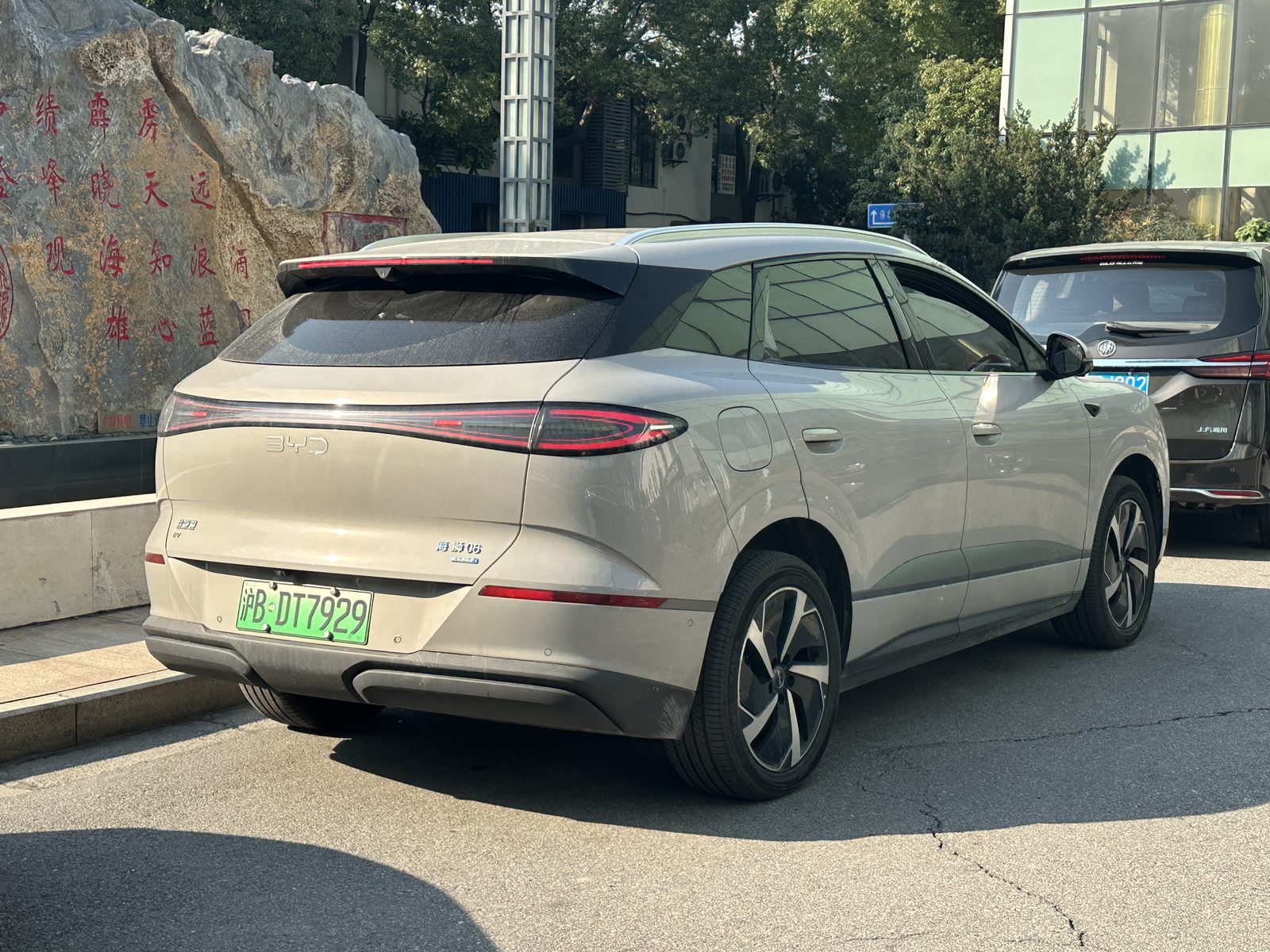
The BYD Sealion 06 EV and Sealion 06 DM-i share one body — 4,810 mm long, 2,820 mm wheelbase, five seats — but almost nothing else. The EV is rear-wheel drive on an 800V pack, rated 605 or 710 km CLTC with 237 kW DC charging. The DM-i is front-wheel drive with a 1.5-litre engine, 205 or 310 km of electric range, and 1,705 to 1,845 km of combined CLTC range on a 60-litre tank. For an Ethiopian importer the EV is the straightforward order; for a Gulf or Central Asian importer the DM-i is the lower-risk one.
That split is not a marketing preference. It follows from the charging network, the fuel price and the distances in each market, and from how customs treats a plug-in hybrid on arrival. This guide sets out the differences version by version, then matches each version to the markets we ship to.
👉 Tell us the destination port and the daily route — we’ll tell you which powertrain fits and quote the car. Ask us on WhatsApp · Browse current stock →
Quick answers:
- Which has more range? The EV: 605–710 km CLTC on one charge. The DM-i does 205–310 km on electricity, then burns petrol.
- Which charges faster? The EV, by a wide margin: 237 kW DC against 57 or 82 kW on the DM-i.
- Which is quicker? The EV: 6.8 s to 100 km/h in the 240 kW version, against 7.8–7.9 s for the DM-i.
- Which should Ethiopia import? The EV. Petrol cars are restricted, electricity is cheap and hydro-generated, and the EV has no classification question at customs.
- Which should the Gulf import? The DM-i, preferably the 310 km version with 82 kW DC charging. Fuel is cheap and intercity legs are long.
- Are the Sealion 06 and the export Sealion 6 the same car? No. The export Sealion 6 is the Song Plus. The Sealion 06 is a separate China-market SUV.
What is the difference between the Sealion 06 EV and the DM-i?
The Sealion 06 EV is a battery-electric SUV with no engine, a 69.07 or 82.73 kWh Blade pack and rear-wheel drive. The Sealion 06 DM-i is a plug-in hybrid with a 26.6 or 38 kWh pack, a 74 kW 1.5-litre petrol engine, a 60-litre tank and front-wheel drive. Both are five-seat mid-size SUVs on the same 2,820 mm wheelbase and the same 4,810 × 1,920 × 1,675 mm body.
The table below uses the current China-market configuration tables. The 2025 cars may still be on offer, so both model years are shown where the numbers differ.
| Spec | Sealion 06 EV | Sealion 06 DM-i |
|---|---|---|
| Powertrain | Battery-electric | 1.5 L petrol + electric motor |
| Drive | Rear-wheel drive | Front-wheel drive |
| System power | 240 kW / 270 kW | 160 kW / 175 kW (motor) |
| System torque | 305 N·m | 260 N·m / 270 N·m |
| 0–100 km/h | 6.8 s / 7.2 s | 7.8 s / 7.9 s |
| Battery | 69.07 / 82.73 kWh LFP | 26.6 / 38 kWh LFP |
| Electric range (CLTC) | 605 / 710 km | 205 / 310 km |
| Electric range (WLTC) | not quoted | 140 / 205 km |
| Combined range (CLTC) | — | 1,705 / 1,845 km |
| DC charging | 237 kW | 57 kW / 82 kW |
| Fuel tank | — | 60 L |
| Battery-depleted fuel use (WLTC) | — | 4.65–4.7 L/100 km |
| Boot volume | 757 L | 695 L |
| Seats | 5 | 5 |
| Length × width × height | 4,810 × 1,920 × 1,675 mm | 4,810 × 1,920 × 1,675 mm |
| Wheelbase | 2,820 mm | 2,820 mm |
Two details matter more than the rest. First, the EV runs an 800V architecture and accepts 237 kW DC, so a 30–80% charge is a short stop rather than a planning exercise. The DM-i’s peak is 82 kW on the 310 km version and 57 kW on the 205 km version. Second, the EV’s boot is 62 litres larger because there is no fuel tank and no engine bay packaging to work around.
The 2025 cars are different again. The 2025 Sealion 06 EV came with a 65.28 kWh pack for 520 km or a 78.72 kWh pack for 605 km. The 2025 DM-i came with 18.3 kWh for 132 km or 26.6 kWh for 190 km. If a supplier quotes “Sealion 06” without a model year, ask for the battery capacity; that number identifies the car faster than the trim name.
Why does the powertrain choice decide the market?
A battery-electric SUV needs a dependable charging routine and predictable daily distances. A plug-in hybrid needs neither, but it only saves fuel when it is charged. That single sentence explains why the same body goes to Ethiopia as an EV and to the Gulf as a DM-i.
In Ethiopia, the EV case is structural. The country has restricted imports of new petrol- and diesel-only private cars since 29 January 2024, while electric vehicles have continued to enter with favourable duty treatment: 15% customs duty, with VAT, excise tax and surtax waived. Most of the grid is hydro-generated, so home or depot charging is cheap where a connection exists, while petrol is imported and constrained by foreign-currency availability. The full rule set is in our Ethiopia electric-car import guide.
In the Gulf, the arithmetic reverses. Fuel is cheap, summer heat loads the cooling system, and a Riyadh–Jeddah or Dubai–Abu Dhabi run is an intercity trip rather than a city errand. A plug-in hybrid with a 60-litre tank removes the charging question entirely, and 205–310 km of electric range still covers most daily driving if the buyer plugs in at home. Our Song Plus EV versus DM-i comparison works through the same trade-off on the older body.
Central Asia sits between the two. Intercity legs of 300–600 km are normal, winter temperatures fall well below freezing, and charging outside the main cities is sparse. That is DM-i territory for the same reasons as the Gulf, with cold rather than heat as the main stress. The overland route through Khorgos is covered in our Khorgos road-transport guide, and the wider market picture is in Chinese cars in Russia and Central Asia.
Which Sealion 06 should an Ethiopian importer order?
Order the Sealion 06 EV — the 605 km version for most fleets, the 710 km version for intercity or high-mileage use. The EV avoids the one unresolved question that hangs over a plug-in hybrid at an Ethiopian port: the published rules name electric and hybrid vehicles, but they do not spell out the customs treatment of a plug-in hybrid in so many words. The broker’s classification at the port is what decides the duty, and a dealer should not ship a container of DM-i cars on an assumption.
The 605 km EV carries a 69.07 kWh pack and consumes 12.7 kWh/100 km on the Chinese cycle. The 710 km car carries 82.73 kWh and quotes 13.3 kWh/100 km. Both use the same 2,820 mm wheelbase and 757 L boot, so the choice is purely range against battery cost and weight, not passenger space.
Charging is the practical question in Addis Ababa. A 7 kW AC wallbox is enough for overnight charging, and the 237 kW DC rating only matters on a public charger that can supply it. Confirm the inlet on the actual car: China-market cars ship with GB/T AC and DC inlets, and the adapter set has to be ordered with the car, not sourced later. Our note on Atto 3 and Sealion 05 EV stock in Djibouti shows how the smaller BYD models are specified for the same route, and the CIF Djibouti cost build-up covers the landed-cost side.
For a fleet doing ride-hailing or corporate shuttle work, compare the Sealion 06 EV with the smaller cars before committing to a mid-size SUV. This comparison of EVs for Addis Ababa ride-hailing sets out the range and charging trade-offs at fleet level. If the budget does not stretch to a Sealion 06, the Seagull generation comparison is the entry point.
Which Sealion 06 should a Gulf importer order?
Order the Sealion 06 DM-i, and specify the 310 km version with 82 kW DC charging. The 60-litre tank and 1,845 km combined CLTC range mean the car never depends on a charger, while 205 km of WLTC electric range covers a normal day in Dubai, Doha or Riyadh. The 205 km version is a city fleet car; the 310 km version is the one that also works for intercity business travel.
Heat is the specification point to watch. The Sealion 06 DM-i uses direct-refrigerant battery cooling across the range, which is the right configuration for Gulf summer temperatures. Ask for the cooling package and the tyre specification on the actual build, because China-market and GCC-market cars can differ even when the nameplate matches. Our GCC versus China specification guide lists the items to check, from cooling to labels and charging inlets.
The DM-i’s fuel figure needs to be read correctly. The 4.65–4.7 L/100 km WLTC battery-depleted consumption is a test-cycle number for a car whose battery has run flat; a Gulf buyer who never plugs in should treat it as the best case, not the expected one. A buyer who does plug in at home will spend most weeks on electricity and use petrol only for the intercity leg. That is the version’s real value, and it is worth explaining to the customer before the quote.
Do not order the EV for a Gulf buyer who has no fixed charging point, even though the 800V pack and 237 kW charging look stronger on paper. The car is excellent where a DC network exists; it is the wrong first import where the buyer’s only charger would be a household socket and the daily route is 150 km.
How do the Sealion 06 and the export Sealion 6 differ?
The export Sealion 6 is the Song Plus, a different and older SUV. The Sealion 06 is the newer China-market car described here. “Sea Lion 06” is only a spacing variant of Sealion 06, not a third model. Buyers mix the three names constantly, and a supplier quoting the wrong one can ship the wrong car.
The export Sealion 6 is sold in Australia, New Zealand and several other right-hand-drive markets, mainly as a plug-in hybrid. It is the Song Plus DM-i under a different name, with a 2,765 mm wheelbase and up to 160 km of CLTC electric range in China-market form. The Sealion 06 DM-i has a 2,820 mm wheelbase, up to 310 km, and a different body. They are not trims of the same car.
Use the VIN and the model year, not the badge, when confirming an order. A supplier’s invoice that says “Sealion 6” usually means the Song Plus; one that says “Sealion 06” or “海狮06” means the car in this article. The full pattern across the BYD range is in BYD China names versus export names, and the same problem across other brands is in Chinese model names versus export names.
If the buyer is specifically comparing the Sealion 06 with the older Song Plus, the two direct comparisons are Sealion 06 EV versus Song Plus EV and Sealion 06 DM-i versus Song Plus DM-i. Both use the same verified configuration tables as this guide.
What should an importer check before ordering a Sealion 06?
Check five things: the model year and battery size, the charging inlet, the drive layout, the cooling package and the export documents. Each one has caught a buyer before.
- Model year and battery. A 2025 EV with a 65.28 kWh pack is a 520 km car; a 2026 car with 69.07 kWh is a 605 km car. The trim badge alone does not tell you which one is on the floor.
- Charging inlet. China-market cars use GB/T. Confirm the inlet and the adapter set before the car leaves the port, especially for the EV, whose 237 kW DC rating is useless without a compatible charger.
- Drive layout. The EV is rear-wheel drive; the DM-i is front-wheel drive. That changes behaviour on gravel, sand and wet roads, and it changes tyre wear.
- Cooling package. Direct-refrigerant cooling is standard on both, but the build for a Gulf buyer should be checked against the GCC specification, not assumed from the Chinese brochure.
- Documents. Certificate of origin, invoice, packing list, bill of lading and the conformity paperwork for the destination. Our car export documents checklist covers the set, and the specification comparison tool is the quickest way to put two versions side by side.
Left-hand drive is not a constraint for Ethiopia or the Gulf: the Sealion 06 is built as a left-hand-drive car in China. Right-hand-drive markets such as Australia and New Zealand are served through the export Sealion 6/Song Plus channel, not through a right-hand-drive Sealion 06.
FAQ
Is the BYD Sealion 06 EV or DM-i better for Ethiopia?
The EV. Ethiopia restricts new petrol- and diesel-only private car imports and gives electric vehicles favourable duty treatment, while the customs treatment of a plug-in hybrid is less clear. The EV also avoids fuel supply and foreign-currency issues. Order the 605 km version for most fleets and the 710 km version for high-mileage use.
Is the Sealion 06 DM-i better for the Gulf?
For most Gulf buyers, yes. Fuel is cheap, intercity distances are long and summer heat is hard on any car that depends on charging. The 310 km DM-i with 82 kW DC charging is the version to specify; the 205 km car suits city fleets.
How far can the Sealion 06 EV go on one charge?
The current China-market car is rated 605 km or 710 km CLTC, from a 69.07 kWh or 82.73 kWh LFP pack. CLTC reads higher than WLTC or WLTP; quote the Chinese figure only when comparing like with like.
How far can the Sealion 06 DM-i go without petrol?
205 km or 310 km CLTC on the battery alone, which is 140 km or 205 km on the WLTC cycle. With a full 60-litre tank the combined CLTC range is 1,705 km or 1,845 km.
Is the Sealion 06 the same as the Sealion 6?
No. The export Sealion 6 is the Song Plus, an older SUV with a 2,765 mm wheelbase sold mainly as a plug-in hybrid in Australia, New Zealand and parts of Asia. The Sealion 06 is a separate, newer China-market SUV with a 2,820 mm wheelbase.
Does the Sealion 06 come in right-hand drive?
The China-market Sealion 06 is left-hand drive. Buyers in right-hand-drive markets are usually offered the export Sealion 6/Song Plus instead, so confirm the steering layout before ordering if the destination drives on the left.
What is the difference between the 2025 and 2026 Sealion 06?
The 2025 EV used 65.28 kWh or 78.72 kWh packs for 520 km or 605 km CLTC. The 2026 EV uses 69.07 kWh or 82.73 kWh for 605 km or 710 km. The 2025 DM-i used 18.3 kWh or 26.6 kWh for 132 km or 190 km; the 2026 DM-i uses 26.6 kWh or 38 kWh for 205 km or 310 km.
Sources: BYD configuration tables for the Sealion 06 EV and Sealion 06 DM-i as published by PCauto (太平洋汽车), retrieved November 2026; model years and launch dates cross-checked against Autohome, Yiche and IT Home launch reports (Sealion 06 EV: 5 March 2026 and 24 July 2025; Sealion 06 DM-i: 26 May 2026 and 24 July 2025). The 800V platform rating, 237 kW DC charging, battery capacities and boot volumes are from the PCauto tables. Ethiopian import treatment follows the January 2024 directive and the customs practice described in our Ethiopia guide; confirm classification with a broker at the port. Export Sealion 6/Song Plus details are from BYD’s overseas market listings. Range figures are CLTC unless marked WLTC. Specifications are for China-market cars; export builds can differ. Photo: JustAnotherCarDesigner / Wikimedia Commons, CC0.