
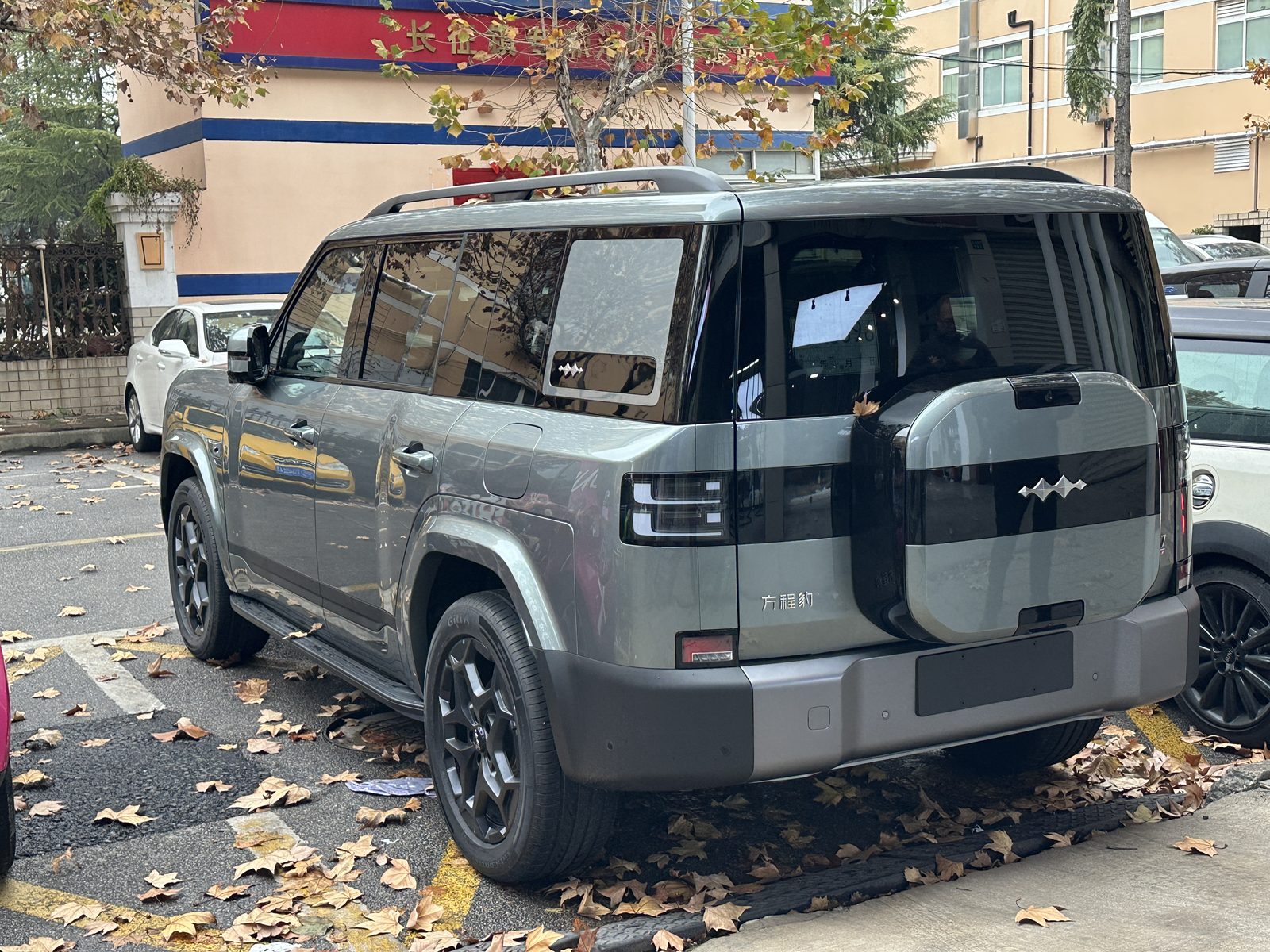
“Leopard 3” and “Leopard 7” are not model names BYD uses. They are the names independent importers in Dubai, Addis Ababa and Kyiv use for two China-market Fangchengbao models: the Tai 3 (钛3) and the Tai 7 (钛7). The Tai 3 is a 4,605 mm five-seat electric SUV sold officially in Thailand as the Denza B3; the Tai 7 is a 4,999 mm plug-in hybrid sold in the UAE, Saudi Arabia and Uzbekistan as the BYD Ti 7. If you order a “Leopard 3” from a Chinese supplier, you get a China-spec car — not the same specification as the Denza or BYD-badged export version.
👉 Not sure which car a supplier is quoting? Send us the name and the photos. Ask us on WhatsApp · The full BYD China-name vs export-name map →
What are the Leopard 3 and Leopard 7?
The brand behind both cars is Fangchengbao (方程豹), which BYD launched in 2023 as its off-road and lifestyle sub-brand. The Chinese name means “Formula Leopard”, which is why English coverage, dealer websites and Google Translate all landed on “Leopard”.
The confusion starts with the model lines. Fangchengbao’s first two cars were the Bao 5 (豹5) and Bao 8 (豹8), body-on-frame plug-in hybrids built on BYD’s DMO platform. English-language coverage and dealers call them Leopard 5 and Leopard 8; in the Gulf they are retailed as the Denza B5 and Denza B8. So “Leopard” is a legitimate family name for the big off-roaders.
Then Fangchengbao added a second, cheaper family on a load-bearing (unibody) platform: the Tai series, where 钛 means titanium. The first car, previewed as the Super 3 concept and widely called the “Bao 3” before launch, went on sale in April 2025 as the Tai 3 (钛3). The larger Tai 7 (钛7) followed in September 2025. Neither uses the Leopard badge in China, but the export trade never dropped the habit: listings in the UAE describe the car as “BYD Leopard 3 — also called Titanium 3”, and Ethiopia’s used-car sites carry dozens of ads under “Byd Leopard 3”. Ukrainian media write “Leopard 3” and “Leopard 7” because the Chinese names are barely used there.
That is the whole trap. The names are real in the market, but they are not in BYD’s catalogue, and they tell you nothing about which specification you are buying.
What is the real name of each Fangchengbao model?
| Name buyers use | China-market name | Official export name | What it is |
|---|---|---|---|
| Leopard 3 | Fangchengbao Tai 3 (钛3) | Denza B3 | Compact five-seat electric SUV, unibody |
| Leopard 7 | Fangchengbao Tai 7 (钛7) | BYD Ti 7 | 4,999 mm five-seat plug-in hybrid SUV (seven-seat export version) |
| Leopard 5 | Fangchengbao Bao 5 (豹5) | Denza B5 | Body-on-frame plug-in hybrid off-roader |
| Leopard 8 | Fangchengbao Bao 8 (豹8) | Denza B8 | Large body-on-frame plug-in hybrid |
Two consequences follow from this table. First, a “Leopard 5” advert can be a China-spec Bao 5 or a GCC-spec Denza B5, and those are not the same car underneath the badge — the GCC vs China-spec comparison explains what changes. Second, the Leopard 3 and Leopard 7 are not scaled-down Leopard 5s. They are a different platform, a different drivetrain layout and a different buyer.
What are the Leopard 3 (Tai 3) specs and versions?
The Tai 3 is Fangchengbao’s smallest model: a 4,605 mm compact electric SUV that competes with the BYD Atto 3 and the Deepal S05 rather than with a Defender. It is a five-seater with a 151-litre front boot and a 28-litre lockable box on the tailgate.
| Specification | Tai 3 |
|---|---|
| Length × width × height | 4,605 × 1,900 × 1,720 mm |
| Wheelbase | 2,745 mm |
| Seats | 5 |
| Battery (original versions) | 65.28 / 72.96 / 78.72 kWh LFP Blade |
| Range (original versions) | 501 km CLTC |
| Power (2025 versions) | 160 kW rear motor (RWD); 310 kW dual-motor (AWD) |
| 0–100 km/h (2025 AWD) | 4.9 s |
| DC charging | 30–80% in about 18 minutes |
| China guide price (2025 versions) | ¥133,800–193,800 |
There is a second generation of the same car that buyers need to know about. On 13 March 2026 BYD added the Tai 3 flash-charge version: a 75.6 kWh pack, 620 km CLTC in rear-drive form with a 240 kW motor, and a 565 km AWD version with 375 kW. BYD quotes 10–70% in about five minutes on its second-generation Blade battery. A cheaper 510 km rear-drive flash version with a 64.3 kWh pack joined in August 2026. China guide prices for the flash versions are ¥153,800 and ¥169,800.
For an importer this means “Leopard 3” alone is not a specification. A 2025 car with 501 km and a 2026 flash-charge car with 620 km are both Tai 3s, and the price difference between them is real. Ask for the model year, the battery capacity and the charging rate before you compare quotes.
The export version is the Denza B3, shown at the Bangkok International Motor Show in March–April 2026. The Thai display car used the 72.96 kWh pack, the 310 kW dual-motor drivetrain and the 501 km CLTC rating; Denza’s Thai distributor had not published a local price at the show. We found no announcement of an official GCC launch of the B3. In the Gulf and in East Africa, the Tai 3 reaches buyers as a China-spec import through traders, which is exactly why the “Leopard 3” name persists.
What are the Leopard 7 (Tai 7) specs and versions?
The Tai 7 is the bigger and more important car for export. It is a 4,999 mm unibody SUV with a boxy, Defender-like body, a 1.5-litre turbo petrol engine and BYD’s DM-p plug-in hybrid system. In China it is a five-seater; the seven-seat version was developed for export markets and adds a tailgate-mounted spare wheel, which stretches the body to about 5,146 mm.
| Specification | Tai 7 (China) |
|---|---|
| Length × width × height | 4,999 × 1,995 × 1,865 mm |
| Wheelbase | 2,920 mm |
| Seats | 5 in China; 7 in export versions |
| Engine | 1.5 T turbo, 115 kW |
| Electric motor | 200 kW rear; 160 kW front on AWD |
| System output (AWD) | 360 kW |
| 0–100 km/h | 4.5 s (AWD) |
| Battery | 26.6 / 35.6 kWh LFP Blade (50 kWh long-range edition later) |
| Electric range (CLTC) | 135 / 190 / 200 km by version |
| Combined range (CLTC) | Up to about 1,300 km |
| Fuel tank | 60 L |
| China guide price | ¥179,800–219,800 (four trims) |
The Ti 7 has had the faster export rollout of the two. BYD launched it as the BYD Ti 7 in Uzbekistan on 1 October 2026, and it is on sale in the UAE through Al-Futtaim’s BYD network and in Saudi Arabia through official dealers. UK orders opened in July 2026 with deliveries from January 2027, where it is sold as a seven-seater. UAE listings quote the 26.6 kWh pack and about 80 km of WLTP electric range, with a combined output marketed at around 480 hp.
The market rollout matters for buyers in our regions. A dealer in Dubai or Riyadh can source a GCC-spec Ti 7 with a local warranty and left-hand drive. A dealer in Addis Ababa, Algiers or Tashkent is more likely to be offered a China-spec car through a trader, sometimes already badged “Leopard 7”. Both are the same body, but the battery, software, charging hardware and paperwork differ.
Why does the name matter on the invoice and customs papers?
The name on the proforma invoice is the name that follows the car through customs, insurance and registration. If your supplier writes “Leopard 7”, the Chinese export documents will normally still carry the homologation name — 方程豹 钛7 — or, for an official export car, “BYD Ti 7”. A mismatch between the invoice, the export licence and the VIN plate is a routine reason for delays at the destination port.
Three checks close the gap:
- Ask for the Chinese name in characters and the model year. “方程豹 钛7 2026款” is unambiguous; “Leopard 7” is not.
- Ask for a photo of the VIN plate and the tailgate badge. China-spec cars carry the Chinese badge and, on the Ti 7, a five-seat cabin unless it is an export version.
- Check the charging inlet on the actual car. China-market cars are built with the Chinese GB/T charging inlet; GCC and European cars use Type 2 and CCS2 connectors. This is the single most expensive difference on an electric Tai 3, and it cannot be fixed with software. Our GCC vs China-spec guide covers the rest of the list.
For a used or “zero-km” example, the 180-day rule for zero-km used-car exports also applies, and the registration date decides whether the car ships as new or used.
Which one should an importer in the Gulf, Africa or Central Asia order?
Choose the Leopard 7 (BYD Ti 7) if you need one car for long distances, poor fuel quality and family transport. The plug-in hybrid layout removes range anxiety in markets where charging is thin, the 60-litre tank and 1,300 km combined CLTC figure suit Gulf and Central Asian inter-city routes, and the car is already sold through official channels in the UAE, Saudi Arabia and Uzbekistan. For a Gulf buyer who wants left-hand drive, a local warranty and a current model year, the official Ti 7 is the safer purchase. The main question to settle is seat count: China-market cars are five-seat and the UK export version is seven-seat, and Gulf stock has been advertised both ways.
Choose the Leopard 3 (Tai 3) if you are supplying a city market with reliable charging and a lower budget. It is smaller, cheaper, fully electric and quick in AWD form. But the official export channel is Thailand’s Denza B3, which is right-hand drive. For a left-hand-drive Gulf or African buyer, a Tai 3 is a China-spec import: GB/T charging, Chinese-market maps and software, and a warranty that depends on the seller rather than the factory. That can still be the right deal at the right price — just do not compare it with a Denza B3 quote as if they were identical.
If neither fits, the same money buys a Sealion 06 in EV or DM-i form, a Sealion 05 EV or Atto 3, or a Yuan UP / Yuan Plus. For a seven-seat family car in Algeria or Côte d’Ivoire, the Jetour X70 Plus is a cheaper alternative to a seven-seat Ti 7. For hard off-road use rather than a lifestyle SUV, the 212 T01 vs Jetour T2 comparison is the more relevant pair.
How do the Leopard 3 and Leopard 7 compare with each other?
| Leopard 3 (Tai 3) | Leopard 7 (Tai 7) | |
|---|---|---|
| Type | Battery-electric | Plug-in hybrid (DM-p) |
| Length | 4,605 mm | 4,999 mm (5,146 mm with spare) |
| Seats | 5 | 5 in China, 7 in export versions |
| Power | 160 kW RWD / 310 kW AWD | 360 kW AWD |
| Range | 501 km CLTC (620 km flash version) | 135–200 km electric, up to 1,300 km combined |
| Official export name | Denza B3 | BYD Ti 7 |
| Official Gulf channel | None announced | UAE, Saudi Arabia |
| Best for | City fleets, cheap electric SUV | Long-distance family and inter-city use |
The two cars share the Fangchengbao design language and the Evo+ unibody platform family, but nothing else that matters to an importer. One needs a charging plan; the other needs petrol and a service network.
FAQ
Is the Leopard 7 a seven-seater?
The China-market Tai 7 is a five-seater. The seven-seat version was developed for export markets and is sold in the UK and approved for Australia; it carries a tailgate-mounted spare wheel and measures about 5,146 mm. Gulf listings have described both layouts, so confirm the seat count on the exact car.
Is the Leopard 3 the same car as the Denza B3?
Yes. The Denza B3 is the export version of the Fangchengbao Tai 3. The body, dimensions and 501 km CLTC rating match the Chinese car, but the badge, charging hardware, software and warranty route depend on the market. A China-spec “Leopard 3” is not automatically a Denza B3.
Are the Leopard 3 and Leopard 7 sold officially in the UAE?
The BYD Ti 7 (Leopard 7) is sold in the UAE through Al-Futtaim’s BYD network, and in Saudi Arabia through official dealers. We found no official UAE launch of the Denza B3 (Leopard 3); cars advertised under that name in Dubai are China-spec imports.
What is the difference between the Leopard 5 and the Leopard 3?
The Leopard 5 is the Fangchengbao Bao 5, a body-on-frame plug-in hybrid off-roader sold in the Gulf as the Denza B5. The Leopard 3 is the Tai 3, a smaller unibody electric SUV. They share a brand and a design language, not a platform.
Can I import a Leopard 3 or Leopard 7 to Ethiopia or Central Asia?
Yes, as a China-spec car through a trader. For Ethiopia, check the charging standard and the EV import rules before you commit; for Central Asia, the Horgos road route and the Central Asia market guide cover the logistics. Uzbekistan now has an official BYD channel for the Ti 7, which changes the calculation there.
Should I buy a Leopard 7 as a used or zero-km car?
A zero-km used car can be cheaper, but the export paperwork and the 180-day rule apply, and the warranty usually does not transfer. Inspect the car before paying and keep the VIN, registration date and battery health report with the shipping documents. See remote inspection before paying and LC vs T/T payment.
Sources: Fangchengbao’s official Tai 3 configuration page; BYD/Fangchengbao China launch coverage for the Tai 3 (April 2025) and Tai 7 (September 2025), including Xinhua, ifanr, Bitauto and Yiche reports; Wikipedia entries for the Fangchengbao Tai 3 and Ti7 (accessed November 2026); CnEVPost, “BYD launches Fang Cheng Bao Tai 7 in Uzbekistan as BYD Ti 7”, 8 October 2026; Paul Tan and the Bangkok International Motor Show 2026 pages for the Denza B3 display; Cars24 and Truck & Fleet Middle East for the UAE Ti 7 launch; Chinese launch reports for the Tai 3 flash-charge version (13 March 2026) and the 510 km version (August 2026); UAE, Ethiopian and Ukrainian dealer listings using the “Leopard 3” and “Leopard 7” names (checked November 2026). Range figures are CLTC unless stated; the UAE WLTP figure is from Cars24 only. Seat count and battery capacity vary by market and model year. Photo: JustAnotherCarDesigner / Wikimedia Commons, CC0.