
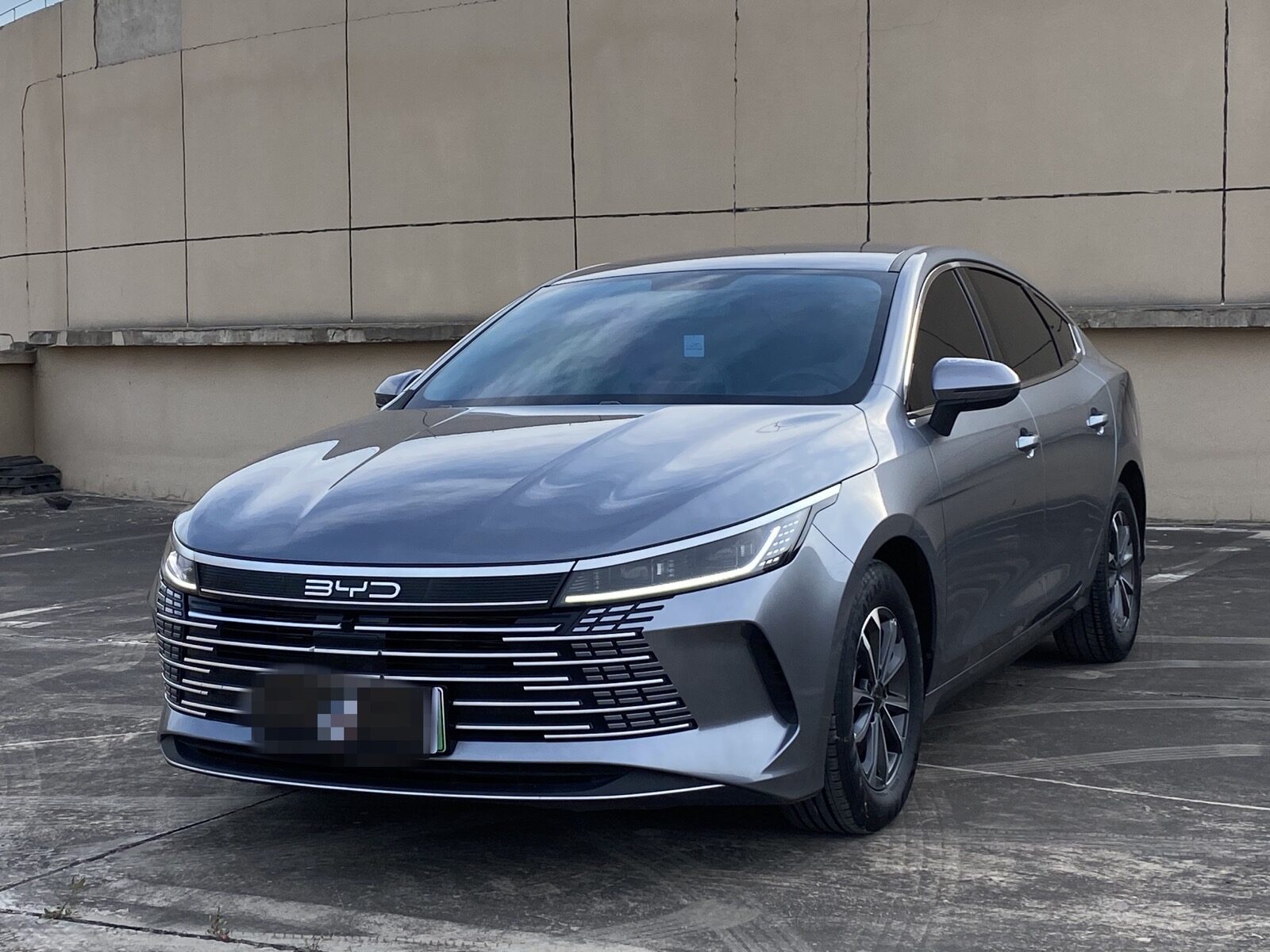
Short answer: mechanically these two are the same car. The 2026 BYD Qin PLUS DM-i and the 2026 BYD Seal 05 DM-i share the same 2,718 mm wheelbase, the same 1.5-litre engine rated at 74 kW and 126 N·m, the same 120 kW drive motor, the same 1,580 kg kerb weight, the same 7.6-second 0–100 km/h time and the same CNY 79,800 entry price in China. If you are choosing between them for export, you are not choosing between two levels of engineering. You are choosing between two dealer networks, two design languages and whatever your supplier can actually source this month.
That is an unusual thing to say in a comparison article, and it is worth explaining properly — because the wrong assumption here costs importers real money. Below is what the spec sheets show, what genuinely separates the two, and the one naming change that matters enormously if you buy used.
Qin PLUS DM-i vs Seal 05 DM-i at a glance (2026 model year)
| Specification | Qin PLUS DM-i | Seal 05 DM-i |
|---|---|---|
| Segment | Compact sedan | Compact sedan |
| Length × width × height | 4,780 × 1,837 × 1,515 mm | 4,780 × 1,837 × 1,515 mm |
| Wheelbase | 2,718 mm | 2,718 mm |
| Track (front / rear) | 1,580 / 1,590 mm | 1,580 / 1,590 mm |
| Engine | 1.5 L naturally aspirated | 1.5 L naturally aspirated |
| Engine output | 74 kW (101 PS) / 126 N·m | 74 kW (101 PS) / 126 N·m |
| Drive motor | 120 kW (163 PS) / 210 N·m | 120 kW (163 PS) / 210 N·m |
| Transmission | E-CVT | E-CVT |
| Kerb weight | 1,580 kg | 1,580 kg |
| 0–100 km/h | 7.6 s | 7.6 s |
| Top speed | 180 km/h | 180 km/h |
| Fuel tank | 65 L | 65 L |
| Boot capacity | 450 L | 450 L |
| Fuel grade | 92 RON | 92 RON |
| Seats | 5 | 5 |
| CLTC electric-only range | 128 km / 210 km | 128 km / 210 km |
| Battery | LFP Blade, 15.87 / 25.28 kWh | LFP Blade |
| China guide price (entry trim) | CNY 79,800 | CNY 79,800 |
| China warranty | 6 years / 150,000 km | 6 years / 150,000 km |
| BYD sales channel | Dynasty Network (王朝网) | Ocean Network (海洋网) |
Every figure in that table comes from the current Chinese-market specification sheets for the 2026 model year of both cars. Line after line, they are identical. The two exceptions worth noting are the trim names and the showroom you buy them in.
Why two identical cars exist
BYD sells through two parallel dealer networks in China. The Dynasty Network carries the Qin, Han, Song and Tang families — Chinese dynasty names, a more conservative “Dragon Face” design language, and an older, more established customer base. The Ocean Network carries the Seal, Dolphin, Seagull and Sealion families — marine names, the newer “Ocean Aesthetics” styling, and a younger buyer profile.
When a platform is competitive, BYD builds a car for each network rather than forcing both sets of dealers to fight over one model. The Qin PLUS DM-i and Seal 05 DM-i are exactly that: one plug-in hybrid compact sedan, two faces, two badges, two showrooms. We see the same pattern elsewhere in the range — the BYD Han DM-i and Seal 5 DM-i sit in a comparable relationship one segment up.
For an importer this is good news, and the reason is unglamorous: service parts. Filters, brake components, suspension arms, the 1.5 L engine, the E-CVT unit and the Blade battery modules are shared. A workshop in Lagos, Dakar or Lima that can service one can service the other. If you are building a fleet, mixing the two badges does not split your parts inventory.
Where they actually differ
The differences are real, just not mechanical.
Exterior and interior design
The Qin PLUS carries the horizontal-bar Dragon Face grille treatment that has defined BYD’s Dynasty sedans for years. The Seal 05 uses the smoother, more rounded Ocean front end with a closed-off panel and slimmer light signature. Inside, the layouts follow the same split — Dynasty models lean traditional, Ocean models lean minimalist. Neither is objectively better; in some markets the older Dragon Face reads as more premium precisely because buyers recognise it.
Brand recognition in your market
This matters more than most spec comparisons admit. The Qin nameplate has been on sale since 2013 and is one of the best-known Chinese plug-in hybrids worldwide. The Seal 05 name is new — it only appeared in 2025. In a market where buyers research before purchase, an established nameplate can be easier to resell. In a market where buyers judge on styling, the newer face may win. Ask your local sales team, not a spec sheet.
Trim naming and equipment
The 2026 Qin PLUS DM-i lineup runs 128KM 进取型 (CNY 79,800), 210KM 进取型 (CNY 89,800) and 210KM 超越型 (CNY 99,800). The Seal 05 DM-i runs 128KM 豪华型 (CNY 79,800), then 210KM 尊贵型 and 210KM 旗舰型 at CNY 89,800 and CNY 99,800. Same three price points, same two battery sizes, different trim vocabulary. Equipment at each price point is close but not always item-for-item identical, so always specify by trim name and model year on the purchase contract — never by “top spec” alone.
The naming change that matters if you buy used
The BYD Destroyer 05 (驱逐舰05) is the direct predecessor of the Seal 05 DM-i. BYD launched the Destroyer 05 in 2022 as the Ocean Network’s plug-in hybrid sedan, then replaced it in early 2025 with the Seal 05 DM-i built on the fifth-generation DM platform. By 2026 the Destroyer 05 is out of production and the name has disappeared from BYD’s current lineup.
If you are sourcing used stock, you will still see plenty of Destroyer 05 cars — and this is where importers get confused, because the mechanical package is genuinely different from the current car:
| Specification | Destroyer 05 (2024, 4th-gen DM) | Seal 05 DM-i (2026, 5th-gen DM) |
|---|---|---|
| Engine output | 81 kW (110 PS) / 135 N·m | 74 kW (101 PS) / 126 N·m |
| Drive motor | 132 kW / 316 N·m | 120 kW / 210 N·m |
| Height | 1,495 mm | 1,515 mm |
| Kerb weight | 1,515 kg | 1,580 kg |
| Entry electric range | 55 km (NEDC) | 128 km (CLTC) |
Read that table carefully, because it contradicts an instinct: the newer car has less peak power on paper. The fifth-generation DM system was engineered for efficiency rather than headline output, and the trade is a large one — the current car more than doubles entry-level electric range and cuts battery-depleted fuel consumption substantially. A 2024 Destroyer 05 is not a broken car; it is a well-proven one at a lower price point. Just do not pay 2026 money for 2022 architecture, and make sure the invoice, the VIN and the model year all agree. Our vehicle inspection and condition report covers exactly this kind of verification on every used unit we list.
What a plug-in hybrid actually means where you are
Most comparison articles written for the Chinese market assume a charger at home and another at the office. For buyers in West Africa, Central Asia or Latin America, that assumption does not hold, and it changes which numbers matter.
It works as a petrol car when it has to
This is the single most important property of a DM-i car in a market with thin charging infrastructure. With a flat battery, the 2026 Qin PLUS DM-i 128KM returns a quoted 3.08 L/100 km, and BYD quotes 2.79 L/100 km for the longer-range configuration. Those figures are Chinese test-cycle numbers and real-world consumption will be higher — but even with a generous margin, a car in this class that never sees a charging cable still undercuts a conventional petrol sedan of the same size. Full tank plus full charge gives a quoted combined range of about 2,110 km. You are not stranded if the grid is unreliable; you simply lose the cheapest part of the running cost.
92 RON is the specification to check
Both cars are specified for 92 RON petrol. This is easy to overlook and expensive to get wrong: a number of imported vehicles require 95 RON, which is not consistently available or affordable in every market we ship to. A 92 RON requirement widens the fuel network your customer can actually use.
LFP Blade chemistry suits hot climates
Both use BYD’s lithium iron phosphate Blade battery rather than nickel-based chemistry. LFP is more thermally stable and more tolerant of the high ambient temperatures typical of tropical and desert markets, and it is more forgiving of being left at high state of charge. It is also less energy-dense, which is part of why these are 128 km and 210 km cars rather than 300 km cars.
Warranty does not travel automatically
The 6-year / 150,000 km warranty quoted above is the Chinese domestic warranty. Coverage outside China depends on whether BYD has an official importer in your country and on the terms of that arrangement. Treat the domestic figure as evidence of how the manufacturer rates the powertrain — not as a guarantee you can claim in Lagos. Confirm local coverage before you promise anything to a retail customer.
Which one should you import?
Because the mechanical package is identical, this is a commercial decision rather than a technical one.
Availability usually settles it. Stock and price move independently between the two networks. If one is available this month at a better landed cost, take it — you are not compromising on engineering by doing so. In practice this decides more orders than anything else on this page.
After that, ask which nameplate your market recognises. Where Chinese brands are already established, Qin carries years of recognition. Where buyers are new to Chinese cars and shopping on appearance, the Seal 05’s newer face tends to test better.
New or used changes the shortlist entirely. If your budget points to used, you are realistically choosing between a used Qin PLUS and a used Destroyer 05 — the Seal 05 is too new to have built meaningful used supply anywhere. Check our live used stock for what is on the ground today, and new cars for export for order-based units.
Then the battery question. The CNY 10,000 step up to the 210 km pack only pays back if your customer can charge regularly. Without reliable charging it is weight the car carries and money spent on capacity nobody uses. Where charging access is poor, the entry 128 km trim is usually the smarter import.
Importing either one through Hanvia
Both cars are compact sedans, which is an advantage at the freight stage: consolidating several units into a single 40 ft container brings the per-unit shipping cost well below the SUVs we cover in our Zeekr 8X vs 9X comparison or the Lynk & Co 900 seating comparison. If you are weighing a petrol SUV instead, we have compared the two engines of the Jetour T2, and for buyers looking at a European badge, the Audi A3 against the Q3. Before you commit, three things are worth reading:
- Importing cars from China to Nigeria and the 2026 levy change — vehicle age limits and duty treatment decide whether a used unit is even viable.
- Shipping cars from China to Africa — ports, transit times and the real cost difference between RoRo and container.
- How to verify a Chinese car exporter before you pay — the checks that matter before any deposit leaves your account.
Plug-in hybrids specifically are covered in our guide to hybrid cars from China to Nigeria, and the wider model landscape in top Chinese SUVs and EVs for export in 2026. If you are new to the process end to end, start with our 2026 import guide for dealers.
Hanvia Motors sources both cars through our dealer network in China, inspects every unit before it is listed, and handles documentation and shipping to your port. You can browse sedans and electrified models in stock, see what we do on the export services page, read about the company on about us, or send us your requirement and we will quote FOB and container options against your target market. French-speaking buyers can also read our Senegal import guide.
Exporting either one to Ethiopia
Ethiopia banned new petrol and diesel private-vehicle imports on 29 January 2024. Electric and hybrid vehicles are exempt and carry 15% customs duty with VAT, excise tax and surtax waived, so an EV or hybrid is the only realistic way into this market now. Both vehicles on this page are left-hand drive, which Ethiopia requires, and seat fewer than 10 passengers, which the provisions cover.
Everything routes through Djibouti. Ethiopia is landlocked and over 90% of its trade moves through the Port of Djibouti, then inland by the Addis Ababa–Djibouti railway or by road. There is no alternative corridor, so plan the timeline around it.
One caveat worth raising with the customer: public charging is thin — roughly 100 stations against an estimated 2,300+ needed nationwide, concentrated in Addis Ababa. Most owners will charge on AC at home or business premises. That favours a buyer with their own charging point over one relying on public infrastructure.
CIF Djibouti is available for Ethiopia. Tell us the model and quantity and we will quote CIF to Djibouti, so you compare one delivered number instead of assembling freight, insurance and handling yourself. EXW, FCA and FOB remain available if you prefer to control the shipping leg.
👉 Ask for current EV and hybrid stock plus a CIF Djibouti landed-cost quote. Talk to us · Ethiopia import rules in full →
FAQ
Is the BYD Seal 05 DM-i the same as the Destroyer 05?
It is the direct replacement, not a rename of the same car. BYD sold the Destroyer 05 from 2022, then replaced it in early 2025 with the Seal 05 DM-i on the fifth-generation DM platform. The current car has a different engine output (74 kW versus 81 kW), a different motor (120 kW versus 132 kW), a taller body and far more electric range. If a supplier offers you a “Seal 05” but the paperwork says 驱逐舰05, you are being offered the older car.
Which is cheaper, the Qin PLUS DM-i or the Seal 05 DM-i?
In China both start at CNY 79,800 for the 128 km trim and both top out at CNY 99,800 for the 210 km trim, so the guide prices are identical. Export pricing is a different calculation — it depends on trim, model year, whether the unit is new or used, current stock, and your destination port. Send us the specification you want and we will price it.
Can these cars run without ever being charged?
Yes. Both operate as a conventional hybrid when the battery is depleted, with quoted battery-depleted consumption of 3.08 L/100 km on the 128 km Qin PLUS trim and 2.79 L/100 km on the longer-range configuration. Real-world figures will be higher than the Chinese test cycle, but the car does not require charging infrastructure to function.
Do they take 95 RON petrol?
Both are specified for 92 RON, which makes them easier to run in markets where higher-octane fuel is inconsistent or expensive.
Are parts shared between the two?
The mechanical package is the same — engine, motor, E-CVT, battery architecture and platform — so major service parts are shared. Body panels, lights and trim are model-specific because the exterior and interior designs differ.
Which one holds value better on resale?
In most export markets the Qin nameplate has longer recognition, which generally helps resale. The Seal 05 is too new for reliable used-market data. Where your buyers judge primarily on styling and equipment rather than nameplate history, that advantage narrows.
Before you order: confirm you and your supplier mean the same vehicle. Chinese model years, nameplate suffixes and trim words do not map onto export badges, and the same name can cover cars an engine apart. See Chinese domestic names, export names and trim ladders.