
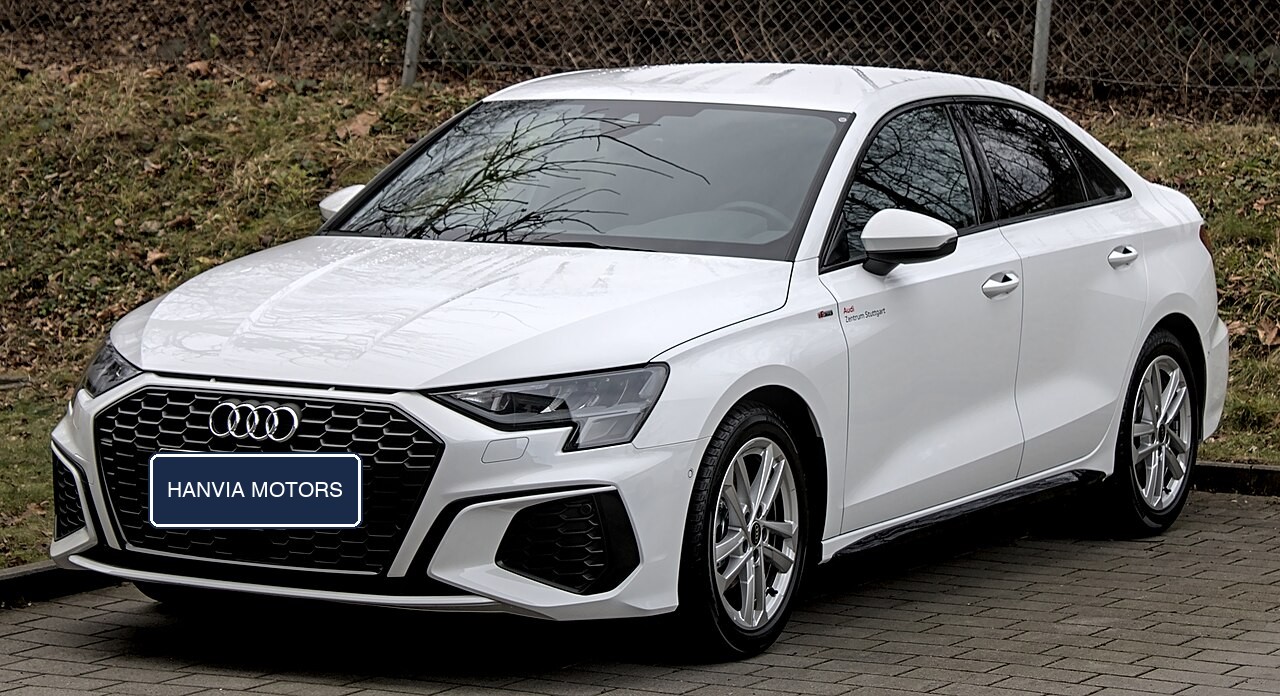
Short answer: at top trim these are not two versions of the same idea — they are two different cars with a CNY 86,900 gap between them. The Audi A3 is 1.5-litre and front-wheel drive across the entire range. The top Q3 is a 2.0-litre quattro with all-wheel drive. And there is one specification line that decides the question for a large number of export markets before any of the others matter: the top Q3 is built for 95 RON petrol.
This comparison uses the current 2026 Chinese-market specifications for both models, and is written for importers deciding which one actually survives contact with their market — not for a domestic buyer choosing a company car.
Audi A3 vs Q3 at top trim (2026)
| Specification | Audi A3L (top trim) | Audi Q3 (top trim) |
|---|---|---|
| Body | Compact sedan (A3L) / hatchback (Sportback) | Compact SUV |
| China guide price | CNY 209,900 | CNY 296,800 |
| Model price range | CNY 165,900–209,900 | CNY 251,800–296,800 |
| Engine | 1.5 T (35 TFSI) | 2.0 T (45 TFSI), 1,984 cc |
| Max power | 118 kW (160 PS) | 162 kW (220 PS) |
| Max torque | 250 N·m | 350 N·m (1,600–4,300 rpm) |
| Drivetrain | Front-wheel drive | quattro all-wheel drive |
| Transmission | 7-speed dry DCT | 7-speed wet DCT |
| 0–100 km/h | 8.6–8.7 s | 7.3 s |
| Fuel consumption | — | 8.0 L/100 km (WLTC) |
| Fuel grade | 92 RON on most trims | 95 RON |
| Length × width × height | 4,606 × 1,814 × 1,432 mm (A3L) | 4,498 × 1,848 × 1,614 mm |
| Wheelbase | 2,730 mm (A3L) / 2,630 mm (Sportback) | 2,680 mm |
| Kerb weight | 1,412–1,435 kg | 1,750 kg |
| Fuel tank | 51 L | 62.5 L |
| Boot | 388 L (A3L) / 356–1,100 L (Sportback) | 450 L |
| Tyres | 225/40 R18 or 225/45 R17 | Model-specific, 18–19 in |
| Top speed | 200 km/h | — |
| Seats | 5 | 5 |
| China warranty | 3 years / 100,000 km | 3 years / 100,000 km |
The fuel grade question comes first
The top Q3 is specified for 95 RON. Most A3 trims are specified for 92 RON, though a few are listed at 95 — so check the individual build sheet rather than assuming.
In markets where 95 RON is available everywhere and the price gap to 92 is small, this is a footnote. In much of West Africa, Central Asia and parts of Latin America it is not a footnote at all. Higher-octane fuel can be inconsistently stocked outside major cities, meaningfully more expensive, and in some markets of variable quality. A vehicle that requires it is a vehicle whose owner is constrained in where they can refuel — and one that will be run on the wrong fuel the first time they are far from a city, with the engine management pulling timing to protect itself and the owner blaming the car.
This is exactly why we flag fuel grade on every model we list. Both versions of the Jetour T2 run 92 RON, as do the BYD Qin PLUS DM-i and Seal 05 DM-i. Chinese manufacturers designing for a domestic market with mixed fuel quality tend to specify 92 as standard. German premium models designed around European fuel often do not. That is a real, recurring difference between the two groups of cars, and it shows up in running cost rather than in the purchase price.
Dry clutch versus wet clutch
The A3 uses a 7-speed dry dual-clutch gearbox. The Q3 uses a 7-speed wet one. This distinction gets almost no attention in sales material and matters more than most of the equipment differences.
A dry-clutch DCT has no oil bath carrying heat away from the clutch packs. In free-flowing traffic it is efficient and pleasant. In dense stop-start traffic, on long uphill crawls, in high ambient temperatures, or when a vehicle is repeatedly launched on a slope, it runs hotter and wears faster. Those conditions describe daily driving in Lagos, Abidjan, Dakar and a great many other cities we ship to.
The Q3’s wet-clutch unit runs its clutches in oil and tolerates that duty cycle considerably better. If your customer’s use case is heavy urban traffic in a hot climate, this is a point in the Q3’s favour that has nothing to do with it being an SUV.
The size comparison is not what you would guess
The instinct is that the SUV is the bigger car. Measured properly, it is not that simple.
The A3L sedan is longer (4,606 mm against 4,498 mm) and rides on a longer wheelbase (2,730 mm against 2,680 mm). Wheelbase is what determines rear legroom, so the sedan can be the more comfortable car for rear passengers despite the Q3’s more imposing exterior. If your customers carry passengers rather than cargo — taxi operators, executive transport, family use — this deserves attention.
The Q3 is taller (1,614 mm against 1,432 mm) and wider (1,848 mm against 1,814 mm), which is where the SUV advantages actually sit: higher seating position, easier entry and exit, better visibility over traffic, more ground clearance for kerbs, speed bumps and rough surfaces, and a larger boot at 450 L against the A3L’s 388 L. The A3 Sportback hatchback is the practical one for bulky loads, with 356 L expanding to 1,100 L with the seats folded.
The Q3 also carries 335 kg more weight and a 62.5 L tank against 51 L.
If you choose the A3, choose the body first
“Audi A3” covers two quite different cars in the Chinese range, and importers regularly order one when they wanted the other. The difference is much larger than the shared badge suggests:
| Specification | A3L Limousine (sedan) | A3 Sportback (hatchback) |
|---|---|---|
| Length | 4,606 mm | 4,354 mm |
| Wheelbase | 2,730 mm | 2,630 mm |
| Height | 1,432 mm | 1,458 mm |
| Boot | 388 L | 356 L, up to 1,100 L seats folded |
| Kerb weight | 1,429–1,435 kg | 1,412–1,418 kg |
That is a 252 mm difference in length and a full 100 mm in wheelbase — the sedan is a noticeably roomier car for rear passengers, and the “L” in A3L refers precisely to that stretch, which is a China-market specification. The Sportback is shorter, marginally lighter and far more flexible for cargo once the rear seats fold.
For most of our markets the sedan is the easier sell: three-box saloons carry more status in much of West Africa and Central Asia, and the longer wheelbase suits taxi, executive and family use. The Sportback makes sense where buyers value manoeuvrability in dense cities and load flexibility over rear legroom. Whichever you choose, put the body style and the wheelbase figure on the purchase order — “A3” alone is not a specification.
Where the CNY 86,900 goes
The price gap at top trim buys three things, in descending order of practical value for an export market:
quattro all-wheel drive. The A3 cannot be ordered with all-wheel drive at any trim level. If traction on wet, loose or unsealed surfaces matters, the Q3 is the only one of the two that offers it. This is the same dividing line that separates the Jetour T2’s two engines — and as there, no amount of extra power substitutes for driven wheels.
Meaningfully more performance. 220 PS and 350 N·m against 160 PS and 250 N·m, and 7.3 seconds to 100 km/h against 8.6–8.7. The Q3 also delivers peak torque from 1,600 rpm, which matters at altitude and when loaded — relevant for markets with mountain routes.
SUV packaging. Ride height, boot space, road presence. In markets where an SUV silhouette signals status, this is a commercial argument rather than an engineering one, and it is often the argument that closes the sale.
Both share the same weak point for export
Both carry a 3-year / 100,000 km Chinese domestic warranty. That is shorter than the 4-year / 100,000 km Jetour offers and considerably shorter than BYD’s 6-year / 150,000 km on its DM-i cars. And as with every Chinese-market warranty, coverage outside China depends on whether the brand has an official importer in your country.
Audi’s advantage here is different in kind: it is an established global brand with existing service infrastructure in most of our markets, so parts and qualified technicians are usually easier to find than for a Chinese brand that has only recently arrived. Against that, genuine Audi parts typically cost more, and the premium positioning that helps resale also raises the cost of every repair. Weigh both sides against your customer’s real ownership horizon.
Which should you import?
Choose the A3 if your buyers want the four rings at the lowest entry point, drive mainly on sealed roads, and refuel where 92 RON is the norm. It is 335 kg lighter, cheaper to buy, and the A3L’s longer wheelbase makes it the better rear-seat car. Be candid with customers about the dry-clutch gearbox in heavy traffic — it is a real consideration, not a defect.
Choose the Q3 if your customers need all-wheel drive, ground clearance and boot space, will pay for the badge in SUV form, and can reliably access 95 RON. All three conditions have to hold. If the fuel condition fails, the rest of the argument fails with it.
Consider a Chinese alternative if the deciding factors are running cost, fuel flexibility and warranty rather than brand. At the Q3’s top-trim price you are into a segment where several Chinese SUVs offer 92 RON, longer warranties and more equipment. Our guide to Chinese SUVs and EVs for export in 2026 covers the alternatives honestly, and we compare two flagship options in the Zeekr 8X vs 9X guide. We sell both German and Chinese vehicles — this is not a recommendation against Audi, it is a recommendation to price the whole ownership picture rather than the sticker.
Importing either model
Before ordering, confirm the three things that decide whether a unit can clear customs and land profitably:
- Age limits and duty. See importing cars from China to Nigeria, the 2026 levy change, or the Senegal import guide.
- Shipping. Compact cars consolidate well into containers — see shipping cars from China to Africa for ports, transit times and the RoRo comparison.
- Supplier checks. Run through how to verify a Chinese car exporter before any payment.
New to importing? Start with our 2026 guide for dealers. Considering a plug-in hybrid instead, where running costs are lower still? See hybrid cars from China to Nigeria and the BYD Seal 5 DM-i and Han DM-i model pages.
Hanvia Motors supplies both models to order and stocks used units sourced through our dealer network in China. Every used vehicle is published with a full inspection and condition report before you pay. Browse the live used listing, sedans or SUVs in stock, see order-based units including the Audi A3 on new cars for export, read what we handle on export services or about us, and send us your requirement for an FOB quotation against your destination port.
FAQ
Does the Audi A3 need 95 RON petrol?
Most A3 trims are specified for 92 RON, though some are listed for 95 — confirm on the specific build sheet before ordering. The top Q3 requires 95 RON. In markets where high-octane fuel is scarce or expensive, this is the first specification to check on any premium import.
Can the Audi A3 be ordered with quattro?
Not in this generation’s Chinese-market range. The A3 is front-wheel drive throughout. quattro all-wheel drive is available on the Q3.
Which has more rear legroom, the A3 or the Q3?
The A3L sedan has a longer wheelbase — 2,730 mm against the Q3’s 2,680 mm — so rear legroom can be better in the sedan despite the SUV’s larger exterior. The Q3 offers more headroom, a higher seating position and a bigger boot.
What is the price difference?
At top trim, CNY 209,900 for the A3L against CNY 296,800 for the Q3 — a gap of CNY 86,900. Export pricing depends on trim, model year, new or used, and destination port, so send us your specification for a quotation.
Why does the gearbox type matter?
The A3 uses a dry-clutch DCT and the Q3 a wet-clutch one. Wet-clutch units cope better with heat and repeated slipping, which makes them more suited to dense urban traffic in hot climates. It is a durability consideration rather than a performance one.
Is the warranty valid in my country?
The 3-year / 100,000 km figure is the Chinese domestic warranty for both models. Coverage in your market depends on Audi’s official importer arrangements there. Confirm locally before promising anything to a retail customer.
Before you order: confirm you and your supplier mean the same vehicle. Chinese model years, nameplate suffixes and trim words do not map onto export badges, and the same name can cover cars an engine apart. See Chinese domestic names, export names and trim ladders.