
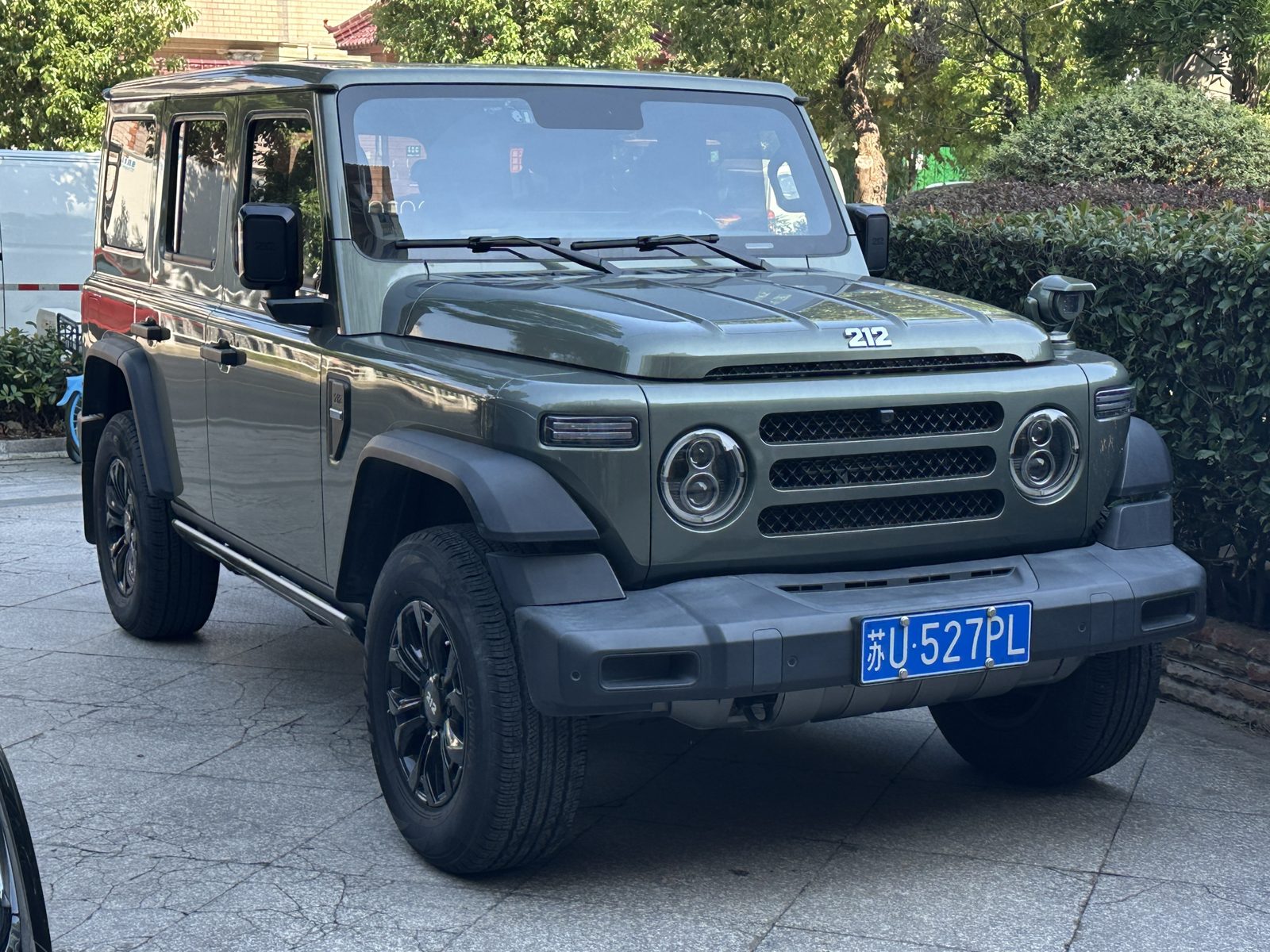
The 212 T01 and Jetour T2 are both boxy Chinese 4x4s with tailgate-mounted spare wheels, and overseas buyers often shortlist them together. They are not the same kind of vehicle. The 212 T01 is a body-on-frame truck with solid axles, a part-time transfer case and a low range. The Jetour T2 is a unibody crossover with independent suspension and on-demand all-wheel drive, with no low range.
That difference decides most of the comparison. If your buyers need a hard-use vehicle for desert, mountains, construction sites or long gravel routes, and they expect to modify it, the 212 T01 is the more suitable base. If they mostly drive in cities and on highways, carry families, and only occasionally leave the tarmac, the Jetour T2 is easier to live with and easier to support through its existing distributor network in the Gulf.
👉 Need a quote? Ask us on WhatsApp · 212 T01 trims and engines explained
What is the 212 T01 and what is the Jetour T2?
The 212 T01 is the modern five-door model sold under the 212 brand, built by Beijing Auto Works and often listed abroad as the BAW 212 T01. It has a ladder frame, a live axle at each end and a mechanical transfer case. China-market cars come with a 2.0T petrol or diesel and an eight-speed automatic. Export listings use trim names such as Changfeng, Highland, Mechanic and Inspector; Changfeng (长风) is also translated as “Long Wind”. Our 212 T01 export guide breaks down the trims.
The Jetour T2 is the export name for the Jetour Traveller (捷途旅行者), a five-seat SUV from the Chery group. In China it has also been sold as the Traveller and Shanhai, with a plug-in hybrid alongside the petrol cars. The T2 uses a unibody platform called Kunlun, a transverse engine and independent suspension. It is not the smaller Jetour T1 or the Jetour Dashing, despite what some classified ads suggest; Chinese model names versus export names covers this naming pattern.
Both are five-seat, five-door SUVs. Neither is a pickup, and neither should be confused with the growing group of Chinese double-cab pickups covered in BYD Shark 6 vs Toyota Hilux and Dongfeng Rich 6 vs Nissan Navara.
How do the 212 T01 and Jetour T2 compare on paper?
The closest comparison is a 212 T01 Changfeng petrol against a Jetour T2 2.0T four-wheel-drive trim. Both have a 2.0-litre turbo petrol engine and an automatic gearbox, but the hardware underneath is different.
| Item | 212 T01 Changfeng (petrol) | Jetour T2 2.0T 4WD |
|---|---|---|
| Engine | 2.0T petrol | 2.0T petrol |
| Power | 185 kW | 187 kW |
| Torque | 410 N·m | 390 N·m |
| Gearbox | 8-speed automatic | 7-speed dual-clutch or 8-speed automatic, by market |
| Drive | Part-time 4WD, 2H/4H/4L | On-demand AWD, no low range |
| Body | Ladder frame (body-on-frame) | Unibody |
| Front suspension | Five-link solid axle | MacPherson strut |
| Rear suspension | Five-link solid axle | Multi-link independent |
| Length x width x height | 4,749 x 1,945 x 1,999 mm | 4,785-4,795 x 2,006 x 1,880 mm |
| Wheelbase | 2,860 mm | 2,800 mm |
| Ground clearance | 256 mm | 220 mm |
| Kerb weight | 2,265 kg | 1,843-1,869 kg |
| Tyres | 285/70 R17 | 255/60 R19 |
| Fuel tank | 80 L | 70 L |
| Wading depth | 850 mm, 910 mm with snorkel | 700 mm |
| Screen | 12.3 inches | 15.6 inches |
The petrol outputs are close: 185 kW against 187 kW, and the 212 has 20 N·m more torque but weighs roughly 400 kg more. The T2 is wider and longer on paper yet 119 mm lower; that lower roof and independent suspension make it feel like a tall estate car on the road.
The 212 T01 also offers a 2.0T diesel with 125 kW and 415 N·m. Most export T2s come only with the 2.0T petrol or a 1.5T front-wheel-drive petrol (135 kW, 290 N·m). If your market runs on diesel and your buyers do heavy, low-speed work, the 212’s diesel is a real advantage; the diesel Changfeng is also about 2,390 kg.
How do the two four-wheel-drive systems differ?
The 212 T01 uses a part-time system with a mechanical transfer case and three modes: 2H, 4H and 4L. In 4H the front and rear axles are locked together at a fixed 50:50 split. In 4L the transfer case adds a low-range reduction, quoted at about 2.5:1 on the petrol and slightly more on some 2026 versions. That low range is what gives the vehicle crawling ability on steep, loose ground, and it is the clearest hardware difference between the two cars.
Part-time 4WD has a rule that new buyers need to understand. Do not leave it in 4H on dry, high-grip tarmac: the axles cannot slip against each other and the transmission winds up. It is for dirt, sand, snow and mud, not permanent all-wheel-drive convenience. That suits trained fleet drivers and can confuse a retail customer who expects to press a button and forget it.
The Jetour T2 uses an on-demand all-wheel-drive system marketed as XWD, with a BorgWarner multi-plate clutch at the rear axle. The car decides when to send torque rearward; the driver can select terrain modes, and some trims add an electronically controlled rear differential lock. There is no low range and no mechanical centre lock. On wet roads, gravel and light sand, the system works well and asks nothing of the driver. On a long, steep climb or in deep sand, it has less torque multiplication and less heat capacity than a mechanical transfer case.
Which is the stronger off-road vehicle, the 212 T01 or the Jetour T2?
The 212 T01 is the stronger off-road vehicle, and the gap is not marginal. It has 256 mm of clearance on the Changfeng body against 220 mm for the T2, and 285/70 R17 tyres against 255/60 R19. The taller sidewall and smaller rim give more deflection over rocks and allow lower sand pressures without damaging the wheel. The 2,860 mm wheelbase is longer than the T2’s and helps stability on climbs.
The 212’s solid axles articulate independently of the body, so a wheel can stay on the ground when the body leans. The T2’s independent suspension keeps the wheels upright on the road but has less articulation for extreme terrain. The 212 wades 850 mm, or 910 mm with the optional snorkel, against 700 mm for the T2, which matters on flooded tracks and river crossings in Central Asia and West Africa.
Differential locks widen the gap further. The 212 T01 Changfeng and higher trims list front and rear electronically controlled locks. The base Mechanic lists a rear lock with a front lock optional, while the Inspector lists both. The Jetour T2 offers a rear lock on some trims, paired with its clutch-based centre coupling. A rear lock helps a T2 in a cross-axle situation, but it cannot make up for the missing low range and the lighter-duty centre clutch.
The T2 is not helpless. Its 220 mm clearance, 700 mm wading depth and terrain modes are enough for gravel roads, farm tracks, beach sand and snow. For a buyer who wants the look and the occasional weekend trail, it is capable. For a buyer who wants to cross a desert, tow a trailer through sand or run a fleet on broken roads every day, the 212 is the correct tool.
Which is better on the road, the 212 T01 or the Jetour T2?
The Jetour T2 is better on the road, for the same reasons it is less capable off it. It weighs about 400 kg less, sits 119 mm lower and uses independent suspension, so it rides more comfortably, steers more precisely and uses less fuel. The 212’s solid axles and ladder frame are built for load and durability, not for suppressing noise or soaking up broken tarmac.
The 212’s Chinese test listing shows around 11 L/100km for the petrol, and the diesel is not much better in stop-start use. The T2’s lower weight and transverse layout should give it a clear advantage at the pump, though we do not have a matched test figure for the exact export trim. Ask for the consumption of the specific unit, not the brochure number.
The cabin technology also favours the T2. It has a 15.6-inch central screen on current trims, a digital instrument cluster and a longer equipment list that includes powered and ventilated seats on higher grades. The 212 has a 12.3-inch screen, a more utilitarian cabin and fewer driver-assistance features. Neither car should be sold as a luxury vehicle, but the T2 is closer to what a retail buyer expects in 2026.
For a family buyer doing the school run and a monthly camping trip, the T2 is the easier recommendation. For a tour operator, a mining or construction fleet, or a buyer carrying heavy loads on bad roads, the 212’s hardware is worth the comfort penalty.
Which one is easier to modify and repair?
The 212 T01 is easier to modify. A ladder frame and solid axles are the traditional base for a lift kit, larger tyres, a winch bumper, a snorkel and a roof rack. The mechanical layout is simple, the body sits on a separate frame, and suspension work does not involve cutting a load-bearing monocoque. That matters where buyers customize for desert, safari or expedition use.
The Jetour T2 can be accessorized, but the unibody limits how far it can go. Large lifts and very tall tyres stress the monocoque and the independent suspension mounts, and the electronic AWD and dual-clutch gearbox need specialist diagnostics that not every small workshop has. A T2 is a good vehicle kept close to standard and a poor base for a heavily modified expedition build.
Repairability follows the same pattern. The 212’s mechanical parts are simple enough for a workshop that knows traditional 4x4s. The catch is parts availability: the 212 export network is young, and a buyer in a secondary market may wait for body or trim parts. The T2 shares components with the wider Chery group and has a more established Gulf distributor network, but its electronics are less repairable at the roadside.
What export support does each brand offer?
The Jetour T2 has the more mature official channel. Jetour launched it in Saudi Arabia in December 2023 and the UAE in January 2024 through appointed distributors; it is also sold in Qatar, Oman, Bahrain, the Philippines, Malaysia, Indonesia, Sri Lanka, South Africa, Italy and Mexico. Not every market has a strong dealer, but buyers can often find a local importer, a warranty and a parts route.
The 212 brand is newer to export. It held a global strategy launch in Dubai in October 2025 and says its network covers more than 70 countries, with the Middle East as a priority. UAE dealers list the T01 in GCC and Chinese specifications, some aimed at export buyers rather than local retail customers. The brand is moving quickly, but its distributor coverage and parts depth are not yet at Jetour’s level.
This changes the risk calculation. A T2 order can lean on an existing distributor structure, which helps with warranty claims and resale. A 212 order may offer more hardware for the money, but the importer carries more of the parts and service burden. Ask for the exact warranty terms, the parts catalogue and the nearest service point. Do not assume a China-market warranty transfers.
Specification is another issue. Gulf markets often require GCC-spec cooling, air-conditioning and emissions calibration, and West African markets have their own fuel and registration rules; GCC spec versus China spec covers the difference. For either car, confirm the specification of the actual unit before comparing it with a rival’s brochure.
Which should you import for the Gulf, Central Asia or West Africa?
For Gulf buyers who run desert tours, dune drives or off-road rental fleets, the 212 T01 Changfeng is the stronger choice. Low range, solid axles, front and rear locks, 256 mm clearance and 285-section tyres are the hardware those customers ask for, and the Dubai launch has made the brand easier to source and show. For a fleet that stays on tarmac and carries families, the T2 is the better business case: lower fuel use, more comfort and a wider dealer network.
For Central Asian buyers, the road decides. In Kazakhstan, Kyrgyzstan and Tajikistan, many buyers cover long distances on broken asphalt and gravel, with winter snow and mountain passes. The T2’s comfort and on-demand AWD suit that mixed use, and its lower weight helps fuel cost. For mining, construction and high-mountain work, the 212’s ladder frame and low range are more durable. The route through Horgos also affects landed cost, so compare the two delivered, not on the Chinese sticker price.
For West African buyers, rough roads, overloaded use and limited service networks favour the simpler layout. The 212 is easier to repair in a small workshop, provided the importer stocks consumables and common parts. The T2 is easier to sell to a retail customer who wants a modern cabin, but its electronics and dual-clutch gearbox are a bigger risk where diagnostic support is poor. Import rules and port costs vary; see importing cars from China to Ghana for one example.
What are the main risks with each vehicle?
The 212 T01’s main risks are support and refinement. The export network is expanding but still thin in many markets, so parts availability and trained service are the first questions. The vehicle is heavy, thirsty and truck-like, and a retail buyer expecting a quiet family SUV may reject it after a test drive. Check its safety rating and homologation market by market; do not assume a China-market result applies elsewhere.
The Jetour T2’s main risks are misuse and complexity. Some buyers will see the boxy body and assume it is a Wrangler-class off-roader, then use it in terrain its unibody, 220 mm clearance and clutch-based AWD were not designed for. The dual-clutch gearbox in some markets needs checking for hot, dusty use, and the electronics need a dealer-level diagnostic tool. The T2 is a good crossover, not a substitute for a ladder-frame 4×4.
Both cars need the same pre-shipment checks: confirm the model year, the exact trim, the emission standard and the specification of the unit you are buying. A remote inspection is cheaper than a container of cars that do not match the offer. Our guides to inspecting cars in Guangzhou and remote inspection before paying explain what to check. For the paperwork, start with the export documents checklist and LC versus T/T before you agree payment terms.
Shipping is straightforward for both. They fit in a 40HQ container or move by RoRo, and the choice affects cost and damage risk; see RoRo versus container and how many cars fit in a container. The 212 is taller and heavier, so check the loading plan and the RoRo rate before quoting. Marine insurance is separate, covered in marine cargo insurance claims.
FAQ
Does the Jetour T2 have low range?
No. The Jetour T2 uses an on-demand all-wheel-drive system with a multi-plate clutch and no low-range transfer case. Some trims add a rear differential lock, but the car relies on electronics and gearing rather than a mechanical reduction gear.
Is the 212 T01 body-on-frame?
Yes. The 212 T01 uses a ladder frame with a solid axle and five-link suspension at both the front and the rear. That construction is heavier than a unibody but stronger for load carrying, towing and hard off-road use.
Does the 212 T01 have front and rear differential locks?
The 212 T01 Changfeng and higher trims list electronically controlled front and rear differential locks. The base Mechanic and Inspector list a rear lock, with a front lock available as an option. Confirm the lock specification on the exact trim and model year you order.
Is the Jetour T2 a real off-roader?
The Jetour T2 is a crossover with off-road styling and useful capability, not a hard-core 4×4. It has 220 mm of ground clearance, 700 mm of wading depth and terrain modes, which are enough for gravel, snow, beach sand and moderate trails. It has no low range, so it is not the right vehicle for serious rock crawling, deep sand or long steep climbs.
Do the 212 T01 and Jetour T2 both run on 92-octane petrol?
The China-market petrol versions of both cars list 92-octane fuel. Export specifications can differ, especially in Gulf markets, so confirm the fuel requirement and the emissions calibration of the exact unit before you ship. The 212 T01 also offers a diesel engine that the T2 does not offer in most export markets.
Sources: Zhichepai specification tables for the 212 T01 and Jetour T2 (dimensions, wheelbase, ground clearance, kerb weight, tyres, fuel tank, engine output, gearbox, suspension, wading depth and screen size), checked November 2026; Autohome specification page for the 2026 212 T01 Changfeng (185 kW / 410 N·m); 212 official Changfeng configuration page and IT Home / Autohome launch coverage for the 2H/4H/4L transfer case, low-range reduction and front/rear differential locks; Wikipedia entry for the Jetour T2 (unibody Kunlun platform, 28-degree approach angle, 30-degree departure angle, 220 mm clearance, 700 mm wading depth, BorgWarner torque manager, markets and launch dates); Jetour global T2 page for the 4,785 mm length and 2,800 mm wheelbase; Gulf Insider and Business Review Middle East coverage of the UAE T2 launch in January 2024, and icartea coverage of the Saudi launch in December 2023; Bitauto and Sina coverage of the 212 brand’s Dubai global strategy launch in October 2025 and its claim of an overseas network in more than 70 countries. All figures are China-market or export-market specifications as noted and can differ by trim, model year and destination. Only from Zhichepai: kerb weights, tyre sizes, fuel tank capacities, the 12.3-inch screen and the 234.6 mm clearance of the 2026 METTA. Only from Wikipedia: the 700 mm T2 wading depth and the 28-degree approach and 30-degree departure angles. Only from one source: the 2.5:1 low-range ratio and the 910 mm wading depth with snorkel. Fuel consumption figures are Chinese test listings, not matched export tests, and are indicative only. Photo: JustAnotherCarDesigner / Wikimedia Commons, CC0.