
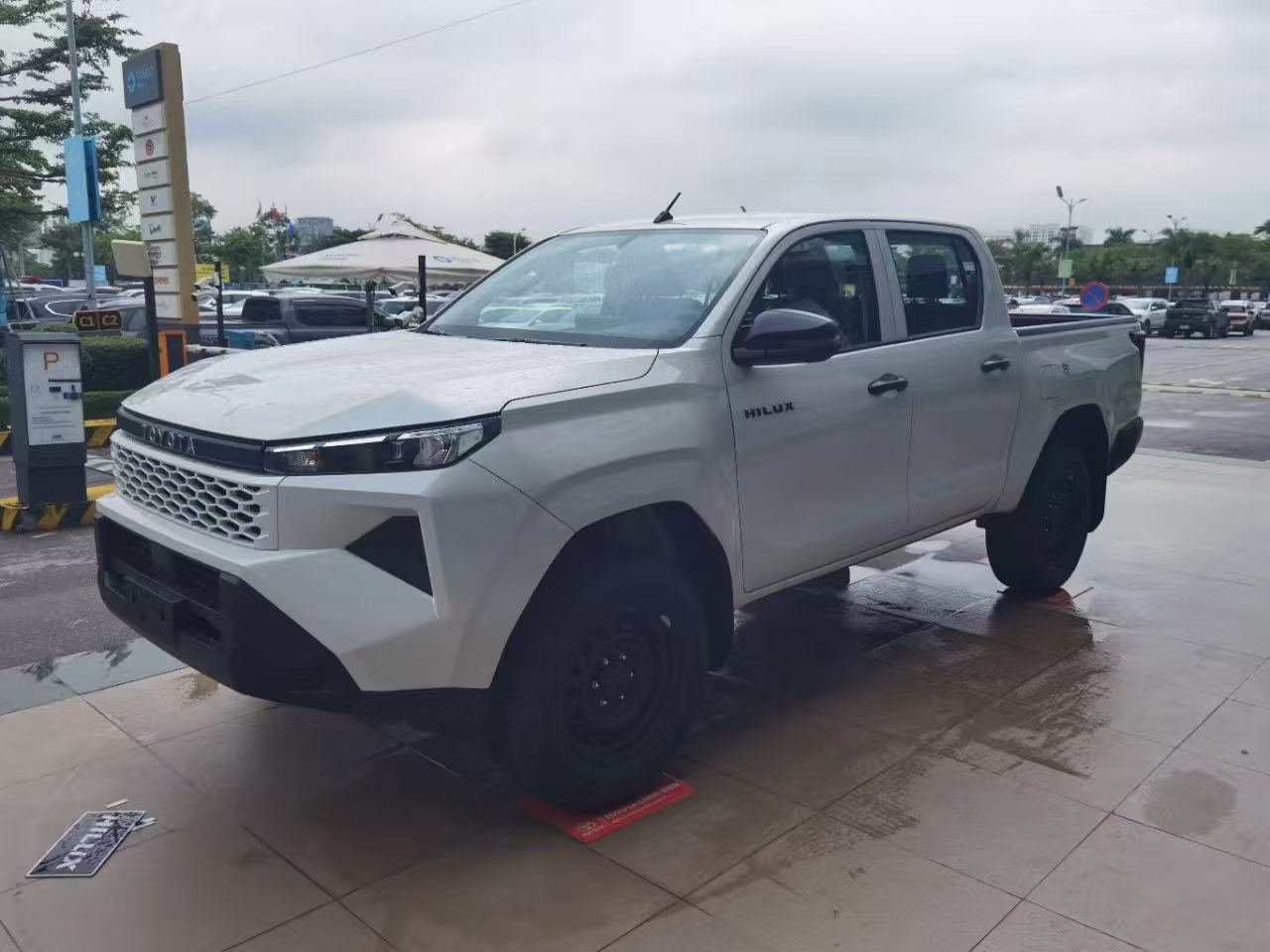
The 2026 Toyota Hilux is one generation, with the Thai plant as the main production base for left-hand-drive export units, sold under three different grade systems. Gulf dealers list it by engine — a 2.7-litre petrol, a 2.8-litre diesel, with a 4.0 V6 also referenced — the Philippines sells seven diesel trims from E to Conquest plus an electric version, and Vietnam sells three: Standard, Pro and Trailhunter. All three export markets take left-hand drive, while the Thai domestic trucks are right-hand drive and are not what an importer buys.
→ See all 7 grades of the 2026 Hilux with full specs and starting prices
That is the whole problem in one sentence: the badge on the tailgate tells you which market the truck was configured for, not what equipment it carries. The generation question is settled — 2026 Hilux versus the previous generation covers what changed — but the country question is not. A buyer who orders “a 2026 Hilux V” without naming the market can receive a 4×4 manual with Toyota Safety Sense 3.0, or a truck from a different market where the same letter means something else. Match engine, gearbox, drivetrain and safety pack first; treat the grade name as the last line on the order, not the first.
This guide compares the Gulf, Philippine and Vietnamese versions of the ninth-generation Hilux, explains what “China stock” actually is, and gives the order-sheet items that stop a mixed container from arriving with the wrong trucks.
👉 Need a version checked against a quote? Ask us on WhatsApp · E, G, V or Conquest: the diesel grade guide →
Is the 2026 Hilux the same truck in the Gulf, the Philippines and Vietnam?
Yes at the mechanical level. All three markets get the same ninth-generation double cab on a 3,085 mm wheelbase, 5,320 mm long, with the 2,755 cc 1GD-FTV four-cylinder diesel as the volume engine. Toyota Vietnam’s official specification sheet lists the diesel at 150 kW, or about 204 PS, with 420 Nm in the manual and 500 Nm in the automatic. Toyota UAE’s official Hilux page lists the 2.8-litre diesel at 201 hp and 500 Nm with a six-speed automatic and four-wheel drive.
The differences sit in the grade structure, the equipment bundles, the emission certificate and the model-year label. The table below is the short version.
| Market | Drive | Model-year label | Diesel grades | Petrol / EV options | 4×4 availability |
|---|---|---|---|---|---|
| Gulf (UAE official page) | Left-hand drive | 2027 | 2.8 diesel, 201 hp / 500 Nm, 6AT | 2.7 petrol, 164 hp / 245 Nm; 4.0 V6 listed | 4×4 listed on the 2.7 and 2.8 grades |
| Philippines (official variant cards) | Left-hand drive | 2026 and 2027 used in launch coverage | E, G, V, Conquest — all 2.8 diesel | BEV 4×4, 59.2 kWh | E 4×4 M/T, V 4×4 M/T, Conquest 4×4 A/T |
| Vietnam (official manual) | Left-hand drive | 2026 | Standard, Pro, Trailhunter — all 2.8 diesel | None listed | Trailhunter 4×4 A/T only |
| China-held stock | Left-hand drive | Varies by build | Whichever imported spec is in stock | — | Depends on the unit |
Two cautions before anyone copies that table into a purchase order. First, the model year is a label, not a build date: the UAE site calls the truck a 2027 model while Vietnam calls the same generation a 2026. Second, the Gulf page lists body styles including a single cab, while the Philippine and Vietnamese grade cards in this comparison are double-cab trucks. Cab style has to be written down separately.
Which 2026 Hilux versions are left-hand drive?
Every Hilux in this comparison that is built for export is left-hand drive. The Thai plant builds both layouts: right-hand drive for Thailand’s own market, where the truck is sold as the Hilux Travo, and left-hand drive for the Gulf, the Philippines, Vietnam and the re-export trade. A left-hand-drive unit from the Thai line is what the trade calls the Middle East specification.
That matters for buyers in East Africa and southern Africa, where right-hand drive is the road norm. A Hilux sourced from the Gulf or the Philippines is left-hand drive and cannot be registered in a right-hand-drive market. Conversely, a Thai domestic truck cannot be sold into Algeria, Côte d’Ivoire, Ethiopia, Central Asia or the Gulf. The drive side is decided at the plant, not at the dealer, and it is printed on the certificate.
Check it in three places: the order, the vehicle’s identification plate, and the export certificate. Brochure photography is not evidence — many regional brochures use a mirrored stock image. The document check is the same one that applies to any Chinese re-export, and the full list is in the China car export document checklist.
How do the grade names map between the Gulf, the Philippines and Vietnam?
The three grade systems do not map one-to-one, and any table that claims they do should be treated as marketing. The Philippine range uses E, G, V and Conquest. Vietnam uses Standard, Pro and Trailhunter. Gulf dealers use their own local grade names — Saudi dealer listings, for example, use GL, GLX and SGLX-type names — and Toyota’s UAE site presents the range by engine rather than by an E/G/V letter. None of those systems translate cleanly. The same naming trap exists on the China-built side, where one domestic name can cover several export names; Jetour’s T2, T1 and Dashing and China-built Toyota RAV4, Corolla and Corolla Cross names show how far apart the two naming systems can be.
What does translate is the equipment. The table below matches the Vietnamese and Philippine grades by what the buyer actually gets.
| Role in the range | Vietnam (official) | Philippines (official cards) | What to check on the order |
|---|---|---|---|
| Base work truck, 4×2 | Standard 2.8 4×2 M/T — 420 Nm, 17-inch steel wheels, rear drum brakes, no TSS | E 4×2 A/T — no TSS, three airbags | Gearbox: Vietnam’s base is manual, the Philippine base is automatic |
| Mid 4×2 with safety kit | Pro 2.8 4×2 A/T — 500 Nm, 18-inch alloys, rear discs, TSS, 12.3-inch screen | Conquest 4×2 A/T — TSS 3.0, 18-inch wheels, rear discs | Both are automatic and carry TSS 3.0 |
| Top 4×4 automatic | Trailhunter 2.8 4×4 A/T — 500 Nm, rear diff lock, multi-terrain select, TSS | Conquest 4×4 A/T — TSS 3.0, multi-terrain select (media) | Diff lock and MTS are separate line items on some sheets |
| 4×4 manual, no safety pack | No equivalent | E 4×4 M/T — no TSS | Only the Philippines offers this combination |
| 4×4 manual with safety pack | No equivalent | V 4×4 M/T with iMT — TSS 3.0 | The V is the only manual 4×4 with TSS in this comparison |
| Electric | No equivalent listed | BEV 4×4, 59.2 kWh | Charging standard and market homologation |
The practical conclusion is blunt: the Philippines has the widest ladder, Vietnam has the narrowest, and the Gulf range is organised around engine choice. If a buyer wants a manual 4×4 with the safety pack, only the Philippine V delivers it. If the buyer wants the cheapest automatic work truck, Vietnam’s Pro or the Philippine E 4×2 A/T are the two candidates, and they differ on safety equipment — the Pro has TSS, the E does not.
What actually differs between the Gulf, Philippine and Vietnamese trucks?
Five differences decide most purchases.
Torque depends on the gearbox, not the market. The Vietnamese manual is rated at 420 Nm; the automatic is rated at 500 Nm. The UAE automatic is also 500 Nm. Toyota Philippines does not publish a torque figure on its variant cards for the E and G, so there is no basis for assuming they match either number. Ask for the homologation sheet rather than extrapolating from the badge.
Toyota Safety Sense 3.0 is bundled by grade, and the bundle point moves. In Vietnam it starts at Pro. In the Philippines it is fitted to the V and the Conquest, not to the E or G. Gulf equipment lists vary by dealer grade, so the buyer has to read the actual specification sheet. The system includes pre-collision braking, lane departure alert, lane tracing, dynamic radar cruise control and automatic high beam.
Brakes and wheels follow the same step-up. Vietnamese Standard: 17-inch steel, rear drums, hydraulic steering. Pro and Trailhunter: 18-inch alloy, ventilated rear discs, electric power steering. Philippine media coverage reports the same split, with the E and G on 17-inch wheels and rear drums and the V and Conquest on 18-inch wheels and four-wheel discs. The official Philippine variant cards confirm the safety equipment but not every wheel and brake item, so treat those two items as media-sourced until the unit’s spec sheet is checked.
Four-wheel-drive hardware is not uniform. Vietnam offers 4×4 only on the Trailhunter, with a rear differential lock and multi-terrain select. The Philippines offers 4×4 on the E manual, the V manual and the Conquest automatic; Philippine media report multi-terrain select on the Conquest 4×4, while the lower grades do not list a rear diff lock. A buyer who needs a locked rear axle on a manual truck will not find it in either official line-up and should confirm whether the market’s homologation allows it as an option.
The emission certificate is market-specific. Toyota Vietnam lists Euro 5 for the 2.8 diesel, and the units we supply are Euro 5. Chile requires Euro 6c for new light vehicles, so we do not supply it. For a destination with high-sulphur diesel, the certificate matters more than the brochure: confirm the emission standard on the document that will be presented at customs, and check it against the fuel actually sold in the destination market.
What does “China stock” mean if Toyota does not sell the Hilux in China?
There is no China-market Hilux grade. Toyota’s China dealer network does not list the Hilux, so every Hilux held in Chinese trade stock is an imported unit being re-exported. In practice that means a Thai-built left-hand-drive truck, usually in Gulf specification, sitting in a Chinese port or inland yard before it leaves again.
The paperwork reflects that double life. The certificate of origin is Thai. The export declaration is Chinese. The invoice is Chinese. None of those documents alone tells the whole story, which is why the market code and grade have to be written into the contract. The China stock and container guide covers the sourcing channels and the 40ft loading maths; this article is about making sure the unit in that container is the version you ordered.
Two checks are worth the time. First, ask for the market code or the original destination on the build sheet, not just “Gulf spec”. Second, compare the delivered unit’s equipment against the official card for that market — wheels, brakes, screen size and the presence of the radar and camera behind the windscreen are quick visual tells. A truck advertised as a Conquest with 17-inch steel wheels is not a Conquest.
Which country version should a Gulf or African buyer order?
The answer follows the job, not the top of the range.
| Buyer’s use | Version to ask for | Why |
|---|---|---|
| Gulf dealer resale, automatic, highway use | Gulf-spec 2.8 diesel A/T, or Philippine Conquest 4×2 A/T | 500 Nm, TSS 3.0 on the Conquest, and the automatic matches local resale expectations |
| Municipal or rental fleet on sealed roads | Philippine E 4×2 A/T, or Vietnamese Pro 4×2 A/T | The E is the cheaper automatic but has no TSS; the Pro adds TSS for fleets that need it |
| Mining, construction, remote sites | Philippine E 4×4 M/T, or Conquest 4×4 A/T | Manual 4×4 with the simplest electronics, or the automatic with multi-terrain select |
| Manual 4×4 with a safety requirement | Philippine V 4×4 M/T | The only manual 4×4 in this comparison with TSS 3.0 |
| Off-road use with a locked rear axle | Vietnamese Trailhunter 4×4 A/T, or Philippine Conquest 4×4 A/T | Trailhunter lists the rear diff lock and MTS; confirm the Conquest’s option list |
| Buyer who needs a right-hand-drive truck | None of the above | These are all left-hand-drive export builds |
For West African buyers, the version question comes after the age and category question. Côte d’Ivoire’s vehicle-age rules and the customs classification of a double cab can decide whether a truck is admissible at all, so settle the category first. Ethiopia is not an option for the diesel Hilux: it no longer admits fuel-powered vehicles.
For Central Asian buyers, the same truck is judged on winter starting, parts availability and resale rather than on the badge. A 4×4 automatic with the larger cabin resells more easily than a base manual, but the base manual remains the volume fleet unit. The general differences between Gulf and China specification are covered in GCC spec versus China spec.
What should be on the order sheet for a 2026 Hilux?
Write these eleven items into the order and the proforma invoice. A supplier who cannot answer them is guessing.
- Market code or original destination — Gulf, Philippine, Vietnamese or other.
- Model year and build date — the label differs between markets.
- Grade name as used in that market, plus the engine displacement.
- Gearbox — manual or automatic, and for the Philippine V, whether iMT is fitted.
- Drive — 4×2 or 4×4, and whether a rear differential lock is included.
- Safety pack — TSS 3.0 yes or no, and the airbag count.
- Cab style — single or double cab.
- Drive side — left-hand drive, stated explicitly.
- Emission standard on the certificate.
- Wheel and brake specification — steel or alloy, drum or disc.
- Colour and any factory options, listed by code rather than by name.
Then attach the documents: certificate of origin, export declaration, commercial invoice, bill of lading and the conformity or homologation paper for the destination. The document set and the bill of lading release options are covered in telex release, sea waybill and original bill of lading, and the full export pack in the export document checklist.
On shipping, two double-cab Hilux load in one 40ft high-cube. RoRo versus container explains when the choice changes the landed cost, and FOB, CFR and CIF explains which of those three prices the quote is actually using. For a first shipment, the single-unit shipping options and the forwarder quote breakdown show which charges should appear before the truck sails; port storage and demurrage explains the cost of a truck that arrives before its paperwork.
FAQ
Is the 2026 Toyota Hilux left-hand drive?
The export versions sold in the Gulf, the Philippines and Vietnam are left-hand drive. Thailand’s domestic market takes right-hand drive, sold there as the Hilux Travo. The drive side is fixed at the plant and shown on the certificate, so confirm it on the documents rather than on a brochure photo.
Is a Gulf-spec Hilux the same as a Philippine Hilux?
They share the same platform, engine family and wheelbase, but the grade structure and equipment bundles differ. The Gulf range is organised by engine, with 2.7 petrol and 2.8 diesel options; the Philippine range is organised into E, G, V and Conquest grades, all 2.8 diesel. Do not assume a Gulf grade equals a Philippine grade with the same position in the range.
Does the 2026 Hilux have a 4×4 automatic in every market?
No. Vietnam offers 4×4 only on the Trailhunter, which is automatic. The Philippines offers 4×4 on the E manual, the V manual and the Conquest automatic. The Gulf page lists 4×4 on the 2.7 and 2.8 grades, but the exact grade and gearbox combination has to be confirmed on the local specification sheet.
Which 2026 Hilux version has 500 Nm?
The automatic versions are rated at 500 Nm in both the Vietnamese official sheet and the UAE official page. The Vietnamese manual Standard is rated at 420 Nm. Toyota Philippines does not publish torque for the E and G on its variant cards, so no figure should be assumed for those two grades.
Can I buy a new Hilux inside China?
Not from Toyota’s China dealer network — the Hilux is not sold there. What exists is imported stock held in China for re-export, normally Thai-built left-hand-drive units. The certificate of origin stays Thai and the export declaration is Chinese, so the unit is a re-export rather than a Chinese-market vehicle.
Is the 2026 Hilux the same as the Hilux Travo?
The Travo is the name Toyota uses for the ninth-generation Hilux in Thailand, where it is built and sold in right-hand drive. Export markets use the Hilux name. The mechanical base is shared, but the Thai domestic specification is not the one to compare against a left-hand-drive export order.
Why do model years differ between markets?
Because each market applies its own model-year convention. The UAE site lists the current Hilux as a 2027 model, while Vietnam lists it as a 2026, and Philippine launch coverage has used both labels. The build date on the identification plate is the reliable reference, not the brochure year.
Sources: Toyota Vietnam official Hilux product page and specification PDF (Standard 2.8 4×2 M/T, Pro 2.8 4×2 A/T, Trailhunter 2.8 4×4 A/T; 2,755 cc 1GD-FTV, 150 kW, 420/500 Nm, 5,320 mm length, 3,085 mm wheelbase, Euro 5; origin Thailand), checked November 2026. Toyota Philippines official Hilux variant cards (E, G, V, Conquest and BEV; drive, gearbox, TSS 3.0, airbags), checked November 2026; wheel, brake and iMT details for the E, G, V and Conquest come from Philippine media coverage (TopGear Philippines and GoFlatOut PH) and are marked as media-sourced in the text. Toyota UAE official Hilux page (2027 model; 2.7 petrol 164 hp / 245 Nm, 2.8 diesel 201 hp / 500 Nm, six-speed automatic, 4×4, single and double cab body styles), checked November 2026. Saudi dealer listings were used only to note that Gulf grades carry local names such as GL and GLX; the Toyota Saudi Arabia full-specification page could not be retrieved (HTTP 404, archive rate-limited), so no Saudi equipment is stated. Toyota Motor Thailand world premiere, Bangkok, 10 November 2025, for the Hilux Travo name and the right-hand-drive Thai domestic market. China stock, starting prices, colour availability, container loading and delivery policy come from our own November 2026 supply sheet. No Chinese domestic Hilux price is used because no Hilux is sold through Toyota’s China dealer network. Photo: Hanvia Motors / own photo, All rights reserved.