
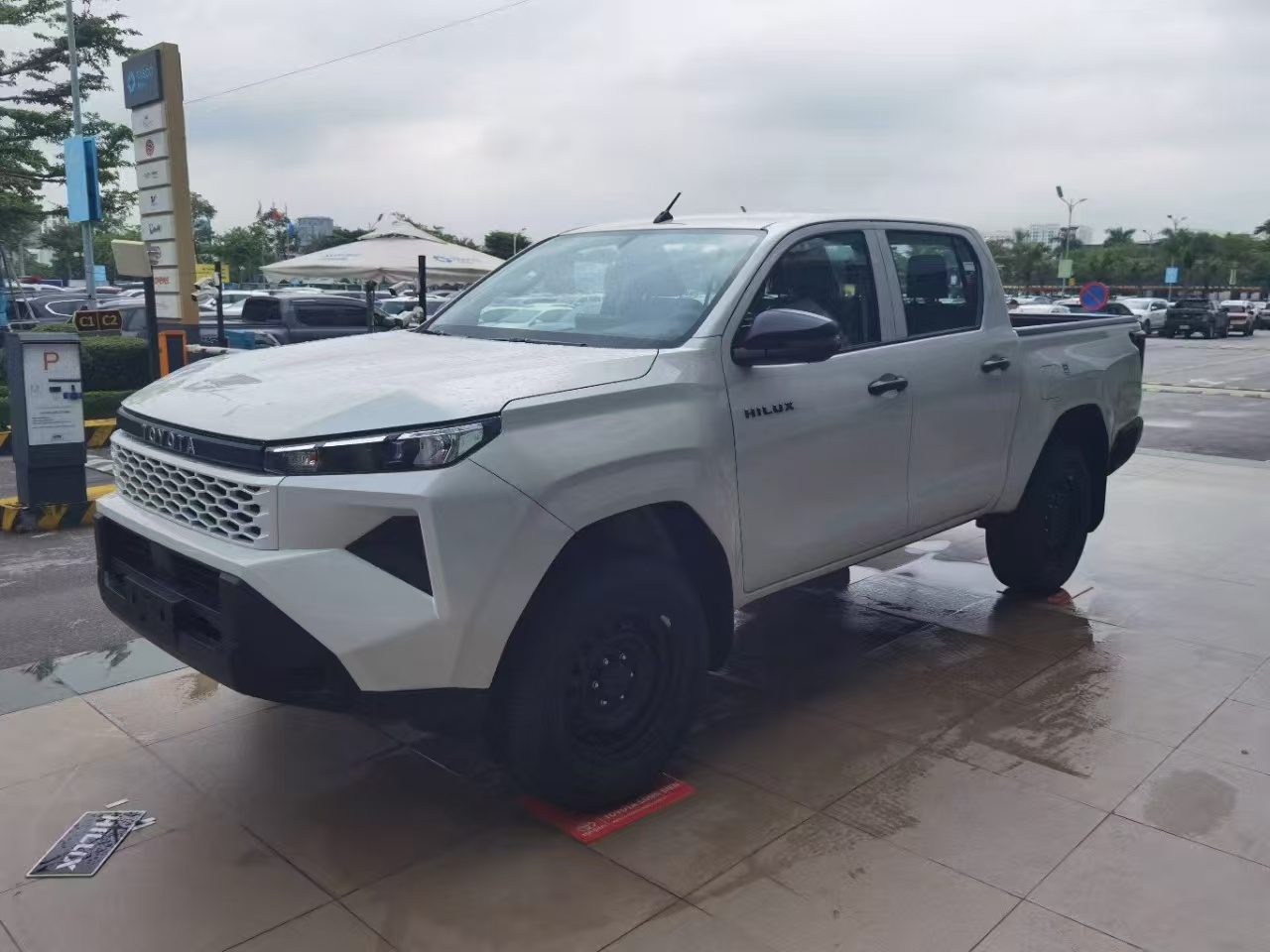
The 2026 Hilux G 4×2 is the version that lets a buyer choose between a six-speed manual and a six-speed automatic without changing grade, body or drive. The manual is rated at 420 Nm and the automatic at 500 Nm from the same 2.8-litre diesel. Everything else Toyota Philippines publishes for the two is the same, apart from a group of equipment rows that appear only in the automatic column. The decision therefore comes down to how the truck will be driven and who services it.
The grades below follow the Philippine specification, because the left-hand-drive Hilux supplied from Thailand is ordered with the Philippine names E, G, V and Conquest. The full E, G, V and Conquest range sets out where the G sits, and the Thailand and Philippines grade map shows the same truck under other market names. A buyer in Algeria, Côte d’Ivoire, Ethiopia, the Gulf or Central Asia should have the delivered unit checked against the sheet before the order is fixed.
👉 Choosing between a G 4×2 manual and automatic? Ask us on WhatsApp · Gulf, Philippine and Vietnamese versions compared →
What do the Hilux G 4×2 manual and automatic share?
Both versions are five-seat double cabs on the same body, 5,320 mm long on a 3,085 mm wheelbase. Both use the 1GD-FTV 2,755 cc four-cylinder turbo-diesel, rated at 204 PS from 3,000 to 3,400 rpm. Both meet Euro 5. Both are two-wheel drive; the G is not offered with the part-time four-wheel-drive system used on the E, V and Conquest 4×4 grades.
The published safety and chassis list is also the same. Both have three airbags: driver, driver’s knee and front passenger. Neither has Toyota Safety Sense 3.0, which the Philippine sheet lists only on the V and the two Conquest grades. Both have rear drum brakes, 265/65 R17 tyres and hydraulic power steering. Neither publishes a payload or braked towing figure by grade; the plate on the delivered unit is the number that matters for a registration file or a fleet tender.
The automatic is a six-speed unit in this grade, paired with the 500 Nm calibration. The manual is a six-speed with the 420 Nm calibration. The engine block, the body and the drive layout do not change between them.
Specification table: G 4×2 M/T against G 4×2 A/T
| Item | G 4×2 M/T | G 4×2 A/T |
|---|---|---|
| Engine | 1GD-FTV 2.8L diesel, 2,755 cc | same |
| Max output | 204 PS at 3,000–3,400 rpm | same |
| Max torque | 420 Nm at 1,400–3,400 rpm | 500 Nm at 1,600–2,800 rpm |
| Transmission | 6-speed manual | 6-speed automatic |
| Drive | 4×2 | 4×2 |
| Airbags | 3 | 3 |
| Toyota Safety Sense 3.0 | Not listed | Not listed |
| Rear brakes | Drum | Drum |
| Wheels and tyres | 265/65 R17 | 265/65 R17 |
| Power steering | Hydraulic | Hydraulic |
| Body | Double cab, 5,320 mm long, 3,085 mm wheelbase | same |
How much torque does the manual give up to the automatic?
The manual gives up 80 Nm at peak: 420 Nm against 500 Nm. The two engines are the same; the difference is in the calibration Toyota applies to the manual gearbox. 4X4 Australia, in its launch review of the 2026 truck, described the manual as de-rated from 500 Nm to 420 Nm.
The shape of the torque curve differs as well as the peak. The automatic reaches 500 Nm between 1,600 and 2,800 rpm. The manual reaches 420 Nm between 1,400 and 3,400 rpm, so its peak arrives 200 rpm earlier and continues to a higher engine speed.
In use, the automatic’s extra 80 Nm is felt when the truck is pulling a loaded trailer or overtaking on a short stretch of road, where the driver wants maximum pull without changing down. The manual’s earlier and longer torque band suits steady work at low speed: a loaded start on a site, a long climb in a low gear, or a road where the driver would rather hold a gear than let an automatic choose one. Neither difference changes the rated payload or towing limit, which Toyota does not publish per gearbox.
The G is two-wheel drive only. A buyer who needs low range, a transfer case or traction on loose ground is looking at the wrong grade and should compare the E 4×4 M/T and V 4×4 M/T or the Conquest 4×4 against the Conquest 4×2.
Does the automatic come with equipment the manual does not?
Not in the published list, but the sheet is not complete for the manual. Toyota Philippines fills several rows only in the G 4×2 A/T column and leaves the G 4×2 M/T cell blank. Among those rows are wireless phone charging, USB-C outlets, drive modes, the parking brake type, the spare wheel and trailer sway control. Other rows, including the fuel tank, rear differential lock and blind spot monitor, are also blank for the manual.
A blank cell means the sheet does not publish a value for the manual. It does not mean the item is missing from the vehicle. Where both columns have a value, the two versions are listed as identical. Where the manual column is blank, the sheet is incomplete.
The same caution applies to iMT. Toyota Philippines labels only the V 4×4 M/T as “6-Speed M/T with iMT”; the G 4×2 M/T is listed simply as “6-Speed M/T”. The sheet does not state whether the G’s gearbox has the rev-matching function. A buyer who needs iMT should confirm it on the destination market’s specification, in writing, rather than assume it from the grade.
Does the manual or the automatic use more fuel?
Toyota does not publish a separate fuel consumption figure for the two G 4×2 gearboxes, so there is no official number to compare. The engine, body and final drive are shared; the transmission calibration and the way the truck is driven are what differ.
Any figure quoted for one market should not be transferred to another. Test cycles differ, and so does the fuel available at the destination. For an order, ask the supplier for the homologated figure of the destination market if one exists, and treat a dealer’s claim of a fixed difference between the two gearboxes as unverified. Consumption in service will depend more on load, terrain, tyre pressure and driving style than on the choice between these two transmissions.
Which gearbox is easier to service and repair?
Servicing differs in what wears and who can work on it. The manual has a clutch, which is a wear item and is replaced when it reaches the end of its life. The automatic has transmission fluid and a filter on its service schedule. Toyota’s Philippine sheet does not publish service intervals or costs per grade, so the owner’s manual for the delivered market is the document to follow.
The practical difference is the workshop. A manual can be worked on by a wider range of workshops in markets where automatic transmission specialists are few. An automatic removes clutch wear caused by poor technique, which matters when a vehicle is shared by many drivers or used in stop-start traffic. Both gearboxes need scheduled service.
Which gearbox suits a fleet and which suits a private buyer?
A work fleet should start with the manual. Construction, agriculture, utility and mining-service trucks spend their time loaded at low speed, where the manual’s 420 Nm band from 1,400 rpm and the driver’s ability to hold a gear are useful. A manual also keeps the service network simple when the fleet is spread across several towns.
A private buyer, a company car or a rental fleet should look at the automatic. The 500 Nm calibration gives more pull for overtaking and towing, and two-pedal driving reduces workload in traffic. For a vehicle that carries passengers or changes drivers often, the automatic is the easier unit to operate.
A buyer who tows heavy trailers regularly should also look at the automatic. Its extra 80 Nm is the reason to choose it, provided the trailer weight is within the limit on the plate. The manual remains the choice where the driver wants engine braking on long descents and direct control of the gear.
Which gearbox suits Algeria, Côte d’Ivoire, Ethiopia, the Gulf and Central Asia?
The route and the driver matter more than the country name. Long-distance and mixed-road work in Algeria and Côte d’Ivoire usually favours the manual for its repair network and engine braking, while city fleets in Algiers or Abidjan often prefer the automatic for traffic. For Ethiopia, where vehicles enter through Djibouti and then face long climbs, the manual’s engine braking is an advantage on descents; the CIF Djibouti terms decide what the landed cost covers. In the Gulf, urban buyers lean to the automatic, while site and utility fleets still order manuals. For Central Asia, the Horgos road route is an alternative to sea freight, and the manual is easier to support where automatic specialists are scarce.
Both versions are available in left-hand drive, which suits all five markets. The truck is built in Thailand, and the left-hand-drive build is the one supplied to these destinations. GCC specification versus China specification explains why the market code on the order matters as much as the grade name. The diesel is Euro 5; confirm that fuel on the route and at the destination meets that standard, and that the local service network can handle the 1GD-FTV.
What should be written on the order sheet?
The order sheet should name the grade, the gearbox and the drive in one line: “2.8 G 4×2 M/T” or “2.8 G 4×2 A/T”. “Hilux G automatic” is not enough, because the same description is used in more than one market with different equipment.
Add the steering side, the colour and the build date. Repeat the airbag count from the market sheet, state that TSS 3.0 is not included, and list the items the buyer needs that the sheet leaves blank for the manual, such as trailer sway control, wireless charging or a spare wheel. If any of those is essential, it should be confirmed on the delivered unit and written into the order, not assumed from the grade.
The documents should match the vehicle. The export documents checklist lists the papers that carry the grade and the identification number. The bill of lading release options decide how the originals reach the buyer, and the payment method should match the order value and the inspection terms. A pre-payment inspection can record the gearbox, the pedals and the equipment on video before the balance is released.
Can a manual and an automatic ship in one container?
Yes. A 40-foot high cube takes two double-cab Hilux units under the current loading plan, and a manual and an automatic can be mixed in the same container. Container versus RoRo shipping explains when a container is the better method for a pickup order, and buying from China stock covers how a Thai-built left-hand-drive unit is held and loaded.
For buyers comparing the Hilux with other pickups, Hilux versus Tacoma and Hilux versus L200 Triton cover the platform differences. New Hilux versus the previous generation explains what changed in the ninth-generation truck.
FAQ
Is the Hilux G 4×2 sold with both a manual and an automatic?
Yes. The G 4×2 is the only grade in the Philippine line offered with either gearbox on the same two-wheel-drive chassis: a six-speed manual or a six-speed automatic.
How much torque does the Hilux G 4×2 manual make?
The manual is rated at 420 Nm from 1,400 to 3,400 rpm. The automatic is rated at 500 Nm from 1,600 to 2,800 rpm. Both use the same 2.8-litre 1GD-FTV diesel rated at 204 PS.
Does the G 4×2 have four-wheel drive?
No. The G is two-wheel drive only. Four-wheel drive is offered on the E 4×4 M/T, V 4×4 M/T and Conquest 4×4 A/T.
Does the G 4×2 manual have iMT?
Toyota Philippines labels only the V 4×4 M/T as “6-Speed M/T with iMT”. The G 4×2 M/T is listed as “6-Speed M/T” without that note. The sheet does not confirm whether the function is fitted, so it should be checked on the destination market’s specification.
How many airbags does the G 4×2 have?
Three: driver, driver’s knee and front passenger. The V and Conquest grades have seven.
Which gearbox uses less fuel?
Toyota does not publish a separate consumption figure for the two gearboxes. Consumption in service depends on load, terrain and driving style; the destination market’s homologated figure, if one exists, is the number to use.
Can the manual and automatic versions ship together?
Yes. A 40-foot high cube takes two double-cab units under the current loading plan, and the two gearboxes can be mixed in one container.
What to do next
The first step is a grade check: confirm the destination market, the steering side, the grade, the gearbox, the airbag count and the equipment items the sheet leaves open for the manual. With those fixed, a supplier can quote the exact unit instead of a grade name that may mean something different in the next market. Prices are quoted on request against the confirmed specification, because equipment and colour availability change with the build.
Sources: Toyota Motor Philippines official Hilux variant page, toyota.com.ph/hilux, read November 2026 (per-grade transmissions, G 4×2 M/T and A/T equipment columns, three airbags on E and G, TSS 3.0 only on V and Conquest, rear drum brakes and 17-inch wheels on E and G, hydraulic steering on E and G, iMT note on the V 4×4 M/T only). CarGuide.PH, “All-new 2026 Toyota Hilux arrives in the Philippines (w/ Specs)”, June 2026 (420 Nm manual and 500 Nm automatic torque figures and engine output, airbag counts, TSS 3.0 on V and Conquest, wheels and brakes). 4X4 Australia, 2026 Toyota Hilux launch review (manual de-rated from 500 Nm to 420 Nm, iMT behaviour). Toyota Motor Vietnam official Hilux specification PDF (shared 1GD-FTV 2,755 cc engine, 204 PS, 420 Nm manual and 500 Nm automatic, 5,320 mm length, 3,085 mm wheelbase, Thailand as country of origin). Zigwheels Philippines, “Toyota Motor PH starts selling all-new Hilux” (grade list, hydraulic steering on E and G, seven airbags on V and Conquest). The equipment rows that are blank for the G 4×2 M/T come from the Philippine sheet alone; the other outlets checked did not list them, and a blank row means the value is not published rather than the item being absent. No price is quoted in this article; equipment can change by market, model year and build date, and the manufacturer’s specification for the delivered unit prevails. Photo: Hanvia Motors / own photo, All rights reserved.