
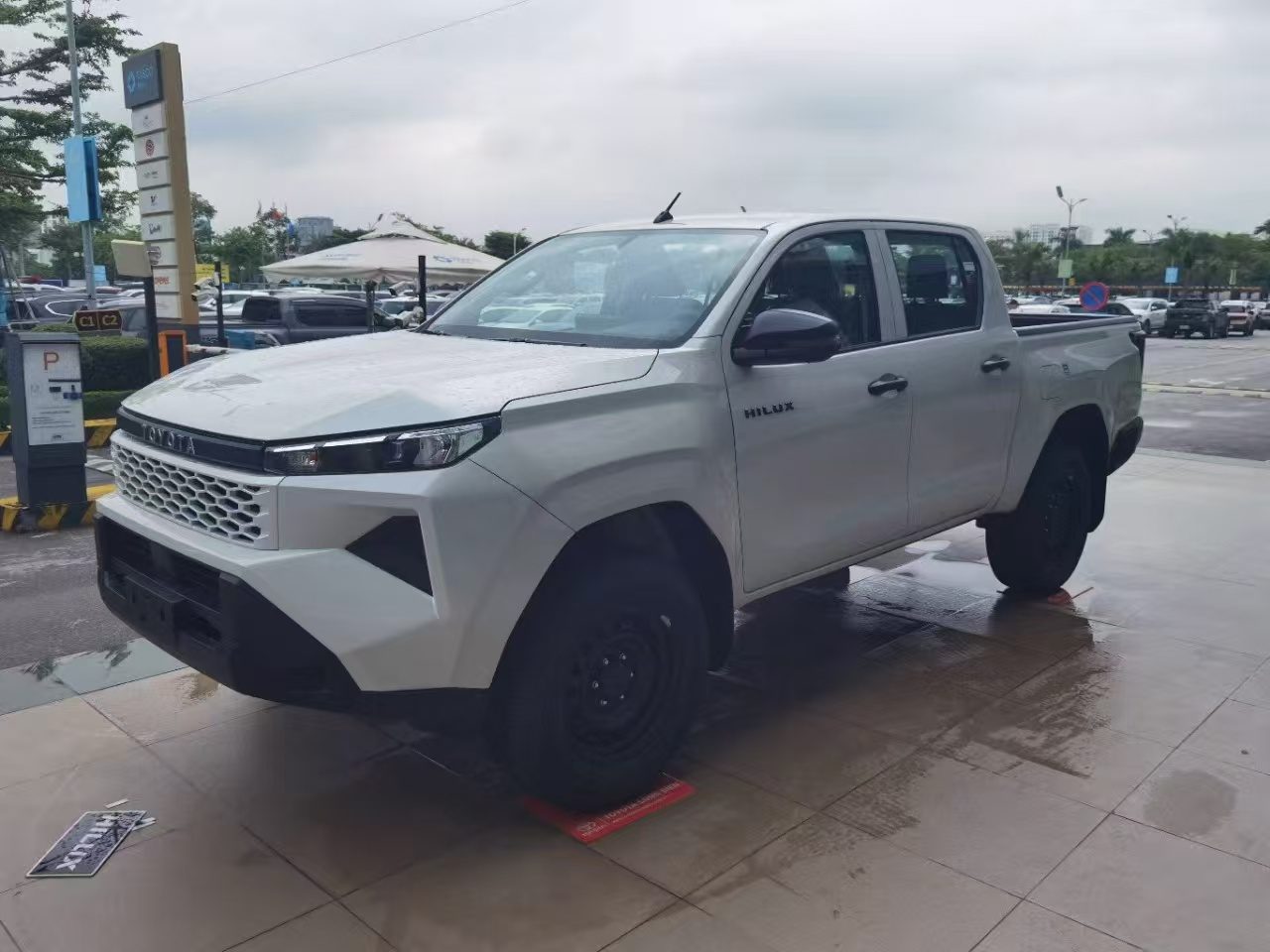
The 2026 Hilux Conquest 4×4 A/T and Conquest 4×2 A/T are the same grade with the same 2.8-litre diesel, the same 500 Nm automatic, the same Toyota Safety Sense 3.0 package and the same cabin. On the Philippine specification sheet, the equipment lists differ on two rows: the drive, and a rear differential lock. The 4×4 starts at USD 43,500 and the 4×2 at USD 36,500 for the standard colours, so the buyer pays about USD 7,000 for four driven wheels, the transfer case and the front axle drive, with a rear differential lock listed only on the 4×4. Whether that is the right order depends on where the truck works.
Equipment in this article is quoted from the Philippine sheet, because the left-hand-drive Hilux supply from Thailand is ordered with the Philippine grade names E, G, V and Conquest. The full E, G, V and Conquest range sets out where each grade sits, and the Thailand and Philippines grade map shows how the same truck is named in a second market.
👉 Ordering a Conquest? Ask us on WhatsApp · The G 4×2 A/T against the Conquest 4×2 A/T →
What do the Conquest 4×4 A/T and Conquest 4×2 A/T share?
The shared list covers almost the whole truck. Both use the 1GD-FTV 2,755 cc four-cylinder turbo-diesel, rated at 204 PS from 3,000 to 3,400 rpm and 500 Nm from 1,600 to 2,800 rpm, with a six-speed automatic. Both are five-seat double cabs on a 3,085 mm wheelbase, measuring 5,320 mm long, 1,885 mm wide and 1,865 mm high, with 312 mm of ground clearance. Both meet Euro 5.
The Conquest kit is also shared. Both have Toyota Safety Sense 3.0, seven airbags, blind spot monitoring with rear cross traffic alert, dynamic radar cruise control, a 360-degree panoramic view monitor, front and rear parking sensors, 18-inch alloy wheels with 265/60 R18 tyres, ventilated disc brakes at both ends, electric power steering, a 12.3-inch instrument display, a 12.3-inch touchscreen with wireless Apple CarPlay and Android Auto, synthetic leather seats, an 8-way power driver seat, dual-zone automatic air conditioning, smart entry with push start and power-folding mirrors.
The cabin and the safety package do not depend on the drive. A 4×2 Conquest has the same interior, the same screens and the same seven airbags as the 4×4. The E 4×4 M/T against the V 4×4 M/T shows the opposite case, where the grade change moves the safety package and the cabin together.
Specification table: Conquest 4×4 A/T against Conquest 4×2 A/T
| Item | Conquest 4×4 A/T | Conquest 4×2 A/T |
|---|---|---|
| Engine | 1GD-FTV 2.8L diesel, 2,755 cc | same |
| Max output | 204 PS at 3,000–3,400 rpm | same |
| Max torque | 500 Nm at 1,600–2,800 rpm | same |
| Transmission | 6-speed automatic | same |
| Drive | Part-time 4×4 | 4×2, rear-wheel drive |
| Rear differential lock | Listed as fitted | Row blank |
| Ground clearance | 312 mm | 312 mm |
| Wheels and tyres | 265/60 R18 alloy | same |
| Brakes | Ventilated discs front and rear | same |
| Airbags | 7 | 7 |
| Toyota Safety Sense 3.0 | Fitted | Fitted |
| Instrument display | 12.3-inch TFT | same |
| Touchscreen | 12.3-inch display audio | same |
| Seat material | Synthetic leather | same |
| Air conditioning | Dual-zone automatic | same |
Every row not listed above is identical on the sheet. The drive row carries hardware that the list does not itemise: a transfer case, a front differential and the front drive shafts on the 4×4. The 4×2 does without those parts and drives the rear axle only.
How does the part-time 4×4 system in the Conquest work?
The Conquest 4×4 uses a part-time system with an electronic transfer switch, as described in Toyota’s Vietnamese specification for the same generation. Part-time means the front axle is engaged by the driver rather than by a centre differential that works all the time. The usual settings are two-wheel drive for sealed roads, four-wheel drive high range for loose or wet surfaces, and four-wheel drive low range for steep grades, deep sand and heavy pulling at low speed.
Low range multiplies torque at the wheels through an extra gear set in the transfer case. It is the setting that lets a loaded double cab climb a loose slope at walking pace without riding the clutch or overheating the automatic. The 4×2 has no transfer case and no low range, so all of its pulling force goes through the rear axle and the gearbox.
A part-time system should not be left in four-wheel drive on dry tarmac. With no centre differential, the front and rear axles turn at slightly different speeds in a turn, and the transmission winds up. The driver selects four-wheel drive when the surface allows the tyres to slip, and returns to two-wheel drive on sealed roads.
When does a Conquest 4×2 lose traction that a 4×4 would keep?
A rear-wheel-drive pickup carries its load over the rear axle, which helps traction when the bed is full. The limit appears when the surface is loose, wet or steep, or when the truck is empty. Wet laterite and clay, sand tracks, mud at a construction site, grass on a slope and a boat ramp at low tide are the usual places where two driven wheels run out of grip. A 4×2 in those conditions relies on tyre choice, load and momentum.
The 4×4 adds a second driven axle, and with it the option of low range. On a loose climb the front axle pulls while the rear pushes, and the driver can slow down without losing forward motion. In mud or sand, the 4×4 can cross a section that stops a 4×2.
The 4×2 remains the better tool on sealed roads. It has fewer driveline parts, no transfer case to service and no front differential, and it is lighter. A courier, rental or municipal fleet that stays on tarmac gains nothing from four-wheel drive except the purchase price and the extra hardware.
Does the Conquest 4×2 have a rear differential lock?
The Philippine sheet lists a rear differential lock on the Conquest 4×4 A/T and leaves the Conquest 4×2 A/T row blank. The same sheet marks the G 4×2 A/T as “Without”, so Toyota uses a separate value when a lock is absent. A blank row on the Conquest 4×2 does not confirm that a lock is fitted or that it is missing.
A rear lock matters when one rear wheel loses grip and the open differential sends the drive to that wheel. Locking the axle keeps both rear wheels turning, which helps on cross-axle ruts, rocks and steep loose ground. On the 4×4 it works together with the front axle. On the 4×2 it would help on the same surfaces, but the sheet does not state that the hardware is there.
A buyer who needs a locking rear axle should put the item on the order in writing and have it checked on the delivered unit. A pre-payment inspection can photograph the switch and the axle, and the inspection report becomes part of the file.
What does the Conquest 4×4 weigh compared with the Conquest 4×2?
Toyota’s Vietnamese specification gives kerb weights of 1,980 kg for the Pro 4×2 A/T and 2,095 kg for the Trailhunter 4×4 A/T. That is a 115 kg gap, but the two figures belong to different market grades with different equipment, so they indicate the size of the four-wheel-drive penalty rather than a Philippine grade-to-grade number. The transfer case, front differential and front drive shafts account for most of the added mass.
The Philippine sheet does not publish a payload figure for either Conquest version. The payload that matters for registration or a fleet tender is the one on the plate of the delivered unit. A 4×4 conversion of a 4×2 rating is not a safe assumption, because the added driveline weight comes out of the same gross vehicle mass.
Which buyer should order the Conquest 4×4 A/T?
The 4×4 suits buyers whose trucks leave sealed roads as part of the job. Mining service, construction, agriculture, plantation, utility and oilfield fleets in Algeria, Côte d’Ivoire, Ethiopia, the Gulf and Central Asia work on surfaces where a rear-drive pickup gets stuck under load. For those buyers, four-wheel drive decides whether the truck can do the work; the cabin is already the top grade.
The Conquest 4×4 also suits a dealer who stocks the top grade for private buyers in markets where four-wheel drive is expected on a flagship pickup. The version carries the full safety and cabin package, so it can serve as the demonstration unit for the grade while the working units come from lower trims.
A mixed fleet can order the Conquest 4×4 for the site vehicles and the Conquest 4×2 for supervisors and office staff who drive on tarmac. Both share the engine, the automatic gearbox, the safety pack and most service parts, which keeps the parts stock and the driver briefing simple.
Which buyer should order the Conquest 4×2 A/T?
The 4×2 fits the buyer who wants the Conquest cabin and safety package but does not need four driven wheels. Courier and delivery fleets, car rental, municipal and airport transfer operators, and company cars that stay on sealed roads fall into this group. The 4×2 delivers the same 500 Nm, the same seven airbags, the same TSS 3.0 and the same 12.3-inch screens for about USD 7,000 less at the starting price.
It also suits markets where the road network is good and the truck is used as a passenger or light-load vehicle rather than a site vehicle. In a city fleet, the 4×2 is easier on fuel and tyres than a 4×4 in normal use, and it has fewer parts that a local workshop needs to understand.
The 4×2 is the wrong choice for a buyer who already knows the truck will work on sand, mud or unsealed mountain roads. The saving is real, but a stuck truck costs more than the difference in purchase price once recovery, downtime and damaged loads are counted.
What is the price difference between the Conquest 4×4 and Conquest 4×2?
The starting prices below are from the November 2026 supply list. They are starting prices for the standard colours; the red option adds USD 300 on the 4×4 and USD 500 on the 4×2. Delivery point, freight and local charges are quoted separately against the confirmed specification, because they depend on the destination and the route.
| Version | Colours | Starting price (USD) |
|---|---|---|
| Conquest 4×4 A/T | Black, white, ash grey | 43,500 |
| Conquest 4×4 A/T | Emotional red | 43,800 |
| Conquest 4×2 A/T | Black, white, ash grey | 36,500 |
| Conquest 4×2 A/T | Emotional red | 37,000 |
The gap is USD 7,000 in the standard colours and USD 6,800 in red, because the red charge differs between the two versions. For a single unit, that is the price of the transfer case, the front axle drive and the rear lock as they come from the factory. For a fleet of ten, the same decision moves the order value by USD 70,000.
The G 4×2 A/T against the Conquest 4×2 A/T shows what the Conquest kit adds for its own premium. A buyer who wants four-wheel drive but not the Conquest cabin should look at the V 4×4 M/T. It has the manual gearbox and the top safety package, and it starts USD 3,000 below the Conquest 4×4.
Which markets suit the Conquest 4×4 and which suit the 4×2?
The Philippine specification is left-hand drive, which suits Algeria, Côte d’Ivoire, Ethiopia, the Gulf and Central Asia. The truck is built in Thailand, and the left-hand-drive build is the one supplied to these markets. GCC specification versus China specification explains why the market code on the order matters as much as the grade name.
In Algeria, the 4×4 suits buyers who work in the highlands and on unpaved routes, while the 4×2 covers coastal and city fleets. In Côte d’Ivoire, the rainy season turns unpaved laterite into a surface where a rear-drive pickup struggles, so site vehicles should be ordered in 4×4. In Ethiopia, the 4×4 is the safer choice for routes outside Addis Ababa. In the Gulf, the 4×4 suits site and desert-edge work, and the 4×2 suits city fleets. In Central Asia, the 4×4 earns its price on winter roads and unsealed routes, while the 4×2 serves sealed-road fleets.
Both versions use the same Euro 5 diesel. Buyers should confirm that the fuel available on the route and at the destination meets that requirement, and that the local service network can handle the 1GD-FTV. The Gulf, Philippine and Vietnamese versions sets out where the regional lines differ.
What should be written on the Conquest order sheet?
The order sheet should name the grade with its drive and gearbox: “2.8 Conquest 4×4 A/T” or “2.8 Conquest 4×2 A/T”. The word Conquest alone is not enough, because both versions carry it and the price differs by about USD 7,000.
Add the colour, the steering side, the build date and whether a rear differential lock is required. Repeat the safety pack and the airbag count from the market sheet, so that the delivered unit can be checked against the order. The build date matters because the model-year label changes by market and does not reliably describe the build.
The documents should match the vehicle. The export documents checklist lists the papers that carry the grade and the identification number. The bill of lading release options decide how the originals reach the buyer, and the payment method should match the order value and the inspection terms.
Can a Conquest 4×4 and a Conquest 4×2 ship in one container?
Yes. A 40-foot high cube takes two double-cab Hilux units under the current loading plan, and the two versions can be mixed in the same container. For a dealer ordering a demonstration unit and a working unit together, that keeps the freight simple. Container versus RoRo shipping explains when a container is the better method for a pickup order, and buying from China stock covers how a Thai-built left-hand-drive unit is held and loaded.
For buyers comparing the Hilux with other pickups, Hilux versus L200 Triton and Hilux versus Tacoma cover the platform differences. New Hilux versus the previous generation explains what changed in the ninth-generation truck.
FAQ
Is the Conquest 4×2 rear-wheel drive?
Yes. The Conquest 4×2 A/T drives the rear axle only. It has no transfer case, no front differential and no low range. The Conquest 4×4 A/T has a part-time four-wheel-drive system with an electronic transfer switch.
Does the Conquest 4×2 have a rear differential lock?
The Philippine specification sheet lists a rear differential lock on the Conquest 4×4 A/T and leaves the Conquest 4×2 A/T row blank. Because the sheet marks the G 4×2 A/T as “Without”, the blank row is not proof either way. Confirm the item in writing if it is required.
Do the Conquest 4×4 and 4×2 use the same engine and torque?
Yes. Both use the 1GD-FTV 2.8-litre turbo-diesel at 204 PS and 500 Nm, with a six-speed automatic. The drivetrain change does not alter the engine rating.
Is the Conquest 4×4 a full-time all-wheel-drive system?
No. It is a part-time system. The driver selects four-wheel drive for loose or slippery surfaces and returns to two-wheel drive on dry sealed roads. There is no centre differential to use four-wheel drive on tarmac.
Do both Conquest versions have the same safety equipment?
Yes. Both have Toyota Safety Sense 3.0, seven airbags, blind spot monitoring, rear cross traffic alert, dynamic radar cruise control and a 360-degree camera. The safety package is part of the grade; the drive does not change it.
How much more does the Conquest 4×4 cost?
The starting price is USD 43,500 for the Conquest 4×4 A/T and USD 36,500 for the Conquest 4×2 A/T in black, white or ash grey. That is about USD 7,000. Delivery point, freight and local charges are quoted separately against the confirmed specification.
Are both versions left-hand drive?
The Philippine specification is left-hand drive, which suits Algeria, Côte d’Ivoire, Ethiopia, the Gulf and Central Asia. Right-hand-drive builds exist for other markets, so the steering side should be written on the order separately from the grade name.
Can the two Conquest versions ship in one container?
Yes. A 40-foot high cube takes two double-cab Hilux units under the current loading plan, and the 4×4 and 4×2 can be mixed in the same container.
What to do next
The first step is a route check: list the surfaces the truck will work on, the loads it will carry and whether a locking rear axle is required. If any regular route is unsealed, muddy or steep, the Conquest 4×4 is the version that keeps the truck working. If the truck stays on sealed roads, the Conquest 4×2 delivers the same cabin and safety package for about USD 7,000 less.
With the version, colour, steering side and build date fixed, the order can be quoted against the confirmed specification. Prices and delivery terms are confirmed in writing once the destination and the route are known.
Sources: Toyota Motor Philippines official Hilux variant page, toyota.com.ph/hilux, read November 2026 (per-grade equipment lists for the Conquest 4×4 A/T and Conquest 4×2 A/T: identical rows except drive and rear differential lock; 500 Nm automatic, seven airbags, TSS 3.0, 18-inch wheels, four-wheel ventilated discs, 12.3-inch screens, synthetic leather, dual-zone climate; the G 4×2 A/T rear differential lock row marked “Without”). Top Gear Philippines, “2026 Toyota Hilux specs and features”, 8 June 2026 (version list and the 500 Nm automatic rating). Zigwheels Philippines, “Toyota Motor PH starts selling all-new Hilux” (grade list and Conquest equipment). Toyota Motor Vietnam official Hilux specification PDF (part-time 4WD with electronic transfer switch; kerb weights of 1,980 kg for the Pro 4×2 A/T and 2,095 kg for the Trailhunter 4×4 A/T; 5,320 mm length, 3,085 mm wheelbase, 312 mm ground clearance; Euro 5; Thailand as country of origin). The 2H, 4H and 4L settings of the part-time system come from Toyota Hilux transfer case service documentation and GCC dealer specification pages, because the Philippine sheet lists only “part-time 4×4”; no ratio or transfer case model number is quoted. Starting prices and colour charges are from our November 2026 supply list. Loading plan of two double-cab units per 40-foot high cube from the same supply list. The Philippine sheet does not publish a payload figure by grade, so no payload is quoted. The rear differential lock row for the Conquest 4×2 A/T is blank on the sheet, and the article says so rather than treating the blank as a confirmed absence. The kerb weights come from two different Vietnamese market grades, and the article presents the 115 kg gap as an indication, not a grade-to-grade figure. Equipment can change by market, model year and build date, and the manufacturer’s specification for the delivered unit prevails. Photo: Hanvia Motors / own photo, All rights reserved.