
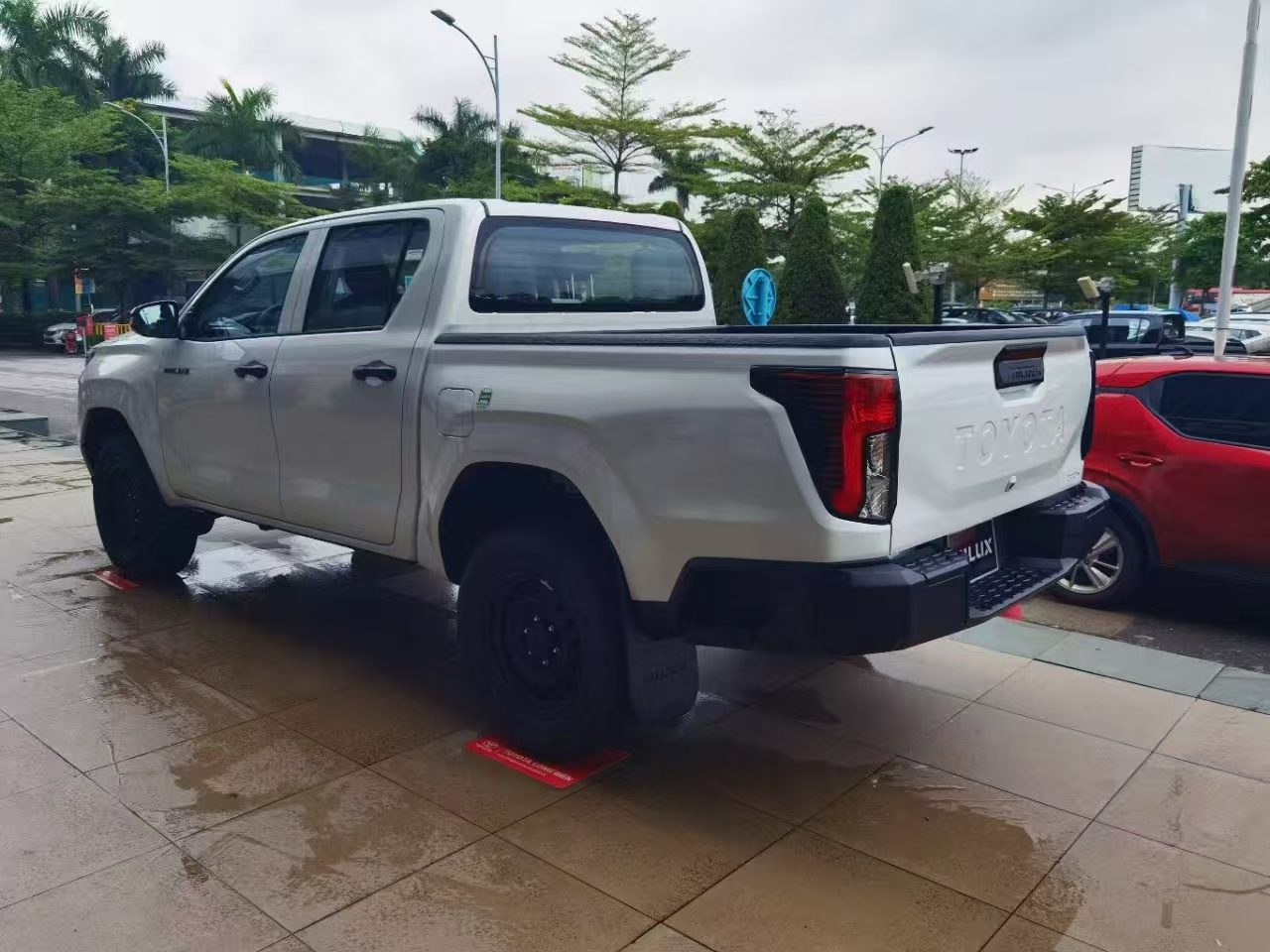
The 2026 Hilux E 4×4 M/T and V 4×4 M/T are both part-time four-wheel-drive double cabs with the 2.8-litre diesel, 420 Nm and a six-speed manual. The E is the entry four-wheel-drive grade in the Philippine line. The V is the same drivetrain wrapped in Conquest-level safety and cabin equipment. A work fleet and a private buyer should not automatically choose the same one.
Equipment in this article is quoted from the Philippine specification sheet, because the left-hand-drive Hilux supply from Thailand is ordered with the Philippine grade names E, G, V and Conquest. The full E, G, V and Conquest range explains where each grade sits, and the Thailand and Philippines grade map shows how the same truck is named in a second market. A buyer in Algeria, Côte d’Ivoire, Ethiopia, the Gulf or Central Asia should have the delivered unit checked against the sheet before the order is fixed.
👉 Checking an E or V 4×4 quote? Ask us on WhatsApp · Gulf, Philippine and Vietnamese versions compared →
What do the Hilux E 4×4 M/T and V 4×4 M/T have in common?
Both versions are five-seat double cabs on a 3,085 mm wheelbase, measuring 5,320 mm long and 1,885 mm wide, with 312 mm of ground clearance. Both use the 1GD-FTV 2,755 cc four-cylinder turbo-diesel, rated at 204 PS from 3,000 to 3,400 rpm and 420 Nm from 1,400 to 3,400 rpm. Both meet Euro 5. Both have a six-speed manual, a part-time four-wheel-drive system with an electronic transfer switch, front double wishbones, a rear leaf-spring axle and a 360-degree panoramic view monitor.
The shared list is longer than the gap in the grade names suggests. Both have LED headlamps with auto-levelling, LED daytime running lamps, LED front fog lamps, eight speakers, a 60:40 split rear seat, 2/4 front and rear parking sensors, two ISOFIX positions, ABS with EBD, vehicle stability control with brake assist, hill-start assist, mudguards, one 12V socket and an immobiliser with alarm.
Neither version publishes a payload or braked towing figure by grade. The Philippine sheet has the rows, but the values are not released per variant. The number on the plate of the delivered unit is the one that matters for a fleet tender or a registration file.
Specification table: E 4×4 M/T against V 4×4 M/T
| Item | E 4×4 M/T | V 4×4 M/T |
|---|---|---|
| Engine | 1GD-FTV 2.8L diesel, 2,755 cc | same |
| Max output | 204 PS at 3,000–3,400 rpm | same |
| Max torque | 420 Nm at 1,400–3,400 rpm | same |
| Transmission | 6-speed manual | 6-speed manual with iMT |
| Drive | Part-time 4×4, electronic transfer switch | same |
| Rear differential lock | Not listed | Fitted |
| Brakes | Ventilated discs front, drums rear | Ventilated discs front and rear |
| Wheels and tyres | 265/65 R17 alloy | 265/60 R18 alloy |
| Power steering | Hydraulic | Electric |
| Airbags | 3: driver, driver knee, front passenger | 7: adds front side and curtain airbags |
| Toyota Safety Sense 3.0 | Not listed | Fitted |
| Blind spot monitor and rear cross traffic alert | Not listed | Fitted |
| Cruise control | Conventional | Dynamic radar cruise control |
| Seat material | Fabric | Synthetic leather |
| Driver seat | 6-way manual | 8-way power |
| Air conditioning | Manual | Dual-zone automatic |
| Instrument cluster | 7-inch TFT | 12.3-inch TFT |
| Touchscreen | 8-inch display audio | 12.3-inch display audio |
| Apple CarPlay and Android Auto | Wired | Wireless |
| Outside mirrors | Power adjust | Power adjust and power fold |
| Keyless entry and start | Remote keyless, key ignition | Smart entry, push start |
| Panoramic view monitor | 360 degrees | same |
| Parking sensors, front / rear | 2 / 4 | same |
How large is the safety difference between the E and V?
The airbag count is the first line that matters. The E 4×4 M/T has three airbags: driver, driver’s knee and front passenger. The V 4×4 M/T has seven, adding front side airbags and curtain airbags for both rows. For a double cab that carries a crew, the four extra airbags change what happens in a side impact.
Toyota Safety Sense 3.0 is the second. The Philippine sheet lists it on the V and both Conquest grades, not on the E or G. On the Hilux the package covers pre-collision warning with automatic braking, lane departure alert, lane tracing assist, automatic high beam and dynamic radar cruise control. The E has conventional cruise control, which holds a set speed but does not keep a distance to the vehicle ahead, and it has no automatic emergency braking or lane-keeping assistance.
The V also carries blind spot monitoring with rear cross traffic alert. On a truck that is 5,320 mm long and often reverses out of a yard or a loading bay, that system is useful in daily work. The E does not list it.
The rest of the passive safety set is shared. Both have the same stability control, hill-start assist, ABS with EBD, two ISOFIX anchors and the same 360-degree camera. The airbag count and the driver-assistance package carry the difference; the basic chassis safety set is the same.
What does the V 4×4 M/T add in the cabin and on the road?
The V moves the cabin up one grade. Synthetic leather replaces fabric, the driver’s seat becomes 8-way power instead of 6-way manual, and the climate control becomes dual-zone automatic instead of manual. The instrument cluster grows from a 7-inch TFT to a 12.3-inch display, and the centre touchscreen from 8 inches to 12.3 inches. Apple CarPlay and Android Auto are wireless on the V and wired on the E. The V also has smart entry with push start, an auto-dimming inside mirror and power-folding outside mirrors.
The chassis differences are easier to miss on a quotation. The V runs 18-inch alloys with 265/60 R18 tyres; the E runs 17-inch alloys with 265/65 R17. The E’s taller sidewall is an advantage on broken surfaces and gives a wider choice of replacement tyres where 18-inch stock is thin. The V has ventilated disc brakes at both ends, while the E has drums at the rear. The V also uses electric power steering and the E keeps hydraulic assistance.
None of these changes the engine, the gearbox or the transfer case. They change the feel of the truck, the parts a workshop will service and the equipment a tender can count.
Does the E 4×4 M/T have a rear differential lock?
The Philippine sheet lists a rear differential lock for the V 4×4 M/T and leaves the E 4×4 M/T row blank. The blank row does not say whether the hardware is fitted. The E is the entry 4×4 grade, so the lock may be omitted, but the sheet does not state it either way.
A buyer who needs a locked rear axle for sand, mud or steep loose climbs should confirm the item on the delivered unit, in writing, before the balance is released. A pre-payment inspection can record the transfer-case controls and the differential lock switch on video. If the lock is essential and the E cannot be confirmed, the V is the grade where the sheet states it.
Is the 420 Nm manual enough for a loaded 4×4?
The manual version of the 2.8 diesel is rated at 420 Nm, against 500 Nm for the automatic. The engine block is the same; the difference is in the gearbox calibration. The manual reaches its 420 Nm from 1,400 to 3,400 rpm, a broad band that covers pulling away with a load and holding a steady climb.
The four-wheel-drive system is part-time, with a transfer case and a low-range gear. Low range multiplies torque at the wheels and is the setting for steep grades, deep sand and heavy trailers at low speed. On dry tarmac the truck should be driven in two-wheel drive; four-wheel drive is for loose or slippery surfaces.
For a fleet, the manual has two practical advantages. It is simpler to repair in markets where automatic transmission specialists are scarce, and it removes the automatic’s service items. The trade-off is driver workload in traffic and the need for clutch discipline with a loaded truck. The V’s iMT system matches engine speed on downshifts, which reduces shock through the driveline when a driver changes down under load. The E has the same gearbox without that function.
Payload and towing should be read from the plate and the local registration rules, not from a brochure line. The Philippine sheet does not publish per-grade figures.
Which buyer should order the E 4×4 M/T?
Work fleets should start with the E 4×4 M/T. Construction, agriculture, mining service and utility teams need traction and ground clearance more than leather and radar cruise. The E has the full 4×4 drivetrain, the 360-degree camera, LED lighting and the same 2.8 diesel as the V. Its 17-inch wheels are easier to replace in remote areas, and the hydraulic steering and rear drum brakes are simple systems that local workshops know.
The E also suits a fleet that buys in volume and standardises. One grade means one parts list and one driver briefing. The absence of TSS 3.0 is a cost and complexity saving, provided the fleet’s own safety policy does not require automatic emergency braking.
The E is not the right choice for a company that carries passengers, dangerous goods or a high-value crew. In those cases the airbag count and the automatic braking on the V are the reason to move up.
Which buyer should order the V 4×4 M/T?
Private retail buyers, company management units and NGO or government tenders should look at the V 4×4 M/T. It is the only way to get Conquest-level equipment with a manual gearbox in this range. The seven airbags, TSS 3.0, blind spot monitoring and radar cruise are the items that private buyers use and that a resale conversation returns to.
The V also fits markets where drivers and mechanics prefer a manual. Rural, farming and mining operations often want a manual for control on descents and for repair simplicity, but still want the top safety package for the people in the cab. The V is that combination. The automatic alternative is the Conquest 4×4 A/T, which carries the same safety equipment with a 500 Nm automatic.
Dealers ordering for resale can use the V as the demonstration or management unit and the E as the working unit. Both share the engine, the manual gearbox family and most service parts, so a mixed order keeps the parts stock simple. The G 4×2 A/T against the Conquest 4×2 A/T shows the same grade logic on the two-wheel-drive side.
Which version suits Algeria, Côte d’Ivoire, Ethiopia, the Gulf and Central Asia?
Both versions are left-hand drive in the Philippine specification, which suits Algeria, Côte d’Ivoire, Ethiopia, the Gulf and Central Asia. The truck is built in Thailand, and the left-hand-drive build is the one supplied to these markets. GCC specification versus China specification explains why the market code on the order matters as much as the grade name.
The diesel engine is Euro 5. Buyers should confirm that the fuel available on the route and at the destination meets the requirement, and that the local service network can handle the 1GD-FTV. The manual gearbox and the part-time transfer case are common across the region, which helps parts supply.
For Ethiopia, the incoming port is Djibouti, and the CIF Djibouti terms decide what the landed cost covers. For Central Asia, the Horgos road route is the alternative to sea freight. For the Gulf, the Gulf, Philippine and Vietnamese versions sets out where the Gulf petrol and diesel lines differ.
What should be written on the order sheet?
The order sheet should name the market code, the drive side, the grade with its gearbox and drive, the safety pack, the airbag count and the build date. “Hilux 4×4 manual” is not enough, because the E and V share that description and differ in safety and cabin equipment.
Write the grade as “2.8 E 4×4 M/T” or “2.8 V 4×4 M/T”. Add whether TSS 3.0 is included, repeat the airbag count from the market sheet, and state whether a rear differential lock is required. Add the colour and the steering side. The build date matters because the model-year label changes by market and is not a reliable description of the build.
The documents should match the vehicle on the sheet. The export documents checklist lists the papers that carry the grade and the identification number. The bill of lading release options decide how the originals reach the buyer. The payment method should match the order value and the inspection terms.
Can both grades ship in one container?
Yes. A 40-foot high cube takes two double-cab Hilux units under the current loading plan, and the E and V can be mixed in the same container. Container versus RoRo shipping explains when a container is the better method for a pickup order, and buying from China stock covers how a Thai-built left-hand-drive unit is held and loaded at a Chinese port.
For buyers comparing the Hilux with other pickups, Hilux versus Tacoma and Hilux versus L200 Triton cover the platform differences. New Hilux versus the previous generation explains what changed in the ninth-generation truck.
FAQ
Is the Hilux E 4×4 M/T a real four-wheel-drive version?
Yes. The E 4×4 M/T has a part-time four-wheel-drive system with an electronic transfer switch and a low-range gear, the same system family as the V 4×4 M/T. It is the first grade in the range with four-wheel drive.
Do the E 4×4 M/T and V 4×4 M/T use the same engine?
Yes. Both use the 1GD-FTV 2.8-litre four-cylinder turbo-diesel at 204 PS and 420 Nm, paired with a six-speed manual. The V adds iMT rev-matching to the same gearbox; the engine and the torque rating are identical.
Does the E 4×4 M/T have Toyota Safety Sense?
Not in the Philippine specification. TSS 3.0 is listed for the V 4×4 M/T and both Conquest grades. The E has conventional cruise control and no automatic emergency braking or lane-keeping assistance.
How many airbags does each version have?
The E 4×4 M/T has three: driver, driver’s knee and front passenger. The V 4×4 M/T has seven, adding front side airbags and curtain airbags for both rows.
Does the V 4×4 M/T have a rear differential lock?
The Philippine sheet lists a rear differential lock on the V 4×4 M/T. The E 4×4 M/T row is blank, so the item should be confirmed on the delivered unit if it is required.
Why does the manual have less torque than the automatic?
The manual version of the 2.8 diesel is rated at 420 Nm and the automatic at 500 Nm. The difference comes from the gearbox calibration and the torque the manual transmission is set to handle, not from a different engine.
Are these versions left-hand drive?
The Philippine specification is left-hand drive, which suits Algeria, Côte d’Ivoire, Ethiopia, the Gulf and Central Asia. Right-hand-drive builds exist for other markets, so the steering side should be written on the order separately from the grade name.
Can the E and V ship in one container?
Yes. A 40-foot high cube takes two double-cab Hilux units under the current loading plan, and the two grades can be mixed in the same container.
What to do next
The first step is a grade check: confirm the destination market, the drive side, the grade, the gearbox, the safety pack, the airbag count and whether a rear differential lock is required. With those fixed, a supplier can quote the exact unit instead of a grade name that may mean something different in the next market. Prices are quoted on request against the confirmed specification, because equipment and colour availability change with the build.
Sources: Toyota Motor Philippines official Hilux variant page, toyota.com.ph/hilux, read November 2026 (seven diesel variants and one BEV; per-grade airbag counts, TSS 3.0 on V and both Conquest grades, blind spot monitor and rear cross traffic alert, cruise control type, parking sensors, seat and screen specifications, wheels, brakes, steering, iMT on the V 4×4 M/T, rear differential lock listed on the V). Top Gear Philippines, “2026 Toyota Hilux specs and features”, 8 June 2026 (version list, 420 Nm manual and 500 Nm automatic, TSS 3.0 on V and Conquest, equipment split). Zigwheels Philippines, “Toyota Motor PH starts selling all-new Hilux” (grade list, seven airbags on V and Conquest, hydraulic steering on E and G, electric steering on V and Conquest). Toyota Motor Vietnam official Hilux specification PDF (shared 1GD-FTV 2,755 cc engine, 150 kW, 420 Nm manual and 500 Nm automatic, 5,320 mm length, 3,085 mm wheelbase, part-time 4WD with electronic transfer, Thailand as country of origin). 4X4 Australia, 2026 Toyota Hilux launch review (iMT behaviour and manual torque rating). Loading plan of two double-cab units per 40-foot high cube from our November 2026 supply sheet. No price is quoted in this article; the Philippine sheet’s local retail prices are not export prices and are not reproduced. Blind spot monitoring, the parking sensor counts, the 360-degree camera on both grades and some cabin trim rows come from the Philippine sheet alone; the other outlets checked did not list those rows. The sheet leaves the rear differential lock row for the E 4×4 M/T blank, and one outlet lists wireless Apple CarPlay and Android Auto on both grades against the sheet’s wired listing for the E. Equipment can change by market, model year and build date, and the manufacturer’s specification for the delivered unit prevails. Photo: Hanvia Motors / own photo, All rights reserved.