
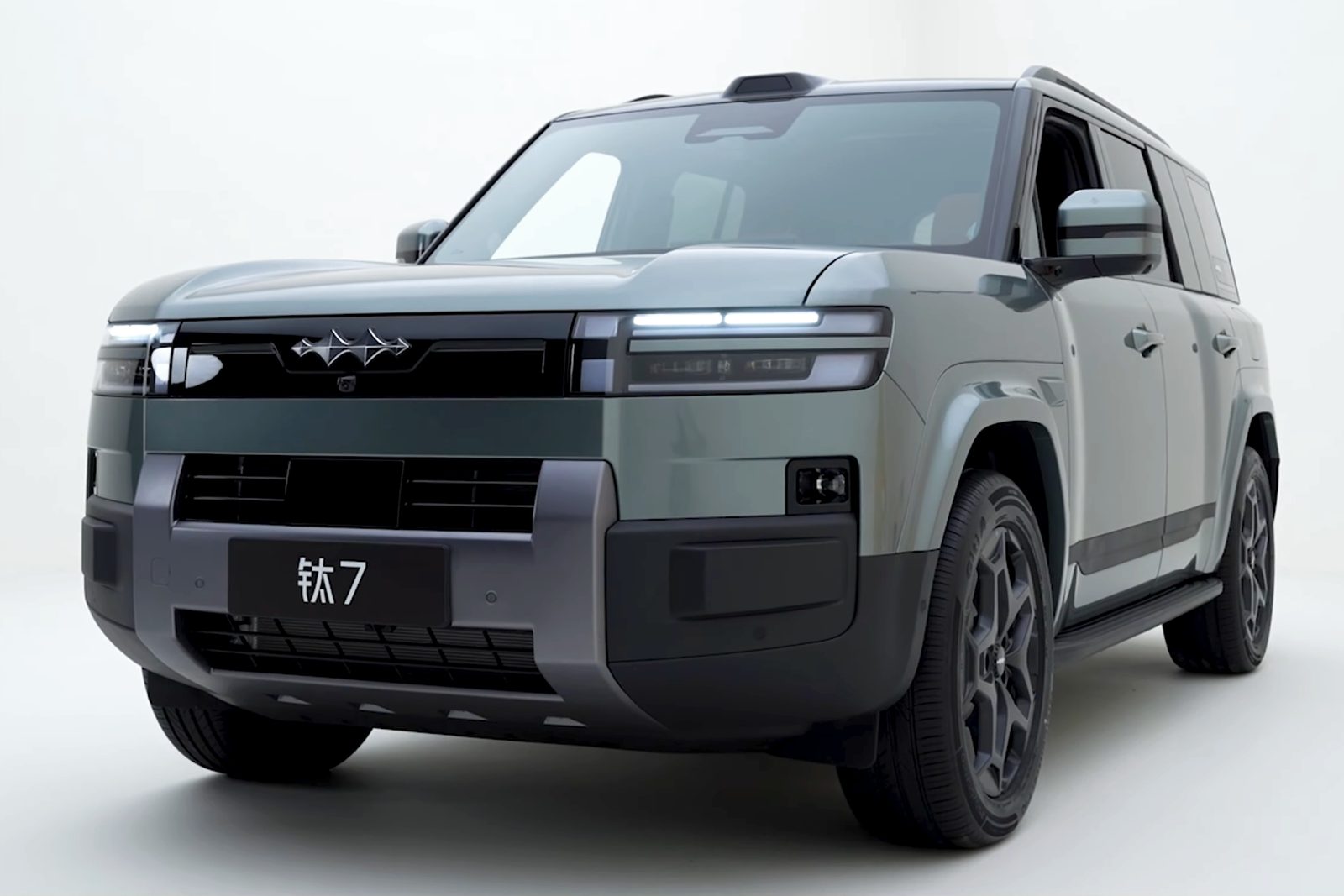
The BYD Ti 7 long-range DM is a China-market version, not the car supplied through official Gulf dealers. It was added on 18 August 2026 with a 50 kWh Blade pack, 315 km of CLTC electric range in rear-drive form and a China guide price of ¥195,800, about ¥6,000 more than the equivalent standard car. The UAE Ti 7, on sale since June 2026, is quoted locally with the 26.6 kWh pack and about 80 km of WLTP electric range, so the first question on any “Ti 7 long range” offer is which battery is actually fitted.
👉 Ordering a Ti 7? Send us the version and the battery capacity. Ask us on WhatsApp · Ti 7 names and export specs →
What is the BYD Ti 7, and what does the long-range version change?
The BYD Ti 7 is the export name of the Fangchengbao Tai 7 (方程豹 钛7), a 4,999 mm five-seat unibody SUV with a 1.5-litre turbo petrol engine and BYD’s DM-p plug-in hybrid system. It went on sale in China in September 2025 with a 2,920 mm wheelbase, a 60-litre fuel tank and a choice of 26.6 kWh or 35.6 kWh Blade batteries. Importers in Dubai and Central Asia also advertise it as the Leopard 7, a name BYD does not use; the Leopard 7 naming guide explains where that alias comes from and what appears on the export documents.
The long-range version keeps the same body, engine and electric motors. The change is the battery: 50 kWh instead of 35.6 kWh, which lifts CLTC electric range from 200 km to 315 km on the rear-drive car and from 190 km to 300 km on the all-wheel-drive car. BYD quotes a combined CLTC range of 1,470 km for the rear-drive long-range car and 1,310 km for the AWD version. DC charging rises from 73 kW to 158 kW, cutting a 30-80% charge to about 13.9 minutes.
BYD launched the long-range pair on 18 August 2026 as two extra trims, not a new generation. The standard four trims remain on sale, so a Chinese dealer can quote six different DM versions of the same car.
How do the six Ti 7 DM versions compare?
All six use the same 1.5 T engine rated at 115 kW. The rear-drive cars use a 200 kW motor; the AWD cars add a 160 kW front motor for a combined 360 kW and 620 Nm. The AWD cars are quoted at 4.5 seconds to 100 km/h.
| Version | China guide price | Battery | EV range (CLTC) | Drive | Combined range (CLTC) |
|---|---|---|---|---|---|
| 135 km 2WD Pro | ¥179,800 | 26.6 kWh | 135 km | RWD, 200 kW | up to about 1,300 km |
| 200 km 2WD Max | ¥189,800 | 35.6 kWh | 200 km | RWD, 200 kW | up to about 1,300 km |
| 190 km 4WD Max | ¥206,800 | 35.6 kWh | 190 km | AWD, 360 kW | up to about 1,300 km |
| 190 km 4WD Ultra | ¥219,800 | 35.6 kWh | 190 km | AWD, 360 kW | up to about 1,300 km |
| 315 km 2WD Max (long range) | ¥195,800 | 50 kWh | 315 km | RWD, 200 kW | 1,470 km |
| 300 km 4WD Ultra (long range) | ¥225,800 | 50 kWh | 300 km | AWD, 360 kW | 1,310 km |
The prices are China guide prices for the 2025 and 2026 model years, not export quotes. The combined figure for the four standard trims is the range-wide claim of about 1,300 km; BYD does not publish a separate combined figure for each standard trim.
The 315 km 2WD Max is ¥6,000 more than the 200 km 2WD Max beneath it. The 300 km 4WD Ultra is ¥6,000 more than the 190 km 4WD Ultra. In both cases the buyer pays for 14.4 kWh of battery and about 110 km of additional CLTC electric range, not for a higher trim level.
What does the extra ¥6,000 buy on the long-range Ti 7?
The extra money buys battery capacity, charging speed and electric range. The long-range 2WD Max keeps the equipment of the standard 2WD Max: DiSus-C adaptive damping, a fridge, ventilated and massaging front seats, and the 15.6-inch centre screen. The long-range 4WD Ultra keeps the standard Ultra specification, including the top driver-assistance package with roof-mounted lidar, 20-inch wheels and the 20-speaker Devialet audio system.
Two options carry over. The 2WD Max can add the same lidar-assisted package for ¥12,000. Both long-range trims can be ordered with a factory tow hook rated at 2 tonnes for ¥4,000. BYD also added a new purple paint colour with the long-range launch.
The long-range DM does not get the 800 V flash-charging system used by the Ti 7 EV. Its 158 kW peak is roughly double the standard car’s 73 kW, but it is not the five-minute charging claimed for the electric version. For a plug-in hybrid that also has a 60-litre tank, that distinction matters less than the battery size.
Why does the long-range version matter for Gulf and Central Asian buyers?
The long-range Ti 7 reduces how often the petrol engine starts. The UAE car with the 26.6 kWh pack is quoted at about 80 km of WLTP electric range, which covers a city commute but not the inter-city runs common in Saudi Arabia, the UAE, Uzbekistan or Kazakhstan. The 50 kWh China-spec car has 315 km of CLTC electric range, against 135 km for the 26.6 kWh China-spec car, so a buyer who charges at home can cover several days of city driving without petrol and still have a 60-litre tank for the highway.
Heat is the second factor. Gulf summer temperatures put a heavy load on air-conditioning, and a smaller battery loses a larger share of its usable range to cooling. A 50 kWh pack leaves more margin. The same applies in reverse in Central Asian winter, where cabin heating and low temperatures cut electric range; the AWD long-range car is the more useful specification for mountain routes and snow.
Charging infrastructure is the third factor. Outside the main Gulf cities and the Tashkent-Samarkand corridor, public charging is sparse. A PHEV does not depend on it, but a larger battery means fewer public charging stops and less generator-style engine running. For a fleet covering high monthly mileage, the fuel saving from the bigger pack can repay the ¥6,000 difference quickly.
CLTC figures are measured on a laboratory cycle that is gentler than Gulf or Central Asian driving. Treat 315 km as a best-case electric range, not a highway figure. At 120 km/h with air-conditioning, the electric range will be materially lower, and the engine will take over earlier.
Which Ti 7 version do UAE and Uzbekistan buyers actually get?
The UAE Ti 7 went on sale through Al-Futtaim’s BYD network in June 2026 in two trims, priced at AED 156,900 and AED 169,900. The launch car is a five-seat AWD model with 360 kW and a combined range quoted at about 1,300 km. UAE listings describe the 26.6 kWh battery and about 80 km of WLTP electric range; that battery figure comes from local listings rather than a published BYD UAE specification sheet, and it should be confirmed on the actual car.
BYD launched the Ti 7 in Uzbekistan on 1 October 2026. Launch coverage reports the five-seat AWD flagship with the DM-p system. No long-range 50 kWh version has been announced for that channel.
The UK shows how far an export specification can move from the Chinese car. The UK Ti 7 is a seven-seater that measures about 5,146 mm with the tailgate-mounted spare wheel, uses a 35.6 kWh battery and a 1.5-litre engine with three electric motors producing 300 kW, and is priced at £47,995 with deliveries from January 2027. That is neither the Chinese five-seat long-range car nor the UAE five-seat car.
An official UAE or Uzbekistan Ti 7 and a China-spec “Ti 7 long range” are different products with different batteries, charging inlets, seat counts and warranty routes. A trader quoting a 50 kWh car is quoting a Chinese domestic trim, not an official GCC or Central Asian version.
How do you check which Ti 7 battery you are being quoted?
Ask for four pieces of evidence before comparing prices.
- The battery capacity from the car, not the brochure. Request a photo of the battery label or the energy screen showing the pack size in kWh. A 26.6, 35.6 and 50 kWh car look identical from outside.
- The charging inlet. China-market cars use the GB/T inlet. GCC and European cars use Type 2 for AC and CCS2 for DC. An adapter can bridge some cases, but it does not turn a China-spec car into a GCC-spec car. The GCC versus China-spec guide lists the rest of the differences.
- The seat count and length. China cars are five-seat and 4,999 mm. The UK export car is seven-seat and about 5,146 mm. Check the rear cabin and the tailgate spare, not the model name.
- The model year and build date. The long-range DM only exists from August 2026. A 2025 build cannot be a factory 50 kWh car unless it has been modified, which is a different risk.
The paperwork should carry the homologation name 方程豹 钛7 and the VIN, and the invoice name should match the export documents. The export documents checklist covers the invoice, certificate and bill of lading set. For a used or zero-km example, the 180-day rule decides whether the car ships as new or used. A remote inspection before payment is cheaper than resolving a battery mismatch at the destination port.
Which Ti 7 DM version should an importer order?
The channel comes first.
For an official UAE or GCC purchase, order the version the local distributor lists. That is currently the 26.6 kWh five-seat car. It comes with a local warranty, a GCC charging inlet and a service network. The long-range 50 kWh car is not part of that offer, so a dealer who promises one should be asked for the battery label and the source of the car.
For a China-spec import into Central Asia or Africa, the 315 km 2WD Max is the value pick. It costs ¥6,000 more than the standard 200 km car and gives 115 km more CLTC electric range, faster DC charging and the same equipment. Cars entering Central Asia by road usually clear through the Horgos crossing, and the Central Asia market guide covers the route and the paperwork. For mountain routes, winter use or a buyer who values the AWD system and the standard lidar assistance, the 300 km 4WD Ultra is the better fit at ¥30,000 more.
For a fleet or high-mileage operator, the long-range car pays back through fuel. The larger pack covers more daily routes on electricity and reduces engine hours. For a private buyer who drives less than 80 km a day and charges at home, the standard 26.6 kWh car is sufficient and cheaper.
For a seven-seat requirement, the Chinese long-range car is the wrong car. It is a five-seater. The UK-style export body is the seven-seat option, and a seven-seat Jetour X70 Plus is a cheaper alternative for family transport in Algeria or West Africa.
Importers comparing the Ti 7 with other plug-in hybrids should also look at the Sealion 06 EV versus DM-i and the Denza N8 five-seat guide. For the larger six-seat Fangchengbao, the Ti 9 import guide covers the model above the Ti 7, and the Battleship 700 versus Ti 9 comparison shows where the Ti 9 sits against a rival.
Does the EU court ruling affect Ti 7 exports to the Gulf and Central Asia?
The injunction applies to the EU market, not to Gulf or Central Asian sales. A Dutch court ruling dated 20 November 2026 blocks the import, production, sale, storage and delivery of the Ti 7 in the European Union while BYD appeals. The UK is outside the EU and its January 2027 delivery plan is unaffected, and the ruling does not cover the UAE, Saudi Arabia or Central Asian markets.
The ruling affects sourcing. A buyer offered EU-spec Ti 7 stock should check where the car is registered and where it will be sold, because a car blocked from sale in the EU may be redirected to another market with different homologation. For Gulf and Central Asian buyers, the relevant question remains the battery, the charging inlet and the warranty, not the EU court case.
FAQ
Is the BYD Ti 7 long-range version available in the UAE?
No long-range 50 kWh version has been announced for the UAE. The official Ti 7 on sale through Al-Futtaim’s BYD network is quoted locally with the 26.6 kWh battery and about 80 km of WLTP electric range. A 50 kWh car offered in Dubai is a China-spec import.
Is 315 km the real electric range of the long-range Ti 7?
No. The 315 km figure is CLTC, a Chinese laboratory cycle. Real-world electric range is lower, especially at highway speed, in Gulf summer heat with air-conditioning, or in Central Asian winter with cabin heating. The petrol engine covers the difference.
Can a China-spec Ti 7 use Gulf charging stations?
A China-spec car has a GB/T inlet, while Gulf public chargers use Type 2 and CCS2 connectors. Adapters exist for some AC cases, but DC fast charging usually requires the matching inlet. An official GCC car is the simpler choice if public charging matters.
Is the long-range Ti 7 worth the extra ¥6,000?
It is worth it if the car will cover more than about 80-100 km a day, if home charging is unreliable, or if the buyer wants to minimise engine running. For short city use with reliable home charging, the standard 26.6 kWh car is enough.
Does the long-range Ti 7 have seven seats?
No. The Chinese long-range Ti 7 is a five-seater with a 4,999 mm body. The seven-seat body is the UK export version, which measures about 5,146 mm with the tailgate-mounted spare wheel and uses a different battery.
What is the difference between the 315 km 2WD Max and the 300 km 4WD Ultra?
The 2WD Max is rear-drive with a 200 kW motor, 315 km of CLTC electric range and a China guide price of ¥195,800. The 4WD Ultra adds a front motor for 360 kW combined, 4.5-second acceleration, standard lidar-assisted driving and a 20-speaker audio system, with 300 km of CLTC electric range at ¥225,800.
Is the Ti 7 called Leopard 7 in export markets?
Leopard 7 is an importer nickname, not a BYD model name. The official export name is BYD Ti 7, and the Chinese homologation name is 方程豹 钛7. The China-name versus export-name map explains why the two names coexist.
Sources: Fangchengbao China launch coverage for the Tai 7 (September 2025) from Xinhua, 12365auto, Bitauto, Yiche and Autohome; Bitauto, 12365auto and 网上车市 reports on the Tai 7 DM long-range launch (18 August 2026) for battery, range, charging, prices and options; 12365auto and Autohome trim listings for the four standard trims; DriveArabia and Tbreak for the UAE Ti 7 launch, trims and AED prices (June 2026); Cars24 and UAE dealer listings for the 26.6 kWh / 80 km WLTP figure, which is the only source for that battery number; CnEVPost, “BYD launches Fang Cheng Bao Tai 7 in Uzbekistan as BYD Ti 7” (8 October 2026); CarsGuide and PerthNow for the UK seven-seat specification and price; electrive and Chinese court coverage for the Hague injunction of 20 November 2026; Wikipedia entries for the Fangchengbao Ti7 (accessed November 2026). Prices are China guide prices for the stated model year and are not export quotes. Option prices and equipment details are from Bitauto only. Range figures are CLTC unless marked WLTP. Battery, seat count and specification vary by market and model year. Photo: AutoLab / Wikimedia Commons, CC BY 3.0.