
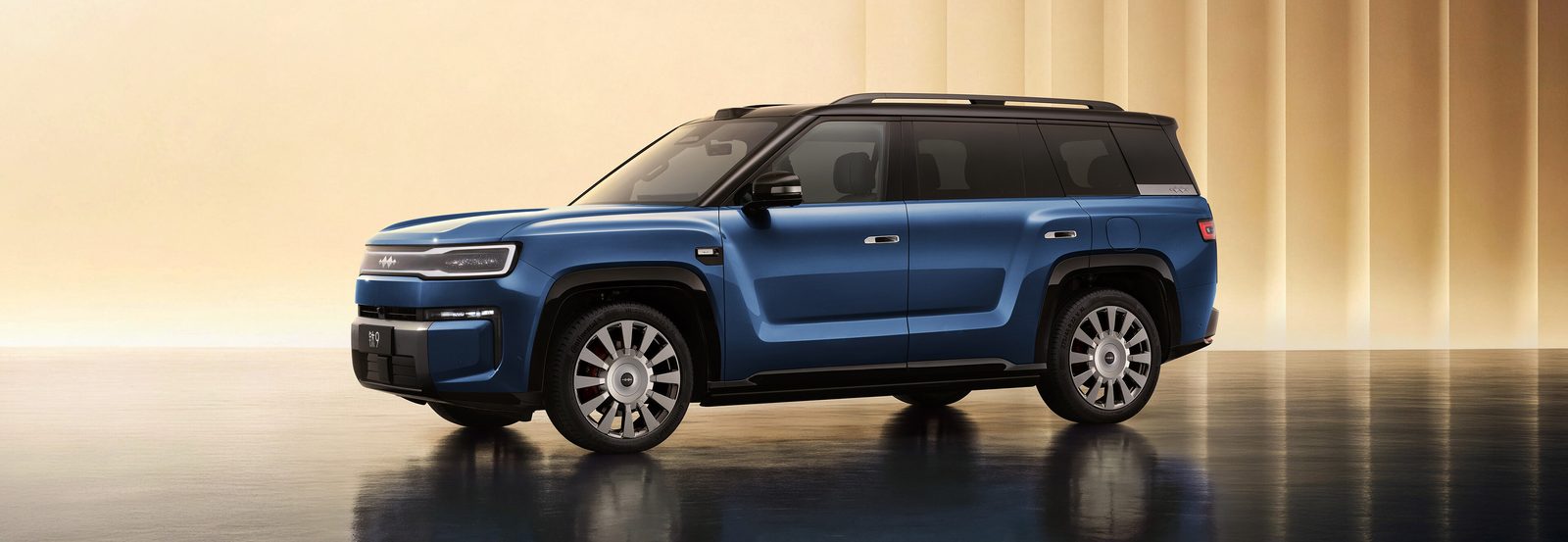
The Geely Galaxy Battleship 700 and the Fangchengbao Ti 9 are both large Chinese plug-in hybrid SUVs launched within six weeks of each other in late 2026, and Gulf buyers now ask which one to import. The Battleship 700 is the off-road car: 233 mm of ground clearance, 800 mm of wading depth, a rear differential lock on the Australian version and five seats. The Ti 9 is the family car: six seats in a 2+2+2 layout, a 66.48 kWh battery, rear-wheel steering and a 2,000 kg towing rating. Neither has a GCC specification or an announced right-hand-drive programme.
Both cars are about five metres long, use air suspension and are sold only in China for now. The choice comes down to five seats with off-road hardware or six seats with more electric range and cabin equipment.
👉 Comparing stock or asking for a quote? Ask us on WhatsApp · Browse new Chinese cars for export →
What are the Geely Battleship 700 and Fangchengbao Ti 9?
The Geely Galaxy Battleship 700 went on sale in China on 10 October 2026. It is a 5,085 mm plug-in hybrid SUV on Geely’s GTA architecture, with a 47.14 kWh CATL lithium iron phosphate battery and a choice of 1.5T or 2.0T engines with one to three electric motors. In China it is called the Zhanjian 700, and Chinese reports suggest export markets may use the name Galaxy Cruiser 700, so buyers should search both names. Our Battleship 700 export guide sets out the six trims and the power outputs in detail.
The Fangchengbao Ti 9 went on sale on 19 November 2026. It is a 5,270 mm six-seat SUV and the flagship of BYD’s Fangchengbao sub-brand, above the Ti 3 and Ti 7. All three launch trims share one powertrain: a 1.5T engine rated at 115 kW, electric motors on both axles with a combined 400 kW, and a 66.48 kWh second-generation Blade battery. The top trim adds a folding steer-by-wire wheel. Our Ti 9 Gulf import guide covers the trims and the equipment differences.
The two cars also sit on different structures. The Battleship 700 uses Geely’s GTA platform, which the company describes as a monocoque body with structural frame members integrated into it rather than a separate ladder chassis bolted underneath; Geely says the design saves weight and lowers the floor compared with a conventional ladder frame. The Ti 9 is a plain monocoque with no integrated frame. Neither is a traditional body-on-frame truck, and buyers comparing either with a Land Cruiser should note that difference.
Names are a practical problem with both. The Battleship can appear as Zhanjian 700, Battleship 700 or Galaxy Cruiser 700; the Ti 9 as Fangchengbao, Fang Cheng Bao or FCB, and as Ti 9, Ti9 or Tai 9. BYD’s naming system and Chinese model names versus export names explain why.
How do the Battleship 700 and Ti 9 compare in size and seating?
The Ti 9 is the longer car and the only one of the two with six seats. It measures 5,270 mm long against 5,085 mm for the Battleship 700, and its wheelbase is 3,130 mm against 2,900 mm. Both are 1,999 mm wide. The Battleship is the taller car, at 1,895 mm to 1,925 mm depending on version, against 1,850 mm or 1,880 mm with roof rails for the Ti 9.
| Item | Geely Battleship 700 | Fangchengbao Ti 9 |
|---|---|---|
| China launch | 10 October 2026 | 19 November 2026 |
| Length / width | 5,085 / 1,999 mm | 5,270 / 1,999 mm |
| Height | 1,895–1,925 mm | 1,850 / 1,880 mm |
| Wheelbase | 2,900 mm | 3,130 mm |
| Seats | 5 | 6 (2+2+2) |
| Kerb weight | Not published in our sources | 2,865–2,965 kg |
| Boot | 1,050 L (five seats up) | 655 L behind third row / 1,245 L folded |
The extra 185 mm of length in the Ti 9 goes mostly into the wheelbase and the cabin. Its second row is two individual chairs with a walk-through gap to the third row, and launch cars had heating, ventilation, massage and reclining backrests in the third row as well as separate air vents. The third row is designed for regular passengers.
The Battleship 700 seats five, and its advantage is height and clearance rather than interior volume. Pre-launch Chinese reports mentioned a six-seat option, but launch cars were five-seat; ask for the trim code if a seller offers six. A buyer who needs to move six adults regularly can drop the Battleship from the shortlist immediately.
Pre-launch reports mentioned five- and seven-seat Ti 9s, but only the six-seat layout was confirmed at launch. Ask for the registration document and trim code before any deposit on a seven-seater.
Which has the stronger powertrain, the Battleship 700 or the Ti 9?
The Battleship 700 has the wider power range, from a 350 kW base version to an 830 kW top version, while the Ti 9 offers one 400 kW powertrain across all trims. The Ti 9 therefore sits between the Battleship’s entry and top versions. The Battleship’s top output is in a different performance class, but it also sits at the top of the range and is not the version most fleet buyers will price first.
| Powertrain | System power | Torque | 0–100 km/h |
|---|---|---|---|
| Battleship 700, 1.5T + single front motor | 350 kW | 605 Nm | 6.4 s |
| Battleship 700, 1.5T + three motors, AWD | Not quoted (sources conflict) | 1,165 Nm | 4.2 s |
| Battleship 700, 2.0T + three motors, AWD | 830 kW | 1,330 Nm | 3.95 s |
| Ti 9, 1.5T + dual motors, AWD | 400 kW | Not published | 4.8 s |
Two notes on that table. The three-motor 1.5T Battleship is reported at 690 kW by CarNewsChina and 570 kW by Wikipedia, so no figure is quoted here; ask the supplier for the Chinese spec sheet of the exact trim. Fangchengbao does not publish a combined system torque figure for the Ti 9 in the launch material we checked, so the table leaves it blank.
Both cars are all-wheel drive in the versions compared here. The Ti 9 is all-wheel drive in every trim. The Battleship 700’s base single-motor version drives the front axle only.
For Gulf use, heat, fuel and tyre cost matter more than acceleration. A 400 kW plug-in hybrid with a 66 kWh battery covers daily trips on electricity and holds highway speed on a full load. The Battleship’s 830 kW version is a flagship with running costs to match.
How do the two compare on battery, electric range and charging?
The Ti 9 has the larger battery and the longer electric range on paper, but the two cars are quoted on different test cycles, so the numbers should not be read as a straight comparison. The Ti 9 uses a 66.48 kWh Blade pack and is quoted at 400 km CLTC or 310 km WLTC of electric range. The Battleship 700 uses a 47.14 kWh CATL pack and is quoted at 305 km CLTC. Combined range is above 1,600 km for the Ti 9 and 1,770 km CLTC for the Battleship 700 with a full tank and battery.
| Item | Battleship 700 | Ti 9 |
|---|---|---|
| Battery | 47.14 kWh LFP (CATL) | 66.48 kWh LFP (Blade, 2nd gen) |
| Electric range | 305 km CLTC | 400 km CLTC / 310 km WLTC |
| Combined range | 1,770 km CLTC | Above 1,600 km |
| Charging inlet | GB/T | GB/T |
The cycle labels matter. CLTC is the Chinese test cycle and returns higher figures than WLTP or WLTC. The Ti 9’s 310 km WLTC figure is the one to use when comparing it with cars sold in markets that quote WLTC. For the Battleship 700, published WLTP figures run from about 170 km (paultan.org) to 247 km (CarNewsChina), with Wikipedia listing 185 km. None of the three is reliable enough to repeat; treat the 305 km CLTC number as a Chinese-cycle figure and ask for the WLTP test sheet if a buyer needs an international comparison.
Charging times are also manufacturer claims on a suitable charger. CarNewsChina reports 10% to 80% in about 10 minutes for the Battleship 700. Launch reports for the Ti 9 quote different windows, from 10% to 70% to 10% to 97%, in single-digit minutes, and they disagree. Neither figure should go into a sales sheet without the Chinese spec sheet behind it.
Both cars use China’s GB/T charging inlet. Gulf AC and DC sites use different connectors, so either car needs a tested adapter or a dedicated AC solution, and the buyer should be told what will and will not work. A 47 kWh or 66 kWh plug-in hybrid is also a lithium-battery vehicle for shipping, so the freight quote has to treat it as dangerous goods; shipping a lithium-battery vehicle explains what that changes.
Which one is the better off-roader?
The Battleship 700 is the off-roader of the pair. Geely quotes 233 mm of minimum ground clearance, approach and departure angles of 30 and 31 degrees, and 800 mm of wading depth. CarNewsChina also reports a floating mode that lets the car move at up to 7 km/h for up to 40 minutes in deep water; treat it as a demonstration feature rather than a working capability. Air suspension with variable damping is part of the package. CarNewsChina lists a rear differential lock on the tri-motor AWD versions, and CarsGuide reports one for the Australian version.
The Ti 9 is a road car with off-road software. It has double-wishbone front and five-link rear suspension, DiSus-A dual-chamber air suspension and continuously variable dampers as standard, plus rear-wheel steering with up to 7 degrees of counter-steer and a claimed 4.95 m turning radius. It also has BYD’s iATS all-terrain mode recognition and a tyre-blowout stabilisation system. Fangchengbao does not publish ground clearance or wading depth for the Ti 9 in the launch material we checked, and the car’s 2,000 kg towing rating with the optional electric hitch is modest for its size.
For desert tours, remote sites or regular wadi crossings, the Battleship 700’s clearance, wading figure and rear locker are the deciding features. For a family that mostly uses highways and city roads, the Ti 9’s air suspension and rear steering are more useful day to day. Neither has the chassis of a Land Cruiser, and neither should be sold as one.
How do the cabins and driver-assistance systems compare?
The Ti 9 carries more cabin technology, while the Battleship 700 puts its sensors and screens behind a more off-road-focused brief. The Ti 9 has a 30-inch panoramic centre display, an augmented-reality head-up display, a 21.4-inch ceiling screen for the second row, a 31-speaker Devialet audio system, an 11.3-litre heated and cooled compartment and 13 airbags. Its driver assistance is God’s Eye B 5.0 with a roof-mounted lidar and 27 sensors. The top trim’s folding steering wheel moves from 0 to 180 degrees in about 10 seconds, is rated for 80,000 cycles and frees around 250 mm of space; the driver’s seat can then recline to 165 degrees. The wheel cannot fold while the car is moving.
The Battleship 700 has a five-screen cabin layout and a 192-line roof-mounted lidar, according to CarNewsChina. Geely’s launch material concentrates on off-road hardware and chassis control.
Both cabins are built for the Chinese market. Menus, navigation, voice assistants and over-the-air updates are Chinese-first, and Arabic or English support, Gulf maps and local emergency-call routing are not confirmed for either. A car that depends on a Chinese server is a different product once registered in the Gulf, and the importer becomes its software support channel.
Can Gulf buyers order either car in GCC specification?
No. Neither the Battleship 700 nor the Ti 9 has an announced GCC specification, a right-hand-drive version or a regional distributor as of late November 2026. Both are left-hand-drive China-market cars with Chinese certification. Geely has been reported to plan the UK as its first export market and Australia in the second half of 2027, each from a single report, but no Gulf timing has been announced. Fangchengbao has announced no export programme for the Ti 9 at all.
That puts both cars in the same category for a Gulf importer: parallel import, with the registration route to be confirmed country by country. GCC spec versus China spec sets out the differences that usually decide whether a Chinese-market car can be registered. The contrast is Yangwang’s Altior launch in Abu Dhabi: when a BYD group model gets an official Gulf launch, the brand announces it, prices it and homologates it. Nothing like that exists for either car here.
The practical questions are the same for both. Can the destination state register a Chinese-market car without GCC type approval, and who handles the individual approval? Who supports the air suspension, rear-wheel steering and driver assistance afterwards? Which charging adapter is tested? A buyer who cannot answer those should not pay a deposit.
Which car suits which Gulf buyer?
The Battleship 700 suits buyers whose use includes rough ground; the Ti 9 suits buyers who need six seats and mostly drive on tarmac.
- Tour operators and site fleets. Choose the Battleship 700 if the route includes sand, water crossings or unsealed tracks and five seats are enough. Confirm the rear locker on the exact trim, because the Australian report may not carry over to a China-market car.
- Large families and private buyers. Choose the Ti 9 if six seats are a requirement and charging is available at home or at the office.
- Buyers who want performance. The Battleship 700’s 830 kW version is faster but harder to support outside China; the Ti 9’s single 400 kW powertrain is simpler to stock and explain.
The Ti 9’s 2,000 kg towing rating is below what Gulf buyers expect from a full-size body-on-frame SUV, and Geely has not published a towing rating for the Battleship 700 in the sources we checked. A buyer who needs to pull a boat or a horse trailer should check that number before anything else.
What should an importer check before ordering either model?
An importer should confirm the trim code, battery health report and charging inlet before paying, then arrange inspection and shipping. Both cars share most of the checklist even though their hardware differs.
Start with the documents: export invoice, Chinese vehicle certificate, VIN and trim code. The China car export document checklist lists a complete set. Pay through a route you can reverse; letter of credit versus T/T explains the trade-offs.
Then inspect the car. On the Battleship 700, cycle the air suspension, check the wading seals and confirm which differential it has. On the Ti 9, fold and unfold the steering wheel if fitted, cycle the suspension, test every screen and seat function, and confirm the inlet type. Remote inspection before paying covers doing this without flying to China.
Finally, decide how it travels. RoRo versus container matters for a 2.7 to 3.0 tonne SUV with a large battery, and a 5.27 m car is close to the practical limit for some container configurations. Who actually sells you a Chinese car explains why the stock’s owner matters, and importing SUVs into Lebanon shows the country-level checks used across the region.
FAQ
Which is bigger, the Battleship 700 or the Ti 9?
The Ti 9 is longer and has the longer wheelbase: 5,270 mm and 3,130 mm against 5,085 mm and 2,900 mm. Both are 1,999 mm wide. The Battleship 700 is taller, at 1,895 mm to 1,925 mm depending on version.
Which car has more seats?
The Ti 9 has six seats in a 2+2+2 layout. The Battleship 700 has five. Only the six-seat Ti 9 was confirmed at launch; five- and seven-seat versions mentioned before the launch were not offered.
Which one is more capable off-road?
The Battleship 700. Geely quotes 233 mm of ground clearance, 30- and 31-degree approach and departure angles, 800 mm of wading depth and a rear differential lock on the Australian version. The Ti 9 is a monocoque road car with air suspension and off-road software, and Fangchengbao does not publish clearance or wading figures for it.
Which has more electric range?
The Ti 9 has the larger battery, 66.48 kWh against 47.14 kWh, and is quoted at 400 km CLTC or 310 km WLTC. The Battleship 700 is quoted at 305 km CLTC. The figures use different cycles, so compare the WLTC figure where one is available.
Are either of these cars available in GCC specification?
No. Neither has an announced GCC specification, right-hand-drive version or Gulf distributor. Both are left-hand-drive China-market cars and would enter the Gulf as parallel imports.
Which one is faster?
The Battleship 700’s top version does 0–100 km/h in 3.95 seconds with 830 kW. The Ti 9 does it in 4.8 seconds with 400 kW. The Battleship’s base single-motor version is quoted at 6.4 seconds.
Can the Ti 9 tow?
Yes, up to 2,000 kg with the optional electric retractable hitch. Geely has not published a towing rating for the Battleship 700 in the sources we checked.
Do both cars use the same charging standard?
Yes. Both use China’s GB/T inlet, so Gulf charging sites need a tested adapter or a dedicated AC solution for either car.
What to do next
The useful first step with either car is a specification check, not a price request: which trim, which battery, which charging hardware, which software language and which country’s registration route. Send us the destination and the use case, and we will tell you what is sourceable now and what has to wait for a factory export programme. How we break down a Chinese model by trim is the same process applied to a simpler car.
Sources: Geely Battleship 700: CarNewsChina launch report, 11 October 2026 (powertrains, dimensions, 233 mm clearance, 30/31-degree angles, 800 mm wading, rear differential lock on tri-motor versions, 47.14 kWh battery, 305 km CLTC and 1,770 km combined, five-screen cabin, 192-line lidar, 10%–80% charging in about 10 minutes); Wikipedia “Geely Galaxy Cruiser 700”, checked November 2026 (830 kW, 605/1,165/1,330 Nm, 305 km CLTC, UK export report); CarsGuide / Canberra Times (Australia in the second half of 2027, rear differential lock for the Australian version, 43,900 pre-sale orders); paultan.org, 2 October 2026 (about 170 km WLTP); Geely GTA platform briefing, August 2026, as reported by ixbt.com and 5koleso.ru (monocoque with integrated frame members, weight saving versus a ladder frame). Ti 9: Fangchengbao official Ti 9 product page (fangchengbao.com/tai9), read November 2026; IT之家, 12365auto and Gasgoo launch reports, 19 November 2026; WhichCar Australia; Bitauto Malaysia. Single-source items are identified in the text: the floating mode (CarNewsChina, with Chinese launch coverage); the three-motor 1.5T power output conflict (CarNewsChina 690 kW versus Wikipedia 570 kW); the 1,165 Nm torque for that version is listed by both; the 1,050 L boot volume is from Chinese dealer specification pages; the Battleship 700 WLTP range figures conflict between paultan.org (about 170 km), Wikipedia (185 km) and CarNewsChina (247 km); the Ti 9’s 2,865–2,965 kg kerb weight range is from WhichCar only; the 250 mm freed by the folding steering wheel is from Gasgoo only; charging windows for the Ti 9 differ between outlets and no single figure is used. No GCC, right-hand-drive or Gulf distribution announcement was found for either model as of 25 November 2026. Chinese domestic guide prices are not quoted. Photo: Fangchengbao / Fangchengbao official Ti 9 product page, press image.