
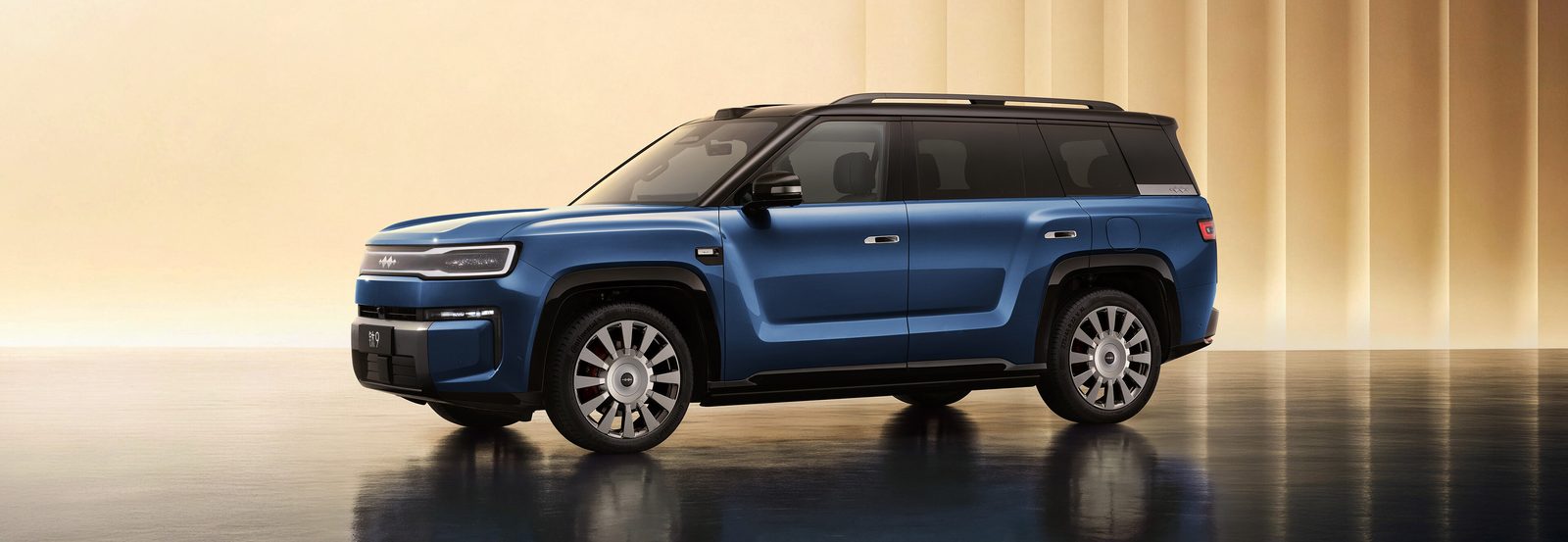
The Fangchengbao Ti 9 is a 5,270 mm six-seat plug-in hybrid SUV that went on sale in China on 19 November 2026, with a 1.5T engine, dual electric motors totalling 400 kW, a 66.48 kWh Blade battery and air suspension as standard. It sits at the top of BYD’s Fangchengbao range, above the Ti 3 and Ti 7. No export version, GCC specification or right-hand-drive version has been announced, so for now the Ti 9 is a China-market car that importers can only source through normal parallel-import channels.
👉 Sourcing a Ti 9 or another BYD group model? Ask us on WhatsApp · Chinese names vs export names →
What is the Fangchengbao Ti 9?
The Ti 9 is the flagship of Fangchengbao, the BYD sub-brand that started with the body-on-frame Leopard (Bao) 5 and Bao 8 and later added the cheaper, car-based Ti line. The Ti 9 is the first “9-series” model in that line, and it is a monocoque SUV rather than a ladder-frame off-roader. BYD built the first production car as its 19-millionth new-energy vehicle on 9 November 2026, ten days before the official launch, and opened pre-orders on the same day.
Three trim levels were released: a four-wheel-drive Max, a four-wheel-drive Ultra, and a top “Foldable Smart Cabin” edition. All three use the same powertrain and battery. The differences are in cabin equipment, with the foldable steering wheel reserved for the top version. Fangchengbao quotes Chinese domestic guide prices for the three, but those are not export prices and we do not publish them here; what a Gulf buyer pays depends on trim, shipping and destination charges.
The Ti 9 also has a naming problem that matters for search and for paperwork. Overseas, the brand appears as Fangchengbao, Fang Cheng Bao or FCB, and the model as Ti 9, Ti9 or Tai 9 depending on the outlet. BYD’s Chinese and export naming system explains why the same car can carry two or three names before it ever leaves China. For the Leopard line specifically, Leopard 3 and Leopard 7 export names show how Fangchengbao badges have travelled so far.
How large is the Ti 9, and how many seats does it have?
The Ti 9 measures 5,270 mm long, 1,999 mm wide and 1,850 mm high, or 1,880 mm with the roof rails, on a 3,130 mm wheelbase. It is a six-seater with a 2+2+2 layout: two individual chairs in the second row and a three-place bench in the third. Chinese launch reports put the boot at 655 litres behind the third row and 1,245 litres with that row folded.
For Gulf family use, the 2+2+2 arrangement is the practical part. Second-row passengers get their own armrests and a walk-through gap to the third row, which is what large families actually use. The third row is not a jump seat: launch cars had heating, ventilation, massage and reclining backrests there, and separate air vents.
Kerb weight is quoted between 2,865 kg and 2,965 kg depending on trim and wheels, which puts the Ti 9 in the same weight class as a full-size body-on-frame SUV. That matters for shipping, tyre choice and recovery equipment, not just for fuel.
One caution on seats: pre-launch Chinese reports mentioned five- and seven-seat versions being prepared. At launch, only the six-seat layout was confirmed. If a seller offers you a seven-seat Ti 9 today, ask for the Chinese registration document and the trim code before paying a deposit.
What powers the Fangchengbao Ti 9?
The Ti 9 is the first car on BYD’s DMS Super Hybrid platform, which the company describes as a merge of its DM-i, DM-p and DMO systems. The hardware is a 1.5-litre turbocharged petrol engine rated at 115 kW, driving the front axle through the hybrid system, plus electric motors on both axles with a combined 400 kW. Fangchengbao quotes 0–100 km/h in 4.8 seconds. The car is all-wheel drive in every trim.
The battery is a 66.48 kWh second-generation Blade pack, lithium iron phosphate. It supports BYD’s flash charging, and launch reports quote a 10% to 70% or 10% to 97% window in single-digit minutes depending on the outlet. Those numbers are manufacturer claims on a suitable charger, and the published figures disagree, so ask for the Chinese spec sheet rather than repeating a time from a news article.
For a Gulf buyer, the appeal of this layout is range without a charging network. A 66 kWh battery covers daily driving; the petrol engine covers the desert road. What it does not do is remove the need to think about charging: a plug-in hybrid with a 66 kWh pack is still a lithium-battery vehicle for shipping purposes, and it still needs a charger that matches China’s GB/T inlet.
How far can the Ti 9 go on electric power alone?
The electric range figure depends on which test cycle you read. Chinese launch coverage quotes 310 km on the WLTC cycle; English-language launch coverage quotes 400 km on the CLTC cycle. Both can be right, because CLTC is the more generous Chinese cycle and WLTC is the more conservative international one. We list both rather than pick one.
Combined range is quoted above 1,600 km with a full tank and a full battery. Some earlier, pre-launch reports claimed more than 2,300 km; that number did not survive the launch and should not be used in a sales sheet. Fuel consumption with the battery depleted was quoted at 6.4 L/100 km by one launch report; treat it as a manufacturer claim until you see the Chinese energy-consumption label.
The honest summary for an importer is this: the Ti 9’s electric range is large for a plug-in hybrid, its combined range is long, and both figures are cycle-dependent. Do not build a brochure around a single range number.
What chassis technology does the Ti 9 use?
The Ti 9 is a monocoque SUV with double-wishbone front suspension and a five-link rear, and DiSus-A dual-chamber air suspension with continuously variable dampers is standard across the range. Rear-wheel steering is also standard, with up to 7 degrees of counter-steer and a claimed turning radius of 4.95 m. The car has BYD’s iATS all-terrain mode recognition and a tyre-blowout stabilisation system.
This is a road-biased package with off-road software, not a Land Cruiser-style ladder frame. Air suspension and rear-wheel steering improve comfort and manoeuvring in a city, and the turning radius helps in tight parking. They also add systems that a parallel import has to keep working without a local dealer.
Towing capacity is 2,000 kg with the optional electric retractable hitch. That is modest for a 5.27 m SUV and well below what Gulf buyers expect from a full-size body-on-frame tow vehicle. If the Ti 9 is going to pull a boat or a horse trailer, the towing figure is the first number to check against the job.
What is the Foldable Smart Cabin trim?
The top trim is called Foldable Smart Cabin, and its party trick is a steer-by-wire steering wheel that folds from 0 to 180 degrees into the dashboard in about 10 seconds. Fangchengbao rates the mechanism at 80,000 cycles and says it frees around 250 mm of space; the driver’s seat can then recline to 165 degrees in about 20 seconds. The wheel cannot be folded while the car is moving.
The same trim adds a 1.1-metre panoramic head-up display. Across the range, launch cars came with a 30-inch panoramic centre display, an augmented-reality head-up display, a 21.4-inch ceiling screen for the second row, a 31-speaker Devialet audio system, an 11.3-litre heated and cooled compartment and 13 airbags.
The foldable wheel is a China-market feature aimed at chauffeur and rest use. It is also a reminder of how much of the Ti 9 is software-defined: steer-by-wire, air suspension, active anti-roll and a lidar-based driver-assistance stack all need updates and diagnostics that a Chinese dealer network provides.
Is the Ti 9 available in GCC spec or for export?
No. As of 21 November 2026, Fangchengbao has not announced an export version, a GCC specification, a right-hand-drive version or an overseas model name for the Ti 9. The car on sale in China is left-hand drive and built to Chinese market requirements. That does not make it impossible to export, but it does mean there is no factory GCC package to order.
This is the same position BYD has taken with several recent flagships. Yangwang’s Altior launch in Abu Dhabi is a useful contrast: when a BYD group car does get a Gulf launch, the brand announces it, prices it and homologates it. Nothing like that exists for the Ti 9 yet.
For an importer, the practical questions are: can the destination country register a Chinese-market car without GCC type approval; who handles the individual approval; and who supports the car afterwards. GCC spec versus China spec covers the differences that usually decide those answers.
What would a Gulf importer have to solve before selling a Ti 9?
Five things, in order of how often they sink a parallel import.
Registration and homologation. A Chinese-market Ti 9 has Chinese certification, not a GCC certificate. Each Gulf state runs its own approval route for non-GCC cars, and some are easier than others. Confirm the route in the destination country before ordering, not after the car lands.
Software and connected services. The infotainment, navigation, voice assistant and over-the-air updates are built for China. Arabic and English menus, Gulf maps and local emergency-call routing are not confirmed for this model. A car that depends on a Chinese server for navigation and updates is a different product abroad.
Driver assistance. The Ti 9 uses God’s Eye B 5.0 with a roof-mounted lidar and 27 sensors, and the launch material promises urban and highway navigation assistance. Those functions are mapped and validated for Chinese roads. Expect them to be limited or inactive elsewhere until a local version exists.
Charging. The car has a GB/T charging inlet. Gulf AC and DC sites use different connectors, so the buyer needs a tested adapter or a dedicated AC solution, plus a clear explanation of what will and will not work. Shipping a lithium-battery vehicle also applies here: a 66.48 kWh plug-in hybrid is dangerous goods, and the freight quote has to reflect that.
Parts and service. Air suspension, rear-wheel steering and steer-by-wire are not parts-bin items. For a brand-new model with no regional dealer, the importer is the parts channel. Budget for a stock of consumables and at least one diagnostic tool that can talk to the car.
How does the Ti 9 fit the Gulf market?
The Ti 9 competes in the large family SUV space, where Gulf buyers already have strong options: full-size body-on-frame SUVs with V6 or V8 engines, long warranty coverage and a dealer on every highway. The Ti 9’s case is different. It offers six captain-style seats, 400 kW of combined output, air suspension and a plug-in hybrid drivetrain that can run on electricity for most daily trips.
That package suits a buyer who does mostly city and highway driving, wants space for six and can charge at home or at the office. It does not suit a buyer who needs a ladder frame, a 3.5-tonne towing rating or a warranty that any workshop in the region can honour. The Ti 9 is a technology flagship, not a Land Cruiser replacement.
Two comparisons help position it. Zeekr 9X versus Lynk & Co 900 shows how Chinese large SUVs are being priced and specified for export. Geely Galaxy Battleship 700 is another big plug-in hybrid aimed at the same family buyer. Neither has a GCC version yet either, which tells you where this class stands.
What should a buyer check on a Ti 9 sourced from China?
Start with the documents: export invoice, Chinese vehicle certificate, VIN, trim code and battery health report. The China car export document checklist lists what a complete set looks like. Pay through a route you can reverse; letter of credit versus T/T explains the trade-offs.
Then inspect the actual car. A new model with a foldable steering wheel and air suspension has more to verify than a Corolla: fold and unfold the wheel, cycle the suspension through its height settings, check every screen and every seat function, and confirm the charging inlet type. Remote inspection before paying covers how to have that done without flying to China.
Finally, decide how the car travels. RoRo versus container matters for a 2.9-tonne SUV with a large battery, and shipping options for a single car covers the small-volume case. A car this size is close to the practical limit for some container configurations.
FAQ
Does the Fangchengbao Ti 9 have seven seats?
No. The launched Ti 9 is a six-seater with a 2+2+2 layout. Pre-launch reports mentioned five- and seven-seat variants being prepared, but only the six-seat version was confirmed at the 19 November 2026 launch.
Is the Ti 9 coming to the UAE or Saudi Arabia?
Fangchengbao has not announced a Gulf launch, a GCC specification or a local distributor for the Ti 9. Any Ti 9 in the Gulf today would be a parallel import. Importing SUVs into Lebanon shows the kind of country-by-country checks that apply across the region.
Is there a right-hand-drive Ti 9?
No right-hand-drive version has been announced. The Chinese-market car is left-hand drive only, which rules it out for right-hand-drive markets such as Kenya, Tanzania or South Africa without a factory programme.
How much does the Ti 9 cost to export?
We do not quote Chinese domestic guide prices as export prices. The delivered cost depends on trim, destination, shipping method and duties, and it changes with the exchange rate. Ask for a quote against a specific trim and port.
Can the Ti 9 tow?
Yes, up to 2,000 kg with the optional electric retractable hitch. That is low for a 5.27 m SUV and should be checked against the trailer or boat it needs to pull.
Does the Ti 9 have a ladder frame?
No. The Ti 9 is a monocoque SUV with independent suspension, air springs and rear-wheel steering. It is designed for road comfort and light off-road use, not heavy-duty chassis work.
What battery does the Ti 9 use?
A 66.48 kWh second-generation Blade lithium iron phosphate pack, with 310 km of WLTC electric range or 400 km on the CLTC cycle, depending on which figure the source quotes. Combined range is quoted above 1,600 km.
Can I charge a Ti 9 outside China?
The car uses China’s GB/T charging standard, so Gulf charging sites need an adapter or a dedicated solution. Confirm what is included with the car before shipping, and test it on arrival.
What to do next
If you are considering a Ti 9 for the Gulf, the useful first step is not a price request but a specification check: which trim, which charging hardware, which software language, and which country’s registration route. Send us the destination and the use case, and we will tell you what is sourceable now and what has to wait for a factory export programme. How we break down a Chinese model by trim is the same process we would apply here.
Sources: Fangchengbao official Ti 9 product page (fangchengbao.com/tai9), read November 2026; IT之家 launch report, 19 November 2026; 12365auto launch report, 19 November 2026; Gasgoo Autonews English launch report, 19 November 2026; Bitauto Malaysia English launch report, November 2026; WhichCar Australia Ti 9 report, November 2026. Specifications checked against at least two independent reports. Notes: electric range appears as 310 km WLTC (IT之家, Bitauto) and 400 km CLTC (Gasgoo, WhichCar); both cycles are labelled in the text. Combined range above 1,600 km is from Gasgoo and IT之家; earlier 2,300 km claims are pre-launch and excluded. Fuel consumption of 6.4 L/100 km is stated by Gasgoo only and is described as a manufacturer claim; the 1.1 m head-up display is also from Gasgoo only. The kerb weight range is from WhichCar only. Boot volumes (655 L / 1,245 L) match the figures used on Fangchengbao’s official Ti 9 product page and launch coverage. Fallback charging times differ between outlets and no single figure is used. No export, GCC or right-hand-drive announcement was found as of 21 November 2026. Photo: Fangchengbao / Fangchengbao press image, Official press image.