
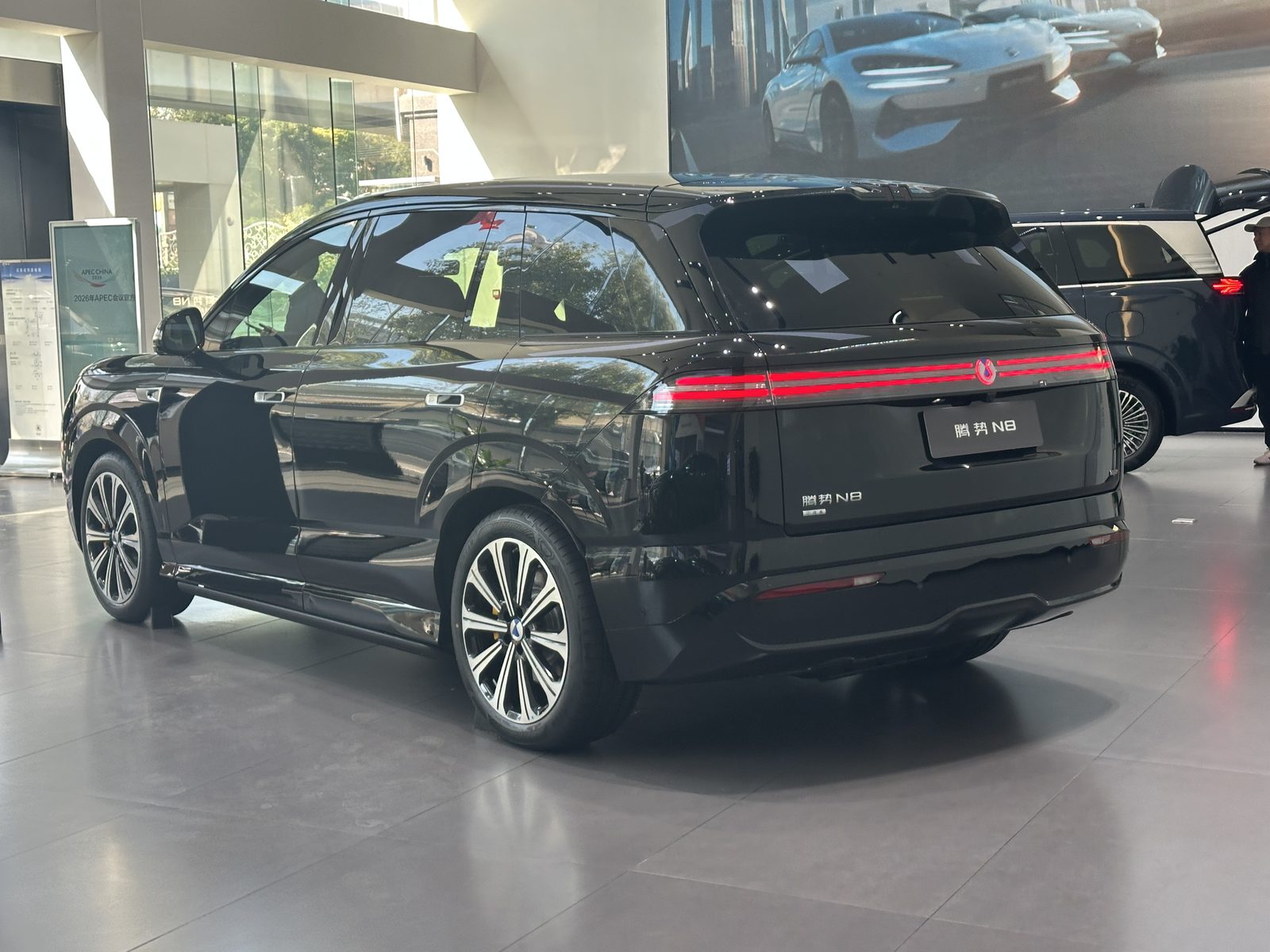
The Denza N8 is a five-seat large SUV that went on sale in China on 12 November 2026, with four pure-electric trims and two plug-in hybrid trims. It measures 5,150 mm long on a 3,075 mm wheelbase, uses BYD’s second-generation Blade battery, and quotes up to 1,003 km of CLTC range in its longest electric version. It is not the same car as the six-seat Denza N8L, and as of launch Denza had announced no GCC version, export programme or right-hand-drive N8.
👉 Sourcing a Denza N8 or another BYD group SUV? Ask us on WhatsApp · BYD’s Chinese and export naming system →
What is the Denza N8?
The N8 is the newest model in Denza, the premium brand that began as a BYD-Mercedes joint venture. It sits below the N9 and alongside the N8L in size, but it is aimed at buyers who want two rows of very large seats rather than three rows of smaller ones. Denza calls it a “wide five-seat SUV”, and the whole cabin is built around that layout: the second row slides, reclines and has its own heating, ventilation and massage features.
The car launched in China on 12 November 2026. Pre-orders had opened on 26 October. Denza quotes Chinese domestic guide prices for six trims, but those are not export prices and this article does not repeat them; what a Gulf buyer pays depends on trim, shipping and destination charges.
There is a naming problem that matters for search and for paperwork. Overseas, the brand appears as Denza, DENZA or sometimes Tengshi, and the model as N8, N8 II or New N8 depending on the outlet. BYD’s Chinese and export naming system explains why the same car can carry two or three names before it leaves China. For the off-road side of the group, Leopard 3 and Leopard 7 export names show how Fangchengbao badges have travelled so far.
Denza N8 vs N8L: what is the difference?
The N8L is 5,200 mm long and has six seats in a 2+2+2 layout. The N8 is 5,150 mm long, 50 mm shorter, with the same 1,999 mm width, 1,820 mm height and 3,075 mm wheelbase. The difference is not 50 mm of space; it is the third row. The N8 deletes it and gives the space to a five-seat cabin and a 1,046-litre boot.
That makes the two cars easy to tell apart in a showroom and hard to tell apart on a spec sheet. If a seller sends you a photo of a car with three rows, it is an N8L, not an N8. If the registration document says six or seven seats, it is either an N8L or the older N8 from 2023.
The N8L is also a different kind of hybrid. It launched in October 2025 with a 2.0-litre turbo engine and a triple-motor plug-in hybrid system, and Denza added an all-electric N8L in September 2026. The new N8 uses a smaller 1.5-litre engine in its PHEV form. The Fangchengbao Ti 9 is the group’s other six-seat plug-in hybrid flagship, and the comparison is useful if a buyer is choosing between five and six seats.
Is this the same Denza N8 that was sold before?
No. The N8 badge was last used on a 2023 model that was a six- and seven-seat plug-in hybrid. That car has been discontinued. The 2026 N8 is a new five-seat SUV with a different engine range and a different battery.
This matters for importers because used-car listings, parts catalogues and even some dealer websites still mix the two. Ask for the model year, the seat count and the battery capacity in writing. A 2023 N8 with 1.5T and three rows is not a cheaper version of the new car; it is a different vehicle with a different parts supply.
How big is the Denza N8, and how many seats does it have?
The N8 measures 5,150 mm long, 1,999 mm wide and 1,820 mm high, on a 3,075 mm wheelbase. It has five seats in two rows and no third row. The boot holds 1,046 litres behind the second row and 2,150 litres with the rear seats folded. There is also a 205-litre front trunk on the electric versions.
For Gulf family use, the important number is the second row. Denza fits two zero-gravity front seats and a rear bench that slides fore and aft, reclines to 146 degrees and carries heating, ventilation and massage on higher trims. That is closer to an MPV’s second row than to a conventional SUV bench, which is the main reason Denza built the car as a five-seater instead of squeezing in a third row.
The 1,046-litre boot is large enough for airport runs and desert trips without folding the rear seats. If a buyer regularly carries six or seven people, the N8L is the correct car, not the N8.
What batteries and range does the Denza N8 offer?
All versions use BYD’s second-generation Blade battery, which is lithium iron phosphate. There are two pack sizes, 105.8 kWh and 130.2 kWh, and four CLTC range figures are quoted: 800 km, 840 km, 970 km and 1,003 km.
| Battery pack | CLTC range figures quoted | Notes |
|---|---|---|
| 105.8 kWh | 800 km, and 840 km in some reports | Rear-wheel drive or tri-motor, depending on trim |
| 130.2 kWh | 970 km and 1,003 km | 1,003 km is the headline long-range version |
Chinese launch reports do not agree on which trim gets which range figure. Some map 800 km to the smaller pack and 1,003 km to the largest; others place 840 km on a tri-motor car and 970 km on a rear-drive trim. Treat the range printed on the Chinese specification sheet for the exact trim code as the authoritative figure, not a number from a news article.
Two cautions on the 1,003 km claim. First, it is a CLTC figure, the Chinese test cycle, which is more generous than WLTP and much more generous than real desert driving. Second, the number applies to one trim, not the whole range. A buyer who orders “the N8” without a trim code can receive a car with roughly 200 km less quoted range.
How fast is the Denza N8?
The electric N8 comes in two drive layouts. The rear-wheel-drive trims use a single rear motor rated at either 320 kW or 370 kW. The tri-motor trims use BYD’s e3 technology: one 270 kW front motor and two 310 kW rear motors, for a combined 890 kW. Denza quotes about 2.9 seconds to 100 km/h for the tri-motor car.
That is a very high output for a five-seat family SUV, and it changes what the car needs in service. Tyres, brakes and wheels are sized for the performance version, and replacement parts are more expensive than on the rear-drive trims. For a fleet buyer, the 320 kW rear-drive version is the simpler and cheaper car to maintain.
The tri-motor cars also get rear-wheel steering, which Denza quotes at a 4.5-metre turning radius. That is useful in Gulf city traffic and parking, but it adds another system that a parallel-import buyer has to be able to service.
What is the plug-in hybrid version?
The N8 PHEV uses a 1.5-litre turbocharged petrol engine rated at 115 kW and 225 Nm, combined with the same e3 triple-motor layout. Chinese launch reports quote a combined motor output of 520 kW and 816 Nm, a 75.26 kWh Blade battery, 435 km of CLTC electric range, 1,567 km of combined CLTC range and 0–100 km/h in 4.3 seconds. The fuel tank is 64 litres.
The electric-only range of 435 km is unusually large for a plug-in hybrid. It means most Gulf daily driving can be done on battery, with the petrol engine reserved for long desert or inter-city runs. The trade-off is weight and cost: a 75 kWh battery is a large pack for a PHEV, and it makes the car heavier than a conventional hybrid.
Plug-in hybrids are still lithium-battery vehicles for shipping. They move under the same dangerous-goods rules as battery-electric cars, which this guide to UN3556 lithium-battery shipping explains.
How fast does the Denza N8 charge?
Denza quotes 10–70% in about five minutes and 10–97% in about nine minutes when the car is connected to its flash-charging network. Those are manufacturer claims under ideal conditions, with a charger and battery at the right temperature. They are not a promise of what a buyer will see on a third-party charger in the Gulf.
The more important question for an importer is the inlet. China-market cars use the GB/T charging standard. Much of the Gulf public network is built around Type 2 for AC and CCS2 for DC. A China-spec N8 will need the right cable and, depending on the car, a compatible onboard charger before it can use local public charging. Ask the seller to photograph the charging port and confirm what comes in the box.
What equipment does the Denza N8 have?
Denza lists a 30-inch panoramic display, a 1.1-metre head-up display, a rear entertainment screen, a refrigerated centre drawer, God’s Eye 5.0 driver assistance and DiSus-A air suspension. Chinese reports disagree on whether the air suspension is standard on all six trims or only the higher ones, so check the trim sheet rather than a launch article.
God’s Eye 5.0 is Denza’s latest assisted-driving system, and some trims list a LiDAR-based version. For a Gulf buyer, the practical question is not which version is fitted but whether the system works outside China. Chinese-market cars are calibrated for Chinese road markings, signs and maps. Ask whether the ADAS can be switched to a Gulf market dataset, and whether the infotainment supports English and local navigation.
Has Denza announced an export or GCC version of the N8?
No. At the November 2026 launch, Denza announced the N8 for the Chinese market only. There was no GCC specification, no export programme and no right-hand-drive version. Denza already sells the B5, B8 and D9 in Australia, a right-hand-drive market, but the N8 has not been confirmed for Australia either.
That does not mean the car cannot reach the Gulf. It means it reaches the Gulf as a parallel import, with the same issues that apply to any China-only model. GCC specification versus China specification covers the differences that matter most: cooling, tyres, language, charging and type approval.
In the UAE, the Denza D9 has been offered mainly through parallel importers rather than as part of an official Denza franchise. We found no official Denza Gulf dealer announcement for the N8. A buyer should confirm who is supplying the car, who handles warranty and who can service it before paying a deposit.
Can a Gulf importer buy a China-spec Denza N8?
Yes, in the sense that a left-hand-drive China-market car can be sourced and shipped. Gulf markets are left-hand drive, so the basic layout matches. The obstacles are type approval, charging, software and warranty, not the steering wheel.
Each Gulf market has its own type-approval process and standards body, such as SASO in Saudi Arabia and ESMA/MOIAT in the UAE. A China-spec car is not automatically approved. The importer has to check whether the exact trim has the required labels, lighting, tyres and emissions documentation, and whether the local authority accepts a parallel-import inspection.
Software is the second obstacle. Chinese-market infotainment, navigation and voice control are built around Chinese services. Ask whether the head unit can be switched to English, whether Gulf maps are available, and whether over-the-air updates will still work outside China. A car that cannot be updated is a car that will age quickly.
Warranty is the third. A parallel-imported Denza may not carry a transferable factory warranty in the Gulf. Get the warranty terms, the service schedule and the battery warranty in writing before payment. A remote inspection before paying is the cheapest way to confirm the car exists, matches the trim and has no transport damage.
What should an importer check before ordering?
Start with the Chinese specification sheet. It should show the trim code, the battery capacity in kWh, the motor layout, the seat count and the charging standard. Compare those numbers with the launch data above, not with a dealer’s summary.
Then check the documents. A normal export file includes the sales contract, commercial invoice, packing list, bill of lading, certificate of origin and the export documents required by the destination market. The China car export document checklist lists what each one is for. FOB, CFR and CIF explains which costs sit with the seller and which sit with the buyer, and letter of credit versus T/T covers payment risk.
Then choose the shipping method. A large SUV can move by container or by RoRo. RoRo versus container shipping explains the cost and damage-risk trade-off, and the shipping options guide covers consolidation and port choice. For a high-value car, cargo insurance is not optional.
Finally, budget for time at the port. Demurrage and storage charges can eat the margin on a single car if the documents are late. If the buyer wants to see the car first, a visit to Guangzhou or the Nansha terminal is the most direct way to do it.
How does the N8 compare with other Chinese large SUVs?
The closest internal comparison is the N8L: same width, height and wheelbase, 50 mm longer, six seats instead of five. Buyers who need three rows should take the N8L. Buyers who want the largest possible second row and boot should take the N8.
Against the Fangchengbao Ti 9, the N8 is shorter and has one fewer seat, but it offers a pure-electric version with a 1,003 km CLTC headline. The Ti 9 is a six-seat plug-in hybrid only. The choice is seats versus electric range.
Against the Geely Galaxy Battleship 700, the N8 is a road-biased five-seat SUV rather than a boxy off-road-style vehicle. Against the Zeekr 9X and Lynk & Co 900, it is a smaller and less expensive class of car. None of these are direct substitutes; they compete for the same importer’s floor space and the same buyer’s budget.
For buyers comparing BYD group powertrains rather than body styles, Sealion 06 EV versus DM-i and Song Plus EV versus DM-i show how the same model splits between electric and plug-in hybrid in practice.
FAQ
Is the Denza N8 a five-seater?
Yes. The 2026 Denza N8 has five seats in two rows and no third row. The six-seat model in the same size class is the Denza N8L.
What is the difference between the Denza N8 and the Denza N8L?
The N8L is 5,200 mm long with six seats in a 2+2+2 layout. The N8 is 5,150 mm long with five seats. They share the same width, height and 3,075 mm wheelbase, so the difference is the third row and the boot, not the footprint.
Is the Denza N8 available in the Gulf?
Denza has not announced a GCC version, an export programme or a right-hand-drive N8. Cars that reach Gulf markets are parallel imports, and the importer is responsible for type approval, warranty and service.
Is the Denza N8 left-hand drive or right-hand drive?
The China-market car is left-hand drive. No right-hand-drive version has been announced. Gulf markets are left-hand drive, so the China-spec layout is usable, but right-hand-drive markets such as Australia have not been confirmed.
What is the real range of the Denza N8?
Denza quotes up to 1,003 km on the CLTC cycle for the longest-range electric trim. CLTC is more generous than WLTP and real-world range will be lower, especially at highway speed, in heat and with air conditioning. The 1,003 km figure applies to one trim, not the whole range.
Can the Denza N8 charge on Gulf public chargers?
The China-market car uses the GB/T charging standard. Gulf public networks are built mainly around Type 2 and CCS2, so the car needs the right cable and a compatible onboard charger. Confirm the charging setup with the seller before shipping.
Is the Denza N8 an EV or a plug-in hybrid?
Both. Denza sells four battery-electric trims and two plug-in hybrid trims. The electric versions quote 800–1,003 km of CLTC range; the PHEV quotes 435 km of electric range and 1,567 km combined.
How many seats does the Denza N8L have?
The N8L has six seats in a 2+2+2 layout, with power adjustment in all three rows. It should not be confused with the five-seat N8.
Sources: Denza N8 launch coverage, November 2026: CnEVPost (12 November 2026), CarSauce (12 November 2026), CNMO (822360), BitAuto HK, and Chinese launch reports from d1ev, IT之家 and Autohome. Dimensions, battery sizes, motor outputs and the 1,003 km CLTC figure are consistent across CnEVPost, CarSauce, CNMO and BitAuto. Charging times (10–70% about 5 minutes, 10–97% about 9 minutes) are manufacturer claims reported by CarSauce and BitAuto. PHEV figures (1.5T 115 kW, 520 kW motors, 75.26 kWh, 435 km EV, 1,567 km combined, 4.3 s, 64 L tank) come from Chinese launch reports and are single-source in places; confirm on the Chinese spec sheet. The 2,150 L folded boot, 205 L front trunk and 146-degree rear recline are from BitAuto only. The note that the D9 in the UAE is mainly a parallel import comes from EVPlus.ae citing YallaMotor, not from an official Denza source. Trim-to-range mapping is not consistent across outlets and is presented as a range of quoted figures, not a fixed table. No export, GCC or right-hand-drive announcement was found as of 22 November 2026. Photo: JustAnotherCarDesigner / Wikimedia Commons, CC0.