
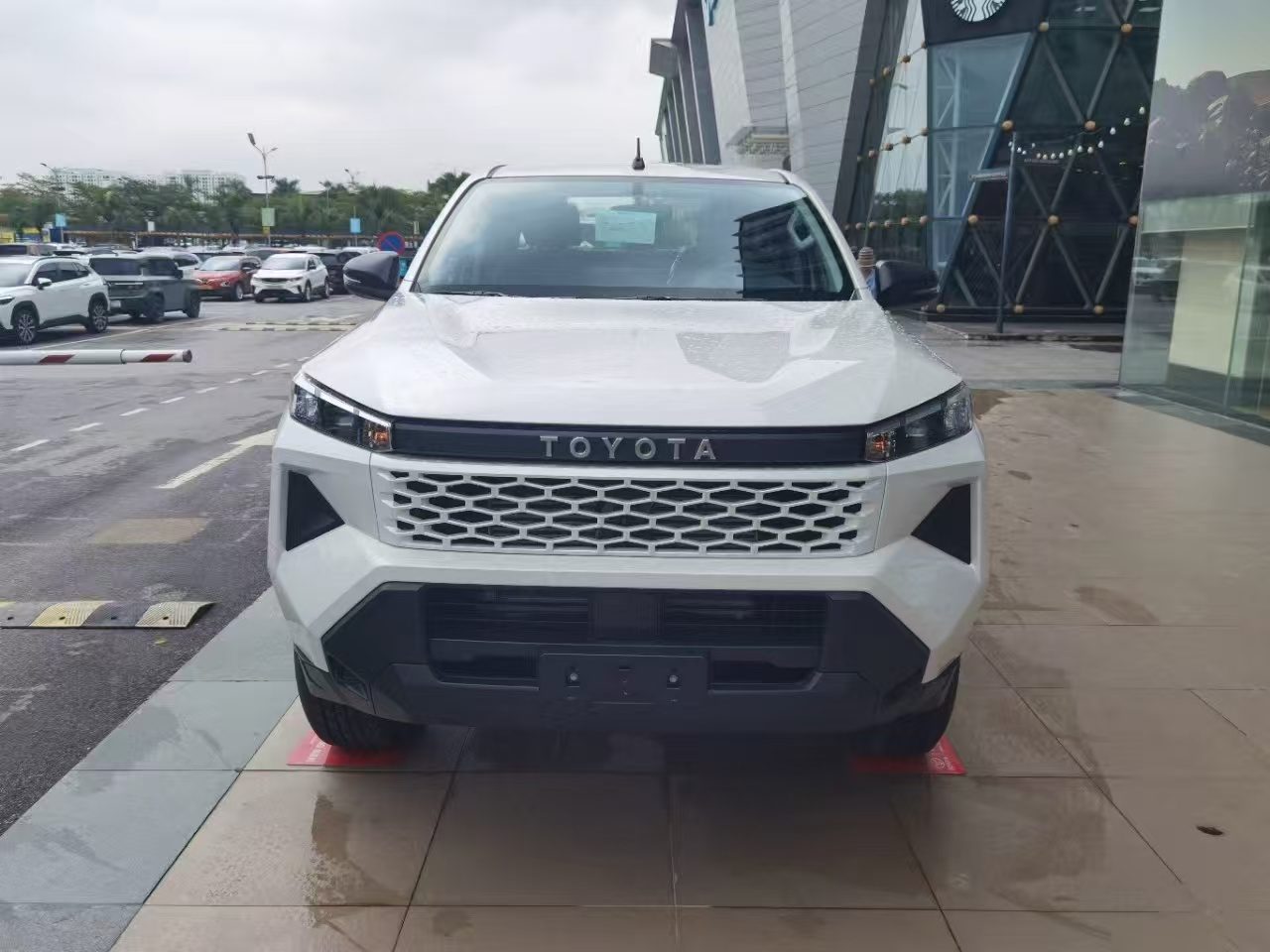
The 2026 Toyota Hilux and the Mitsubishi L200 — sold as the Triton in South Africa, Australia and Thailand — are both one-ton, body-on-frame, Thai-built diesel double cabs. They are not equivalent buys. The Hilux 2.8 diesel makes 150 kW and 500 Nm with the automatic and uses a simple part-time transfer case. The L200’s 2.4 diesel comes in at least three power tunes, and its Super Select 4WD-II has a centre differential that lets 4H stay engaged on dry asphalt.
→ See all 7 grades of the 2026 Hilux with full specs and starting prices
That difference decides more than the badge. A truck that lives on tarmac and gravel benefits from the L200’s full-time-capable 4H. A truck that works in a mine or beyond the reach of a dealer benefits from the Hilux’s larger engine, simpler driveline and deeper parts network.
👉 Comparing a Hilux and an L200 quote? Send both spec sheets on WhatsApp · Hilux E, G, V and Conquest: which diesel grade fits →
Are the 2026 Toyota Hilux and Mitsubishi L200 the same class of pick-up?
Yes. Both are one-ton body-on-frame double cabs with five seats, a leaf-spring live rear axle and Thai production, and both are built in left-hand drive for Gulf and African markets. They share no mechanical parts.
The naming is the first trap. Mitsubishi sells this truck as the L200 in the Gulf and much of the Middle East, and as the Triton in South Africa, Australia, Thailand and the Philippines. A quotation that says “L200” without a market is incomplete, because the previous L200 generation is still listed alongside the current truck in some Gulf markets.
The generation is the second trap. The ninth-generation Hilux had its world premiere in Bangkok on 10 November 2025, with the Asian rollout starting in 2026; what changed from the previous Hilux covers the differences. The current Triton went on sale from 2023 and reached most markets in 2024. A 2026 model-year label does not prove which generation is under it, so check the wheelbase, body code and engine output before the deposit.
How much power does the L200 2.4 diesel make against the Hilux 2.8?
The Hilux 2.8 makes 150 kW and 500 Nm with the automatic, while the L200 2.4 ranges from an 81 kW commercial tune to a 150 kW bi-turbo. The top L200 tune matches the Hilux on power but remains 30 Nm behind on torque.
The Hilux uses the 2,755 cc 1GD-FTV four-cylinder diesel. Toyota Vietnam’s official sheet lists 150 kW at 3,400 rpm, 420 Nm from 1,400 to 3,400 rpm with the six-speed manual, and 500 Nm from 1,600 to 2,800 rpm with the six-speed automatic.
The L200 uses the 2,442 cc 4N16 four-cylinder diesel, and Mitsubishi does not sell it with one fixed output:
| L200 2.4 diesel version | Power | Torque | Where it is listed |
|---|---|---|---|
| Commercial tune | 81 kW (110 hp) | 200 Nm | South African single-cab GL |
| Low-output tune | 110 kW (150 hp) | 330 Nm | GL+ manual trims on several Mitsubishi regional sites |
| Single-turbo | 135 kW (184 hp) | 430 Nm | Mainstream South African double-cab and 4×4 trims |
| Bi-turbo | 150 kW (204 hp) | 470 Nm at 1,500–2,750 rpm | Mitsubishi Australia Triton range |
Against the low-output L200, the Hilux automatic has 40 kW and 170 Nm more. Against the bi-turbo, power is level and the Hilux keeps 30 Nm, with 313 cc more displacement to carry it at low engine speed. That helps in sand, on long grades and near gross weight, because the engine works less to hold speed.
Displacement also affects tax in some countries, where duty is banded by engine size, so check the destination tariff before assuming a 2.4 is cheaper to run. Gulf, Philippine and Vietnamese Hilux specifications shows how the same 2.8 diesel is rated and equipped in three left-hand-drive markets.
Which four-wheel-drive system is better on Gulf and African roads?
The L200’s Super Select 4WD-II is easier on mixed roads; the Hilux’s part-time system is simpler and better for known off-road duty. The choice follows the route, not the brochure.
The Hilux 4×4 uses a part-time transfer case with 2H, 4H and 4L, selected electronically. In 4H the front and rear axles are locked together with no centre differential, so 4H is for gravel, sand, mud and snow, not dry tarmac in a tight turn. Leaving it engaged on a high-grip surface loads the driveline and makes the steering fight the driver. Toyota Vietnam lists a rear differential lock and Multi-Terrain Select — snow, mud, sand, dirt and auto — on the Trailhunter; Philippine media report the same on the 4×4 Conquest.
The L200 uses Super Select 4WD-II with 2H, 4H, 4HLc and 4LLc. In 4H the centre differential is open, so the axles can turn at different speeds and the system can be used on dry sealed roads as well as rain, gravel and broken surfaces; Mitsubishi’s market sites describe 4H as the mode for ordinary roads and highways. 4HLc locks the centre differential for loose ground, and 4LLc adds low range for serious off-road work; neither belongs on dry asphalt. High trims add a rear differential lock.
For a fleet running between a paved depot and unpaved customer sites, the L200’s 4H removes a decision from the driver. For a mining or construction fleet on a known access road, the Hilux’s part-time system has fewer parts to go wrong and every driver knows how to use it.
How do the Hilux and L200 compare on size, payload and towing?
The L200 rides on a 45 mm longer wheelbase and publishes a payload figure; the Hilux publishes kerb and gross weights instead. Compare the exact variant, not the headline.
| Specification | 2026 Hilux (Vietnam official sheet) | L200 / Triton (current generation) |
|---|---|---|
| Length | 5,320 mm | 5,320 mm |
| Width | 1,855 mm (1,885 mm Pro/Trailhunter) | 1,865 mm |
| Height | 1,815 mm | 1,795 mm |
| Wheelbase | 3,085 mm | 3,130 mm |
| Ground clearance | 312 mm | 222 mm |
| Kerb weight | 1,968–2,095 kg | Varies by cab and drivetrain; confirm the plate |
| Gross vehicle weight | 2,850–2,950 kg | Varies by cab and drivetrain; confirm the plate |
| Payload | Not published as a single figure by Toyota Vietnam | Up to 1,111 kg maximum, model range |
| Braked towing | Confirm by market and grade | 3,500 kg |
The L200’s extra 45 mm of wheelbase goes into the cabin and tray, and its 20 mm lower roof helps with car parks and height barriers. The Hilux’s higher clearance figure comes from a different measuring convention as well as the suspension, so do not read the 90 mm gap as a direct obstacle-clearing advantage.
On payload, Mitsubishi Australia quotes a maximum of 1,111 kg across the Triton range. That is a range headline: dual-cab 4×4 versions carry less, and the figure moves with cab style, drivetrain and suspension. Toyota Vietnam lists kerb and gross weights for each Hilux grade but no payload number, so usable load must be calculated from gross weight and confirmed on the grade’s specification sheet.
Towing follows the same rule. Mitsubishi quotes 3,500 kg braked for the Triton in Australia. Toyota’s Hilux rating varies by market, engine, gearbox and cooling package, so confirm the Gulf or African figure on the local homologation document rather than an Australian brochure.
Is the safety equipment on a Hilux and an L200 comparable?
No, not across the range. Both manufacturers put the full active-safety package on upper trims and strip it from commercial grades, so a base Hilux and a base L200 are both light on driver assistance.
On the Hilux, Toyota Philippines lists Toyota Safety Sense 3.0 — pre-collision, lane departure alert, lane tracing, radar cruise and automatic high beam — only on V and Conquest. The E and G grades do not get it. Side and curtain airbags follow the same pattern: V and Conquest have them; E and G have driver, driver’s knee and front passenger airbags only. Toyota Vietnam applies a similar split, with TSS from the Pro grade.
The L200 follows the same commercial logic. High trims carry the full ADAS set, and Gulf high-trim dealer sheets list seven airbags, blind-spot monitoring, rear cross-traffic alert and front and rear parking sensors. The low-output GL+ and commercial grades lose part of that package. Exact fitment changes by market, so the destination variant card is the only document that settles it.
An importer should write the safety package into the order, not just the grade letter. “2026 Hilux V 4×4 automatic with TSS” is an order; “2026 Hilux V” is a hope, because the same letter has meant different equipment in different markets and model years. The same applies to the L200: state the ADAS package and airbag count on the proforma invoice.
Which pick-up is easier to keep on the road in Africa and the Gulf?
In most of Africa and the Gulf, the Hilux is easier to keep running, because parts availability follows the number of trucks already in the country. The L200 is supported but has a smaller parc in many of the same markets.
The Hilux has been the default work pick-up in much of Africa and the Middle East for decades, leaving pattern parts, used parts, independent workshops and drivers who know the truck. That also supports resale: a used Hilux is a known quantity, which shortens the time to sell.
The L200 has an official channel in many Gulf and African markets, but the depth varies. In a capital with an active distributor, routine service and common parts are not a problem. In a secondary town or on a cross-border route, the nearest body panel or suspension arm may be further away.
Before choosing, ask three local questions rather than read another table. Does the main parts supplier hold brake pads, filters, suspension parts and lamps? Does the local insurer recognise the model without a surcharge? Does the used-car market take it quickly? For the L200, add a fourth check: confirm generation, power tune, wheelbase and steering side in writing.
Which L200 generation is a Gulf buyer actually being offered?
Some Gulf listings still describe the previous L200 generation as current, so check the wheelbase and body before accepting a quotation. The previous truck is about 5,225 mm long on a 3,000 mm wheelbase; the current one is 5,320 mm on 3,130 mm.
The two also differ in engine tune and equipment. Gulf dealer material describes high trims such as the Athlete and Sportero as the current bi-turbo, while lower and commercial listings can still be the older single-turbo truck. Both may be advertised as a 2026 L200, because registration year is not generation.
There is a second layer: GCC and non-GCC specification. A GCC-spec L200 is built and certified for the Gulf Cooperation Council markets, with the equipment and cooling package that go with it. A non-GCC truck can look identical and carry a different certificate, which affects registration and insurance. Dealer pages often mix the two.
The order sheet should carry four items: generation or body code, engine output in kW, wheelbase, and GCC or non-GCC specification. A fifth — left-hand drive — should be obvious, but write it down when the truck is sourced through a third country.
Can a Gulf or African buyer source either truck from China?
The Hilux can be sourced from Chinese re-export stock in left-hand-drive Gulf specification; the L200 is not part of our supply line and has to be sourced separately.
The Hilux is built in Thailand, but much of the left-hand-drive export stock is held, inspected and loaded in China. The same Thai-built Gulf-spec trucks can be handed over at any Chinese port or land border, and a 40ft high-cube takes two double cabs. How Hilux stock is held in China and loaded explains the paperwork: the certificate of origin stays Thai while the export declaration is Chinese.
The L200 is not in our supply line. A buyer needs to confirm the generation, power tune, left-hand-drive build, origin and destination certification separately. The Gulf carries both GCC and non-GCC trucks, and the two cannot be treated as interchangeable.
For either model, the shipping documents decide whether the container clears. FOB, CFR and CIF explains which costs sit with which party, telex release and sea waybill covers the document that releases the cargo, and demurrage and storage at the port explains the charges that start when paperwork is late. Ethiopia no longer admits fuel-powered vehicles, so neither diesel pickup can be shipped there.
Toyota has also confirmed a battery-electric Hilux with a 59.2 kWh battery, 144 kW combined output and a target range of at least 300 km on the NEDC cycle, but the Asian rollout starts in 2026 and it is not a Gulf stock item today. Buyers in markets with EV incentives can follow the Ethiopian EV import route; buyers who need a diesel work truck now should not wait for it.
Which one should you choose?
The Hilux suits buyers who value engine size, driveline simplicity and parts availability; the L200 suits buyers who spend most distance on mixed surfaces and need a 4WD system that tolerates tarmac.
- Mine, construction or remote site. Hilux 2.8 4×4, manual for simplicity or automatic for driver fatigue. The larger engine, part-time transfer case and wider parts network matter more than the L200’s centre differential.
- Depot-to-customer delivery on paved and gravel roads. L200 4×4 automatic. Super Select 4H can stay engaged across changing surfaces, so the driver does not stop at the edge of the tarmac.
- Heavy payload on a known route. Compare the exact payload plates. The L200 publishes a higher range maximum, but the dual-cab 4×4 figure is lower; the Hilux figure has to be calculated from the chosen grade’s gross weight.
- Safety-first fleet. Top trim on either model: Hilux V or Conquest, L200 with the full ADAS package. Do not buy a commercial grade and expect the brochure car’s safety equipment.
- Resale and repair convenience. Hilux in most African and Gulf markets. The larger parc supports parts, workshops, insurers and used-car demand.
What are the alternatives if neither truck fits?
If both miss the budget or the duty cycle, Chinese-brand pick-ups and SUVs offer different trade-offs. They are not direct substitutes for a Hilux in parts availability, but they can suit a fleet with a local workshop or a buyer who prioritises equipment per dollar.
The Nissan Navara Pro-4X is the closest mainstream Gulf alternative, with a coil-spring rear axle and a more comfortable ride. The 212 T01 is the value-focused hard-core option, and its comparisons with the Tank 300 and Jetour T2 show where it gives up refinement and where it holds its own. Jetour’s model names need decoding before an order, because the same number can mean different bodies in different markets.
For buyers who do not need a ladder frame, the Tiggo 7 Pro and Tiggo 8 Pro cover the seven-seat SUV case, and the CS75 Plus and X5 Plus are the volume choices for Algeria and Côte d’Ivoire.
FAQ
Is the Mitsubishi L200 the same truck as the Triton?
Yes. L200 is the name used in the Gulf and much of the Middle East; Triton is used in South Africa, Australia, Thailand and the Philippines. The mechanical package is the same, but equipment and certification differ by market.
Which truck has more torque, the Hilux 2.8 or the L200 2.4?
The Hilux automatic has 500 Nm. The L200 bi-turbo has 470 Nm, the single-turbo 430 Nm and the low-output tune 330 Nm. The Hilux also has 313 cc more displacement, which helps at low engine speed under load.
Can the L200 be driven in 4H on dry tarmac?
Yes, in 4H with the centre differential open. Mitsubishi’s market literature describes 4H as suitable for ordinary roads, including dry sealed surfaces. 4HLc and 4LLc lock the centre differential and are for loose ground only.
Which truck carries more payload?
Mitsubishi quotes up to 1,111 kg across the Triton range, but dual-cab 4×4 versions carry less. Toyota Vietnam publishes kerb and gross weights for the Hilux rather than a payload figure, so usable load depends on the grade. Compare the plates, not the headline.
Is there an electric Hilux?
Toyota has shown a battery-electric Hilux with a 59.2 kWh battery, 144 kW combined output and a target range of at least 300 km on the NEDC cycle. The Asian rollout begins in 2026; availability in Gulf and African markets must be confirmed before it can be quoted.
Can you supply an L200 from China?
No. Our supply line covers the Hilux, not the L200. An L200 buyer needs a separate source and must confirm generation, power tune, left-hand-drive build and destination certification.
Sources: Toyota Vietnam Hilux product page and official specification PDF (2026 Standard, Pro, Trailhunter; 2,755 cc 1GD-FTV, 150 kW, 420/500 Nm, dimensions, weights, part-time 4WD, Trailhunter rear diff lock and Multi-Terrain Select), checked November 2026. Toyota Philippines Hilux variant pages (E, G, V, Conquest; TSS 3.0 and airbags), checked November 2026. Toyota global newsroom, ninth-generation Hilux world premiere, Bangkok, 10 November 2025, and BEV prototype figures (59.2 kWh, 144 kW, 300 km NEDC target). Mitsubishi Motors Australia Triton range (2.4 bi-turbo 150 kW/470 Nm, 3,500 kg braked towing, maximum payload up to 1,111 kg), checked November 2026. Mitsubishi Motors South Africa Triton range (2.4 single-turbo 135 kW/430 Nm), checked November 2026. Mitsubishi regional sites (Ghana, Liberia and others) for the 110 kW/330 Nm GL+ manual tune. Mitsubishi official Super Select 4WD-II explanations (Japan, Indonesia, Chile) and the Triton owner’s manual for 4H, 4HLc and 4LLc usage, checked November 2026. Gulf L200 dealer sheets for the seven-airbag high trim and the previous-generation wheelbase, checked November 2026; dealer-sourced, not a factory publication. 4×4 Australia and CarExpert for current Triton dimensions and dual-cab payload figures, checked November 2026. Single-source notes: the Trailhunter rear diff lock and Multi-Terrain Select come from the Toyota Vietnam sheet; 4×4 Conquest fitment is reported by Philippine media and should be confirmed on the destination variant card. Our November 2026 supply sheet covers starting prices, colour availability, container loading and delivery policy; the L200 is not in our supply line. No Chinese domestic price is used. Photo: Hanvia Motors / own photo, All rights reserved.