
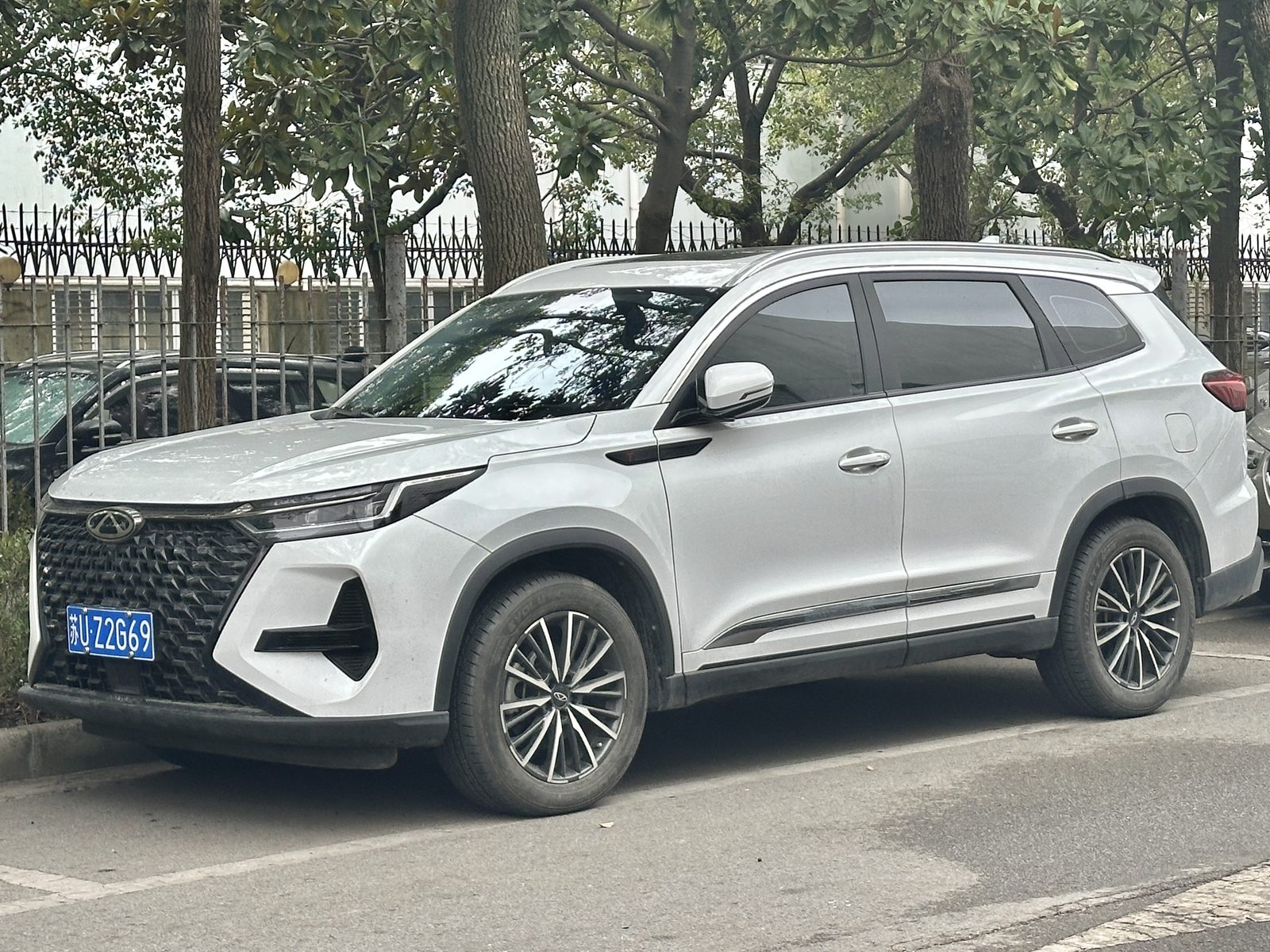
The Chery Tiggo 7 Pro is a five-seat compact SUV, and the Tiggo 8 Pro is a longer seven-seat SUV built on a 2,710 mm wheelbase. Both are front-wheel drive and left-hand drive, and both are sold in Algeria and Côte d’Ivoire. The difference that catches importers is the engine: the Tiggo 7 Pro uses a 1.5T with 108 kW in Algeria, but the same badge in Côte d’Ivoire is a 1.6T with 145 kW. The Tiggo 8 Pro is a 1.6T seven-seater in both markets, with a 2.0T offered in Côte d’Ivoire.
That means a quote that says “2026 Tiggo 7 Pro, automatic, five seats” can describe two cars with different engines, different fuel consumption and different parts. The order sheet has to carry the engine code and the seat count, not just the model name.
Quick answers:
- How many seats? Tiggo 7 Pro: 5. Tiggo 8 Pro: 7 (2+3+2).
- Which engine? Tiggo 7 Pro 1.5T 108 kW/210 Nm in Algeria and Kazakhstan-type specs; 1.6T 145 kW/290 Nm in Côte d’Ivoire. Tiggo 8 Pro 1.6T 145 kW/290 Nm, detuned to 134 kW/290 Nm on the Ivorian Confort trim.
- Gearbox? CVT on the Tiggo 7 Pro in both markets; 7-speed wet DCT on the Tiggo 8 Pro.
- How big? 4,500 mm vs 4,745 mm long; 2,670 mm vs 2,710 mm wheelbase.
- Drive? Front-wheel drive only in the versions reviewed here.
- Left- or right-hand drive? Left-hand drive for Algeria and Côte d’Ivoire. South Africa’s right-hand-drive cars are a different build.
- Fuel? The 1.5T is rated for 92 RON petrol and above; the 1.6T is a direct-injection engine.
What are the Tiggo 7 Pro and Tiggo 8 Pro outside China?
Both names are export badges for cars that China sells under different names. The Tiggo 7 Pro is the export name for the car China sells as the Tiggo 7 Plus. The Tiggo 8 Pro is the export name for the long-body seven-seat car China sells as the Tiggo 8 Plus. Chery’s own Ivorian site goes one step further and lists the seven-seater simply as “Tiggo 8”, in Confort and Premium trims.
There are two traps in that mapping. China also sells a car it calls the Tiggo 8 Pro, which is a different product from the export Tiggo 8 Pro, and a cheaper domestic Tiggo 7 that is not the export Tiggo 7 Pro. On top of that, an export badge can point to a facelift or a pre-facelift body, and two 2026 listings on different dealer sites can show different front ends and different length figures while both are honest about the car they have. When you search for parts or a workshop manual, the Chinese domestic name is often the one with the full catalogue. The naming pattern is the same one that trips up buyers of BYD and Toyota’s China-built models, and it is worth ten minutes before you compare prices.
How much bigger is the Tiggo 8 Pro?
The Tiggo 8 Pro is roughly 245 mm longer than the Tiggo 7 Pro and sits on a 40 mm longer wheelbase. Most of that extra length goes behind the second row, which is where the third row lives.
| Spec | Tiggo 7 Pro (1.5T) | Tiggo 7 Pro (1.6T, CI) | Tiggo 8 Pro (1.6T) |
|---|---|---|---|
| Length × width × height | 4,500 × 1,842 × 1,705 mm | not published on the Ivorian page | 4,745 × 1,860 × 1,745 mm |
| Wheelbase | 2,670 mm | 2,670 mm | 2,710 mm |
| Seats | 5 | 5 | 7 |
| Boot | 475 L / 1,500 L folded | 475 L / 1,500 L folded | 193 L with 7 seats up / 1,930 L folded |
| Engine | 1,498 cc turbo, 108 kW (147 hp), 210 Nm | 1,598 cc turbo, 145 kW (197 hp), 290 Nm | 1,598 cc turbo, 145 kW (197 hp), 290 Nm |
| Gearbox | CVT | CVT | 7-speed DCT |
| 0–100 km/h | 9.8 s | not published | about 8.9 s |
| Fuel tank | 51 L | not published | 51 L |
| Ground clearance | 190 mm | not published | not published in the sheets reviewed |
| Kerb weight | 1,540 kg | not published | about 1,600 kg |
Height is the one number that moves between market sheets. The Tiggo 7 Pro is listed at 1,705 mm on the Kazakh specification sheet and at up to 1,746 mm on some market pages. For the Tiggo 8 Pro, Chery South Africa lists 1,705 mm while the global configuration page for the 1.6T DCT lists 1,745 mm. Treat roof height as approximate until you have the certificate for the exact unit.
Does the Tiggo 7 Pro have the same engine in Algeria and Côte d’Ivoire?
No. This is the single most useful thing to know before quoting the car to either market.
- Algeria: 1.5T, engine code SQRE4T15C, 1,498 cc, 108 kW at 5,500 rpm, 210 Nm from 1,750 to 4,000 rpm, CVT, 5 seats. Chery’s own specification sheet for this tune lists 10.8 L/100 km city, 6.6 L/100 km highway and 8.2 L/100 km combined, and states 92 RON fuel or higher.
- Côte d’Ivoire: 1.6T, 1,598 cc, 145 kW (197 cv), 290 Nm, CVT, 5 seats, 7.0 L/100 km claimed. The Ivorian page also lists 18-inch wheels, six airbags, a 10.25-inch screen, a 360-degree camera, a panoramic sunroof and a Sony six-speaker system on the Luxury trim.
- Other markets: Malaysia and China sell a 1.6T Tiggo 7 Pro with a 7-speed DCT instead of the CVT, at 4,513 mm long. Same engine family, different gearbox and body revision.
The 1.5T is the easier engine for a market where 92 RON is the norm and where buyers do high mileage on poor surfaces: it makes its torque low down, it has one less thing to go wrong in the fuel system, and Chery has sold this engine for years. The 1.6T is the better drive, with 80 Nm more torque, and it shares its engine with the Tiggo 8 Pro, which helps a dealer keep one set of engine parts.
One detail to verify with the supplier: a CVT behind 290 Nm is unusual in this class, and Chery fits a 7-speed DCT to this engine in several other markets. The Ivorian official page says CVT for the Tiggo 7 Pro Luxury. Ask for the gearbox code on the certificate, and do not assume the DCT from a Malaysian review applies to an Ivorian car.
Is the third row in the Tiggo 8 Pro usable?
For children and short trips, yes. For seven adults on a long drive, no. With all three rows up the boot is 193 litres, which is roughly a large suitcase and a soft bag. Fold the third row and the car becomes a five-seat SUV with a very deep boot; fold both rows and Chery quotes 1,930 litres.
That shape suits two buyer types in these markets: families with three or more children, and operators who need to move seven people occasionally but want a normal SUV the rest of the week. If the car will carry seven people every day, a van-based MPV does the job better, and the Tiggo 8 Pro is the wrong tool.
The Tiggo 7 Pro’s 475-litre boot is bigger than the Tiggo 8 Pro’s seven-seat figure and close to what many buyers actually use. If the third row will stay folded 50 weeks a year, the smaller car gives you the same practical space in a body that is easier to park and cheaper to run.
Which one should an Algerian dealer order?
Algeria gets the Tiggo 7 Pro with the 1.5T and CVT, and the Tiggo 8 Pro with the 1.6T and 7 seats. The warranty quoted on the Algerian range is 7 years or 200,000 km, which is longer than what most competitors offer and is a real selling point in showroom conversations.
One gearbox detail to settle locally: the 1.6T is paired with a 7-speed DCT in Côte d’Ivoire and South Africa, but at least one Algerian range listing quotes the Tiggo 8 Pro with a manual gearbox. Confirm the gearbox on the certificate for the exact Algerian unit before you commit to a spec sheet.
For a dealer, the choice comes down to the buyer in front of you:
- First-time SUV buyers and city families: Tiggo 7 Pro 1.5T. Lower purchase price, 8.2 L/100 km combined, 92 RON fuel, and a 4.5 m body that fits Algerian streets and parking.
- Large families and inter-city users: Tiggo 8 Pro 1.6T. Seven seats, 290 Nm for loaded highway driving, and the extra length that makes the third row possible.
- Fleet and taxi-adjacent use: the Tiggo 7 Pro, on fuel and tyre cost, unless the route needs seven seats.
The Tiggo 7 Pro is also the easier car to stock in more than one colour and trim, because the range is narrower. The 1.5T/CVT combination has been in the market longer than the 1.6T, so workshop familiarity is higher.
Algerian buyers who compare this car with a Chinese rival usually put it against the Changan CS75 Plus and X5 Plus or the Jetour X70 Plus. The Chery’s advantage is the dealer network and the warranty length; the Changan’s is usually equipment for the money.
Which one suits Côte d’Ivoire buyers?
Côte d’Ivoire is a different proposition, because the Tiggo 7 Pro arrives there as a 1.6T with 197 hp, not the 1.5T. Chery’s Ivorian distribution was relaunched at the end of 2025 under Tractafric Motors, with a range that runs from the Tiggo 2 to the Tiggo 8 and a 5-year/150,000 km warranty.
That changes the comparison. In Côte d’Ivoire the Tiggo 7 Pro and Tiggo 8 Pro share the same 1.6T engine, so the decision is almost purely about size and seats:
- Five seats is enough: Tiggo 7 Pro 1.6T. You get the 197 hp engine, 7.0 L/100 km claimed, a 475-litre boot and a smaller body for Abidjan traffic.
- Seven seats needed: Tiggo 8 Pro. The 1.6T Confort is listed at 183 cv and 290 Nm, and the 2.0T Premium at 195 cv and 375 Nm, both with the 7-speed DCT and seven seats.
Note the trim trap on the Ivorian Tiggo 8: the 1.6T Confort is listed at 183 cv, a lower tune than the 197 cv quoted for the same engine elsewhere, and the 2.0T Premium is a different engine entirely. If your buyer is comparing power figures from a South African or UAE brochure, the numbers will not match. The Ivorian official page is the reference for cars sold in Côte d’Ivoire.
How do fuel use and running costs compare?
On paper the bigger, more powerful car uses less fuel per 100 km than the small one. That is not a mistake: the Tiggo 8 Pro’s 1.6T is a direct-injection engine with a 7-speed DCT, and Chery quotes 7.1 L/100 km WLTC; Chery South Africa quotes 7.2 L/100 km. The Tiggo 7 Pro 1.5T with CVT is quoted at 8.2 L/100 km combined on the older NEDC-style cycle.
Real-world numbers will be closer than that gap suggests, especially loaded, and the 1.5T’s 92 RON requirement is an advantage where 95 RON is scarce or expensive. The 1.6T is direct injection and will be less forgiving of poor fuel quality over time, which is worth telling buyers in markets where fuel standards vary.
Service costs depend more on the dealer network than on the engine. Both cars sit on 18-inch wheels; the Tiggo 7 Pro 1.5T sheet specifies 225/60 R18, which is a common size and easy to source. Confirm the tyre size on the Tiggo 8 Pro trim you order rather than assuming it matches.
What should you check on the paperwork before ordering either car?
The certificate and the VIN plate decide what you are buying. Check these six things on every unit, whichever name is on the quote:
- Engine code and displacement. SQRE4T15C is the 1.5T. A 1,598 cc entry is the 1.6T. The two take different parts and different service schedules.
- Seat count on the registration document. A five-seat Tiggo 8 is not the seven-seat car your buyer expects, and the reverse mistake happens too.
- Model year and facelift. Length and front-end parts differ between revisions.
- Gearbox type. CVT and DCT are not interchangeable in the buyer’s mind or in the workshop.
- Steering side. Both markets here are left-hand drive; a right-hand-drive unit from South Africa is a different car.
- Emission standard and fuel requirement. Match the certificate to the fuel available at the destination.
For the paperwork side of the shipment, the car export documents checklist covers the commercial invoice, packing list, certificate of origin and bill of lading. If you cannot see the cars in person, book a remote inspection or come to Guangzhou and inspect the stock yourself before paying. Shipping quotes are easier to compare once you know whether the car moves by RoRo or container and which Incoterm applies — see FOB, CFR and CIF explained.
One more check for anyone buying stock rather than a factory order: China’s 180-day rule for used-car exports decides whether a zero-kilometre car can leave as new or as used. It changes the paperwork, not the car.
How do these two compare with the Jetour X70 Plus?
The Jetour X70 Plus is the closest structural rival to the Tiggo 8 Pro: same group, same 1.5T/1.6T idea, five or seven seats, and a similar footprint. Its trap is the opposite one — the X70 Plus has several 1.5T outputs and two lengths under one name, so the certificate matters even more. The full breakdown is in the X70 Plus export guide, and the naming logic is in Jetour model names explained.
If your buyers also ask about larger Chinese SUVs, the Geely Galaxy Battleship 700 is the next size up, and the GCC-spec vs China-spec article explains which equipment changes when a car is built for Gulf markets.
Frequently asked questions
Is the Tiggo 7 Pro a five-seater?
Yes. Every market sheet reviewed here lists five seats for the Tiggo 7 Pro, with a 475-litre boot expanding to about 1,500 litres with the rear seats folded.
Does the Tiggo 8 Pro have seven seats in every market?
The versions sold in Algeria, Côte d’Ivoire and South Africa are all listed with seven seats in a 2+3+2 layout. Confirm the seat count on the registration document anyway, because the same body has been sold as a five-seater in some markets.
What is the difference between the 1.5T and 1.6T Chery engines?
The 1.5T in the Tiggo 7 Pro makes 108 kW and 210 Nm and runs on 92 RON fuel. The 1.6T makes 145 kW and 290 Nm, uses direct injection and is paired with a CVT in Côte d’Ivoire or a 7-speed DCT in the Tiggo 8 Pro and in several other markets.
Why is the Tiggo 7 Pro a 1.6T in Côte d’Ivoire but a 1.5T in Algeria?
Chery homologates different engine and gearbox combinations by market. Algeria’s Tiggo 7 Pro is the 1.5T/CVT; the Ivorian range lists the 1.6T/CVT. Neither is a misprint, but a quote that does not name the engine is not a quote you can compare.
Which one is better for a large family?
The Tiggo 8 Pro, if the family regularly carries more than five people. Its third row is usable for children and short trips, and the boot behind it is 193 litres. For occasional seven-seat use, it works; for daily seven-adult transport, a larger MPV is the better choice.
Are these cars front-wheel drive?
Yes, in the versions sold in Algeria and Côte d’Ivoire. All-wheel drive appears on some Tiggo 8 variants in other markets, so check the certificate if AWD is part of the requirement.
Can I import either car as a single unit?
Yes. A single car ships by container or RoRo depending on the port and the schedule; the process is the same as for any other model. See shipping options for a single car and Nansha terminal for the export route out of Guangzhou.
👉 Tell us the destination port, the seat count and the engine you need — we will confirm which Tiggo 7 Pro or Tiggo 8 Pro version is available and send the specification sheet for that unit. Ask us on WhatsApp · Browse current stock →
Sources: Chery Kazakhstan official Tiggo 7 Pro specification sheet (1.5T, SQRE4T15C, dimensions, fuel figures, 92 RON), checked November 2026; Chery Côte d’Ivoire official model pages for Tiggo 7 and Tiggo 8 (1.6T and 2.0T outputs, seats, boot, equipment, 5-year warranty), checked November 2026; Chery South Africa official Tiggo 8 Pro LS page (4,745 mm length, 2,710 mm wheelbase, seven seats, 137 kW/275 Nm tune, 7.2 L/100 km), checked November 2026; global Tiggo 8 Pro 1.6T DCT configuration page (4,745 × 1,860 × 1,745 mm, 193–1,930 L, 51 L tank, 7.1 L/100 km WLTC), checked November 2026; Algerian Chery range listings for the Tiggo 7 Pro 1.5T and Tiggo 8 Pro 1.6T seven-seat versions and the 7-year/200,000 km warranty, checked November 2026; press reports of the Chery relaunch in Côte d’Ivoire under Tractafric Motors, December 2025. Power and torque figures vary by market tune; the height of the Tiggo 8 Pro is listed as 1,705 mm in the South African sheet and 1,745 mm on the global configuration page, and is given as a range in this article. The 0–100 km/h figure for the Tiggo 8 Pro (about 8.9 s) is from the global configuration page only. Photo: JustAnotherCarDesigner / Wikimedia Commons, CC0.