
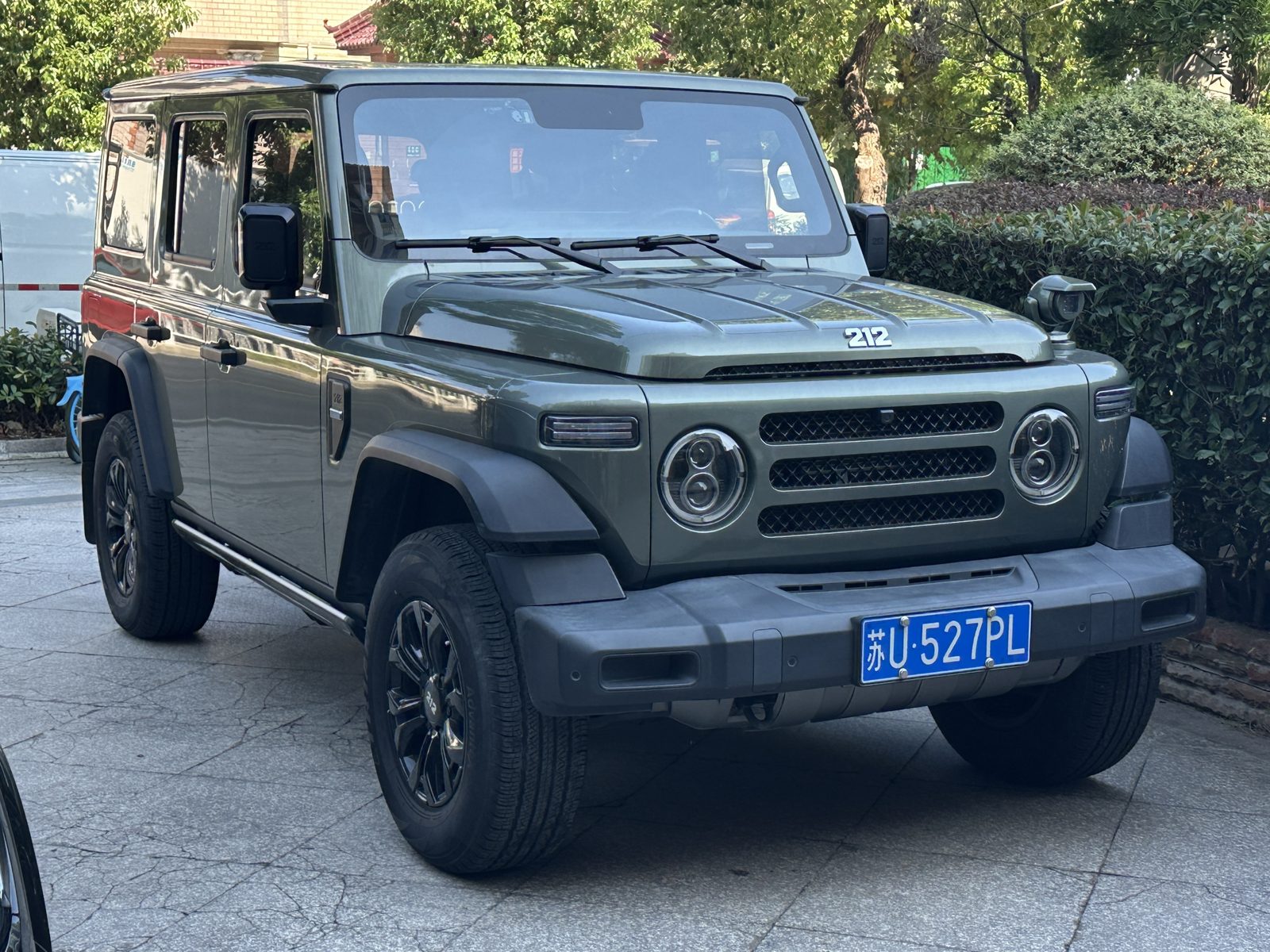
The 212 T01 and the GWM Tank 300 are the two Chinese body-on-frame 4x4s overseas dealers most often put side by side. Both are five-seat ladder-frame SUVs with low range, but they are not built to the same brief. The 212 T01 keeps solid axles at both ends, more ground clearance and a lower price. The Tank 300 gives up the solid front axle for independent suspension, adds a stronger 2.4T diesel in China and comes with something the 212 lacks in most markets: an official distributor network.
For a dealer or importer, that is the whole argument. If your customers run desert tours, mining roads or remote sites and expect to modify the vehicle, the 212 T01 is the more suitable base. If they want a hard-use SUV a retail buyer will also accept, with warranty support and resale value, the Tank 300 is easier to sell. This guide compares the hardware, ownership risk and market fit using China-market and export specifications as of November 2026.
👉 Need a quote? Ask us on WhatsApp · 212 T01 trims and engines explained
What are the 212 T01 and the Tank 300?
The 212 T01 is the modern five-door model from the 212 brand, built by Beijing Auto Works, now owned by Shandong Weiqiao Group. It launched in China in 2024 and is sold in trims such as Mechanic, Inspector, Changfeng and Highland. Changfeng (长风) is sometimes translated as Long Wind, so export listings use both names. The T01 is a ladder-frame SUV with five-link coil suspension and a solid axle at each end, closer to a Jeep Wrangler or old Defender than a crossover. Our 212 T01 export guide lists the trims and the equipment that comes with each.
The Tank 300 is GWM’s Wrangler competitor, sold under the Tank brand. It is a mainstream model in China with a large aftermarket following, and in the Gulf it is sold through official GWM distributors, including in Oman. It is also sold in Australia and South Africa. The export car most Gulf dealers know is the 2.0T petrol with a ZF eight-speed automatic. China’s 2026 update moved to a nine-speed automatic and added a 2.4T diesel, so a China-spec car and a GCC-spec car are not always the same vehicle. GCC spec versus China spec explains why that matters.
Neither car is a pickup; buyers who need a load bed should look at the double-cab segment, such as the Dongfeng Rich 6 versus Nissan Navara.
How do the 212 T01 and Tank 300 compare on engines and gearboxes?
The 212 T01 has the more powerful petrol engine; the Tank 300 has the stronger diesel. The 212’s 2.0T petrol, coded N20TG, makes 185 kW and 410 N·m from 1,900 rpm. The Tank 300’s export 2.0T makes 167 kW and 387 N·m from 1,800 to 3,600 rpm. The China-market petrol versions of both list 92-octane fuel and use an eight-speed automatic in most export specs. The 212 has about 18 kW and 23 N·m more, which matters on sand and at altitude, although the Tank 300’s torque arrives lower in the rev range.
The diesel comparison goes the other way. The 212 T01 uses a 2.0T diesel rated at 125 kW and 415 N·m. The Tank 300’s 2.4T diesel, added in the 2026 China lineup, is rated at 137 kW and 490 N·m and comes with a nine-speed automatic. That is 12 kW and 75 N·m more, useful for towing and mountain passes. Chinese listings put the 212 diesel at 8.9 L/100 km and the Tank 300 diesel at 8.3 to 8.5 L/100 km on WLTC.
Both engines are turbocharged direct-injection units built to China VI emissions. In markets with high-sulphur diesel, the diesel versions need low-sulphur fuel and the correct particulate-filter service regime. Petrol is safer where fuel quality is inconsistent, which is why many Central Asian buyers still prefer it. The Central Asia market guide covers fuel and winter diesel.
| Specification | 212 T01 2.0T petrol | Tank 300 2.0T petrol (export) | 212 T01 2.0T diesel | Tank 300 2.4T diesel (China 2026) |
|---|---|---|---|---|
| Max power | 185 kW | 167 kW | 125 kW | 137 kW |
| Max torque | 410 N·m | 387 N·m | 415 N·m | 490 N·m |
| Gearbox | 8AT | 8AT | 8AT | 9AT |
| Fuel | 92 RON petrol | 92 RON petrol | Diesel | Diesel |
| Drive | Part-time 4WD, low range | Part-time 4WD, low range | Part-time 4WD, low range | Part-time 4WD, low range |
Which has the stronger off-road hardware, the 212 T01 or the Tank 300?
The 212 T01 has the stronger off-road hardware in standard form. Its advantages are the solid front axle, higher ground clearance, deeper wading rating and bigger tyre options. The base T01 lists 235 mm of clearance; Qichejingwei’s trim table gives it a 40-degree approach angle and 36-degree departure angle. The Changfeng and Highland versions raise clearance to 256 mm, with a 42–43-degree approach and 38–39-degree departure in the same table, and list 910 mm of wading depth with the raised intake. The base car lists 850 mm. All T01 versions use five-link coil suspension with a solid axle front and rear.
The Tank 300 lists 224 mm of clearance, a 33-degree approach angle, a 34-degree departure angle and 700 mm of wading depth. It uses double-wishbone independent suspension at the front and a solid axle at the rear. That is the better layout for gravel roads, long-distance touring and pavement, because each front wheel can absorb a bump without disturbing the other. It is not the better layout for rock crawling or for carrying a heavy front bumper and winch, where a solid axle is simpler and stronger.
Both cars use a part-time transfer case with 2H, 4H and 4L. The 212 Changfeng and Highland list front and rear differential locks; the base Mechanic and Inspector offer a rear lock as an option. GWM’s export specification lists front and rear locks plus crawl control and tank turn. Confirm the lock specification on the exact trim and model year, because export listings frequently mix trims. The 212’s 285/70 R17 tyre option and factory lift make it easier to fit a taller tyre without a major rebuild, which is why desert and rock buyers gravitate to it.
How do the 212 T01 and Tank 300 compare on size and daily comfort?
The 212 T01 is slightly shorter but taller, and it rides on a longer wheelbase. The standard T01 measures 4,705 mm long, 1,895 mm wide and 1,936 mm tall on a 2,860 mm wheelbase. The Changfeng and Highland versions grow to 4,749–4,811 mm long and 1,945 mm wide, with a height of 1,999 mm. The Tank 300 export car measures about 4,760 mm long, 1,930 mm wide and 1,927 mm tall on a 2,750 mm wheelbase. China’s 2026 facelift lists 4,750 mm long and 1,903 mm tall on the same 2,750 mm wheelbase.
The 110 mm wheelbase advantage gives the 212 more rear legroom and a more stable ride over whoops, but it also makes the car less nimble in tight city traffic. The 212 is the taller vehicle, which helps visibility and ground clearance but hurts fuel consumption and garage clearance. Both are five-seat cars with an 80-litre tank in the versions compared here; the Tank 300 diesel lists 78 litres. Both weigh around 2.2 to 2.4 tonnes depending on engine and trim.
On the road, the Tank 300 is the more comfortable car. Independent front suspension, better sound insulation and a wider driver-assistance package make it easier on long highway stages. The 212 has a 12.3-inch screen and 4G, but its cabin is utilitarian and its ride is truck-like on broken pavement. Retail buyers usually prefer the Tank 300; fleet buyers who care about axle strength and repair simplicity usually prefer the 212.
Which 4×4 is easier to modify and repair?
The 212 T01 is easier and cheaper to modify. A ladder frame with solid axles is the traditional base for a lift kit, larger tyres, a winch bumper, a snorkel and a roof rack. The suspension is a simple coil-and-link layout, the body sits on a separate frame, and a workshop that knows old-school 4x4s can work on it without factory diagnostic equipment. The Changfeng already comes with nitrogen shocks, 256 mm clearance and 285-section tyres, so the buyer starts closer to the finished vehicle.
The Tank 300 also has a large aftermarket, especially in China and Australia, but the independent front suspension limits how far a budget build can go. Taller tyres and a big lift put more stress on the front subframe and half-shafts, and the electronics need specialist diagnostics. That does not make it a bad build base; it makes it a more expensive one. The 212’s main weakness is parts outside China; body panels and trim may have to be shipped in, so a dealer should stock consumables before the first car lands.
Repairability is also about who has the parts. A Tank 300 in the Gulf can often be repaired through the official distributor or the independent network. A 212 may be mechanically simpler but wait longer for a windscreen or door mirror. Price a parts package into the first order: filters, belts, brake pads, bushes, a diagnostic tool and commonly damaged body parts.
What dealer and parts support does each brand offer in the Gulf and Central Asia?
The Tank 300 has the stronger official support. GWM sells the Tank 300 through official distributors in the Gulf, including Oman, and the brand has a wider export footprint across the Middle East, Australia, South Africa and parts of Central Asia. That gives a retail buyer warranty, service history and a resale market. It also means a parallel-imported China-spec Tank 300 may sit awkwardly beside the official car: different gearbox, different emissions calibration and possibly no warranty recognition. Check with the local distributor before you base a business on undercutting it.
The 212 brand is newer to export. It held a global strategy launch in Dubai in October 2025 and says its network covers more than 70 countries, with the Middle East as a priority. Those claims are still being converted into parts stock and trained service points, so in most markets the importer is the support network for the first few years. Fleets and tour operators who can stock parts are a better fit than retail buyers who expect a dealer on every corner.
Central Asia is a mixed picture. The Tank 300 is the better-known name in Kazakhstan and Uzbekistan; the 212 brand is still building its regional presence. The 212’s simpler mechanical layout appeals to mining and construction fleets in Kyrgyzstan and Tajikistan, where a solid-axle 4×4 with a low range is still the default work vehicle. Road transport through Horgos makes a small batch of 212s practical for those buyers. For a comparison of how a more comfort-oriented Chinese SUV handles the region, see the Hongqi HS5 export guide.
How much does each cost relative to the other?
The 212 T01 starts at a lower price in China than the Tank 300. The gap is large enough that a Changfeng T01 with locks, a lift and 285 tyres can still land below a comparable Tank 300 in many export deals, before shipping and homologation. The Tank 300’s price reflects its brand, dealer network and stronger diesel, so the two are not competing for the same retail customer. We do not publish China guide prices because they change by model year and landed cost depends on freight, duty and destination specification.
The cheaper purchase price is not the whole cost. A 212 buyer should budget for a parts package and for training the first service point. A Tank 300 buyer pays more up front but inherits a support structure. For a fleet of ten cars, that can be worth more than the price gap; for one enthusiast who wants a solid-axle 4×4, the lower entry price is the point.
Which should you import for your market?
The choice depends on the customer, not on equipment counts.
| Buyer or use case | Better choice | Why |
|---|---|---|
| Desert tours, dune driving, off-road rental | 212 T01 Changfeng | Solid axles, 256 mm clearance, 285 tyres, front and rear locks, lower entry price |
| Rock crawling and hard-core builds | 212 T01 | Solid front axle, simple suspension, easier lift and bigger tyre fitment |
| Long-distance touring, mixed pavement and gravel | Tank 300 | Independent front suspension, better comfort and sound insulation |
| Mining, construction, remote fleet | 212 T01 diesel or petrol | Simple mechanical layout, easy field repair, low range |
| Retail buyer who wants warranty and resale | Tank 300 | Official distributors, brand recognition, stronger resale |
| Dealer who needs a differentiated low-cost 4×4 | 212 T01 | Fewer competitors, lower capital per unit, clear off-road story |
| Buyer who needs maximum diesel torque | Tank 300 2.4T | 490 N·m and a nine-speed automatic |
For the Gulf, the 212 T01 Changfeng is the stronger product for desert and fleet use, provided the importer stocks parts. The Tank 300 is the easier retail sale and the safer choice for a dealer whose customers expect warranty and a trade-in value. For Central Asia, the Tank 300’s comfort and diesel torque suit long-distance buyers, while the 212’s simplicity suits remote industrial users. In both regions, check cooling and air-conditioning calibration: a China-spec car may need GCC-spec parts for 45°C heat.
If you are weighing the 212 against another body-on-frame option, our 212 T01 versus Jetour T2 comparison explains why the T2 is a crossover, not a direct rival. The Geely Galaxy Battleship 700 is a larger Chinese off-road SUV in a different size and price class.
What should you check before buying either car in China?
Confirm the exact model year, trim and emission standard before you pay. The Tank 300 changed to a nine-speed automatic in China for 2026, and the 2.4T diesel is China-market only. Export listings often describe a 2025 car as a 2026 model or mix Conqueror equipment into a lower trim. Ask for the VIN, the configuration sheet and photos of the actual unit.
Check the destination rules next. Gulf markets apply GCC specification and their own type approval; Central Asian markets in the Eurasian Economic Union have a separate approval process. A China-market certificate is not a Gulf or EAEU homologation, and the car may need changes to the speedometer, labels, tyres or emissions equipment. GCC spec versus China spec and the export documents checklist cover the paperwork.
Inspect the car before paying, not after it lands. A remote inspection through a third-party inspector is cheaper than a container of cars that do not match the offer. If you buy in volume, visit the market yourself; our Guangzhou inspection guide explains the route. For shipping, both cars fit a 40HQ container or move by RoRo, and the choice affects cost and damage risk; see RoRo versus container and shipping options for one car. FOB, CFR and CIF explains which costs sit with which party, and the zero-km used-car rule matters if the unit is registered in China before export.
Finally, price the support package: for the 212, filters, belts, brake pads, bushes, a diagnostic tool and likely body parts; for the Tank 300, confirm whether the local distributor will service a parallel import and what warranty applies. The cheapest quotation is not always the cheapest fleet car.
FAQ
Does the Tank 300 have low range?
Yes. The Tank 300 uses part-time four-wheel drive with 2H, 4H and 4L, and the Conqueror export trim lists front and rear locks. Low range is a mechanical reduction in the transfer case, which suits steep descents, sand and heavy towing.
Which is better in desert sand, the 212 T01 or the Tank 300?
The 212 T01 has the hardware advantage: more clearance, a solid front axle, 285-section tyres on the Changfeng and a 910 mm wading rating with the raised intake. The Tank 300 counters with a stronger diesel, better cooling in some export specs and a parts network. For a tour fleet, the 212 is the more capable base; for occasional sand use, the Tank 300 is easier to own.
Can I ship a China-spec Tank 300 to the Gulf?
You can, but check whether the local distributor will honour any warranty, whether the car meets GCC type approval and emissions rules, and whether the specification matches retail expectations. A China-spec 2026 car may have a nine-speed automatic the GCC export car does not, which complicates resale and parts matching.
Is the 212 T01 available with a diesel engine?
Yes. The 212 T01 offers a 2.0T diesel rated at 125 kW and 415 N·m, with an eight-speed automatic and part-time four-wheel drive. It is China-market only, so confirm the emission standard and low-sulphur diesel availability before ordering a fleet.
Sources: Zhichepai specification table for the 212 T01 (dimensions, wheelbase, clearance, kerb weight, tyres, fuel tank, engine output, gearbox, suspension and wading depth), checked November 2026; Qichejingwei 212 T01 configuration table (trim dimensions, 910 mm wading depth with raised intake, approach and departure angles, differential locks, tyre sizes, WLTC consumption), checked November 2026; GWM Oman official Tank 300 page (167 kW / 387 N·m, ZF 8AT, part-time 4WD with 2H/4H/4L, 224 mm clearance, 33/34/23.1-degree angles, 700 mm wading, front and rear locks), checked November 2026; PCauto 2026 Tank 300 2.0T Conqueror and 2.4T diesel pages (4,750 mm length, 2,750 mm wheelbase, 9AT, 137 kW / 490 N·m, 78-litre tank), checked November 2026; GWM South Africa and Cars.co.za Tank 300 coverage for the export body dimensions, checked November 2026; Bitauto and Sina coverage of the 212 brand Dubai launch in October 2025 and its 70-country network claim. Figures are China-market or export specifications and differ by trim, model year and destination. Only from Qichejingwei: the 850/910 mm wading depths, approach and departure angles, and trim-by-trim lock list. Ownership by Shandong Weiqiao and the 2024 relaunch: Economic Daily and Sohu coverage, checked November 2026. Only from one source: the 212 diesel 8.9 L/100 km and Tank 300 diesel 8.3–8.5 L/100 km WLTC figures. Photo: JustAnotherCarDesigner / Wikimedia Commons, CC0.