
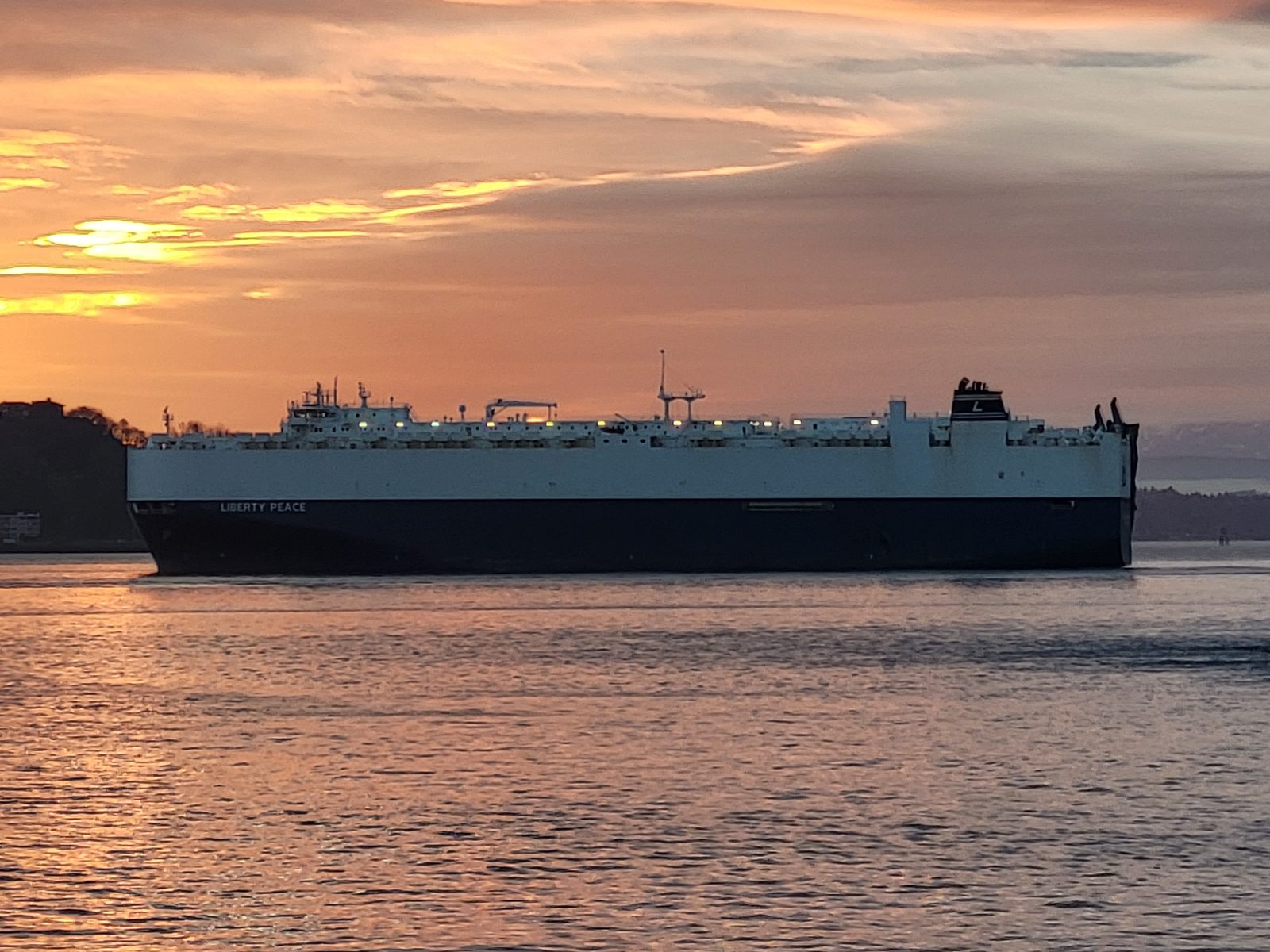
RoRo (roll-on/roll-off) is usually the better fit for large batches of running cars going to a port that handles vehicle carriers; containers are usually the better fit for small lots, ports with thin RoRo service, and cars you want sealed away from other cargo. Neither is cheaper or safer in every case. The deciding factors are the destination port, how many cars you ship at once, whether each car can be driven, and how your forwarder and shipping line treat electric vehicles.
👉 Planning a first shipment? Ask us on WhatsApp · How the China car export chain works →
What is the difference between RoRo and container shipping for cars?
On a RoRo ship the car is driven up a ramp onto a vehicle deck and secured there with lashings. At the destination it is driven off. The ship is the container, in effect: one hull carrying hundreds or thousands of vehicles. CarNewsChina describes RoRo as efficient for wheeled, self-driving cargo, and it still carries the large majority of vehicle shipments, though no published source gives a percentage.
In container shipping the car is loaded into a 20 ft or 40 ft box, braced and lashed to the container’s lashing points, and the container is sealed. A box is a standard unit that moves on any container ship, truck or rail wagon. How many cars fit in a container covers the loading side: roughly two cars in a 40 ft high cube without a frame, three or four with a steel racking frame, and fewer for tall SUVs and pickups.
| RoRo | Container | |
|---|---|---|
| How the car moves | Driven on and off | Loaded, braced and sealed in a box |
| Unit of booking | Per vehicle (by size) | Per box, shared by the cars inside |
| Exposure | Open vehicle deck, shared with other cars | Sealed box, shared only with your own cars or a consolidated load |
| Port coverage | Ports with vehicle terminals | Almost any container port |
| Cars that cannot be driven | Needs the line’s agreement | Can be loaded in the box (confirm with your forwarder) |
When does RoRo make more sense?
RoRo suits a regular flow of cars of similar size to a port that already receives vehicle carriers. Large batches fill the ship’s decks efficiently, and nobody has to build bracing frames. Handling is quick because each car is simply driven on and off.
RoRo has real limits for an importer. Vehicle-carrier capacity has been tight. ShipUniverse reported in July 2026 that dedicated carrier supply is not growing as fast as export volumes, and CarNewsChina made the same point the same month. On a tight market, a single car or a small batch can wait longer for a slot than a full container would. Check the sailing schedule for your destination port before you commit to a delivery date.
The car must also be securable. The master of a ship must be satisfied that every vehicle can be secured for the voyage and can refuse one that cannot, according to Maritime New Zealand. The IMO’s ro-ro securing guidance exists because inadequate securing has caused serious accidents. China has a national standard on securing points for road vehicles carried by RoRo, GB/T 39037.1-2021. In practice, a car with a normal factory tie-down point is a non-issue; a modified or heavy vehicle may need a second look.
When does container shipping make more sense?
Container shipping suits small lots, mixed models, and destinations where RoRo service is infrequent or absent. It also lets you use the same port and trucking chain you would use for any other cargo.
Container loading has its own cost structure. Ocean freight and terminal charges are billed per container, so a full box lowers the cost per car. A shared box (consolidation) adds consolidation and deconsolidation handling, can wait for other buyers’ cars to fill, and links your customs clearance to theirs. Our container guide lists those trade-offs in detail.
Containers are also taking a larger share of Chinese car exports. ShipUniverse’s July 2026 report says about 2 million vehicles are expected to move by alternative modes, mainly containers, in 2026, against over 1 million in 2025, within a projected 10 million Chinese light-vehicle exports. The report does not name its data provider and describes the 2 million as a projection, so read it as a direction of travel, not a measured total.
How does shipping an electric car change the choice?
Electric and plug-in hybrid cars add a dangerous-goods question to both methods. Lithium-ion batteries are regulated cargo, and the vehicle’s classification under the IMDG Code decides what paperwork and labels it needs.
An industry notice from npdlship reports a recent IMDG change: UN3171 (battery-powered vehicle) now covers only vehicles with wet or sodium batteries, while lithium-ion vehicles fall under UN3556. A 2025 PHMSA letter points the same way, finding that the exception for wet and sodium batteries does not extend to lithium-ion batteries. Neither gives a clear effective date, and PHMSA’s letter is a US regulator’s reading, not the IMDG text. Ask your forwarder which entry your shipment is declared under and whether the line needs a battery inspection report or a dangerous goods declaration before booking.
On RoRo ships, fire safety is the open topic. The UK Maritime and Coastguard Agency notes that the IMO has no requirements specific to carrying electric vehicles on cargo RoRo ships, and the IMO circular MSC.1/Circ.1615 is guidance, not mandatory. The MCA guidance recommends damaged EVs be inspected by a competent person before carriage, kept on weather decks where possible, and not carried with dangerous goods. It favours charging at the port over charging at sea. According to Interferry’s summary of the IMO’s March 2026 sub-committee meeting, interim fire-safety guidelines for vehicle carriers were prioritised, and any resulting SOLAS amendments would enter into force on 1 January 2032 at the earliest.
For you as the buyer, the practical point is simple. Lines set their own acceptance rules for EVs, and those rules differ. Do not assume a booking confirmed for a petrol car carries over to the electric version of the same model. The BYD Seagull and the Atto 3 are EVs, while the Galaxy Battleship 700 is a plug-in hybrid. Tell your forwarder the powertrain, not just the model name.
Which method fits which port?
Port capability decides more than price does. A major hub with a vehicle terminal gives you both options; a smaller port may only have container service, or RoRo only on a monthly rhythm. Check these three things for your destination:
- Does the port have a vehicle terminal, and which lines call there?
- How often do vehicle carriers sail to it, compared with container services?
- Can the port clear vehicles that arrive in containers, and does it charge differently?
For African routes, Shipping cars from China to African ports explains which gateways serve which markets. Ethiopian buyers who route through Djibouti can see a worked example in the CIF Djibouti breakdown and the Ethiopia EV import guide. For South America, the port pattern in the Peru guide and the Bolivia guide shows how transit through a neighbouring port can change the picture.
Not every market is reached by sea. Orders for Central Asia and Iran often go overland; see the Hongqi HS5 Central Asia guide and the Iran import guide.
What should you ask before you choose?
- How many cars per shipment, and how often? A steady flow favours RoRo; a one-off small lot favours containers.
- Do all the cars run? If not, confirm acceptance with the line first.
- Are they EVs or plug-in hybrids? Get the line’s battery documentation requirements in writing before booking.
- Which delivery term applies? FOB, CFR and CIF split cost and risk differently, and insurance is a separate decision. Payment terms also tie to when documents are issued, so settle shipping method before you finalise the payment structure.
- Who is responsible at the destination port? Free time, storage and clearance are on your side of the chain.
We do not quote freight here. Rates change by lane and season, so get them from your forwarder in writing. If you want to compare how sellers present their shipping terms, how to check a Chinese car export company and the used-car import checklist list the questions worth asking. Recent export volume context is in the September 2026 CAAM export data, and if a model has a different name abroad, see Chinese names vs export names.
FAQ
Is RoRo cheaper than container shipping for cars?
Not always. RoRo tends to be efficient for large batches of running cars, but a full container can be competitive for small lots, and prices vary by lane and season. Ask your forwarder for both quotes in writing for the same port and the same dates.
Can a car that does not run go by RoRo?
It depends on the line. RoRo is built around vehicles that are driven on and off, so a car that cannot run needs the line’s agreement first. A container can usually take such a car, but confirm with your forwarder.
Are electric cars allowed on RoRo ships and in containers?
Both methods can carry them, but lithium-ion batteries are regulated under the IMDG Code and each line sets its own acceptance rules. Expect to provide the powertrain type and, in some cases, battery documents before booking.
How many cars fit in a 40 ft container?
Typically two to four cars, depending on the model height and whether a racking frame is used. Tall SUVs and pickups reduce the number.
Does the car need special lashing for RoRo?
The ship’s crew lashes it, and the master must be satisfied that it can be secured. Standard factory tie-down points are normally enough; modified or heavy vehicles may need a second look.
Which is safer, RoRo or container?
Neither is safe or unsafe by default. A container gives a sealed box, which protects from handling and weather; RoRo keeps the car in one piece, with fewer handling steps. Insurance and careful loading matter more than the method.
Sources: CarNewsChina, “How China is shipping cars when specialized carriers aren’t enough” (6 July 2026); ShipUniverse, “China’s car export boom could send record 2 million vehicles by container in 2026” (21 July 2026; the 2 million, 10 million and carrier-supply figures appear only here and are projections); UK Maritime and Coastguard Agency, MGN 653 (M) Amendment 1 on electric vehicles onboard ro-ro ferries; IMO circular MSC.1/Circ.1615 as described by the MCA guidance; Maritime New Zealand, guidance on lashings for heavy vehicles and the master’s duty to secure cargo; Chinese national standard GB/T 39037.1-2021; npdlship notice on the updated IMDG Code for battery-powered vehicles and PHMSA letter 25-0096 (UN3171/UN3556 change; effective date not confirmed); our own container-loading guide for car-per-box figures. Interferry regulatory report on IMO SSE 12 (March 2026; the 2032 date is from this report only). Checked October 2026. The statement that RoRo still carries most vehicle shipments is from CarNewsChina only. No freight rates are quoted because they vary by lane and date. Photo: FPTI / Wikimedia Commons, CC0.