
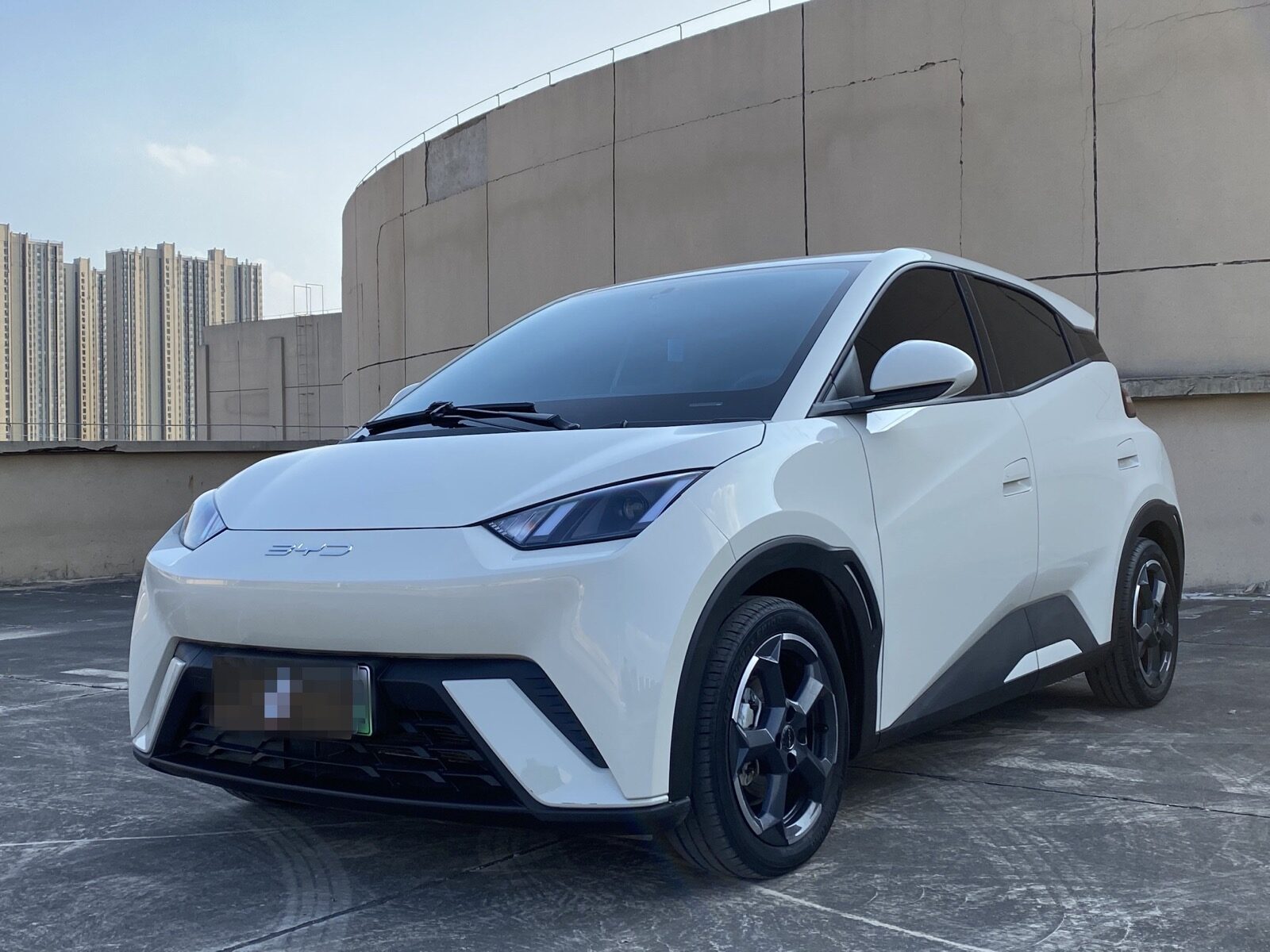
The BYD Seagull is the cheapest way to put a current-generation Chinese electric car into a container — but the car that leaves a Chinese port is not the car Europe knows as the Dolphin Surf. Different body, different battery, different motor, same name on the badge. This guide covers the verified specifications of the China-market Seagull, what its quoted range is actually worth once the car lands, and the full disclosure data on the three units sitting in our stock today, including the two that have had paint work.
One car, four names, and only one of them ships from China
Search for a Seagull and the results fold together several cars that are not interchangeable. BYD sells this model as the Dolphin Mini across Latin America, as the Dolphin Surf in Europe and South Africa, and as the Atto 1 in Indonesia, Thailand and Australia. Those are marketing names for a platform, not for one identical vehicle.
The gap is not cosmetic. The European car measures 3,990 mm long and 1,810 mm wide, carries a 43.2 kWh pack and a 65 kW motor. The China-market Seagull — the one that appears in used stock and goes into export containers — is 3,780 mm long, 1,715 mm wide, and runs a 55 kW motor with either a 30.08 kWh or 38.88 kWh battery. A buyer who researches the Dolphin Surf and then imports a used Seagull has researched a different car.
This kind of mismatch is common enough across Chinese exports that we wrote a separate piece on the traps in buying a used car from China. Naming is one of them, and it is the one that survives all the way to the customer, because the buyer in your market will Google the name on the badge too.
Verified specifications, China-market Seagull
| Item | Figure |
|---|---|
| Launched | 27 April 2023, China |
| Body | 5-door hatchback, 4 seats |
| Length × width × height | 3,780 × 1,715 × 1,540 mm |
| Wheelbase | 2,500 mm |
| Kerb weight | 1,160–1,240 kg |
| Battery | BYD Blade LFP, 30.08 kWh or 38.88 kWh |
| Range (CLTC) | 305 km / 405 km respectively |
| Motor | 55 kW, 135 N·m, front-wheel drive |
| Top speed | 130 km/h |
| DC fast charging | 30 kW or 40 kW depending on version; 30–80% in roughly 30 minutes |
| Steering | Left-hand drive as standard |
Two details in that table decide most import questions before anything else does. It is a four-seater, not a five-seater, which rules it out of some taxi and ride-hail licensing categories and needs checking against your homologation rules before you commit to volume. And it is left-hand drive only from the factory, which suits West Africa, North Africa, Latin America and Central Asia, and rules out any right-hand-drive market outright.
Two batteries, and they are not the same purchase
The 30.08 kWh car and the 38.88 kWh car look identical on a forecourt and behave differently in a fleet. The smaller pack is the one that hits the lowest landed cost, and 305 km on the Chinese test cycle is plenty for a car that stays inside a city. The larger pack costs more and buys headroom — it is the one to specify if the buyer will run intercity legs, or if your market has no reliable public charging and drivers need several days between plug-ins.
Motor output is the same on both, so the bigger battery does not make the car quicker. It makes it heavier and gives it more usable margin. For most of the markets we ship to, the 405 km version is the safer specification and the 305 km version is the one that wins on price. We stock both, which is unusual — most exporters carry whichever version they happened to source.
What CLTC range is worth after it lands
CLTC is China’s domestic test cycle and it runs optimistic against WLTP and considerably more so against EPA. That is not a defect and it is not specific to BYD; it is how the cycle is constructed. The practical consequence for an importer is that the number on the spec sheet should be treated as a ceiling, not a plan.
Heat is the other factor buyers underestimate. Sustained high ambient temperatures push the battery’s thermal management to work harder, and air conditioning running continuously is a real, constant draw on a pack this size. LFP chemistry handles heat better than most alternatives, which is a genuine argument for this car in hot markets, but no chemistry makes the air conditioning free. Plan a Seagull deployment around the lower end of its quoted figure and the car will do the job. Plan around the headline number and drivers will be stranded, and that is a warranty conversation you cannot win from another continent.
The three Seagulls currently in our stock
Here is what we actually hold, taken from the live listings rather than from a brochure. Every VIN below is published on the vehicle page and can be decoded independently before anyone pays anything.
| JT012 | JT014 | CC003 | |
|---|---|---|---|
| Model year | 2024 | 2024 | 2024 |
| Built | September 2024 | April 2024 | December 2023 |
| Colour | White | Black | Warm white |
| Mileage | 21,000 km | 22,000 km | 35,000 km |
| Battery | 30.08 kWh | 30.08 kWh | 38.9 kWh |
| Range (CLTC) | 305 km | 305 km | 405 km |
| VIN | LGXCE4CC9R0634788 | LGXCE4CC9R0215663 | LGXCE4CC9P0823163 |
| Flood / fire / major accident | No / No / No | No / No / No | No / No / No |
| Bodywork | Yes | Yes | No |
| Repaint | Yes | Yes | No |
| Condition score | 4.5 / 5 | 4.5 / 5 | not scored |
| FOB | USD 8,400 | USD 8,400 | on enquiry |
The paint work is stated because hiding it is how a deal dies at the destination. JT012 has partial body and paint repair on the two right-side doors, with the rest of the body and paint original, and one key. JT014 has more of it: left front wing, left rear wing and right rear door repainted, partial bodywork on the tailgate, dent repair on the bonnet and right front wing. Neither car has flood damage, fire damage or a major accident recorded. CC003 is on all-original paint with no bodywork at all, and it carries the larger battery — which is why it is the one we would put in front of a buyer who intends to keep the car rather than flip it.
Only 21 of our 78 in-stock units carry a numerical condition score, and CC003 is not one of them. We publish that gap rather than paper over it. How the scoring and disclosure work is set out in our vehicle inspection and condition report guide; third-party inspection can be arranged on request, and we do not claim every car arrives with an independent report, because it does not.
Model year is not build date, and the port cares about build date
CC003 is the cleanest illustration of a problem that catches importers every month. It is listed as a 2024 model. It was built in December 2023. The tenth character of its VIN is P, which decodes to 2023 and confirms the build date independently of anything we say about it.
Most countries that restrict vehicle age count from the month of manufacture, not from the model year printed in the brochure. A car sold as a 2024 that was built in December 2023 can be a full year older than the buyer assumed, and in a market with a tight age ceiling that is the difference between clearing customs and paying storage while somebody argues about it. Age rules also move — Senegal’s framework is covered on our French-language Senegal import page, and it should always be checked against the current official notice rather than against any guide, including ours.
Ask for the build month and the VIN on every unit, from any supplier. If a seller quotes a model year and goes quiet when you ask for the manufacture date, that tells you something about how close they are to the car. Our piece on who actually sells you a Chinese car explains why so many sellers genuinely cannot answer that question.
Charging, in markets that do not have a charging network
The Seagull takes 30 kW or 40 kW on DC depending on version, which is modest by 2026 standards and almost irrelevant in most of the markets we ship to, because the public DC network there is thin to nonexistent. What matters instead is that a 30 to 39 kWh pack refills overnight from ordinary AC. That is the quiet reason this car works where larger EVs struggle: a 100 kWh SUV needs infrastructure, and a Seagull needs a wall.
Where grid supply is unreliable, the arithmetic still favours the small pack — less energy to put back per day, and a shorter window needed when power is available. Buyers running solar or a generator backup can size around a car this small in a way they cannot around a large SUV. If the use case genuinely needs long unsupported range, the honest answer is that a plug-in hybrid fits better, and we make that argument in full in our guide to hybrids from China to Nigeria.
Shipping and what to expect at the other end
Electric vehicles ship as battery-powered vehicles under the maritime dangerous goods framework, and individual carriers set their own conditions on top of that — state of charge on loading is the usual one. That is a booking question, not an obstacle; it is handled routinely, and it is worth confirming with the line rather than assuming, because carrier policies are not uniform.
On loading, the Seagull’s size works in your favour. At 3,780 mm it is one of the shortest cars we handle, and short cars are what make a container pay: a 40ft high cube takes four vehicles on a racking frame and two without one, and freight is billed by the box rather than by the car. The full arithmetic is in how many cars fit in a container. Route options, transit times and port choices are covered in shipping cars from China to Africa.
Parts availability is the honest weak point. BYD’s service footprint outside China is uneven, and in several of our markets there is no factory-backed workshop at all. The Seagull is mechanically simple, which helps — no gearbox, no exhaust, no clutch, a single-speed reduction drive — but consumables and body panels come from the aftermarket or from China, and a buyer planning a fleet should build that into the plan before ordering, not after.
Who this car suits, and who should buy something else
The Seagull earns its place on price per kilometre in a city. Urban taxi and ride-hail work where trips are short and the car returns to one base overnight, small-business delivery, driving schools, staff transport, and dealers who need an entry price point that a first-time EV buyer will actually accept — that is where it works, and it works well.
It is the wrong car for intercity work, for anyone who needs five seats, for markets that drive on the left, and for buyers who want a boot that swallows a family’s luggage. Those buyers should be looking one class up. The BYD Seal 5 DM-i covers the budget plug-in hybrid case, the BYD Han DM-i covers the long-distance executive sedan case, and the BYD Seal U or the Leapmotor C16 covers families who need seats and space. If you are choosing between the two BYD budget sedans specifically, we compared them directly in Qin PLUS DM-i vs Seal 05 DM-i. A wider shortlist across body styles is in top Chinese SUVs and EVs for export, and for larger flagship SUVs there is Zeekr 8X vs 9X.
Frequently asked questions
What does a used BYD Seagull cost to export from China?
Our two 30.08 kWh cars are listed at USD 8,400 FOB each, both 2024 builds with 21,000 and 22,000 km. The 38.88 kWh car is on enquiry. Those are FOB figures — freight, insurance, duty and clearance at destination are additional, and vary by port and country.
Is the BYD Seagull the same as the Dolphin Surf or the Atto 1?
No. They share a platform and a name family, but the European Dolphin Surf is 3,990 mm long with a 43.2 kWh battery and a 65 kW motor, while the China-market Seagull is 3,780 mm long with a 30.08 or 38.88 kWh battery and a 55 kW motor. Used stock exported from China is the China-market car.
How many seats does the Seagull have?
Four. This is worth confirming against your local homologation and any taxi licensing rules before ordering volume, because several categories assume five.
Is it available in right-hand drive?
Not from the China-market production we source. All units are left-hand drive.
How far will it really go on a charge?
The quoted 305 km and 405 km figures are CLTC, China’s domestic test cycle, which is optimistic relative to WLTP and EPA. Treat those numbers as a ceiling and plan around the lower end, particularly with air conditioning running continuously in a hot climate.
Can I get an independent inspection before paying?
Yes, third-party inspection can be arranged on request. We publish the VIN, build month, mileage and disclosed damage history on every listing so that a buyer or their agent can verify independently. We do not claim every unit ships with an independent report, because that is not the case.
How do I check the build date myself?
Read the tenth character of the VIN, which encodes the model year the vehicle was built under, and cross-check it against the manufacture date on the door pillar plate. On CC003 the VIN character is P for 2023 and the plate reads December 2023, while the car is marketed as a 2024. Both should agree; if a seller’s paperwork does not, ask why before paying.
Next steps
All three Seagulls are live with photographs, VINs and full disclosure on our used vehicle stock pages, alongside the rest of what we hold. If you want a car we do not currently have, we also handle new vehicles to order. The end-to-end process is set out in how to import cars from China, what we do at each stage is on our services page, and the checks worth running on any Chinese exporter before you transfer money — including on us — are in how to verify a Chinese car export company. Country-specific notes for Nigeria are in our Nigeria import guide.
Tell us the destination port, the quantity and whether you need the 305 km or 405 km version, and we will come back with a landed-cost breakdown rather than an FOB number on its own. You can reach us through the contact page, and more about who we are is on our about page.