
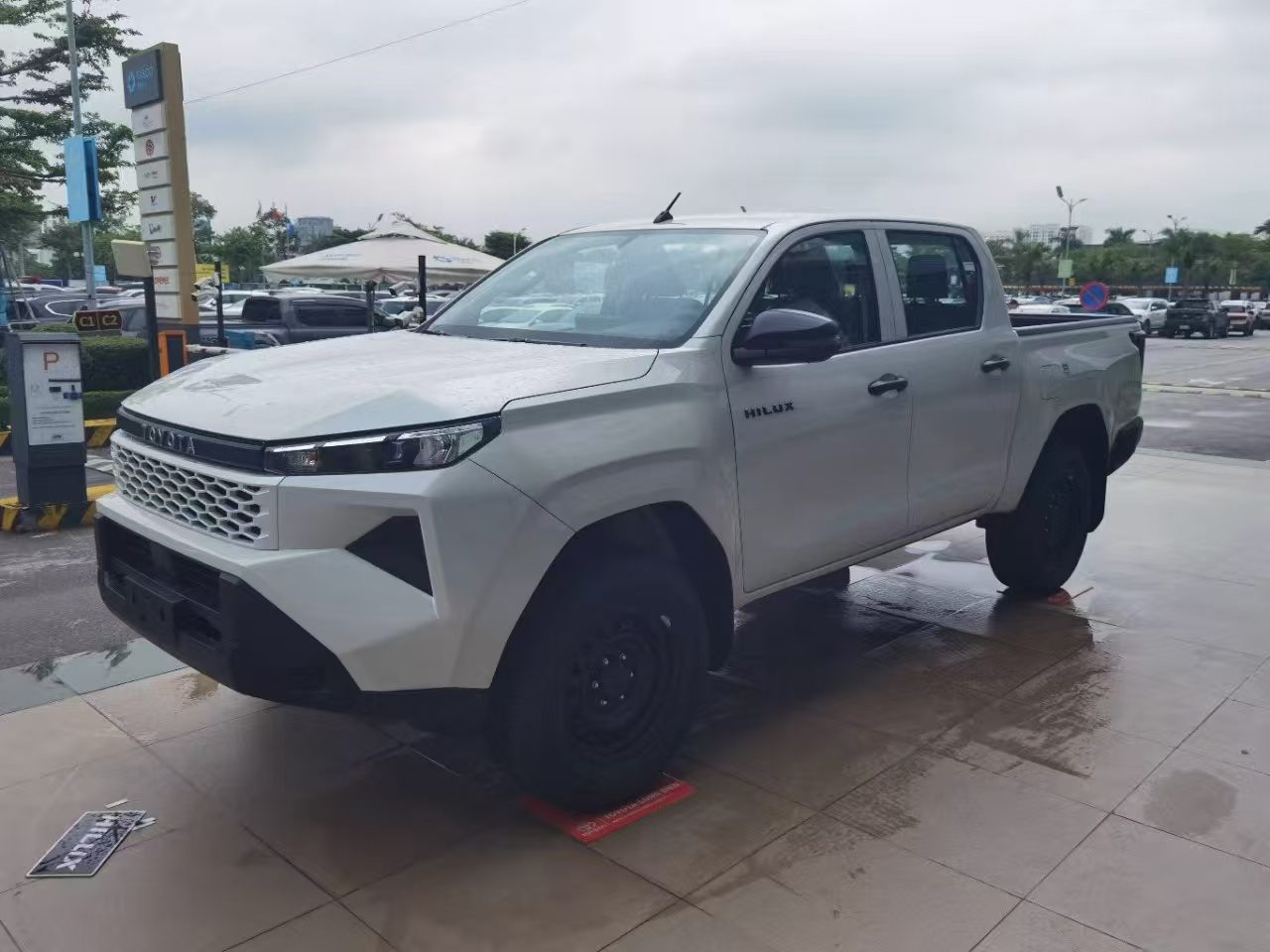
The 2026 Toyota Hilux is a heavy update of the truck it replaces, not a clean-sheet design. The 2.8-litre turbo diesel, the 3,085 mm wheelbase and the leaf-spring rear axle carry over from the previous generation. The changes that matter to an importer are electric power steering, rear disc brakes on upper grades, a 12.3-inch cabin and Toyota Safety Sense 3.0 — and the safety package is not fitted to every trim.
→ See all 7 grades of the 2026 Hilux with full specs and starting prices
That split decides the buying question. A new-generation V or Conquest is a noticeably more modern truck than any previous Hilux. A new-generation E or G has the new body and the bigger base engine, but not the safety and cabin upgrades of the top grades. Discounted previous-generation stock still makes sense for fleets, remote sites and buyers who want the simplest hardware.
Is the 2026 Toyota Hilux a new platform or a heavy update?
Toyota staged the world premiere in Bangkok on 10 November 2025, and the truck is sold as the Hilux Travo in Thailand, with a battery-electric Travo-e alongside it. In the Philippines and Vietnam it is simply the 2026 Hilux. The trade calls it the ninth generation, but the mechanical layout is inherited: Toyota’s own specification sheets for both generations quote the same 3,085 mm wheelbase, the same double-wishbone front suspension, the same leaf-spring rear axle and the same 2,755 cc 1GD-FTV engine.
What is new is the body and the equipment layered on top. The front end moves to a taller, blockier design with slim LED headlamps, a honeycomb grille and TOYOTA lettering in place of the oval badge. The cab retains four doors and the same footprint. Buyers who expect a longer cabin or a deeper bed will not find one: Toyota’s Vietnamese sheet lists 5,320 mm overall length against 5,325 mm for the previous 2.8 double cab.
Toyota has not published new stiffness figures for the frame. The measurable changes are in steering, brakes, cabin electronics and safety, covered below.
How big is the 2026 Hilux compared with the previous generation?
The two generations are effectively the same size. The table compares Toyota’s official sheets for a previous-generation 2.8 double-cab 4×4 automatic and the three 2026 Vietnamese grades. Width grows by 30 mm only on the wide-body Pro and Trailhunter.
| Specification | Previous gen 2.8 4×4 A/T | 2026 Standard 2.8 4×2 M/T | 2026 Pro 2.8 4×2 A/T | 2026 Trailhunter 2.8 4×4 A/T |
|---|---|---|---|---|
| Length / width / height (mm) | 5,325 / 1,855 / 1,815 | 5,320 / 1,855 / 1,815 | 5,320 / 1,885 / 1,815 | 5,320 / 1,885 / 1,815 |
| Wheelbase (mm) | 3,085 | 3,085 | 3,085 | 3,085 |
| Curb weight (kg) | 2,090 | 1,968 | 1,980 | 2,095 |
| Gross vehicle weight (kg) | 2,910 | 2,850 | 2,850 | 2,950 |
| Rear brakes | Drums | Drums | Ventilated discs | Ventilated discs |
| Power steering | Hydraulic | Hydraulic | Electric (EPS) | Electric (EPS) |
| Wheels and tyres | 265/65 R17 | 265/65 R17 steel | 265/60 R18 alloy | 265/60 R18 alloy |
The practical point for a dealer is that a 2026 Hilux will fit the same parking bays, containers and workshop lifts as the old one. It will not fit the same bull bar, side steps or canopy without checking: the front sheet metal and bumper are new, so accessories are generation-specific. Confirm fitment with the accessory supplier before you quote a build.
Does the 2026 Hilux use a new engine or the same 2.8 diesel?
The 2026 Hilux uses the same 1GD-FTV 2.8-litre four-cylinder turbo diesel. Output is unchanged at 150 kW (204 PS) and 500 Nm with the six-speed automatic, and 420 Nm with the six-speed manual. The previous-generation 2.8 in Toyota’s African-market sheet is also rated at 150 kW and 500 Nm, so there is no power or torque gain to sell.
The bigger change is at the bottom of the range. The previous generation was offered with a 2.4-litre 2GD-FTV rated at 110 kW (150 PS) and 400 Nm. That engine does not appear in the 2026 Philippine or Vietnamese line-ups, where every diesel is the 2.8. For a buyer stepping out of an old 2.4, the new base truck has 54 PS more, and 20 Nm more in manual form (420 Nm against 400 Nm). For a buyer comparing a discounted old 2.4 with a new 2.8, the old truck is the smaller-engine option; the new range no longer offers it.
Both generations use a six-speed manual or six-speed torque-converter automatic. The Philippine V grade pairs the manual with iMT, Toyota’s intelligent manual transmission. The Vietnamese sheet lists Euro 5 emissions for the 2.8; the older African sheet does not state an emissions standard. If your market has high-sulphur diesel, confirm the emissions build and the diesel particulate filter service regime for the exact unit, not just the model name. The Central Asia fuel and winter guide covers the same issue for other brands.
Toyota also sells a battery-electric Hilux, the Travo-e, with a 59.2 kWh battery, a De Dion rear axle and Toyota Safety Sense 3.0 in Philippine specification. A 48-volt mild-hybrid version has been announced for some markets. Neither is part of the Philippine or Vietnamese diesel line-ups quoted here, so importers shopping for a work pickup should treat them as separate products. Buyers considering the electric version for East Africa should read Ethiopia’s electric vehicle import rules before ordering, because the charging and duty position is different from a diesel pickup.
What changed in the chassis, steering and brakes?
The chassis layout is unchanged, but the steering and brakes are the clearest mechanical split between grades. The 2026 Standard keeps hydraulic power steering and rear drum brakes, exactly like the previous generation. The Pro and Trailhunter move to electric power steering and ventilated rear discs. The previous-generation 2.8 Executive in the African sheet lists rear drums and a manual parking brake on every trim.
Electric power steering is the change a driver notices first in town: lighter effort at parking speed and no hydraulic fluid or pump to service. It also means front-end repairs and wheel alignment need a shop that can read the steering module. In a remote fleet workshop, the old hydraulic system is easier to keep alive.
Rear discs shorten stopping distance when the truck is loaded and reduce fade on mountain descents. They also add a parking brake that is electronic on the Pro and Trailhunter, replacing the manual lever. An electronic parking brake needs battery voltage and a diagnostic tool to release for brake service. For a mining or construction fleet that services its own trucks, the manual lever on the old model and on the new Standard is the lower-risk choice.
Suspension hardware is unchanged: double wishbone at the front, leaf springs and a rigid axle at the rear. Toyota has not published a new payload or towing rating in the sheets used here. The previous-generation 2.8 4×4 automatic is listed at 3,500 kg braked towing and 2,910 kg gross vehicle weight; the 2026 Vietnamese sheets list 2,850 kg for the 4×2 and 2,950 kg for the 4×4 Trailhunter, without a towing figure. Ask for the towing rating of the exact build before you promise a trailer capacity.
How does the 2026 Hilux interior compare with the old one?
The cabin is where the generation gap is widest, but only on upper grades. The previous-generation 2.8 Executive uses an 8-inch touchscreen, automatic air conditioning, leather upholstery, a power driver’s seat, six speakers, a rear camera and front and rear parking sensors. The 2026 Standard starts lower: a 9-inch touchscreen, a 7-inch colour trip meter, manual air conditioning, fabric seats, four speakers and a rear camera.
The 2026 Pro and Trailhunter jump to a 12.3-inch touchscreen and a 12-inch digital instrument cluster, with dual-zone automatic air conditioning, leather, a 10-way power driver’s seat, eight speakers and a 360-degree camera. Physical buttons remain for climate and off-road controls, which matters in a work truck used with gloves.
For an importer, the trap is assuming that “2026 Hilux” means the 12.3-inch cabin. It does not. In the Philippine range, the E and G grades sit below the V and Conquest and do not carry the full equipment set. Match the grade, not the model year, to the buyer.
Which 2026 Hilux trims get Toyota Safety Sense 3.0?
Toyota Safety Sense 3.0 is fitted to the 2026 V, Conquest and BEV in the Philippines, and to the Pro and Trailhunter in Vietnam. The E, G and Standard grades do not get it. Toyota Philippines lists only driver, driver-knee and passenger airbags for the E and G; the V, Conquest and BEV add side and curtain airbags. It bundles pre-collision braking, lane tracing, radar cruise control and automatic high beam, with blind-spot and rear cross-traffic monitoring on the upper grades.
The previous generation, in the African-market sheet used for this comparison, lists cruise control on the 2.8 Executive but no Toyota Safety Sense items at all. The African sheet is one market’s specification, so check the grade of the actual unit; an old top trim may have more kit than the sheet suggests, but it is not a substitute for the numbered safety system on a new V or Conquest.
This is the strongest argument for buying new, and the strongest argument for reading the grade list. A 2026 E with a rear camera and three airbags is not a safer truck than a well-kept 2024 Conquest with a full safety package. If safety is the reason for the upgrade, the budget must reach the V, Conquest, Pro or Trailhunter.
How do Hilux version names map between markets?
The same truck carries different grade names in different countries, and the names do not transfer cleanly. The table maps the 2026 line-ups in the two left-hand-drive markets used for this article.
| Market | 2026 grade names | Layout notes |
|---|---|---|
| Philippines | E, G, V, Conquest, BEV 4×4 | All diesel grades are 2.8; V is 4×4 manual with iMT; Conquest comes 4×2 or 4×4 automatic |
| Vietnam | Standard, Pro, Trailhunter | Standard is 4×2 manual; Pro is 4×2 automatic; Trailhunter is 4×4 automatic |
| Thailand (right-hand drive) | Travo, 4TREX, Prerunner | Naming only; Thai domestic specification is right-hand drive and is not a guide to left-hand-drive export builds |
Conquest is a Philippine grade name. A Gulf buyer who asks for a “Conquest” may mean the top Philippine truck, while a dealer in another market may use the name for a different package. Always quote the market, the grade and the model year together. The GCC versus China specification guide explains why the same badge can hide different equipment, and the Toyota naming guide for China-built models shows how far the same brand can drift between markets.
The previous generation used yet another set of names: Active and Executive in the African sheet, E, G, V and Conquest in the Philippines. Do not map an old Executive to a new Conquest by name. Compare the equipment list.
Should an importer buy the new Hilux or clearance old stock?
The answer depends on the buyer, not on which truck is objectively better. The table is the short version.
| Buyer type | Better fit | Why |
|---|---|---|
| Urban or retail buyer who wants the current look and resale | 2026 V, Conquest, Pro or Trailhunter | Full safety kit, 12.3-inch cabin, rear discs, electric steering |
| Fleet, mining, construction or remote site | Previous-generation 2.4 or 2.8, or 2026 Standard | Hydraulic steering, rear drums, manual parking brake, fewer electronics |
| Price-led entry buyer | Previous-generation 2.4 | Lowest entry cost; the new range starts at the 2.8 |
| Buyer who needs a truck now | Whichever grade is in stock | New-generation stock is still building; old stock is immediately available |
| Safety-first buyer on a fixed budget | Previous-generation top grade with TSS, if verified | A new base grade without TSS is not the safety upgrade |
Previous-generation stock has three real advantages. It is cheaper to buy, it uses hardware a local workshop already knows, and it is available now. Its disadvantages are the older cabin, weaker active safety and faster depreciation once the new shape becomes common.
New-generation stock has the opposite profile. It is more expensive, it ties the buyer to a newer electronics platform, and body panels and accessories are still new to the aftermarket. In return it gives the safety kit, the screens, the rear discs and the resale value that retail customers notice.
Most importers do best with one new V or Conquest for the showroom and one or two previous-generation units for fleet customers.
What should you verify before buying either generation?
Start with the build documents, not the paint. Confirm the model year and build date, the VIN, the country of assembly and the market specification. Toyota builds the Hilux in Thailand; Thai domestic sales are right-hand drive, while left-hand-drive builds are produced for export markets. A left-hand-drive truck sold in the Philippines or Vietnam is not the same specification as a right-hand-drive Thai unit, even when the grade name matches.
For a previous-generation unit, check the tyres for age and flat spots, the battery and brake fluid, and the diesel particulate filter history if the truck has been idling or doing short runs. Look for repaint, panel gaps and underbody damage, and confirm the odometer against service records. Old stock that has sat for a year needs a full fluid and filter service before delivery.
For a new-generation unit, compare the actual equipment against Toyota’s official sheet for that market. Check whether TSS 3.0, rear discs, the 12.3-inch screen and the 360-degree camera are present, because grade names differ and dealers sometimes describe a lower trim with the features of a higher one. If the truck has been repaired, ask whether the front radar and camera were recalibrated. Unused previous-generation stock is sometimes sold as zero-kilometre; the zero-km and 180-day rules explain how that status is treated at Chinese customs.
Both generations need the same export paperwork: invoice, packing list, certificate of origin, bill of lading and the destination country’s import documents. The export document checklist lists them in order, and remote inspection before payment explains how to verify a unit you cannot see. If you plan to visit, the Guangzhou inspection guide covers what to check in person.
How are new Hilux units shipped from China?
New-generation Hilux stock can be loaded in a 40-foot high-cube container, two double-cab units per box. RoRo is the alternative for single units and for ports without container handling. The RoRo versus container guide compares transit time, damage risk and port charges, and shipping options from China covers the booking process.
Payment terms and documents should be agreed before the truck is loaded. FOB, CFR and CIF explains where our responsibility ends under each term, and letter of credit versus T/T covers the payment routes banks in Algeria and West Africa usually accept. Cargo cover should be in place before sailing; marine insurance and claims explains what a policy does and does not cover, and demurrage and port storage explains the charges that start when documents arrive late. For deliveries through Central Asia by road, the Horgos crossing guide explains the border process, and Nansha terminal is the main south China RoRo point.
We supply new-generation Hilux units from stock in China and from Thailand, the Philippines and Vietnam, with delivery at any Chinese port or border crossing. Prices are starting prices per unit from the November 2026 supply sheet; the delivery point (Tianjin Port, another Chinese port or border crossing, or the buyer’s own port) is agreed when the buyer inquires, freight is quoted separately, and the final price is confirmed in a written quote. Ask for the current sheet for the grades you need rather than working from an old quote.
FAQ
Is the 2026 Toyota Hilux a completely new truck?
No. It keeps the previous generation’s ladder frame, 3,085 mm wheelbase, 2.8-litre diesel and leaf-spring rear axle. The body, cabin, steering, brakes and safety equipment are new or revised.
Does the 2026 Hilux have more power than the old one?
Not in 2.8 form. Both generations are rated at 150 kW (204 PS) and 500 Nm with the automatic, and 420 Nm with the manual. The gain is at the bottom of the range, where the old 2.4 made 110 kW and 400 Nm and the new line-up starts with the 2.8.
Which 2026 Hilux grades have Toyota Safety Sense 3.0?
In the Philippines, the V, Conquest and BEV. In Vietnam, the Pro and Trailhunter. The E, G and Standard grades do not have it.
Is the 2.4 diesel still available in the new Hilux?
Not in the 2026 Philippine or Vietnamese line-ups, which are 2.8-only for diesel. Other markets may still offer the 2.4, so confirm the market specification before ordering.
Can I still buy a new previous-generation Hilux?
In some markets, yes. Toyota has kept the older truck on sale as a work model in Thailand and some other countries. Availability and build dates vary, so confirm the model year and emission standard of the exact unit.
What is the towing capacity of the 2026 Hilux?
Toyota’s sheets used here do not publish a towing figure for the new truck. The previous-generation 2.8 4×4 automatic is listed at 3,500 kg braked. Ask for the rating of the exact grade and market before promising a trailer capacity.
Sources: Toyota Vietnam Hilux product page and official specification PDF (2026 Standard, Pro and Trailhunter; dimensions, outputs, brakes, steering, Euro 5), checked November 2026. Toyota Philippines Hilux variant pages (2026 E, G, V, Conquest and BEV 4×4; TSS 3.0 availability, iMT, airbags), checked November 2026. Toyota Rwanda official Hilux double-cab brochure and Toyota Bharat Hilux specification page (previous-generation 2.8 GD; dimensions, gross vehicle weight, rear drums, manual parking brake, 8-inch touchscreen), checked November 2026; the 2.4 GD output and the 3,500 kg braked towing rating come from the Toyota Rwanda brochure only. Toyota Motor Thailand world premiere, Bangkok, 10 November 2025, and Travo, 4TREX, EPS and rear-disc grade fitment as reported by Motorist Thailand and Automachi. The 48-volt mild-hybrid announcement comes from the same launch coverage. No prices from Toyota’s China operations are used. Photo: Hanvia Motors / own photo, All rights reserved.