
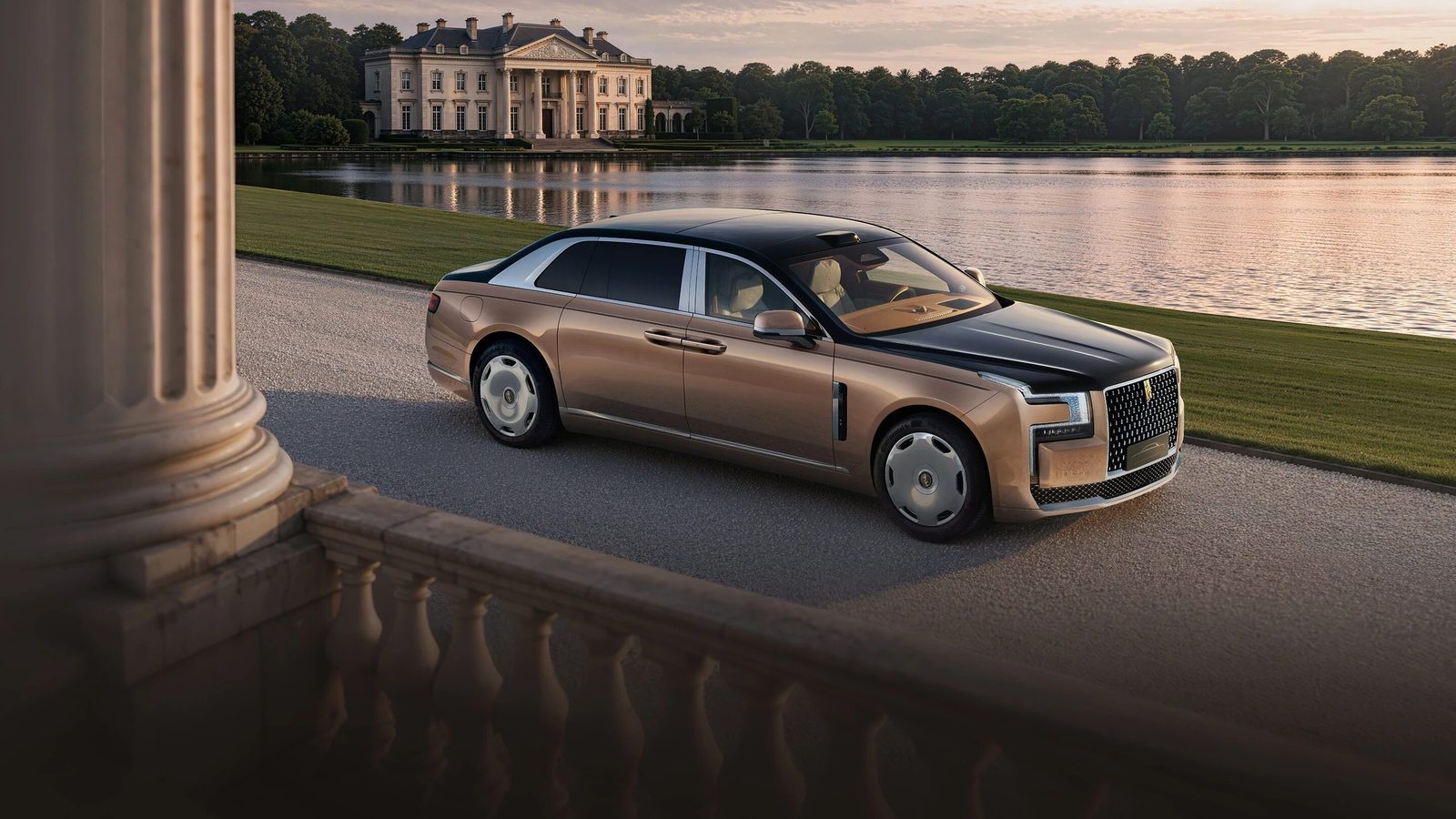
The Yangwang Altior is BYD’s first ultra-luxury electric sedan, and it was launched in Abu Dhabi on 7 November 2026 rather than in China — the clearest sign yet that Yangwang treats the Gulf as a launch market, not an afterthought. The car is a 5.6-metre, four-seat flagship with four motors, a second-generation Blade battery and a claimed CLTC range above 1,000 km. What it does not yet have is a published price, a confirmed power figure, or an export timetable.
For a dealer or importer, that combination matters more than the show-car details. A car launched in your region, with no price and no allocation, is a brand statement first and a product second. Here is how to read it.
👉 Sourcing Chinese premium EVs for the Gulf? Ask us on WhatsApp · the 2026 dealer import guide →
What is the Yangwang Altior?
Yangwang is BYD’s ultra-luxury sub-brand, launched in January 2023. Its first models were the U8 off-roader and the U9 supercar, both built around the e⁴ four-motor platform. The Altior is the brand’s first sedan and its first chauffeur-focused car.
In China the car is called the 鼎曜 (Dingyao). “Altior” is Latin for “higher”, and it is the first Yangwang model whose export name does not follow the U-number pattern — a naming split we cover in our guide to BYD’s China and export names and, more broadly, in China model names versus export names.
BYD positions the Altior against the Rolls-Royce Ghost and the Mercedes-Maybach S-Class: a long-wheelbase four-seater for owners who are driven rather than driving. Two trims were named at launch, Executive and Bespoke, and the first Bespoke commission is a limited edition called Shanhe Dingyun (山河鼎韵).
What did BYD confirm at the Abu Dhabi launch?
The launch took place on the evening of 7 November 2026 at the Emirates Palace Mandarin Oriental in Abu Dhabi. It was Yangwang’s first global premiere held outside China, and the car was shown abroad before its Chinese debut.
| Item | Confirmed at launch |
|---|---|
| Length / width / height | 5,600 / 2,030 / 1,590 mm |
| Wheelbase | 3,500 mm |
| Seating | Four, in a 2+2 layout |
| Drive | e⁴ four-motor, one motor per wheel |
| Suspension | DiSus active body control |
| Battery | Second-generation Blade battery, 1,000-volt architecture |
| Range | More than 1,000 km, CLTC |
| Charging | Flash charging; power and times not disclosed |
| Driver assistance | God’s Eye, roof-mounted LiDAR, BYD’s 4 nm Xuanji A3 chip |
| Doors | Rear-hinged coach doors, 80° front and 90° rear |
| China debut | Guangzhou auto show, interior opened to the public |
| China deliveries | Second quarter of 2027 (GeekPark report) |
The design language is built around the Chinese ding, a bronze ritual vessel: a tall, upright grille with 137 faceted jewels, a 24K gold badge in oracle-bone script, and a 4.8-metre shoulder line running the length of the car. The rear doors are rear-hinged, which is unusual for a Chinese production sedan and changes how the car is used at an entrance — the door opens behind the passenger rather than in front of them.
Inside, the layout is symmetrical, with a full-width screen, a solid-wood centre console between the rear seats, and zero-gravity rear seats with mechanical massage. These are show-car details from the launch, not independent measurements.
What did BYD not confirm about the Altior?
Several numbers that circulate online were not published by BYD, and buyers should treat them as unconfirmed.
Power. Chinese reports from the launch quote “more than 1,000 kW, about 1,300 hp”. Other coverage reuses the 1,197 hp figure associated with earlier e⁴ models. BYD did not publish a single official output number at the event. Until it does, the output is unknown, and any quotation that states one figure as fact is guessing.
Battery capacity, torque and acceleration. None was disclosed. The battery is described as a second-generation Blade unit, which is a lithium iron phosphate chemistry — not the solid-state battery that some pre-launch reports speculated about.
Charging power. BYD confirmed a 1,000-volt architecture and “flash charging” but gave no kW figure and no charging time. Reports of 1,000 kW and 1,500 kW both circulate; neither has been confirmed.
Price. No price was announced for China, the UAE or any other market. Chinese media have estimated a figure around the two-million-renminbi mark, and reservation reports have appeared, but these are not official prices. We do not repeat them as a guide, because an unconfirmed number becomes a false anchor in a negotiation.
Export timing and overseas pricing. Not announced. The car will be delivered in China from the second quarter of 2027; nothing was said about when a GCC-spec or export version will be available, or what it will cost.
Why did Yangwang choose Abu Dhabi for the world premiere?
The choice of Abu Dhabi is the most useful signal in the whole launch. Chinese brands normally launch at home and export later. Yangwang did the opposite: the car’s first public appearance was in the Gulf.
The UAE is already Yangwang’s most developed overseas market. BYD’s local partner, Al-Futtaim Electric Mobility, operates Yangwang showrooms in Dubai and a service point in Abu Dhabi, and the U8 and U9 are already sold there. A flagship sedan launched into that network has somewhere to be serviced and displayed, which is not true in most export markets.
GeekPark reported after the launch that BYD describes the Altior as a global car from the development stage, with a plan to establish it in the Middle East first and then move into Asia-Pacific and Europe. That sequence is from one Chinese outlet, not from a BYD press release, so treat it as the company’s intention rather than a dated plan.
The Gulf also has the buyer profile the car needs. The region is one of the few markets where a four-seat luxury sedan at this price can find volume, and where a Chinese brand can be compared directly with European flagships without explaining itself first. The same logic has already brought Lynk & Co’s large SUV to Dubai, as we covered in the Lynk & Co 900 Dubai launch.
Will the Altior be sold in the Gulf, and who will get it?
Yangwang sells through appointed distributors, not through open wholesale. In the UAE that means Al-Futtaim Electric Mobility; in other GCC states it will mean whichever distributor BYD appoints. No allocation, price or on-sale date has been announced for any Gulf market.
That structure is normal for a halo car. Volumes will be tiny, and the factory will prioritise markets where it already has a service network and a brand centre. For an independent dealer, the practical consequence is simple: there is no legitimate open channel to buy new Altior stock in 2026, and anyone offering “confirmed allocation” should be asked for the distributor agreement behind it.
The commercial opportunity for dealers is indirect. A car like this pulls traffic into showrooms, supports service and charging offers, and gives a Chinese brand a reason to be compared with European luxury. That halo is worth more to a distributor than the margin on a handful of cars.
Can an independent importer buy a China-market Altior?
Technically, a China-market car can be purchased and shipped. Practically, registering it in a GCC state is the hard part.
New vehicles need type approval before registration. At the regional level that means compliance with GSO vehicle regulations; at national level the UAE requires an Emirates conformity certificate through MoIAT, and Saudi Arabia runs its own programme through SASO and SABER. A China-market car carries a Chinese certificate of conformity, not a Gulf one. The differences are set out in our GCC-spec versus China-spec comparison.
Charging is the second issue. Cars sold in China use the GB/T connector standard; Gulf public charging follows the European Type 2 and CCS2 pattern. An adapter can bridge some AC cases, but it does not solve DC fast charging, and on a car whose selling point is flash charging that matters. Confirm the inlet and onboard charger on the actual unit before paying.
The third issue is software and warranty. A flagship EV depends on over-the-air updates, account provisioning and battery warranty tied to a market. A parallel-imported car may not receive any of them. For a car in this class, that is a bigger risk than the shipping cost.
Shipping itself is routine but regulated: a lithium-battery vehicle moves as dangerous goods under UN3556, which affects booking and documentation. Our guides to shipping EVs with lithium batteries and RoRo versus container shipping cover the paperwork.
If you are considering any Chinese flagship on spec, the same discipline applies as with a volume model: inspect before paying, as described in remote inspection before payment, and check the documents against the export documents checklist.
How does the Altior compare with other Chinese flagships?
The Yangwang Altior is not a like-for-like comparison with the Zeekr 9X or Lynk & Co 900: it is a four-seat electric sedan, while those are large SUVs. The Zeekr 9X and Lynk & Co 900 are large SUVs, and the 9X is a plug-in hybrid. They compete for the same “Chinese premium” budget but not for the same use case.
What they share is a strategy: each brand is using a flagship to lift the price ceiling and give dealers something to show. Zeekr’s 9X and 8X are already orderable for export through official channels, as covered in the Zeekr 9X order guide and the Zeekr 8X order guide; Lynk & Co’s 900 has its own order guide and a 9X versus 900 comparison. Hongqi has taken a similar route in Central Asia and the Middle East with the HS5, covered in the Hongqi HS5 export note.
The Altior sits above all of them on positioning. That makes it a useful benchmark when a buyer asks what a Chinese car can be, even if you never sell one.
What does the Altior mean for Chinese car exports?
Three things, in order of usefulness to a dealer.
First, it confirms that the Gulf is now a launch region rather than a clearance market. That is a change in how Chinese factories allocate cars: a model can be shown in Abu Dhabi before Chinese customers see it.
Second, it raises the reference price of “Chinese car” in buyers’ minds. That helps mid-market models, because a buyer who has seen a 5.6-metre Yangwang is less likely to dismiss a Chinese SUV on quality grounds.
Third, it does not create a new import product. Halo cars are sold through factory channels, in small numbers, with market-specific software and warranty. The export business remains in the volume models covered in our 2026 export model list and in the China car export supply chain.
What should a Gulf dealer do now?
- Register interest with the appointed distributor in your market, and ask for allocation timing in writing. Do not take customer deposits against an unconfirmed allocation.
- If a customer wants a China-market car now, price the conformity route first: GSO compliance, the national certificate, and any modification required. If that route is not open, say so.
- Check the charging inlet and onboard charger on any unit offered. GB/T is the China standard; Gulf networks are Type 2 and CCS2.
- Ask for the battery warranty terms in the destination market, in writing. A China warranty may not transfer.
- Treat power and charging figures in any quotation as unconfirmed until BYD publishes them. Ask the supplier to cite the source.
- Use the car as a showroom draw, not as stock. Its value to a dealer is traffic and brand credibility.
Frequently asked questions
Is the Yangwang Altior the same car as the Dingyao?
Yes. Dingyao (鼎曜) is the Chinese-market name and Altior is the international name. Some early reports wrote the Chinese name with a different character; the official name is 鼎曜.
How much does the Yangwang Altior cost?
No official price has been announced for any market. Chinese media estimates and reservation figures are not official prices and should not be quoted to customers as such.
Is the Altior fully electric?
Yes. It is a battery-electric sedan on the e⁴ four-motor platform, with a second-generation Blade battery and a claimed CLTC range above 1,000 km. It is not a plug-in hybrid.
Is the Altior’s battery solid-state?
No. BYD confirmed a second-generation Blade battery, which is lithium iron phosphate. Pre-launch speculation about a solid-state battery was not correct.
How many seats does the Yangwang Altior have?
Four, in a 2+2 layout with a rear centre console. It is a chauffeur car, not a five-seat family sedan.
Will there be a right-hand-drive Altior?
None has been announced. China and the GCC are left-hand-drive markets, so a GCC-spec car would not need conversion. Right-hand-drive markets in Africa and Asia are not covered by any announced plan.
When can Gulf buyers get an Altior?
China deliveries are scheduled for the second quarter of 2027. No export version, Gulf on-sale date or price has been announced.
Can I import a China-market Altior into Saudi Arabia or the UAE?
Only if it can obtain the destination market’s type approval and conformity certificate. A China-market car does not carry Gulf approval, and the charging standard differs. Confirm the route with the authority or a specialist before shipping.
Sources: Yangwang official Chinese website product page for 鼎曜 (checked 8 November 2026); IT之家, “比亚迪超豪华行政旗舰轿车登场!仰望鼎曜行政版车长 5.6 米、续航破千公里” (7 November 2026); GeekPark, “200 万的仰望鼎曜,藏着比亚迪怎样的野心和真心” (7 November 2026); 第一电动网 (d1ev), “1300马力国产超豪华轿车!仰望鼎曜阿布扎比全球首秀” (7 November 2026); UECN, “BYD’s Yangwang to Host World Premiere of Altior Limousine in Abu Dhabi” (October 2026); Yangwang UAE (yangwanguae.ae), Al-Futtaim partnership and location pages (checked 8 November 2026); GCC Standardization Organization vehicle regulation list and UAE MoIAT conformity requirements as summarised in our GCC-spec article; DEWA EV Charging Technical Regulations V1 (IEC 62196-2 Type 2 for AC, IEC 62196-3 CCS2 for DC) for the UAE connector standard. The “Middle East first, then Asia-Pacific and Europe” sequence is from GeekPark only. The 1,300 hp and 1,500 kW charging figures are media reports, not official figures, and are marked as such above. Range is CLTC; no WLTP or EPA figure has been published. Checked November 2026. Photo: Yangwang / Yangwang official website, Manufacturer press image.