
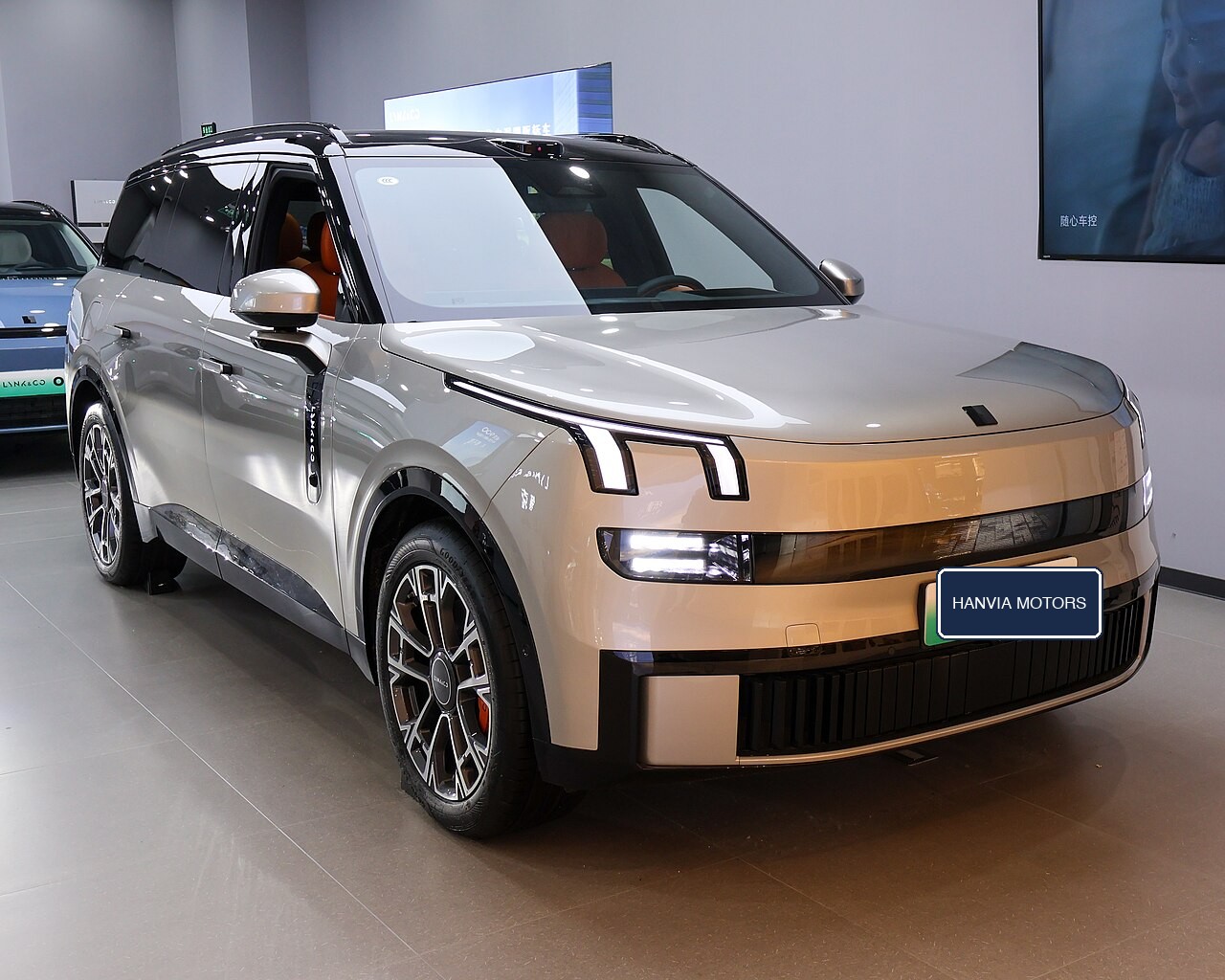
Short answer: you can buy a Lynk & Co 900 in Dubai’s re-export market, but it is a Chinese-built car, and sourcing it in Dubai means paying for a leg it already travelled. At source in China the 900 runs CNY 299,800 to 416,900 across six trims. The UAE itself only registers vehicles that are left-hand drive and under 10 years old, both of which a new 900 satisfies comfortably. The question worth asking is not where in Dubai to find one, but whether Dubai needs to be in your supply chain at all.
This page covers the China price ladder trim by trim, what the Dubai leg actually adds, the UAE rules that govern registration and re-export, and the specifications that decide whether the car suits Gulf and onward African conditions.
Quick answers
- Is the Lynk & Co 900 left-hand drive? Yes, and the UAE registers left-hand drive only.
- What does it cost at source? CNY 299,800 for the 1.5T Halo five-seat, up to CNY 416,900 for the 2.0T 探索版.
- Why is it cheaper direct from China? Because a Dubai unit has already carried freight, a trader’s margin and often a registration step.
- Will it run on Gulf fuel? Yes. It specifies 95 RON, and Special 95 is the UAE’s standard grade.
- Ground clearance? 194 mm across every trim, which is usable on the roads most re-export destinations have.
What “from Dubai” actually means
Dubai is one of the world’s largest vehicle re-export hubs. Cars arrive there from Japan, Korea, China, Europe and the US, sit in trader yards, and leave again for Africa, Central Asia and the subcontinent. For a lot of models that is genuinely useful, because Dubai aggregates supply that would otherwise be scattered.
The Lynk & Co 900 is a different case. It is built by Geely in China. A 900 sitting in a Dubai yard got there the same way anything else does: it was shipped from China. By the time you buy it, the unit has absorbed China-to-UAE freight, a trader’s margin, UAE handling, and in many cases a registration and de-registration cycle before it can be exported again.
None of that makes the car worse. It makes it a car you are buying second in line. If your destination is anywhere Chinese vessels already call — West Africa, East Africa, Central Asia, Latin America — the shorter route is to buy at origin and ship once. Our breakdown of who really sells you a Chinese car sets out where the layers of margin sit in this trade.
There are cases where Dubai still wins. If you need a unit this month and cannot wait on a build slot, a yard car is available now and a factory order is not. If your destination has no direct sailing from China but a well-served route from Jebel Ali, the freight maths can favour Dubai. Both are real. Neither is about the car.
Lynk & Co 900 price at source: the full trim ladder
Chinese guide prices. The six-seat line launched in April 2025; a five-seat line followed in April 2026.
| Trim | Seats | Engine | Battery | CLTC electric | 0–100 km/h | China guide price |
|---|---|---|---|---|---|---|
| 2026 1.5T Halo | 5 | 1.5T, 140 kW | 44.85 kWh | 220 km | 4.8 s | CNY 299,800 |
| 2026 1.5T Ultra | 5 | 1.5T, 140 kW | 44.85 kWh | 220 km | 4.8 s | CNY 325,800 |
| 2025 1.5T Halo | 6 | 1.5T, 140 kW | 44.85 kWh | 220 km | 4.8 s | CNY 309,900 |
| 2025 1.5T Ultra | 6 | 1.5T, 140 kW | 44.85 kWh | 220 km | 4.8 s | CNY 336,900 |
| 2025 2.0T Ultra | 6 | 2.0T, 187 kW | 52.38 kWh | 280 km | 4.6 s | CNY 366,900 |
| 2025 2.0T 探索版 | 6 | 2.0T, 187 kW | 52.38 kWh | 268 km | 4.3 s | CNY 416,900 |
Three observations a Dubai listing will not give you.
The five-seat car is the cheaper car, not the stripped one. At matching trim the 2026 five-seat sits about CNY 10,100 below the six-seat: CNY 299,800 against 309,900 on Halo, CNY 325,800 against 336,900 on Ultra. It also carries dramatically more luggage — 1,215 litres behind the second row against 300 litres behind the six-seater’s third row, a gap of 915 litres. If your customer is not going to use a third row, they are paying more for less space. Our Lynk & Co 900 five-seat vs six-seat comparison goes through the layouts in detail.
The 2.0T is a different powertrain, not a bigger badge. It steps from 140 kW to 187 kW on the engine, from a 44.85 kWh battery to 52.38 kWh, and from 220 km to 280 km of CLTC electric range. The 探索版 adds a third motor for 463 kW combined and 4.3 s. That is CNY 117,100 above the entry car.
Every trim is the same size. 5,240 mm long, 1,999 mm wide, 3,160 mm wheelbase, 194 mm of ground clearance. Nothing in the ladder changes the footprint.
UAE rules that govern the car
Two hard constraints apply if the vehicle is to be registered in the UAE rather than simply transiting.
- Left-hand drive only. Right-hand-drive vehicles cannot normally be registered for road use in the UAE, with narrow exceptions for approved classics. The Lynk & Co 900 is left-hand drive, so this is not an obstacle.
- Under 10 years old. Imported vehicles must generally be less than ten years old. A new 900 is obviously fine; this matters more if you are looking at used stock in a Dubai yard.
Note that a car passing through Dubai purely for re-export does not necessarily follow the registration path — traders often move units on export plates without registering them locally. Which route applies changes your paperwork and your cost, so establish it before you agree a price.
The onward leg is where age rules bite hardest. Destination countries set their own limits, and some are far tighter than the UAE’s ten years. Algeria, for one, is widely reported to require vehicles under three years old measured at the moment of customs filing, with little tolerance for a discrepancy. We do not publish destination duty rates or age limits as fixed numbers, because they change and a stale figure is worse than none — confirm the current position for your destination before committing. What we will say is the mechanism: age is calculated from the build date, not the model year, and those two disagree routinely on Chinese vehicles. Our guide to Chinese model names and export names and our seven import traps checklist both cover how to settle a build date from the VIN.
Does the 900 suit Gulf and onward conditions?
Fuel: matched. The 900 specifies 95 RON. UAE stations sell E-Plus 91, Special 95 and Super 98, with Special 95 as the standard grade most manufacturers recommend. No issue in the Gulf. Worth checking on the onward leg though — several West African markets retail 91 or 93 as standard, and a 95-RON engine becomes a live question there. If that is your destination, the BYD Qin PLUS DM-i and Seal 05 DM-i run on 92 RON instead.
Ground clearance: comfortable. 194 mm across the range. That is meaningfully better than the 171 mm of the Zeekr 8X, and enough for the mixed surfaces most re-export destinations actually have.
Heat and charging. The 900 is a plug-in hybrid, so a customer with no charger still has a fully working car and simply forgoes the 220 to 280 km of electric range. In Gulf and African markets where public charging is thin or unreliable, that architecture removes the main objection to a Chinese new-energy vehicle. It is the same argument we set out for hybrids into Nigeria and across the segment in top Chinese SUVs and EVs for export in 2026.
Weight, for your shipping maths. 2,660 to 2,820 kg depending on trim, on a 5,240 mm body. That is a large, heavy unit. Our guide to how many cars fit in a 40ft container and our comparison of shipping routes from China to African ports cover where that starts to matter.
Buying direct instead
If the Dubai leg is not buying you speed or a better sailing, the direct route is straightforward.
- Choose the trim and the seat count. “Lynk & Co 900 Ultra” describes two different cars at two different prices. Put the layout on the purchase order.
- Confirm destination rules. Age limit, drive side, emissions and any homologation requirement, with your broker and the current schedule.
- Send us the destination port. We come back with availability, an FOB or CIF quote and a timeline.
- Start battery documentation at order. A 44.85 or 52.38 kWh pack ships under lithium battery rules, which take longer to paper than a petrol SUV.
Hanvia Motors sources at origin and ships from Tianjin Port and the Khorgos land port, so the car makes one journey rather than two. We handle inspection and condition reporting, export documentation and freight. See the Lynk & Co 900 order page, or the smaller Lynk & Co 06. Other flagships worth comparing: the Zeekr 9X and Zeekr 8X, with the layout question covered in Zeekr 9X five-seat vs six-seat. If you are new to sourcing at origin, start with our 2026 dealer guide to importing from China and how to verify a Chinese exporter.
Frequently asked questions
Can I export a Lynk & Co 900 from Dubai?
Yes, Dubai has an established vehicle re-export trade and units can be moved on export plates. But the 900 is built in China, so a Dubai unit has already travelled from China and carries that freight plus a trader’s margin. Unless Dubai buys you immediate availability or a better sailing to your destination, buying at origin means shipping the car once instead of twice.
How much does a Lynk & Co 900 cost?
Chinese guide prices run from CNY 299,800 for the 2026 1.5T Halo five-seat to CNY 416,900 for the 2025 2.0T 探索版. Guide prices are not transaction prices, and landed cost depends on your port, duties and freight. Ask for an FOB or CIF quote against a specific trim.
Is the Lynk & Co 900 left-hand drive?
Yes. Every trim is left-hand drive, which is what the UAE requires for registration and what most of the onward re-export destinations need. Right-hand-drive vehicles cannot normally be registered in the UAE.
What is the age limit for importing a car into the UAE?
Vehicles imported into the UAE must generally be under ten years old and left-hand drive. A new Lynk & Co 900 clears both. Destination countries on the onward leg often apply much tighter limits than the UAE, and those are calculated from the build date rather than the model year, so confirm the current rule for your specific market.
What fuel does the Lynk & Co 900 take?
95 RON. In the UAE that is Special 95, the standard grade at ADNOC, ENOC and EPPCO stations, so there is no constraint locally. On the onward leg it can matter: several West African markets retail 91 or 93 RON as standard.
Five-seat or six-seat?
The five-seat is both cheaper and roomier for luggage. At matching trim it is about CNY 10,100 less, and it offers 1,215 litres behind the second row against 300 litres behind the six-seater’s third row. Take the six-seat only where the third row will genuinely be used.
Can Hanvia Motors supply the 900 direct from China?
Yes. Units are built to order rather than taken from stock. Send your destination port, the trim and the seat count and we confirm availability, pricing and a delivery timeline, shipping from Tianjin Port or the Khorgos land port.