
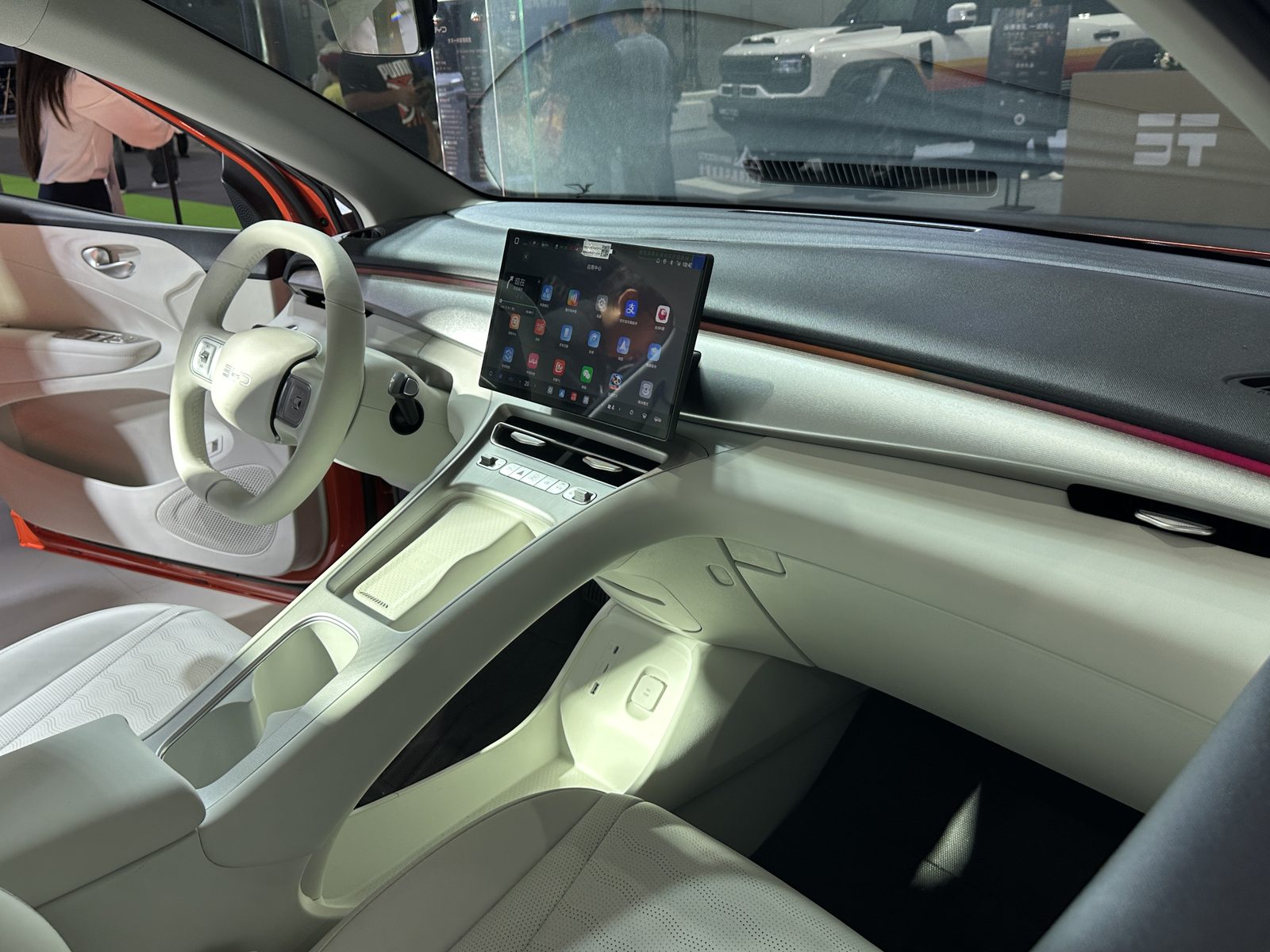
The second-generation BYD Seagull is 425 mm longer than the car it replaces, seats five instead of four, moves to rear-wheel drive and offers up to 420 km of CLTC range. It went on sale in China on 20 October 2026 in five trims. For an Ethiopian importer, the five-seat layout is the change that decides whether the car can serve taxi and family buyers at all; the five-minute flash charge is the change least likely to matter, because it depends on charging stations that exist only in China.
This is not a facelift. It is the first full generation change since the Seagull launched in 2023, and it moves the car up a size class — from the A00 city-car segment into the A0 supermini class, close to the Dolphin. The first-generation car remains what is actually available for export today; the new one has not been released for export yet.
We do not quote Chinese guide prices here: they do not reflect landed cost in Djibouti or Addis Ababa, and they make poor negotiating anchors.
👉 Is five seats a hard requirement for your next order? Ask us on WhatsApp · see the first-generation Seagull export guide →
What is the second-generation BYD Seagull?
The Seagull (海鸥) is BYD’s entry-level electric hatchback, sold through its Ocean network. The second generation was launched at the Zhengzhou International Circuit on 20 October 2026, with five trims and two battery sizes. It is built in Zhengzhou, Henan.
At 4,205 mm it is no longer a microcar: it is now almost the same length as the Dolphin, a separate model rather than a rebadged Seagull. Buyers cross-shopping the two should re-read our Dolphin versus Seagull comparison, because the gap has narrowed.
At launch the car is China-only, and BYD has not announced an export date. One trade report points to fleet handovers in early 2027; Brazilian coverage says the new generation stays China-only through 2027 and exports from 2028. No Ethiopian date, specification or price has been announced, so you cannot inspect a production export unit.
How much bigger is the Seagull Gen 2 than the Gen 1?
The new car is 425 mm longer, 95 mm wider and 30 mm taller, on a wheelbase stretched by 150 mm. Most of that length went into the cabin and the rear overhang, not the nose.
| Specification | Gen 1 (from 2023) | Gen 2 (from October 2026) |
|---|---|---|
| Length × width × height | 3,780 × 1,715 × 1,540 mm | 4,205 × 1,810 × 1,570 mm |
| Wheelbase | 2,500 mm | 2,650 mm |
| Seats | 4 | 5 |
| Battery (LFP Blade) | 30.08 / 38.88 kWh | 30.1 / 39.2 kWh |
| CLTC range | 305 / 405 km | 320 / 420 km |
| Motor | 55 kW / 75 PS | 95 kW on 420 km trims; 85 kW quoted for 320 km trims |
| Drive | Front-wheel drive | Rear-wheel drive |
| Rear suspension | Torsion beam | Multi-link independent |
| DC charging | 30–80% in 30 minutes | 10–70% in 5 minutes at BYD flash stations |
| Top speed | 130 km/h | 150 km/h |
| Kerb weight | 1,160–1,240 kg | 1,180–1,255 kg |
| Cargo, quoted maximum | 930 L | 1,380 L, plus a 94 L front trunk |
| Tyres | 165/65 R15 or 175/55 R16 | 205/60 R16 |
The cargo figures are manufacturer maximums with the rear seats folded; neither describes the boot behind the seats, so do not compare them as if they did.
The size change has a freight consequence: the Gen 2 is 425 mm longer and 95 mm wider, so ask for a loading plan rather than assuming the old container count still applies. Our comparison of RoRo and container shipping explains why the answer changes the per-car freight number.
Does the new Seagull have five seats?
Yes. The second-generation Seagull is homologated as a five-seat car in China, with a three-place rear bench. That is the single most important change for this market.
The Gen 1 was a four-seater: the wrong vehicle for a family of five, and a limit on taxi work. Ethiopia’s EV import rules pushed many Addis Ababa buyers into this segment anyway, and the four-seat limitation was a recurring objection. The new car removes it, and rear legroom and hip room were enlarged with taxi use in mind.
Two cautions. Seat count is a homologation item: confirm it on the import documents and the unit’s plate, because export configurations can differ. And five seats do not make this a family SUV — it is still a 4.2-metre hatchback with a modest boot; families carrying five adults and luggage should look at the Yuan UP or Yuan Plus instead.
Our guide to EVs for Addis Ababa ride-hailing sets out the questions that matter more than the badge.
How much range does the Seagull Gen 2 have?
BYD quotes two CLTC figures: 320 km from a 30.1 kWh pack, and 420 km from a 39.2 kWh pack. The first-generation car was rated 305 km and 405 km from almost identical battery capacities — 30.08 kWh and 38.88 kWh.
The small gain is the honest story. The new car is longer, wider, heavier and considerably more powerful, so most of the extra battery energy goes into moving the extra mass and turning the bigger tyres. A 15 km increase at the top of the range is not a reason on its own to replace a Gen 1 fleet.
CLTC is a Chinese lab cycle and flatters urban EVs. Reported WLTP conversions are roughly 259 km for the 30 kWh version and 340 km for the 39.2 kWh version — still a lab number, but a better guide to mixed driving. Plan around WLTP, and treat a supplier who quotes only CLTC as someone who has not thought about the buyer’s use case.
The 420 km version is the one for intercity work. The Addis Ababa–Adama corridor and the route south toward Hawassa are both within a single charge on paper, but a loaded car climbing out of the Rift Valley will not return the lab figure. Ask for a real-world test on the route the customer actually drives.
What changed under the Seagull’s skin?
Four changes matter to a buyer, and one of them is not visible on the spec sheet.
Power. The motor rises from 55 kW to 95 kW in the 420 km versions, an increase of about 73%. That is the difference between a city car that struggles with a full load on a hill and one that keeps up with traffic. The 320 km versions are quoted at 85 kW — still a large step up from the old car.
Drive layout. The Gen 2 is rear-wheel drive, where the Gen 1 was front-wheel drive. Rear drive improves traction under acceleration and gives a tighter turning circle in tight spaces, but it also changes how the car behaves on loose gravel or a wet, unsealed slope with a light rear end. Test one loaded on the kind of road your customer actually uses before you order a fleet.
Rear suspension. A multi-link independent rear axle replaces the torsion beam. This is a genuine comfort and stability improvement for rear-seat passengers, which matters for taxi work.
Tyres and speed. The car moves to 205/60 R16 tyres and a 150 km/h top speed, against 165/65 R15 or 175/55 R16 and 130 km/h before. The wider tyres give more grip and more pothole protection, but they cost more to replace and are less likely to be stocked by a small tyre shop outside Addis Ababa. Price a set before you commit to a fleet.
One thing BYD has not published is ground clearance. For Ethiopian roads that is not a minor omission. Ask for the figure, and measure it on a unit if you can, before you promise a customer that the car will handle a rural route.
Does the five-minute flash charge work in Ethiopia?
No — not as advertised. The 10%–70% in five minutes figure applies at BYD’s dedicated flash-charging stations, and only the three 420 km trims support it. It is not a property of the car that transfers to any DC charger.
BYD is building that network in China, not in Ethiopia. The public charging network around Addis Ababa remains thin — our Ethiopia import guide puts it at roughly 100 stations in the capital against a national requirement several times that size. A flash-charging station is not among them, and is unlikely to be for years.
BYD has not published a standard DC charging time for the new car. That is a real gap in the launch data: the old car’s 30–80% in 30 minutes was a useful, comparable number, and the new one has no equivalent figure yet. If a supplier markets the car on “five-minute charging”, ask what it does on a normal 60 kW DC charger. If they cannot answer, they are repeating a press release.
The practical position is the same as for any EV here: overnight AC charging at home or at a business, with DC occasional. The 94 L front trunk is a better feature for this market than the flash charge — it keeps the cables and adapters out of the cabin.
Which Seagull Gen 2 trim should an Ethiopian importer order?
There are five China-market trims, in two groups:
- 320 km group (two trims): 30.1 kWh battery, 85 kW motor. These are city cars. They suit a private buyer who charges at home and rarely leaves Addis Ababa.
- 420 km group (three trims): 39.2 kWh battery, 95 kW motor, flash charging. These suit taxi and fleet work, intercity use, and any buyer who cannot guarantee a nightly charge.
- The top trim adds a roof-mounted lidar and BYD’s DiPilot 300 driver-assistance system.
Our recommendation for most Ethiopian importers is a middle trim in the 420 km group. You get the larger battery and the stronger motor, which are the two things that affect daily usefulness, without paying for the lidar and the China-market assistance stack.
That top trim deserves a warning. Its navigation assist depends on mapping, connectivity and over-the-air service in the market where the car is sold, none of which has been confirmed for Ethiopia. A lidar-equipped car whose assistance cannot be activated is an expensive roof ornament, and harder to repair.
Export trim names will differ. Treat this structure as a guide to the battery and motor combination, not a price list.
Are BYD Seagull “GO” and “Lite” official trims?
We could not find either name in BYD’s Chinese launch material or confirmed export naming. They appear in dealer listings and blog posts, often attached to imported cars with unclear specifications.
Treat them as seller labels, not model codes. A “Seagull GO” could be a Gen 1, a Gen 2, a de-contented fleet build or a car with a badge the seller chose. The name tells you nothing about the battery, motor or seat count — the three things that decide what the car is worth.
Ask for the vehicle’s own specification sheet and check four numbers: battery capacity in kWh (30.1 or 39.2 for a Gen 2), motor output in kW (85 or 95), seat count (five for a Gen 2), and model year. Then check them against the VIN. Our checklist of import traps covers the rest of the pattern, and a remote inspection before payment is cheaper than discovering the mismatch in Djibouti.
When will the Seagull Gen 2 be available for export?
China first, export later. The launch was a Chinese-market event. Export timing is disputed: one trade publication reports fleet handovers from early 2027, while Brazilian coverage of the Dolphin Mini says the new car will stay China-only through 2027 and reach export markets from 2028. BYD has announced no Ethiopian launch, allocation or export price. Treat any date you are given as unconfirmed.
Export names in use are Dolphin Mini in South America, Dolphin Surf in Europe and Atto 1 in Australia and Southeast Asia. Ethiopia imports directly from China, so the car you are offered may keep the Seagull name and Chinese specification. That is not necessarily a problem — Ethiopia is left-hand drive — but it is a China-market car, not a market-specific export build.
Two checks: confirm the GB/T charging inlet against the customer’s charging point and budget for an adapter or wallbox; and until BYD publishes an export sheet, contract against the specification you can verify, not the launch presentation.
Is the first-generation Seagull still worth importing?
Yes, for the right buyer. The Gen 1 is proven: a 405 km top trim, a 55 kW motor, a 30-minute 30–80% DC charge and a large parts and service base after three years on the road. It is cheaper than the new car and available now.
The catch is the seat count: if the customer needs five, the Gen 1 cannot serve them, and no discount fixes that. If four are acceptable — a single buyer, a couple, a small delivery business — it remains a sensible import.
One market effect: the five-seat replacement will pressure Gen 1 resale values, so do not value stock on today’s retail price as though the new car did not exist. Our Seagull versus Wuling Bingo comparison still describes the Gen 1’s position against its closest rival.
For buyers who need five seats now rather than waiting for the export version, the Dolphin is the obvious alternative inside the BYD range, and the Dolphin versus Seagull comparison sets out the size and price step. The Yuan UP is the cheaper five-seat option.
What should an Ethiopian importer check before ordering?
Six things, in order:
- The import rule. Ethiopia treats electric and hybrid imports differently from petrol and diesel cars, and that difference is the main reason this segment exists. Our Ethiopia import guide sets out the current rules and the points still in flux; confirm the rate with a licensed clearing agent before you quote.
- The landed cost through Djibouti. Most Ethiopian vehicle imports arrive via the Port of Djibouti. Our CIF Djibouti explainer sets out what belongs in the number and what does not.
- The documents. The export document checklist covers the invoice, packing list, bill of lading and certificate of origin. A missing certificate of origin is the most common reason a duty exemption stalls at the border.
- The payment route. Letter of credit versus T/T explains when each protects the buyer, and what a supplier will and will not accept before a build slot is confirmed.
- The unit itself. Inspect before payment. For a new car that means confirming the build sheet, the battery capacity, the seat count and the charging equipment, not just the paint.
- The charging plan. Confirm the inlet standard and what the customer will charge from. A car that cannot be charged at the buyer’s premises is not a sale.
Frequently asked questions
Is the BYD Seagull Gen 2 a five-seater?
Yes. It is homologated as a five-seat car in China, with a three-place rear bench; the Gen 1 was a four-seater. Confirm the count on the import documents, because export configurations can differ.
What is the range of the Seagull Gen 2?
BYD quotes 320 km CLTC from a 30.1 kWh battery and 420 km CLTC from a 39.2 kWh battery. The reported WLTP equivalents are about 259 km and 340 km. Use the WLTP figure as the more realistic planning number for Ethiopian roads.
Is the Seagull Gen 2 rear-wheel drive?
Yes. The second-generation car moves to a rear-mounted motor and rear-wheel drive, with a multi-link independent rear suspension. The first-generation car was front-wheel drive with a torsion beam.
What is a BYD Seagull GO or Seagull Lite?
Neither appears in BYD’s Chinese launch material or confirmed export naming; they are dealer labels. Ask for battery capacity, motor output, seat count and model year, and check them against the VIN.
Can the Seagull Gen 2 use Ethiopian charging stations?
It charges on standard AC and DC equipment, but the five-minute flash charge only works at BYD’s dedicated stations, a Chinese network with no presence in Ethiopia. BYD has not published a standard DC time for the new car.
When can Ethiopia get the Seagull Gen 2?
No. Reporting conflicts: one trade report says fleet handovers begin in early 2027, Brazilian coverage says exports start in 2028, and BYD has announced no date. The first-generation car is what is available for export now.
Should I buy the Gen 1 or wait for the Gen 2?
Buy the Gen 1 if four seats are enough and you need the car now; it is cheaper and proven. Wait for the Gen 2, or choose a five-seat Dolphin or Yuan UP, if five seats are a requirement. Do not order a Gen 2 against an unconfirmed export specification without agreeing in writing what happens if it changes.
Sources: CnEVPost, “BYD launches larger second-gen Seagull, adds flash charging” (20 October 2026); East Asia Brief, “BYD widens Seagull hatchback to five seats for export drive” (October 2026); Autodeal Philippines, “Next-gen BYD Seagull gets a bigger body and more power” (October 2026), for the WLTP conversions; Paultan.org and AutoIndustriya launch coverage (21 October 2026), used for cross-checking the dimensions, battery and charging figures; WhichCar Australia, “2027 BYD Atto 1 teased” (September 2026), for the Australian export name; first-generation specifications from the EVlook Seagull configuration table (checked November 2026); Ethiopian import rules from our Ethiopia import guide. Brazilian coverage (AutoPapo and Quatro Rodas, October 2026) gives the conflicting 2028 export timing. The 85 kW output for the 320 km trims is from CnEVPost only; the WLTP conversions are from Autodeal only; Gen 2 kerb weight is from East Asia Brief only; Gen 1 charging time, top speed, kerb weight, tyre sizes and cargo volume are from the EVlook configuration table only. The exact export specification, Ethiopian availability and standard DC charging time for the Gen 2 have not been published. All range figures are CLTC unless stated as WLTP; prices are deliberately not quoted. Checked 8 November 2026. Photo: JustAnotherCarDesigner / Wikimedia Commons, CC0.