
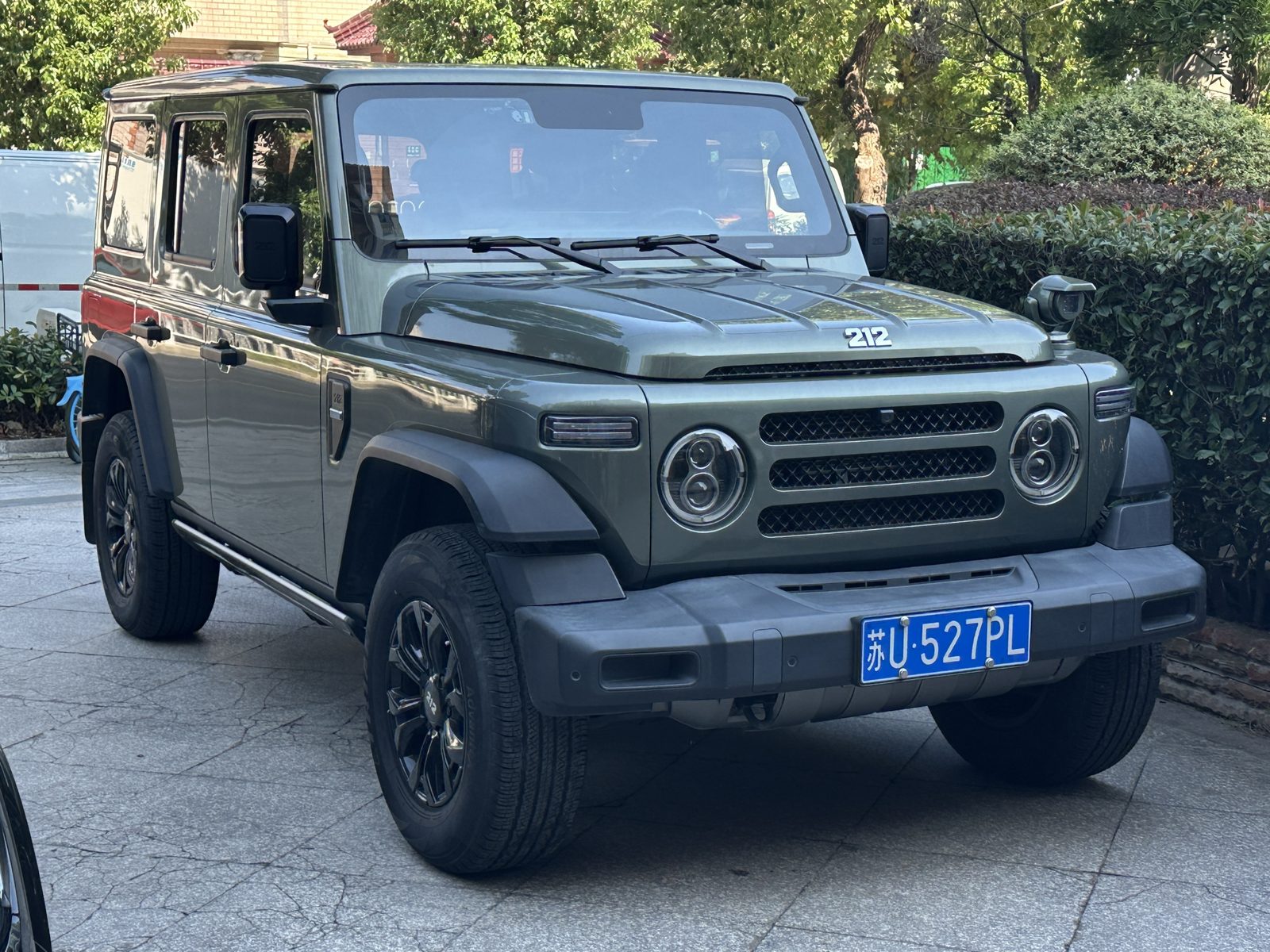
The 212 T01 and the BAIC BJ40 are the two Chinese boxy 4x4s buyers most often mix up. They look similar and both use ladder frames, but they come from different companies and are built to different briefs. The 212 T01 keeps solid axles at both ends, offers up to 256 mm of ground clearance and 850 mm of wading depth, and starts at a lower price in China. The BAIC BJ40 gives up the solid front axle for independent suspension, adds a longer body, a bigger boot and far more cabin technology, and has the longer official presence in GCC markets.
Desert tours, mining and remote-site fleets that modify their cars suit the 212 T01. Retail buyers who want comfort, driver assistance and a dealer-backed warranty are easier to sell the BJ40. This guide compares the hardware, the trim trap and the support situation as of November 2026.
👉 Need a quote? Ask us on WhatsApp · 212 T01 trims and engines explained
What are the 212 T01 and the BAIC BJ40, and are they related?
No. The 212 T01 is built by Beijing Auto Works (BAW), the company behind the original BJ212 military 4×4, and sold under the standalone 212 brand. It launched in China in August 2024. BAW is now part of the Shandong Weiqiao group, and the 212 brand held its global strategy launch in Dubai in October 2025, claiming a sales and service footprint in more than 70 countries.
The BAIC BJ40 is a BAIC Motor product sold under the Beijing (BAIC) brand. The current five-door generation went on sale in China in 2024, alongside older BJ40 bodies still offered in GCC showrooms. That is the first trap: “BJ40” in a dealer advert can mean three different vehicles.
- BJ40 Pro (current five-door): 4,790 mm long, 2,760 mm wheelbase, 2.0T petrol or diesel, independent front suspension. This is the car closest to the 212 T01.
- BJ40 SE: a two-door body, 4,645 mm long and 2,465 mm wheelbase, with a removable hard top.
- BJ40 Plus and older C versions: previous-generation bodies still listed by Gulf dealers, often with older engines or gearboxes.
If a buyer sends a BJ40 listing, ask for the model year, door count, wheelbase and gearbox before comparing it with anything. Our GCC spec versus China spec guide explains why the same badge can hide different hardware. The 212 side has a similar trap: the entry body and the Changfeng/Highland body differ in height, clearance and tyres. The 212 T01 export guide sets that out trim by trim, and Chinese model names versus export names explains the naming.
How do the 212 T01 and BAIC BJ40 compare on engines and gearboxes?
Both cars use a 2.0-litre turbocharged four-cylinder and an eight-speed automatic, but the 212 has the higher peak petrol output while the BJ40 delivers its torque lower down. The 212’s petrol engine, coded N20TG, makes 185 kW and 410 N·m from about 1,900 rpm. The BJ40 Pro’s 2.0T makes 180 kW and 386 N·m in GCC trim, or 395 N·m in the China-market version, with peak torque from 1,600 to 3,600 rpm.
| Item | 212 T01 2.0T petrol | 212 T01 2.0T diesel | BJ40 Pro 2.0T petrol | BJ40 Pro 2.0D diesel |
|---|---|---|---|---|
| Max power | 185 kW | 125 kW | 180 kW | 120 kW |
| Max torque | 410 N·m | 415 N·m | 386 N·m (GCC) / 395 N·m (China) | 390 N·m |
| Gearbox | 8AT | 8AT | 8AT | 8AT |
| Fuel | 92-octane | Diesel | 92-octane | Diesel |
| Tank | 80 L | 80 L | 85 L | 85 L |
| Emissions (China) | China VI | China VI | China VI | China VI |
On paper the 212 petrol is slightly ahead: 5 kW and 15 to 24 N·m. In practice the BJ40’s torque curve is broader and arrives earlier, which makes it feel stronger in traffic and on graded roads. The 212’s advantage is at the top end, where the extra power helps in soft sand and at altitude.
The 212’s 125 kW and 415 N·m diesel is the torquier unit and the one to order for low-speed pulling and long gravel routes. The BJ40’s 120 kW and 390 N·m diesel is the smoother unit in our reading of the dealer specifications, and BAIC’s market sheets list 800 mm of wading for the diesel against 750 mm for the petrol. Both are China VI. The BJ40 Pro diesel is listed for 0# to -35# diesel, so confirm cold-start equipment and local fuel grade before promising winter use in Central Asia.
Which has the stronger off-road hardware, the 212 T01 or the BAIC BJ40?
The 212 T01 has the more traditional, modification-friendly chassis; the BJ40 Pro has the more capable electronics package. The 212 uses a ladder frame with solid axles and five-link coil suspension at both ends, part-time four-wheel drive with low range, and a disconnecting front anti-roll bar on some trims. The BJ40 Pro uses independent double-wishbone front suspension and a multi-link solid rear axle, also with part-time 4WD and low range.
| Item | 212 T01 (tall body) | 212 T01 (entry body) | BJ40 Pro | BJ40 SE (2-door) |
|---|---|---|---|---|
| Front suspension | Solid axle, five-link | Solid axle, five-link | Independent double wishbone | Independent double wishbone |
| Rear suspension | Solid axle, five-link | Solid axle, five-link | Multi-link solid axle | Five-link solid axle |
| Clearance | 256 mm | 235 mm | 220–230 mm | 210 mm |
| Wading | 850 mm (910 mm with snorkel) | 850 mm | 750 mm petrol / 800 mm diesel | Not stated |
| Locks | Front and rear, trim-dependent | Front and rear, trim-dependent | Front, rear and centre transfer case | Front, rear and centre |
| Low range | Yes | Yes | Yes | Yes |
The 212’s clearance advantage is real: 256 mm on the Changfeng and Highland bodies against 220 to 230 mm for the BJ40 Pro. That matters on rutted tracks, in soft sand and when a buyer fits larger tyres. The 212 also quotes 850 mm of wading depth, rising to 910 mm with the optional raised intake, against 750 mm for the petrol BJ40.
The BJ40 answers with electronics the 212 does not offer: front and rear locking differentials plus a centre transfer case on the Pro, crawl mode, a tank-turn function and a wading sensor. The 212’s locks are listed as front and rear electronic units on some trims and as options on others. Confirm what is fitted to the unit you are buying.
Angles are where published figures disagree most. Chinese 212 tables quote about 40 degrees approach and 36 departure; a UAE dealer listing quotes 36 and 40 in the opposite order. The BJ40 Pro is listed at 36–37 degrees approach and 31 departure, depending on the market sheet. Treat the 212 figures as approximate until you have the exact trim sheet.
How do the 212 T01 and BAIC BJ40 compare on size and daily comfort?
The BJ40 is the longer car and the easier one to live with; the 212 is taller and has the longer wheelbase, but gives away cabin space and technology. The 212 Changfeng measures 4,749 mm long, 1,945 mm wide and 1,999 mm tall on a 2,860 mm wheelbase, with a 2,265 kg kerb weight. The entry body is 4,705 mm long, 1,895 mm wide and 1,936 mm tall, at about 2,150 kg.
| Item | 212 T01 Changfeng | 212 T01 entry body | BJ40 Pro |
|---|---|---|---|
| Length | 4,749 mm | 4,705 mm | 4,790 mm |
| Width | 1,945 mm | 1,895 mm | 1,940 mm |
| Height | 1,999 mm | 1,936 mm | 1,895 mm |
| Wheelbase | 2,860 mm | 2,860 mm | 2,760 mm |
| Kerb weight | 2,265 kg | 2,150 kg | 2,130 kg |
| Boot | Fold-flat rear seats | Fold-flat rear seats | 965 L |
| Tyres | 285/70 R17 | 265/70 R17 or 265/65 R18 | 265/65 R17 |
The 212’s extra height and wheelbase do not translate into a roomier cabin. It is a narrower, more utilitarian package, with a 12.3-inch centre screen, a 10.25-inch cluster, a 360-degree camera and, in UAE specification, heated and massaging front seats. Materials and sound insulation are a step below the BJ40’s.
The BJ40 Pro is the more complete family car. It has a 12.8-inch centre screen, a second 12.8-inch screen for the passenger, a 10.25-inch cluster, a panoramic roof, ventilated and massaging front seats, powered side steps and a 965-litre boot. It also carries an ADAS suite with autonomous emergency braking, adaptive cruise, lane keeping and blind-spot monitoring. None of that is available on the 212 in the specifications we have seen. A family buyer will accept the BJ40’s smaller clearance for its ride and equipment; a buyer treating the car as a tool will prefer the 212’s simpler hardware.
Which of the two is easier to modify and repair?
The 212 T01 is the easier car to modify and the simpler one to repair in a basic workshop. Solid axles at both ends, coil springs, a disconnecting anti-roll bar and a part-time transfer case are familiar territory for off-road specialists, and lifting the body or fitting larger tyres does not require recalibrating an independent front suspension or a suite of driver-assistance sensors. The 212 also has a growing Chinese aftermarket for bumpers, rock sliders, snorkels and suspension kits.
The BJ40 has a large Chinese aftermarket too, but its electronics work against deep modification. The ADAS sensors, cameras and 8155-based infotainment all need to keep working after a lift or a bumper change, and independent front suspension limits how far you can raise the car. For a buyer who wants a 50 mm lift and 33-inch tyres, the 212 is the cleaner starting point.
Repair cost depends more on parts supply than on the car. Outside China, the 212’s simplicity helps a good independent workshop, but body panels must come from China and its overseas parts network is younger. The BJ40 benefits from BAIC’s longer export history and wider dealer footprint, so consumables and body parts are easier to source in GCC markets. In a market with no dealer for either brand, plan a small stock of filters, brake pads, belts and suspension bushes.
What dealer and parts support exists in the Gulf and Central Asia?
Both brands now have an official UAE distributor, which changes the import calculation. The 212 brand appointed Legend Motors, part of Legend Holding Group, as its exclusive UAE distributor, and opened a flagship showroom on Al Ittihad Road in Deira, Dubai, in December 2025, with a second site in Musaffah, Abu Dhabi. It offers sales, after-sales and genuine parts.
BAIC’s UAE distributor is Al Shaali Moto, which sells the BJ40 Pro and BJ40 SE through its Dubai showrooms. BAIC also has dealer coverage in Saudi Arabia, where the BJ40 SE and BJ40 C are listed with agency warranties.
For an importer, the practical difference is this: the 212 now has an official UAE channel, so a parallel import has to compete with a dealer car that comes with a local warranty and parts counter. The same is true of the BJ40, but its channel is more mature.
In Central Asia, both brands are sold through independent importers. The 212 has a visible presence at Moscow and Kazakh shows and in Kazakh dealer listings; the BJ40 has been exported there longer. For transport via Khorgos, see our Horgos port guide, and for the wider context Chinese cars in Russia and Central Asia.
How do the 212 T01 and BAIC BJ40 compare on price for importers?
The 212 T01’s China guide price starts below the BJ40’s and stays below it across the range, which is the main reason buyers ask about it. The gap is widest at entry level, where the 212 competes on hardware per dollar rather than on equipment. The BJ40’s higher guide price buys the longer body, independent front suspension, extra screens and the ADAS suite.
We do not publish China guide prices as export quotes, and we do not quote our own prices. Use the relative position when building a business case: the 212 leaves more room for freight, duty and dealer margin at the same retail price. In the UAE both cars are now sold through official dealers, so check the local retail price before assuming a parallel import is cheaper. A China-spec car with a different screen, tyre or lock package is not the same product as the GCC car.
Resale follows the same logic. Where the BJ40 has an official dealer and a known badge, it will hold value better than a newly introduced 212. Where neither has a dealer, resale depends on parts availability and importer support.
Which should you import for your market?
There is no single winner. The right car depends on the buyer, the terrain and the support you can offer after the sale.
- Desert tours, mining and remote-site fleets: choose the 212 T01 Changfeng petrol. Its 256 mm clearance, solid axles, 850 mm wading depth, 2.5-tonne UAE towing rating and simpler electronics make it the better tool. Order the locks explicitly and specify the taller body.
- Retail buyers who want comfort, safety aids and a warranty: choose the BJ40 Pro through the official channel, or import only if you can beat the local dealer on price and specification.
- Two-door buyers: the BJ40 SE is the only short-wheelbase option here. Market it as a lifestyle 4×4 with a removable roof and three locks, not a fleet vehicle.
- Central Asian mountain and gravel routes: the 212 Changfeng diesel is the stronger low-speed and towing unit, with 415 N·m and an 80-litre tank. Confirm cold-weather diesel availability and emissions rules first.
- Markets with no dealer for either brand: the 212 is easier for an independent workshop to keep running, but parts take longer. The BJ40 has broader parts coverage but more electronics to diagnose.
If you are weighing other body-on-frame rivals, see our 212 T01 versus Tank 300 and Tank 300 export versions, or the 212 T01 versus Jetour T2 comparison. For pickups, read the Nissan Navara Pro guide and Hilux stock and shipping notes. For the wider list of models, see top Chinese SUVs and EVs for export.
What should you check before buying either car in China?
- Identify the exact BJ40. Confirm whether it is a Pro five-door, an SE two-door or an older Plus/C body. Wheelbase, suspension, gearbox and equipment all change with the body.
- Identify the exact 212 body. The entry body has 235 mm of clearance and smaller tyres; the Changfeng and Highland bodies have 256 mm and 285/70 R17 tyres. A UAE-spec T01 may run 18-inch wheels.
- Confirm the locks. The 212’s front and rear locks are trim-dependent and sometimes optional. The BJ40 Pro has front and rear locks plus a centre transfer case; the SE has three. Get the build sheet, not the brochure.
- Check emissions and fuel. Both petrol engines are China VI and ask for 92-octane; both diesels are China VI. Confirm destination import rules and local diesel sulphur content.
- Check the model year. The same name appears across 2024, 2025 and 2026 with different equipment. The 212 diesel only arrived in December 2025, so its field record is shorter.
- Inspect before shipping. See visiting Guangzhou to inspect cars and the Nansha terminal guide, plus shipping options and RoRo versus container.
We do not hold export qualifications or brand authorisation, and we do not publish prices in this guide. Ask us on WhatsApp for current availability and a quote on the exact trim.
FAQ
Are the 212 T01 and BAIC BJ40 the same company?
No. The 212 T01 is built by Beijing Auto Works (BAW) and sold under the 212 brand, now part of the Shandong Weiqiao group. The BAIC BJ40 is a BAIC Motor product sold under the Beijing (BAIC) brand. They share a boxy shape, not a platform.
Does the BAIC BJ40 have front and rear differential locks?
The BJ40 Pro has front and rear locking differentials plus a centre transfer case, according to the UAE dealer specification. The BJ40 SE lists three locks. Older or lower trims may have a rear lock only, so confirm the build sheet.
Is the 212 T01 sold officially in the UAE?
Yes. Legend Motors, part of Legend Holding Group, is the exclusive UAE distributor. It opened a flagship showroom in Deira, Dubai, in December 2025, with a second site in Musaffah, Abu Dhabi.
Which is better in desert sand, the 212 T01 or the BJ40?
The 212 T01 has the advantage in clearance, wading depth and solid-axle durability, which suits dune and desert-track use. The BJ40 Pro has the broader torque curve and more comfort, which suits long highway drives to the desert. For a modified tour fleet the 212 is the better base; for a retail buyer who drives to work all week, the BJ40 is easier to live with.
Can I import a China-spec BJ40 or 212 into the Gulf?
Yes, but the China-spec car is not identical to the GCC car. Power ratings, wheel sizes, clearance and equipment differ, and the local dealer may offer a warranty the import cannot match. Check the exact specification and local type-approval rules before shipping.
Sources: Zhichepai 212 T01 configuration table (dimensions, clearance, output); 212 China launch coverage from Zhihu, Dongchedi and 58che (August 2024, 185 kW/410 N·m); YallaMotor UAE launch article (Legend Motors distributor, 248 hp, 235 mm clearance, 18-inch tyres); DriveArabia and Dubicars on the Legend partnership and Deira showroom; CRI and Yicai on the 27 October 2025 Dubai launch and 70-country network; Bitauto global BJ40 config (180 kW/395 N·m, 2,760 mm wheelbase, 230 mm clearance, 965 L boot); Germantech Motors UAE BJ40 Pro and SE pages (386 N·m, 390 N·m diesel, front and rear locks, 220 mm clearance, 750/800 mm wading, 36/31 degrees; SE 4,645 mm, 2,465 mm wheelbase, 210 mm, 165 kW/380 N·m, three locks); BAIC Argentina, Peru and Philippines official BJ40 Pro pages; Autohome and 58che BJ40 tables; Al Shaali Moto and Dubicars UAE listings; Almuraba and Syarah Saudi listings. All checked November 2026. Figures differ by trim, model year and destination. Only from YallaMotor: the 248 hp UAE rating, 18-inch tyres and 2.5-tonne towing. 212 approach and departure angles conflict between sources, so no single figure is given. Photo: JustAnotherCarDesigner / Wikimedia Commons, CC0.