
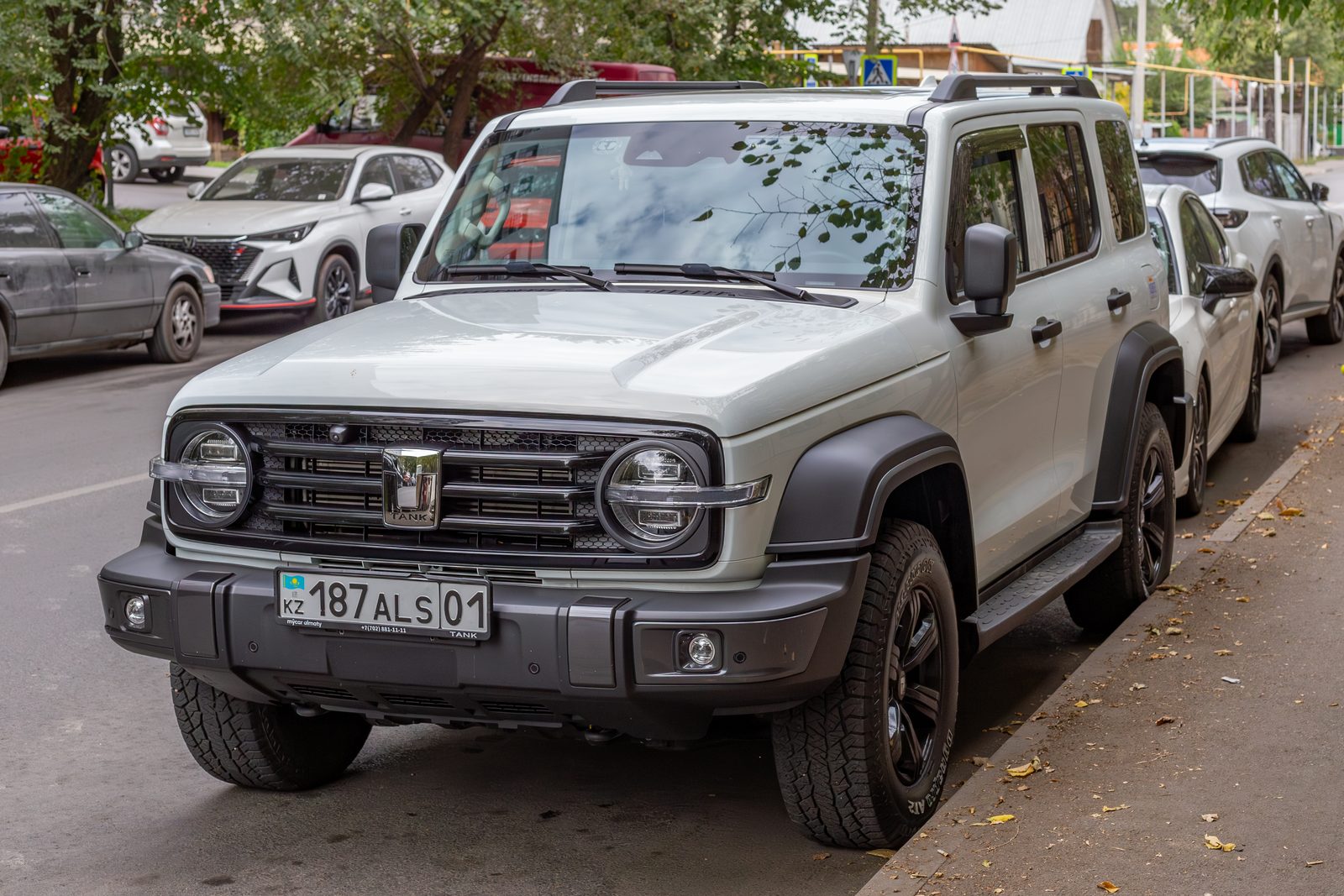
The Tank 300 is not one vehicle in 2026. Gulf distributors sell a 167 kW 2.0T petrol with a ZF eight-speed. China’s 2026 line-up adds a 480 Nm 2.4T diesel with a nine-speed automatic and a 300 kW Hi4-T plug-in hybrid with a 37.11 kWh battery. Russia and Kazakhstan sell a 218–220 hp 2.0T assembled locally. The version you order decides the gearbox, fuel system, charging standard and service network your buyer inherits.
The same badge also moves through parallel channels from China, where a diesel or plug-in hybrid can look cheaper and still lack urea supply, high-voltage service and type approval at destination.
👉 Checking a Tank 300 build sheet or quotation? Send it to us on WhatsApp · what GCC spec actually changes →
Which Tank 300 versions are on sale in 2026?
Four powertrains and two body lengths carry the Tank 300 name in 2026, and no single market gets all of them.
| Version | Main markets | Output | Gearbox | Body |
|---|---|---|---|---|
| 2.0T petrol | GCC, Russia, Kazakhstan, China | 167 kW rated / 162 kW net; 380–387 Nm | ZF 8AT in GCC and Russia; 9AT in China from 2026 | 4,750 mm |
| 2.0T HEV | UAE dealer line-up | 255 kW / 648 Nm combined | 9HAT | 4,760 mm |
| 2.4T diesel | China, Thailand, Australia | 135 kW / 480 Nm | 9AT | 4,750 mm |
| Hi4-T PHEV | China, Australia, New Zealand | 300 kW / 750 Nm combined | 9HAT | 4,760 mm; 4,886 mm as the China-only 300L |
The 2.0T petrol is the car Gulf dealers know: a 1,967 cc E20CB four-cylinder with a part-time transfer case. The UAE HEV pairs an E20NA 2.0T with a motor; the diesel is the E24D family; the Hi4-T is a parallel hybrid with a much larger battery.
Body length is the first thing to check. The export car is 4,750–4,760 mm on a 2,750 mm wheelbase. The new long-wheelbase body is 4,886 mm on 3,010 mm and, for now, stays in China. Model-year labels are unreliable; the Hilux generational guide shows the same trap, and the Jetour naming guide explains why badges mislead.
What does the Gulf-spec Tank 300 include?
The Gulf-spec Tank 300 that GWM Oman lists is a 2.0T petrol with 167 kW, 387 Nm and a ZF eight-speed, not the diesel or plug-in hybrid. It has a dual-speed part-time four-wheel-drive system with 2H, 4H and 4L, front and rear locks, crawl control, tank turn and nine driving modes.
The off-road numbers are common to petrol and diesel: 224 mm ground clearance, 33/34/23.1-degree angles, 700 mm wading and a 70% climb. The Chinese and Russian cars use 265/65 R17; confirm the GCC wheel and tyre package on the exact trim.
The UAE is the wider Gulf market: dealer listings show the 2.0T petrol and a 2.0T HEV with 255 kW and 648 Nm combined, 9HAT and front and rear locks. GWM’s own HEV sheet gives the same figures. The HEV suits retail customers whose dealer can service high-voltage systems, not fleets.
Diesel is the gap: GWM Oman lists only petrol, and UAE dealer listings are dominated by petrol and HEV, with some China-spec diesel units. The 2.4T diesel is a factory offering in China, Thailand and Australia, so in the Gulf it comes through parallel channels. The Hilux country-version guide shows how far Gulf and Asian specs diverge.
What is the 2.4T diesel, and who should order it?
The 2.4T diesel is the torque choice: 135 kW and 480 Nm from 1,500 rpm, a nine-speed automatic, a 78-litre tank and 2,500 kg braked towing. China added it for 2026 and positions it between the 2.0T petrol and the Hi4-T. The same engine is sold in Thailand and Australia, so the hardware and service information exist outside China.
The official Chinese figure is 135 kW and 480 Nm. Some Chinese dealer and price sites quote 137 kW and 490 Nm. Treat the higher figure as a listing error or a different measurement basis until GWM’s sheet for the exact model year confirms it; buyers comparing quotations will see both.
The diesel suits towing and long-distance fuel cost; peak torque at 1,500 rpm helps a loaded trailer or a mountain pass. Against it are the particulate filter and urea tank, and delivery on 0号 diesel, the Chinese 0 °C grade. In a Kazakh or Kyrgyz winter that is not what you buy at the pump: ask for the cold-climate package and confirm winter diesel and urea on the route.
For Gulf retail buyers the diesel is a specialist parallel order; for Central Asian fleets and tour operators it can be right. Our 212 T01 petrol-versus-diesel guide follows the same logic, and the Hilux diesel trim guide covers the pickup alternative.
Is the Hi4-T plug-in hybrid available in the Gulf or Central Asia?
No. As of November 2026 GWM sells the Tank 300 Hi4-T in China, Australia and New Zealand. It is not in the official Gulf, Russian or Kazakh line-ups. A buyer who wants one is looking at a China-spec parallel import, which changes the charging, service and resale calculation.
The hardware is a 2.0T petrol engine, a 120 kW electric motor, a 37.11 kWh nickel-manganese-cobalt battery and a nine-speed hybrid automatic. Combined output is 300 kW and 750 Nm. GWM quotes 115 km of electric range on NEDC for Australia and New Zealand, and 105 km on WLTC for the Chinese long-wheelbase 300L. Those are different test cycles, not a disagreement; do not quote 115 km to a customer who will drive the Chinese car.
Charging is 50 kW DC, 30–80% in about 24 minutes, with 6 kW vehicle-to-load. Braked towing is 3,000 kg, and the Hi4-T keeps mechanical four-wheel drive, low range and front and rear locks.
The problem is the ecosystem. A China-market Hi4-T uses GB/T charging; the export car in Australia and New Zealand uses CCS2. A China-spec car will not plug into a Gulf CCS2 charger without an adapter, and an adapter does not solve high-voltage service. Gulf heat also loads battery cooling in a way a China-spec calibration may not have been validated for. In Central Asia charging is sparse, but the car can run as a hybrid; the battery still adds weight and a high-voltage system the local workshop may never have seen.
For a dealer building stock, it is the highest-risk version until GWM announces a Gulf launch, service programme and warranty path; the PHEV import comparison explains why.
What is the 4,886 mm Tank 300L, and should buyers wait for it?
The 4,886 mm car is a new long-wheelbase body that China launched in July 2026. It measures 4,886 mm long, 1,984 mm wide and 1,927 mm tall on a 3,010 mm wheelbase, 260 mm longer between the axles than the 4,760 mm car. GWM Australia says the new body is a domestic-market release for now, so Gulf and Central Asian buyers should not contract on it.
The Chinese long-wheelbase line-up includes an Hi4-T with a 37.1 kWh battery and 105 km WLTC range, and an Hi4-Z with a 59.6 kWh battery, 200 km range, 560 kW combined and a 4.3-second 0–100 km/h time. The Hi4-Z is the flagship and the version least likely to reach Gulf or Central Asian dealers soon.
Waiting has a cost: the new body may change resale values on current stock. Put the length and wheelbase in the contract, not just the model year.
How do the three powertrains compare on fuel, heat and cold?
Petrol is simplest in the Gulf, diesel is strongest for towing but needs winter fuel and urea in Central Asia, and the Hi4-T needs charging and high-voltage service.
| Question | 2.0T petrol | 2.4T diesel | Hi4-T PHEV |
|---|---|---|---|
| Fuel | 92 RON | 0号 diesel in China; winter grade in cold markets | Petrol plus electricity |
| Official Gulf line-up | Yes | No | No |
| Official Russia/Kazakhstan line-up | Yes | No | No |
| Braked towing | 2,500 kg | 2,500 kg | 3,000 kg |
| Best for | Retail, mixed use, resale | Towing, long distance, fuel cost | City and short trips with charging |
| Main risk | None major | DPF, urea, winter diesel, thin resale | Charging standard, HV service, heat, resale |
The 2.0T runs on 92 RON; Gulf stations sell 91, 95 and 98, so do not feed it 91 to save money. The diesel’s 480 Nm is why a fleet buys it, but the DPF and urea system is why a city buyer should not. The Hi4-T’s 300 kW is combined, not engine alone.
Heat and cold change the ranking. In a Gulf summer the petrol car has the least thermal complexity; the HEV and Hi4-T add battery cooling, and a China-spec calibration may not match a 45 °C duty cycle. In a Kazakh winter the diesel needs winter fuel and urea; the Hi4-T loses electric range and relies on the engine for heat.
Why are there three different 2.0T ratings for the same engine?
The Gulf car is rated 167 kW and 387 Nm, the Chinese car 162 kW net and 380 Nm, and the Russian car 218 hp (160 kW) and 380 Nm. These are rating and calibration differences, not three engines: the Chinese sheet lists both 167 kW rated and 162 kW net for the same E20CB.
The gearbox is the bigger difference. GWM Oman’s official car and the Russian car use a ZF eight-speed; the Chinese 2026 car moved to a nine-speed, and some UAE spec listings show a nine-speed too, usually a China-spec unit. A parallel import therefore has a gearbox a Gulf or Russian dealer may not have diagnostic coverage for.
Russia lists 218 hp, an eight-speed, 224 mm clearance and 2,500 kg towing in four trims. Kazakhstan sells a restyled 220 hp 2.0T with a five-year or 150,000 km warranty and 24 service centres in 18 cities; TANK has sold 3,102 Tank 300s there in three years and assembles the car in Almaty. That local base is why the official car holds value and a China-spec parallel import does not.
For the wider regional picture, see what changed for Chinese cars in Russia and Central Asia in 2026 and the Hongqi HS5 winter guide.
Which Tank 300 should a Gulf dealer order?
For retail sales, order the official 2.0T petrol: the distributor supports it, parts coverage is widest and trade-in buyers recognise it. Add the HEV only if the dealer can service high-voltage systems and customers do the mileage where 648 Nm pays for the complexity.
Treat the 2.4T diesel and Hi4-T as special orders, not stock: neither has a Gulf launch, service programme or warranty path. A parallel import can still be sold, but price the lack of factory support into the deal and tell the buyer what happens at the first high-voltage fault or DPF problem.
For a desert fleet, the petrol car with front and rear locks, 265/65 R17 tyres and GCC cooling is the safer base. The 212 T01 is the more hardcore solid-axle alternative and the Tank 300 the easier retail sale; our 212 T01 versus Tank 300 comparison sets out the trade-off. If the fleet also runs pickups, see the Hilux versus L200 comparison.
Which Tank 300 should a Central Asian buyer order?
In Kazakhstan and Russia, the official 218–220 hp 2.0T with the eight-speed is the lowest-risk car: local assembly, a dealer network, a warranty and a resale market. The Chinese 2026 car’s nine-speed and 162 kW net rating may look similar on paper, but it is a different service proposition.
In Kyrgyzstan, Tajikistan and Uzbekistan, where the China-spec car arrives through Horgos, the 2.4T diesel is worth it only when winter diesel, urea and DPF service exist on the route. For a mining or construction fleet with its own workshop, 480 Nm and a 78-litre tank are a real advantage; for a city buyer, the petrol is simpler and easier to resell. The Horgos road-port guide covers transport.
Do not order the Hi4-T for Central Asia unless the buyer has a charging point and a workshop that can handle the high-voltage system. It can run without charging, but the battery and motor add weight, cost and a service dependency the official 2.0T does not have.
What should you verify on the build sheet before paying?
Check the body length, engine code, gearbox, emission standard, differential locks, fuel and charging standard against the market you will register in. The quotation is often less specific than the car.
- Body and wheelbase. 4,750–4,760 mm on 2,750 mm is the current export body; 4,886 mm on 3,010 mm is the China-only 300L.
- Engine code and rating. E20CB for the 2.0T petrol, E24D for the 2.4T diesel, E20NA for the 2.0T HEV. Ask whether power is rated or net.
- Gearbox. ZF 8AT in the Gulf and Russia, 9AT in China from 2026, 9HAT in the HEV and Hi4-T.
- Emission and fuel. China VI for the China car; 92 RON for petrol; 0号 diesel and urea for the diesel.
- Locks and tyres. Front and rear locks are not standard on every trim; the base Chinese 2.0T Challenger has a rear lock and an optional front lock, while the Gulf Conqueror lists both.
- Charging. GB/T for the China-market Hi4-T, CCS2 for the Australia/New Zealand export car. Confirm cable and onboard charger before shipping.
- Documents. VIN, certificate of conformity, export invoice and the destination type-approval route; our export document checklist lists the file set.
- Condition. A remote video inspection and third-party check beat a clean quotation; see how to inspect a car in China remotely.
For a single unit, read how one car ships from China before comparing freight quotes. For a plug-in hybrid, UN 3556 and battery declarations covers shipping.
FAQ
Is the Tank 300 diesel available in the UAE?
Not through the official GWM line-up. UAE dealer listings show the 2.0T petrol and 2.0T HEV. The 2.4T diesel is sold in China, Thailand and Australia. A UAE buyer can parallel-import one, but registration, warranty and parts support become the buyer’s responsibility.
Does the Tank 300 Hi4-T come in right-hand drive?
Yes, for Australia and New Zealand. The Gulf, Russian, Kazakh and Chinese cars are left-hand drive. Do not assume a left-hand-drive China-spec Hi4-T can be registered in a right-hand-drive market.
Can I import a China-spec Tank 300 into the Gulf?
You can buy it as an export unit, but that is not a registrable car. Confirm the type-approval route with the UAE or Saudi authority or a local agent before payment; a China-spec car may also differ in gearbox, emission calibration and cooling.
Which Tank 300 is best for Kazakhstan?
The official 220 hp 2.0T with the eight-speed automatic: locally assembled, sold through 24 service centres in 18 cities and covered by a five-year or 150,000 km warranty. A China-spec diesel or Hi4-T is a specialist import, not the default.
Sources: Gulf-spec Tank 300 2.0T petrol 167 kW / 387 Nm, ZF 8AT, part-time 4WD with 2H/4H/4L, front and rear locks, 224 mm clearance, 33/34/23.1-degree angles, 700 mm wading, 70% climb: GWM Oman official Tank 300 page, read November 2026. China-market 2026 Tank 300 2.0T Challenger 162 kW net / 220 PS / 380 Nm, 9AT, 4,750 × 1,930 × 1,903 mm, 2,750 mm wheelbase, 224 mm clearance, 80 L tank, 92 RON, China VI, 9.7 s, 9.86 L/100 km WLTC: PCauto 2026 Tank 300 2.0T Challenger configuration page, read November 2026. A second source, Bitauto’s UAE Tank 300 config page, lists 167 kW rated / 162 kW net / 387 Nm with a nine-speed and also shows a 2.4T diesel column; it is a spec-listing source, not GWM’s official Gulf sheet, and the Gulf gearbox should be confirmed by VIN. Read November 2026. China-market 2026 Tank 300 2.4T diesel 135 kW / 184 PS / 480 Nm at 1,500–2,500 rpm, 9AT, 4,750 mm length, 2,750 mm wheelbase, 224 mm clearance, 700 mm wading, 33/34-degree angles: PCauto 2026 Tank 300 2.4T diesel configuration page, read November 2026. The 78 L tank, 2,500 kg braked towing and 0号 diesel grade are from Chinese dealer spec sheets (58che and Yiche), read November 2026; only from those sheets. Some Chinese listings quote 137 kW / 490 Nm for the same diesel; the article uses the 135 kW / 480 Nm official figure and notes the conflict. Hi4-T 300 kW / 750 Nm combined, 2.0T plus 120 kW motor, 9HAT, 37.11 kWh NMC battery, 115 km NEDC, 50 kW DC with 30–80% in about 24 minutes, 6 kW V2L, 3,000 kg braked towing, CCS2: GWM New Zealand official news release and CarSauce 2026 Tank 300 Hi4-T specification report, both read November 2026. China 300L Hi4-T 37.1 kWh / 105 km WLTC, Hi4-Z 59.6 kWh / 200 km / 560 kW / 4.3 s, 4,886 × 1,984 × 1,927 mm, 3,010 mm wheelbase: CnEVPost pre-sale report and CarExpert new-generation Tank 300 report, both read November 2026. The statement that the new 4,886 mm body is domestic-only for now is from a GWM Australia spokesperson quoted by CarExpert, read November 2026. Russian-market 218 hp, 8AT, 224 mm clearance, 2,500 kg towing and four trims: TANK Russia official Tank 300 page, read November 2026; the 380 Nm torque figure for the Russian car is from Russian automotive press (Autoreview and ZR), not the official page — only from those outlets. Kazakhstan 220 hp, 8AT, Premium / Tech Plus / City Plus trims, five-year or 150,000 km warranty: Astana Motors official Kazakhstan launch release, read November 2026; 3,102 Tank 300 sales, 24 service centres in 18 cities, local assembly in Almaty and the three-year market presence: TANK Kazakhstan official news release, read November 2026. UAE 2.0T HEV 255 kW / 648 Nm, 9HAT, 4,760 × 1,930 × 1,903 mm, 2,750 mm wheelbase and front/rear locks: GWM Indonesia official Tank 300 HEV specification page, read November 2026; UAE availability is from Dubai dealer listings (dubicars and YallaMotor), not a GWM UAE page — only from those listings. Confirm the gearbox on the exact VIN, because the 8AT and 9AT are market-specific. Photo: Nikolai Bulykin / Wikimedia Commons, CC BY-SA 4.0. Photo: Nikolai Bulykin / Wikimedia Commons, CC BY-SA 4.0.