
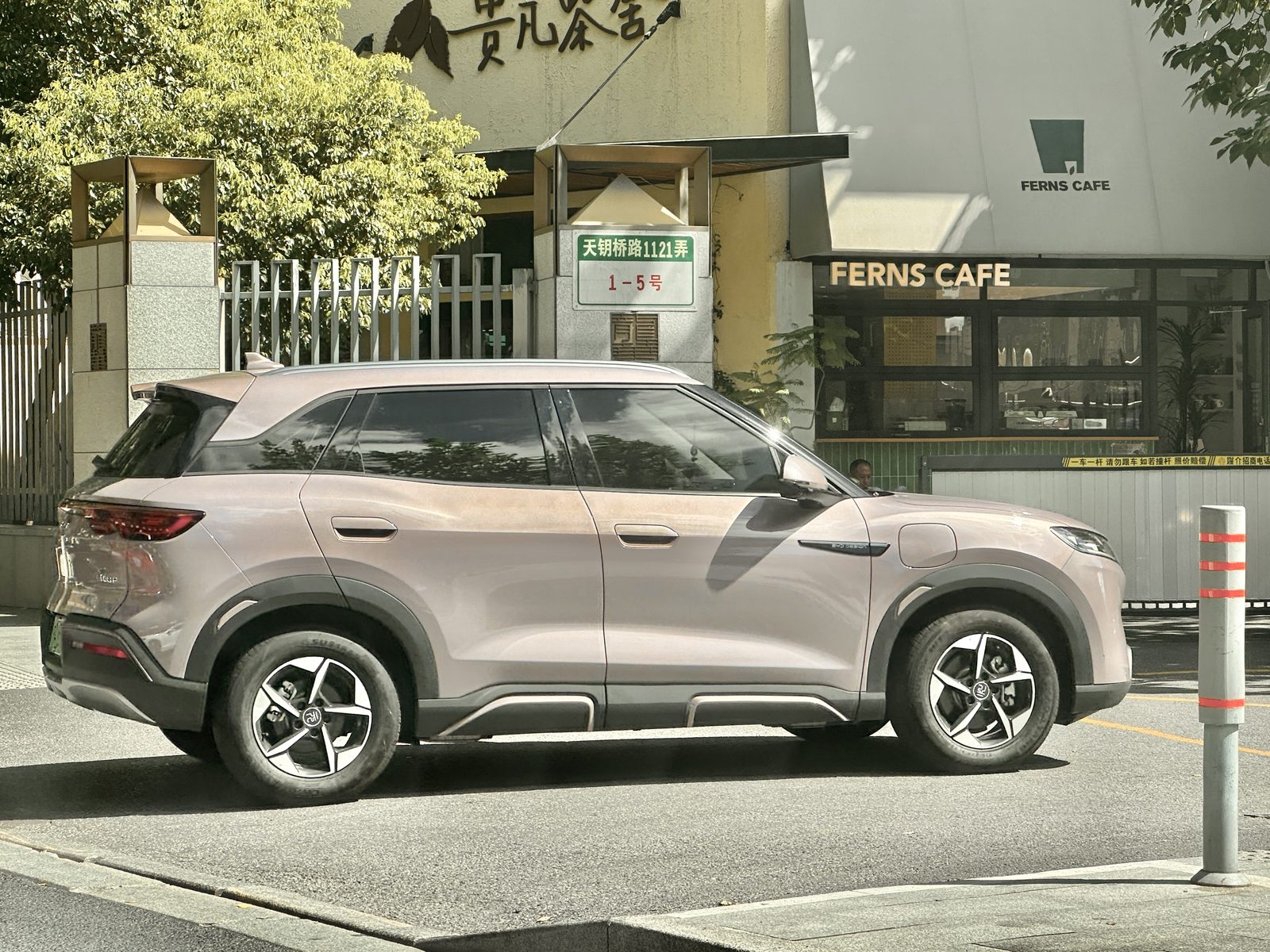
For Ethiopia, order the 401 km BYD Yuan UP with the 130 kW motor, not the 301 km car. The 401 km version carries a 45.12 kWh Blade battery, charges at up to 65 kW DC and has the margin for the hills around Addis Ababa; the 301 km version has a 32 kWh pack, a 70 kW motor and 45 kW charging. The second decision matters as much: a China-market Yuan UP has a GB/T charging inlet, while the export-spec Atto 2 sold in left-hand-drive markets such as Jordan uses CCS2. Confirm which build you are buying before you pay, because the inlet decides where the car can charge.
👉 Tell us the version and quantity and we’ll confirm the motor output, battery and charging inlet on the VIN before you pay. Ask us on WhatsApp · Browse current EV stock →
Is the BYD Yuan UP the same car as the BYD Atto 2?
Yes. The BYD Yuan UP is the China-market name for the BYD Atto 2, the same five-door electric SUV with a 4,310 mm body, a 2,620 mm wheelbase and five seats. The car is built in China and sold at home as the Yuan UP; outside China, BYD uses the Atto 2 name for the same vehicle. The name on the invoice, CoC and VIN plate can differ; the VIN must still describe one car.
| Market | Name | Notes |
|---|---|---|
| China | BYD Yuan UP (元UP) | Sold through BYD’s domestic dealer network |
| Export markets | BYD Atto 2 | Same body; export specification and equipment can differ |
| Earlier export name in some markets | Atto 2 / Yuan UP used interchangeably in trade | Buyers search both names |
If a supplier quotes an “Atto 2” and the export documents say “Yuan UP”, the customs broker will compare the VIN, not the badge. Our guide to Chinese model names versus export names explains why the same car can carry two names, and the Atto 2 versions guide shows how one name hides three different powertrains.
Which Yuan UP version should you order for Ethiopia?
Order the 401 km version with the 130 kW motor. It is the only Yuan UP that combines the 45.12 kWh battery with the stronger motor, 65 kW DC charging and a 7.9-second 0–100 km/h time. BYD’s China configuration sheet lists three powertrain combinations under the same body:
| Spec | 301 km / 70 kW | 401 km / 70 kW | 401 km / 130 kW |
|---|---|---|---|
| Battery (LFP Blade) | 32 kWh | 45.12 kWh | 45.12 kWh |
| CLTC range | 301 km | 401 km | 401 km |
| Motor power | 70 kW / 95 Ps | 70 kW / 95 Ps | 130 kW / 177 Ps |
| Torque | 180 N·m | 180 N·m | 290 N·m |
| 0–100 km/h | 12.0 s | 12.9 s | 7.9 s |
| Top speed | 150 km/h | 160 km/h | 160 km/h |
| DC fast-charge peak | 45 kW | 65 kW | 65 kW |
| DC 30–80% | about 30 min | about 30 min | about 30 min |
| Kerb weight | 1,430 kg | 1,520 kg | 1,540 kg |
The 401 km / 70 kW car is the value option. It has the same battery and the same 65 kW charging as the 130 kW car, but 12.9 seconds to 100 km/h and 180 N·m. For a customer who drives only inside Addis Ababa, that is enough. For hills with four passengers and luggage, the 130 kW motor is the one that does not feel strained.
The 301 km car is the one to avoid for anything beyond city use. Its 32 kWh battery and 45 kW DC charging are a full step below the 401 km cars, and its 12.0-second acceleration is only slightly better than the 70 kW car because it weighs 90 kg less. It exists to hit a lower price point, not to cover distance.
For reference, China domestic guide prices for the 2025 model year are RMB 74,800 (301 km), RMB 99,800 (401 km / 70 kW) and RMB 109,800–119,800 (401 km / 130 kW). These are China guide prices for the 2025 model year, not export prices or landed costs in Ethiopia.
BYD’s official Jordan page, a left-hand-drive export market, lists a single Atto 2 version: 45.12 kWh, 130 kW, 290 N·m, 312 km WLTP / 401 km CLTC, CCS2, 11 kW AC and 65 kW DC. An export-spec Atto 2 is likely to be this car. If the quote is for a China-market Yuan UP, the 301 km and 70 kW cars are also in play, and the version must be written into the contract.
What range can a Yuan UP actually deliver in Ethiopia?
Use 312 km, the WLTP figure, as the realistic benchmark — not the 401 km CLTC headline. CLTC is a Chinese laboratory cycle run at low speed with generous assumptions; WLTP is the European cycle and lands much closer to real driving. BYD’s own Jordan page lists both numbers for the same 45.12 kWh car: 401 km CLTC and 312 km WLTP. The gap is not a defect; it is two different test procedures.
Addis Ababa sits at roughly 2,355 m and is hilly. Altitude does not cost an electric motor power the way it costs a petrol engine, because the motor does not need oxygen. Altitude does affect how the car is used: steeper grades, more braking and accelerating, and air-conditioning all draw from the same battery. Treat 312 km as the starting point and leave a charging margin for hills, load and air-conditioning. For a rural route, plan the charging stop well inside that margin, not around the CLTC number.
The 301 km car uses a smaller 32 kWh battery, so its real margin is proportionally thinner, and its 45 kW DC charging makes a top-up slower. That is why it suits Addis city use and little else.
Does the Yuan UP charge fast enough for Ethiopian roads?
On the 401 km car, yes: BYD’s China configuration sheet gives about 30 minutes for a 30–80% DC charge at 65 kW. The 301 km car peaks at 45 kW, so the same 30–80% window takes about the same time but adds less range. The export-spec Atto 2 listed by BYD Jordan also quotes 65 kW DC and an 11 kW onboard AC charger, so an overnight AC charge from a wallbox is practical.
The limit is the network, not the car. Public charging in Ethiopia is concentrated in Addis Ababa and thin outside it, as our Ethiopia EV import guide explains. Before promising a route, check the connector and output of the chargers on it, not just their presence on a map.
The car also offers vehicle-to-load (V2L) output of up to 3.3 kW, enough to run tools or a household circuit during an outage, and its LFP Blade battery tolerates routine 100% charging and heat better than many nickel-based packs.
Will your Yuan UP have a GB/T or a CCS2 charging inlet?
The inlet depends on which build you buy: a China-market Yuan UP has a GB/T inlet, while the export-spec Atto 2 listed by BYD in left-hand-drive markets such as Jordan has CCS2. This is the single most expensive detail to get wrong, because the inlet is not a trim item you can change later.
| Build | Charging inlet | What it means in Ethiopia |
|---|---|---|
| China-market Yuan UP | GB/T (separate AC and DC pins) | Needs GB/T charging equipment or an active conversion solution |
| Export-spec Atto 2 | CCS2 (Type 2 AC plus DC) | Matches the CCS2/Type 2 equipment common on export-market chargers |
A passive plug adapter does not bridge the difference for DC charging. GB/T and CCS2 use different communication protocols between the car and the charger, so a physical adapter alone will not make a GB/T car fast-charge on a CCS2 station. Active adapters exist but are expensive and must be matched to the car and charger; get written confirmation before budgeting for one.
Ask for a close-up photo of the charging port before payment. On a China-market car, the port has separate AC and DC openings; on a CCS2 car, the lower DC pins sit inside the same Type 2 connector. The photo is quicker than the spec sheet and harder to fake.
What documents should an Ethiopian buyer have before the ship sails?
An Ethiopian buyer needs the commercial invoice, packing list, bill of lading, certificate of origin and insurance certificate for every car — plus a Certificate of Conformity and Djibouti transit paperwork where they apply. The documents are cross-checked, so VIN, motor number and model year must match.
| Document | Who issues it | When | Why it matters |
|---|---|---|---|
| Commercial invoice | Seller | Before shipment | Must show VIN, model year, motor kW and battery kWh |
| Packing list | Seller / forwarder | Before shipment | Container and unit identification |
| Bill of lading | Shipping line | After loading | Must show VIN, motor number and year; the title document |
| Certificate of origin | Chamber of commerce / authorised body | Before shipment | Confirms Chinese origin |
| Insurance certificate | Insurer | Before shipment | Covers the sea leg under CIF |
| Certificate of Conformity (CoC) | Accredited inspection body in China | Before shipment | Ethiopia’s PVoC programme; confirm the HS code and product scope |
| Djibouti ECTN | Forwarder / ECTN platform | Before vessel departure | Container cargo unloaded in Djibouti; transit exemption depends on B/L wording |
| Import permit / licence | Ethiopian importer | Before clearance | The importer’s own authorisation, not the seller’s |
| Dangerous goods / battery declaration | Forwarder | Before booking | EVs move as Class 9; the line needs the battery paperwork |
Ethiopia runs a Pre-Export Verification of Conformity (PVoC) programme. The Certificate of Conformity is issued in the exporting country by an accredited body and checked at clearance; TÜV Rheinland’s programme guide puts the threshold at an FOB value of €3,000 or more. Cotecna lists vehicles among the sectors represented after the 2024 expansion to 11 import categories, but the HS code decides whether a CoC is required for a specific shipment. Confirm with the inspection body before booking, not after the car lands; a CoC that arrives late or with a different VIN is worse than none.
Djibouti requires an Electronic Cargo Tracking Note (ECTN) for containerised cargo unloaded at the Port of Djibouti; the ECTN is separate from the Ethiopian CoC. Djibouti’s ECTN platform states that cargo in direct transit to Ethiopia is exempt only if the bill of lading names Ethiopia as the final destination, or states “in transit to Ethiopia”, and the consignee is in Ethiopia. If the B/L wording is ambiguous, file the ECTN anyway; the certificate costs far less than demurrage. The official platform is ctndjibouti.com, and shipping lines have issued advisories repeating the requirement.
Our CIF Djibouti guide covers which documents come with a CIF shipment, and the bill of lading guide explains original, telex release and sea waybill, which decides how the car is released after arrival.
How does a Yuan UP travel from China to Addis Ababa?
Every Yuan UP enters Ethiopia through the Port of Djibouti, then travels inland on the Addis Ababa–Djibouti corridor. Ethiopia is landlocked, and the Port of Djibouti handles the large majority of its trade. There is no realistic second port for a car shipment.
The sea leg from a Chinese port to Djibouti takes several weeks, depending on sailing and carrier. The inland leg is either the roughly 753 km electrified Addis Ababa–Djibouti railway or road haulage on the same corridor. Road haulage runs on the same corridor; rail or road changes transit time and handling, not the port.
For a single car or a small order, the container question comes first. A 40ft high cube can carry several small SUVs with a racking frame, but the count depends on the loading plan; how many cars fit in a container explains why a full box beats a shared one. For one unit, see shipping options for a single car and RoRo versus container.
Most container lines treat EVs as Class 9 dangerous goods and ask for battery documentation and a state-of-charge declaration before booking. The forwarder handles that paperwork, but the seller should confirm the battery specification early; a late document can miss the sailing. Shipping cars from China to African ports covers the route and transit-time picture.
What should you check on the VIN, battery and charging port before paying?
Check four things before payment: the motor output on the VIN plate, the battery capacity on the CoC, the charging inlet in a photo, and the build date against the model year on the invoice. A Yuan UP can be a 70 kW car or a 130 kW car under the same body, and the price difference is real.
- Motor output. The VIN plate and CoC should show 130 kW for the version you ordered; a 70 kW car will show 70 kW. Do not accept a verbal confirmation.
- Battery capacity. The 401 km cars have 45.12 kWh; the 301 km car has 32 kWh. The CoC and the battery label should match the invoice.
- Charging inlet. Ask for a close-up photo of the port. GB/T and CCS2 look different, and the photo settles which build you are buying.
- Build date and model year. A China-market car and an export-spec car with a different model year can carry different equipment; the invoice, CoC and B/L should agree.
- Odometer and condition. Even a new car can collect delivery mileage; ask for a walkaround video and an odometer photo.
- Head-unit language. China-market cars may ship with a Chinese interface; if the customer needs English or Arabic, confirm the menu language before shipment.
A live video inspection is the cheapest way to catch a mismatch before loading. Remote inspection before paying explains what to film, and what a condition report covers sets out the disclosure standard. For the supplier side, see how to verify a Chinese car export company and how the export supply chain works.
Is the Yuan UP the right BYD for Ethiopia, or should you look at the Atto 3?
The Yuan UP is the right BYD for Addis city use and short regional trips; the Atto 3 is the safer car for long-distance use with a full load. The Yuan UP is 4,310 mm long with 401 km CLTC and a 45.12 kWh battery. The Atto 3 is a class larger, with 430 km and 510 km versions and a bigger cabin. Our Yuan UP versus Yuan Plus comparison puts the two side by side.
If the customer needs range margin for routes outside Addis, the Atto 3 430 km versus 510 km comparison is the next decision. We also hold Atto 3 and Sealion 05 EV stock already in Djibouti, which shortens the sea leg to zero, and the Sealion 05 EV versus Atto 3 comparison covers the newer car.
FAQ
Is the BYD Yuan UP sold as the Atto 2 in Ethiopia?
Yes. The Yuan UP is the China-market name and the Atto 2 is the export name for the same car. Ethiopian buyers may see either name on a quotation; the VIN is what identifies the vehicle.
Can I import a right-hand-drive Yuan UP into Ethiopia?
No. Ethiopia requires left-hand drive; a right-hand-drive car will not clear, so do not let a supplier ship one.
Is the 301 km Yuan UP enough for Addis Ababa?
For city-only use with home or office charging, the 301 km car can work. Its 32 kWh battery and 45 kW DC charging leave little margin for hills, air-conditioning and weekend trips, so most buyers are better served by the 401 km / 130 kW version.
What is the difference between the 401 km CLTC and 312 km WLTP figures?
They are two test cycles applied to the same 45.12 kWh battery. CLTC is the Chinese cycle and gives 401 km; WLTP is the European cycle and gives 312 km. Use WLTP for planning and discount it for hills, load and air-conditioning.
Does the Yuan UP support DC fast charging?
Yes. The 401 km cars charge at up to 65 kW DC and the 301 km car at 45 kW; BYD’s China sheet gives about 30 minutes for 30–80%.
Do I need a Certificate of Conformity to import a Yuan UP into Ethiopia?
Ethiopia’s PVoC programme requires a CoC for regulated goods with an FOB value of €3,000 or more. Vehicles are among the sectors in the expanded programme, but the HS code and current product list decide the specific requirement. Confirm with the inspection body before shipment; a missing CoC stops clearance.
How long does shipping from China to Ethiopia take?
The sea leg to Djibouti takes several weeks, then the car moves inland by rail or road. Ask the forwarder for the sailing date and inland transit time for your booking; both change with the carrier and season.
Sources: BYD Jordan official Atto 2 page (byd.com.jo), checked November 2026 — 45.12 kWh, 130 kW / 290 N·m, 312 km WLTP / 401 km CLTC, CCS2, 11 kW AC, 65 kW DC. China-market Yuan UP configuration table (evlook.com), checked September 2026 — 301 / 401 km, 32 / 45.12 kWh, 70 / 130 kW, 45 / 65 kW DC, China guide prices for the 2025 model year. Ethiopia EV import rules: our Ethiopia import guide, checked November 2026 — petrol/diesel private-car import ban since 29 January 2024, 15% customs duty with VAT, excise and surtax waived for EVs, left-hand drive only. Ethiopia PVoC / CoC: TÜV Rheinland Ethiopia PVoC programme guide (CoC mandatory for regulated goods with FOB value of €3,000 or more) and Cotecna’s August 2024 workshop note (programme expanded to 11 categories, vehicles among the sectors represented); confirm the vehicle HS code with the inspection body. Djibouti ECTN: ctndjibouti.com and CMA CGM client advisory — ECTN required for containerised cargo unloaded at Djibouti; direct transit to Ethiopia exempt only with B/L naming Ethiopia and an Ethiopian consignee. Single-source items: the 0–100 km/h time and kerb weight for the 401 km / 70 kW version are from the China configuration table only. The 15% duty/VAT-waived structure comes from our Ethiopia guide; confirm current rates with a licensed clearing agent. Photo: JustAnotherCarDesigner / Wikimedia Commons, CC0.