
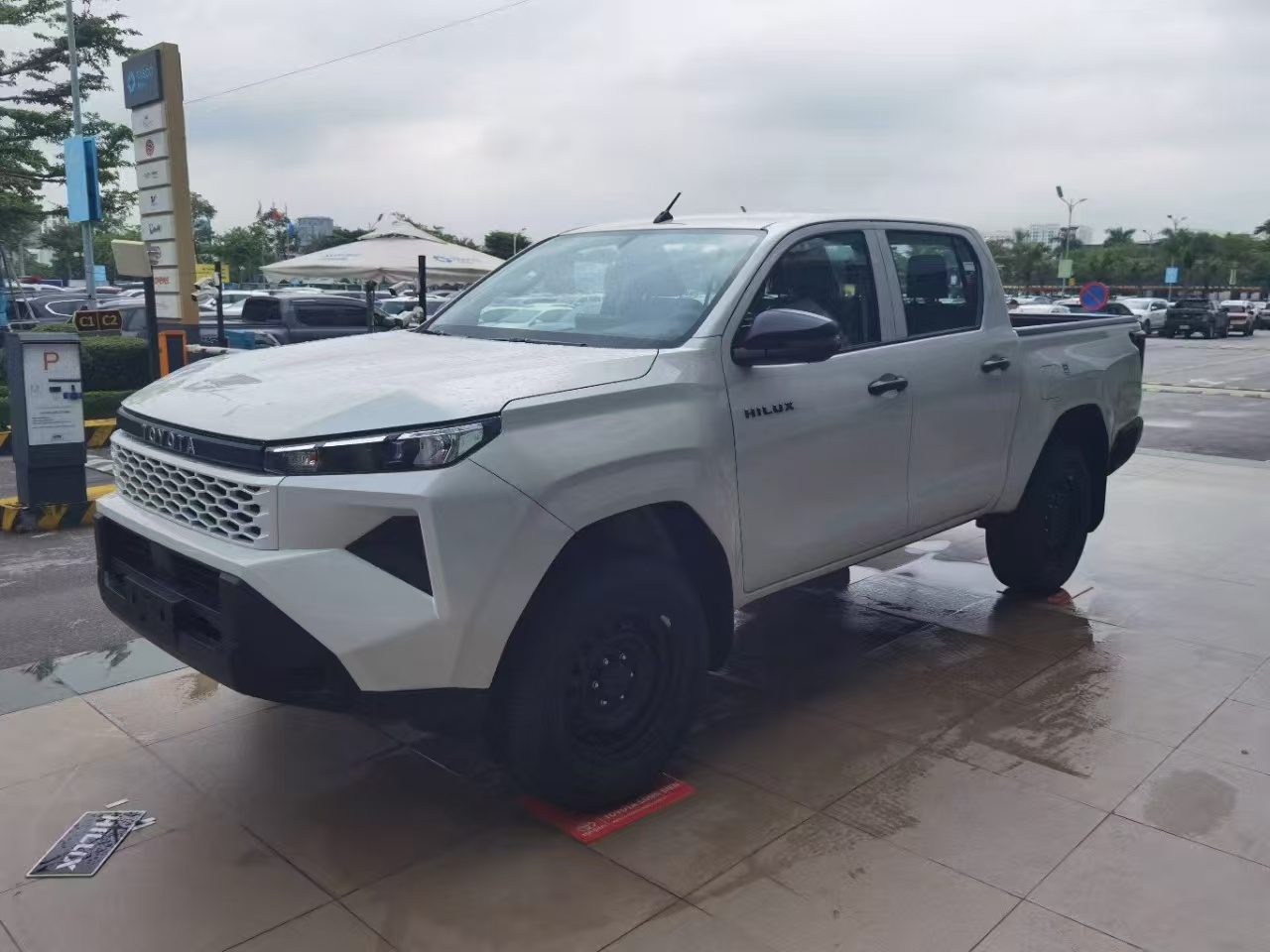
The 2026 Toyota Hilux and Ford Ranger are both one-ton, body-on-frame, Thai-built double-cab pickups, but their engine ranges no longer line up. The Hilux sells one 2.8-litre diesel in two tunes: 204 PS and 500 Nm with the automatic, 420 Nm with the manual. The Ranger now offers a 2.0-litre single-turbo diesel at 170 PS and 405 Nm, or a 3.0-litre V6 diesel at 250 PS and 600 Nm. Ford removed the 2.0 bi-turbo from the Thai line-up in 2026 and replaced it at the top of the Philippine range with the 3.0 V6.
A buyer who wants the simplest diesel and the widest parts coverage lands on the Hilux. A buyer who wants 600 Nm or a full-time four-wheel-drive system lands on the Ranger V6.
👉 Comparing a Hilux and Ranger quotation? Send both spec sheets on WhatsApp · Hilux E, G, V and Conquest: which grade fits →
Are the 2026 Toyota Hilux and Ford Ranger the same class of pick-up?
Yes. Both are five-seat, body-on-frame double cabs with a leaf-spring live rear axle, one-tonne payload class and Thai assembly for ASEAN and left-hand-drive export markets. They compete for the same fleet, mining, construction and farm buyers in the Gulf, West Africa and Central Asia.
The generations are different ages. The ninth-generation Hilux had its world premiere in Bangkok on 10 November 2025, and the Asian rollout began in 2026. The current Ranger was revealed in November 2021 and reached most markets from 2022, so the Ranger is a four-year-old design going through a 2026 update rather than a new platform. What changed from the previous Hilux covers the Toyota side of that generational step.
The naming is the first trap. Toyota sells the new truck as the Hilux in the Philippines, the Gulf and Africa, and as the Hilux Travo in Thailand. Ford uses Ranger in every market discussed here. A quotation that says “Hilux” without a country can mean the ninth-generation truck or remaining eighth-generation stock.
The second trap is model year. Toyota UAE labels the current Hilux a 2026, while some Gulf dealers call the same truck a 2027. Ford Philippines added the 3.0 V6 Wildtrak and Wildtrak X in September 2026, but several price sites still list the older 2.0 variants. Check the engine code and trim on the variant card, not the model year in the advert.
Which engines does each truck offer in 2026?
The Hilux has one diesel family across the grades that matter to export buyers. The Ranger now has two, with the middle bi-turbo withdrawn from the Philippine and Thai ranges.
| Powertrain | Hilux 2026 | Ranger 2026 |
|---|---|---|
| Base diesel | 2.8 L 1GD-FTV, 204 PS, 420 Nm (6MT) | 2.0 L single-turbo, 170 PS, 405 Nm (10AT in Thailand) |
| Mid diesel | Same 2.8 L, 500 Nm (6AT) | 2.0 L bi-turbo, 210 PS, 500 Nm (dropped in the Philippines and Thailand for 2026) |
| Top diesel | None above the 2.8 | 3.0 L V6, 250 PS, 600 Nm (10AT) |
| Petrol | 2.7 L, 166 PS, 245 Nm (Gulf) | 2.3 L EcoBoost, 270 PS, 420 Nm (Gulf) |
| Electric | Hilux Travo-e BEV, Thailand | None in these markets |
The Philippine Hilux range is seven diesel grades plus a BEV: E, G, V and Conquest, all on the 2.8. The Gulf, Philippine and Vietnamese version map explains why the same engine appears under different grade names; the Thai and Philippine grade map sets the Travo names beside them. In the Gulf, Toyota also sells a 2.7-litre petrol at 166 PS and 245 Nm, which changes the comparison for Saudi and UAE fleet buyers.
Ford changed both ranges in 2026. In the Philippines, the refreshed Ranger’s top grades are Wildtrak 4×4 V6 and Wildtrak X, at 250 PS and 600 Nm, and the 2.0 bi-turbo is no longer the top diesel. In Thailand, the MY2026 Wildtrak line is a 2.0 single-turbo at 170 PS and 405 Nm, in 4×2 and 4×4, plus the Wildtrak X V6. Headlight Magazine’s Thai price and spec table records the bi-turbo as discontinued.
How does the Hilux 2.8 compare with the Ranger 3.0 V6?
The Ranger V6 makes 46 PS more and 100 Nm more than the Hilux 2.8 automatic. The Hilux counters with a simpler engine bay, a six-speed automatic and a longer service record in the region.
Toyota’s 2,755 cc 1GD-FTV is rated at 150 kW, or about 204 PS, at 3,000 to 3,400 rpm. Torque is 500 Nm from 1,600 to 2,800 rpm with the six-speed automatic and 420 Nm with the manual; the same G 4×2 in both gearboxes shows what changes on the order. The engine has been in Hilux, Fortuner and Land Cruiser Prado models since 2015, so consumables, injectors and turbo parts are stocked far beyond the Toyota dealer network.
Ford’s 2,993 cc V6 diesel is rated at 184 kW, or 250 PS, at 3,250 rpm and 600 Nm from 1,750 to 2,250 rpm. It uses a 10-speed automatic with an e-shifter. In Thailand the V6 is listed as Euro 5 and B20 biodiesel compatible. The same engine is sold in the Ranger Wildtrak and Wildtrak X in Thailand, Vietnam, the Philippines, South Africa and Australia, which helps parts availability but does not match the Hilux’s aftermarket depth.
On the road the difference is felt with a loaded trailer or a full bed. The V6 holds a gear longer and pulls from lower revs. For a buyer running at gross vehicle weight daily, the V6 is the stronger tool. For mixed loads on variable fuel, the 2.8 wins on familiarity: a workshop that has never seen a Ranger V6 will still know the 1GD-FTV.
What does the Ranger’s 2.0 single-turbo offer against the Hilux 2.8?
The 2.0 single-turbo is the volume Ranger in Thailand and the lower rungs of the Philippine range. It makes 170 PS and 405 Nm, which is 34 PS and 95 Nm below the Hilux 2.8 automatic.
Ford’s 1,996 cc four-cylinder uses a single turbo with a 10-speed automatic in Thailand and a six-speed automatic in some Philippine listings, and either rear-wheel drive or part-time four-wheel drive. Thai documentation lists 125 kW at 3,500 rpm and 405 Nm from 1,750 to 2,500 rpm. The Philippine 2.0 XLS is listed at the same 170 PS and 405 Nm.
The 10-speed automatic is the point of difference. More ratios than the Hilux’s six-speed help fuel economy and highway refinement, but the unit is more complex to service, which matters where the nearest Ford dealer is far away. The 2.0 single-turbo suits light duty and lower fuel use; it does not suit regular towing at 3,500 kg.
Which four-wheel-drive system suits Gulf and African roads?
The Hilux uses a part-time system in every grade. The Ranger offers part-time on the 2.0 4×4 and a full-time 4A system with an active centre differential on the V6 Wildtrak X in Thailand.
Toyota’s Hilux has 2H, 4H and 4L, with the driver shifting between them. There is no centre differential, so 4H is for loose surfaces, not dry tarmac. A rear differential lock is fitted to the V 4×4 manual and the Conquest 4×4 automatic in the Philippine range; the lower grades do not list one. Conquest 4×4 against Conquest 4×2 sets out what the extra driveline hardware costs in equipment terms.
Ford’s V6 Wildtrak X adds 4A, which can stay engaged on sealed roads and shifts torque to the front axle when grip drops. Thai launch material also lists an active centre differential and an electronic rear diff lock. The 2.0 4×4 versions remain part-time.
For a Gulf buyer on tarmac with occasional gravel, 4A saves shifting in and out of 4H. For mining or farm work that needs low range and a locked rear axle, both the Hilux Conquest 4×4 and the Ranger V6 deliver.
How do size, wheelbase and ground clearance compare?
The Ranger is larger on paper, mostly in wheelbase. It measures 5,370 mm long, 1,918 mm wide and 1,884 mm high, with a 3,270 mm wheelbase. The Hilux measures 5,320 mm long, 1,885 mm wide and 1,865 mm high, with a 3,085 mm wheelbase.
The 185 mm wheelbase difference matters with a load: it gives the Ranger a more stable ride with a load and more room between the axles, at the cost of a wider turning circle in tight yards. The Hilux is 50 mm shorter and 33 mm narrower, which helps in narrow port gates.
Ford lists 235 mm of ground clearance for the standard Ranger 4×4 and about 256 mm for the Wildtrak X, which rides on 265/70 R17 all-terrain tyres and Bilstein dampers. Toyota’s published Hilux clearance varies between market sheets, so compare the destination variant card, not a regional brochure.
The Ranger carries an 80-litre fuel tank in these versions. Ford quotes 3,500 kg braked towing for the Ranger 4×4. Toyota’s Philippine Hilux sheet does not publish a towing row, so a buyer who needs a specific rating should ask for the destination market’s variant card.
Is the safety equipment comparable?
The top Hilux grades and the Ranger Wildtrak are close, but the entry grades are not. Toyota puts its full safety package only on V and Conquest; Ford spreads more of its driver-assistance kit across the Ranger range.
The Hilux V and Conquest get seven airbags and Toyota Safety Sense 3.0, which includes pre-collision warning with pedestrian detection, lane departure alert, lane tracing and dynamic radar cruise control. The E and G grades get three airbags and do not list the same package.
The Ranger Wildtrak adds autonomous emergency braking, adaptive cruise control, lane keeping, blind-spot monitoring and a 360-degree camera, and Ford lists a knee airbag on the higher grades. Philippine listings show six airbags on the XLS and seven on the Wildtrak. Exact content varies by market; the variant card remains the reference.
For fleet buyers in Algeria, Côte d’Ivoire or Central Asia, specify the grade rather than the model. A base Hilux E and a Hilux Conquest are not comparable on safety.
Which truck is easier to keep on the road in Africa and the Gulf?
The Hilux has the wider service and parts network across Africa, and the Ranger has the stronger dealer presence in Thailand and the Philippines.
Toyota’s 1GD-FTV is shared with the Fortuner and Prado, and the Hilux is one of the most common pickups in West, East and Southern Africa. Independent workshops stock filters, belts, injectors and suspension parts, so a broken Hilux in a provincial town is usually a same-week repair.
Ford’s Ranger is well supported in Thailand, the Philippines and South Africa. In thinner markets, the V6 and the 10-speed automatic are the risk: a dealer-only diagnostic tool and less aftermarket depth can turn a transmission fault into a long wait.
Both trucks need low-sulphur diesel for their emission hardware: Ford lists the Philippine 2.0 Ranger as Euro 4 and the Thai V6 as Euro 5, Toyota the Hilux 2.8 as Euro 5 in Philippine documentation. In high-sulphur markets, confirm the standard and service schedule before the order.
What do Ford’s 2026 line-up changes mean for buyers?
Ford has moved the Ranger upmarket in the Philippines and simplified the diesel range in Thailand. A buyer working from an old price list is comparing the wrong truck, so check the trim before the quote.
In the Philippines, the top Ranger grades are the Wildtrak 4×4 V6 at ₱2,469,000 and the Wildtrak X at ₱2,609,000, at Ford Philippines list prices reported in September 2026. The Hilux Conquest 4×4 automatic is listed at ₱2,611,000 by Toyota Philippines. At the top of the range the Ranger V6 now undercuts the Hilux.
In Thailand, the Ranger Wildtrak 2.0 single-turbo starts at 1,159,000 baht for 4×2 and 1,249,000 baht for 4×4; the Wildtrak X V6 is 1,469,000 baht. Toyota’s Thai grades use different names, so compare the same cab, drive and trim.
These are local list prices for context, not export prices. What a buyer pays delivered to Abidjan, Algiers, Djibouti or Central Asia depends on the sourcing route, freight and duties. FOB, CFR and CIF explains which costs sit with which party; CIF Djibouti delivery covers the Ethiopian route.
Can a buyer source either truck from China?
The Hilux can be sourced from Chinese stock and from Thai or Philippine allocations in left-hand drive. The Ranger cannot be sourced from China, because Ford does not build it there.
Toyota’s Thai plant builds the left-hand-drive Hilux that goes to the Gulf and other export markets, and Chinese traders hold stock in Tianjin and other ports. Buying a Hilux from China stock covers the port and container side. The 2026 Hilux is a new generation, so confirm the build date and the grade against the destination market before paying a deposit.
Ford’s Gulf Ranger is built in Thailand and shipped through Ford’s own distribution. A Chinese exporter cannot add one to a mixed container the way it can a Hilux; buyers should work through the Ford distributor or a trader with an existing allocation.
A Hilux order can be adjusted at the port, combined with other units and shipped on the next sailing; a Ranger order follows Ford’s production schedule. RoRo and container shipping explains why that matters for small orders, telex release and sea waybill covers the document that releases the cargo, and demurrage and storage explains the charges that start when paperwork is late.
Which one should you choose?
The Hilux 2.8 suits work far from a Ford dealer, a driver who wants a simple part-time 4×4 with a locked rear axle, or an order that has to move quickly from Chinese or Thai stock. The 500 Nm automatic is enough for most one-tonne work; the 420 Nm manual suits fleets that want fewer electronics.
The Ranger V6 suits towing at the limit, mixed tarmac and gravel where 4A helps, or a buyer who wants 600 Nm and the 10-speed automatic. The Wildtrak X adds raised suspension and all-terrain tyres for desert tracks.
The Ranger 2.0 single-turbo is for light duty only: it is the cheapest way into a current Ranger, but 405 Nm is a step below the Hilux 2.8, and the 10-speed adds service complexity without the V6’s output.
For a fleet with mixed duty cycles, the Hilux is easier to standardise: one engine, two gearboxes and a parts chain that reaches most of Africa. For a heavy-tow fleet, the Ranger V6 is the stronger vehicle and, in the Philippines, the cheaper top-of-range option.
What are the alternatives if neither truck fits?
The Mitsubishi L200, sold as the Triton in Thailand, South Africa and Australia, has a full-time-capable Super Select 4WD system and a 2.4 diesel. Hilux against L200 and Triton compares the two drivelines in detail.
The Nissan Navara is the other direct rival in the Gulf and Africa, and Nissan is preparing a China-built Navara Pro for the Middle East. What is confirmed on the Navara Pro sets out the launch position.
Buyers who want a petrol truck in the Gulf should also look at the Ranger 2.3 EcoBoost, the main Ranger engine in UAE and Saudi showrooms at 270 PS and 420 Nm. Hilux against the Tacoma is the reference for buyers comparing American-market petrol pickups.
FAQ
Is the Ford Ranger bigger than the Toyota Hilux?
Yes. The Ranger is 5,370 mm long with a 3,270 mm wheelbase; the Hilux is 5,320 mm with a 3,085 mm wheelbase. The Ranger is 33 mm wider.
Does the 2026 Ranger still have the 2.0 bi-turbo?
Not in the Philippines or Thailand: Ford Philippines replaced the bi-turbo at the top of the range with the 3.0 V6 in September 2026, and Thailand’s MY2026 line-up lists it as discontinued. Other markets may hold stock.
Which truck has more torque?
The Ranger 3.0 V6 makes 600 Nm against 500 Nm for the Hilux 2.8 automatic; the Ranger 2.0 makes 405 Nm.
Can the Hilux be driven in four-wheel drive on dry tarmac?
No. The Hilux has a part-time transfer case with no centre differential, so 4H is for loose surfaces. The Ranger V6 Wildtrak X adds a 4A mode usable on sealed roads.
Which is cheaper in the Philippines, the Hilux or the Ranger?
At the top of the range, the Ranger Wildtrak V6 is listed at ₱2,469,000 and the Hilux Conquest 4×4 automatic at ₱2,611,000, before discounts or export costs.
Can you supply a Ford Ranger from China?
No. Ford does not build the Ranger in China; the Gulf truck comes through Ford’s Thai production. Hilux supply from China stock is a separate route.
Sources: Toyota Thailand Hilux Travo launch release (10 November 2025) and Toyota Vietnam Hilux specification PDF (2,755 cc 1GD-FTV, 150 kW, 420/500 Nm, dimensions, part-time 4WD). Toyota Philippines Hilux variant pages and TopGear Philippines (grades, TSS 3.0, airbags, list prices). Toyota UAE Hilux page (2.7 petrol 166 PS/245 Nm, 2.8 diesel 204 PS/500 Nm). Ford Thailand MY2026 Ranger Wildtrak and Wildtrak X pages and Headlight Magazine official price/spec table (2.0 170 PS/405 Nm, 3.0 V6 250 PS/600 Nm, 4A and active centre differential on Wildtrak X, bi-turbo discontinued). Ford Philippines Ranger pages via AutoDeal and Zigwheels (2.0 170 PS/405 Nm, bi-turbo 210 PS/500 Nm, 3.0 V6, 5,370/1,918/1,884 mm, 3,270 mm wheelbase, 235 mm clearance, 80 L). AutoIndustriya and Manila Times on the September 2026 Philippines V6 launch. Ford Middle East and UAE distributor listings (2.3 EcoBoost 270 PS/420 Nm). All checked November 2026. Single-source notes: Wildtrak X clearance about 256 mm and 3,500 kg braked towing come from Ford regional material and need confirmation on the destination variant card; list prices are single-source per brand and exclude discounts. No Chinese domestic or export price is used. Our supply line covers the Hilux re-export route, not the Ranger. Photo: Hanvia Motors / own photo, All rights reserved.