
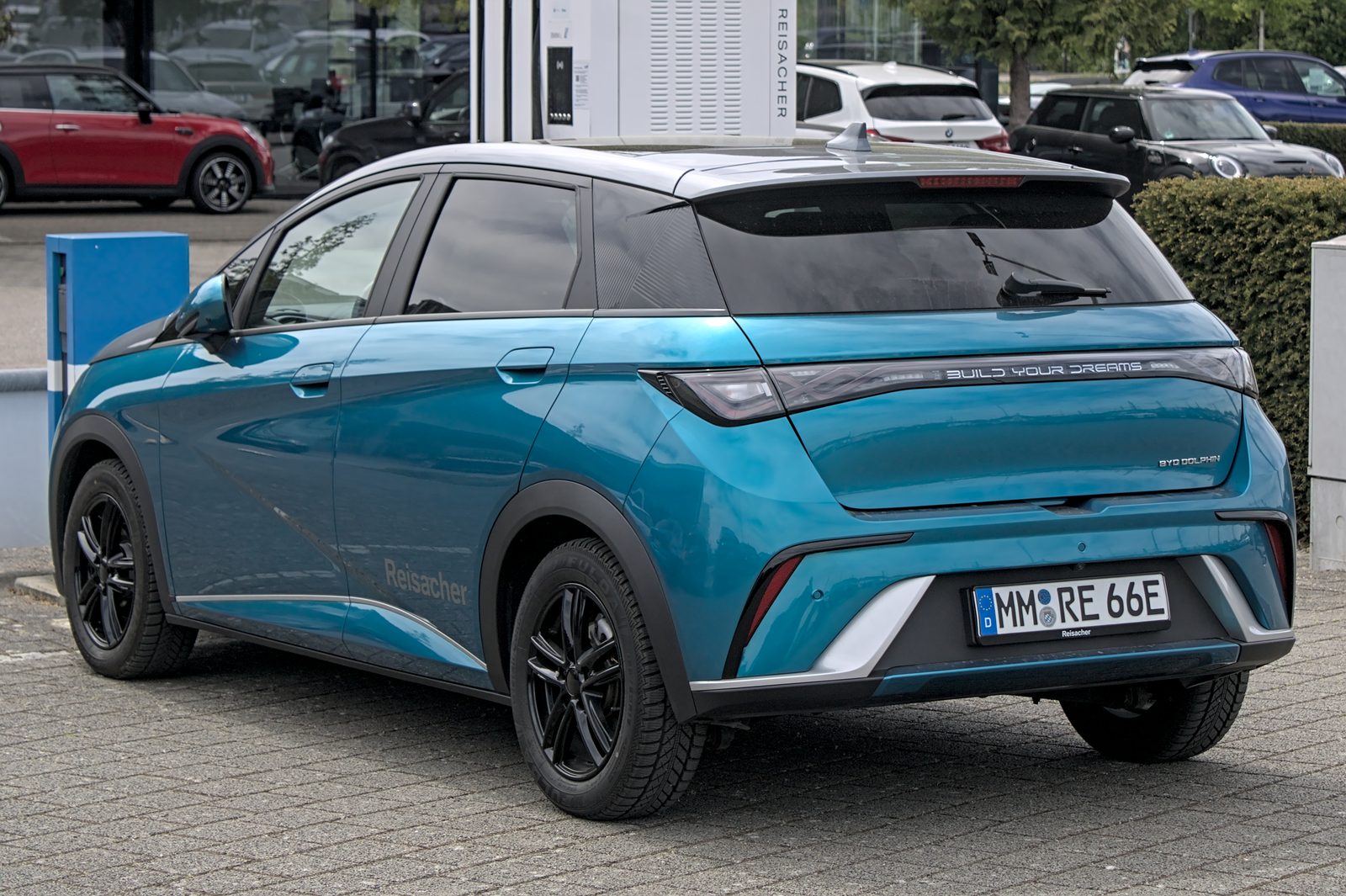
The 2026 BYD Dolphin is a 4,290 mm five-seat electric hatchback sold with a 44.9, 50.25 or 60.48 kWh battery, depending on which build your market receives. The Extended Range car quotes 427 km WLTP and 150 kW; the Standard Range quotes 70 kW and either 340 km WLTP on the older 44.9 kWh pack or 435 km NEDC on the newer 50.25 kWh pack of Thai-built cars. The car is built in both left-hand and right-hand drive.
Three numbers decide what you are buying: battery kWh, charging inlet and hand of drive. A 2026 badge on the invoice does not tell you any of them. This guide separates the export car from the China-market 海豚, explains which range figure to trust, and what to put in the contract.
👉 Send us the VIN or the build sheet and we’ll confirm the battery, motor, charging inlet and hand of drive before you pay. Ask us on WhatsApp · Browse current EV stock →
What is the 2026 BYD Dolphin export version?
The export Dolphin is the global-spec car: a 4,290 mm five-door hatchback on a 2,700 mm wheelbase with five seats. BYD’s German model page lists those dimensions; the same body is sold in the Gulf, Europe, Latin America, Southeast Asia and Australia.
That 4,290 mm figure matters because the China-market 海豚 is shorter. BYD’s Chinese configuration sheets list the domestic car at 4,125 mm or 4,150 mm depending on model year, with the same 2,700 mm wheelbase. The export body is 140–165 mm longer, visible at the bumpers rather than in the cabin. If a “2026 Dolphin” measures 4,150 mm, it is a China-market build, not the global car.
The export car has not had a full model change since its 2023 European launch. The 2025 and 2026 changes are running updates — a stronger DC charger and larger boot in Europe, a larger Standard Range battery on Thai-built cars — and they did not reach every market at once.
| Export Dolphin | Figure |
|---|---|
| Body | 5-door hatchback, 5 seats |
| Length × width × height | 4,290 × 1,770 × 1,570 mm |
| Wheelbase | 2,700 mm |
| Boot | 345 L; 364 L on the updated European car; 1,310 L with seats folded |
| Drive | Front-wheel drive, single motor |
| Suspension | MacPherson front; rear layout varies by version |
Which battery and motor versions does the 2026 Dolphin come in?
Export markets receive three battery builds: 44.9 kWh and 50.25 kWh Standard Range cars with a 70 kW motor, and a 60.48 kWh Extended Range car with a 150 kW motor. The 44.9 kWh pack is the original Standard Range; the 50.25 kWh pack replaced it on Thai-built cars from the 2026 model year. The Extended Range pack has not changed.
| Spec | Standard Range, 44.9 kWh | Standard Range, 50.25 kWh | Extended Range, 60.48 kWh |
|---|---|---|---|
| Battery | LFP Blade, 44.9 kWh | LFP Blade, 50.25 kWh | LFP Blade, 60.48 kWh |
| Motor | 70 kW / 95 hp, 180 N·m | 70 kW / 95 hp, 180 N·m | 150 kW / 204 hp, 310 N·m |
| 0–100 km/h | about 12.3 s | about 12.3 s | about 7.0 s |
| Range, NEDC | about 410 km | 435 km | 490 km |
| Range, WLTP | 340 km | not published | 427 km (559 km urban) |
| DC peak | lower than Extended Range | 70 kW | about 88 kW (80 kW on some sheets); 110 kW on the updated European car |
| AC charging | 7 kW | 6.6–7 kW | 7 kW; 11 kW three-phase in Europe |
Trim names vary by market — Active, Boost, Comfort and Design in Europe; Standard and Extended Range in the Gulf; Premium Extended Range in Malaysia — and none is a reliable guide to the pack. The battery kWh is. Our Atto 2 versions guide shows the same problem in another BYD model.
Ask specifically about the 50.25 kWh Standard Range. Thai price lists from January 2026 and the April 2026 Vietnam launch describe a 70 kW, 435 km NEDC car built in Thailand. BYD’s global site does not publish that pack and Gulf listings still quote 44.9 kWh, so treat it as a real build in Thai-sourced supply, not the default everywhere.
How far does a 2026 BYD Dolphin go on one charge?
Use 340 km for the 44.9 kWh Standard Range and 427 km for the Extended Range, because those are the WLTP figures; the 490 km and 520 km numbers you see online are NEDC or CLTC and are not comparable. The Extended Range car is also quoted at 559 km on the WLTP urban cycle, which flatters city driving and should not be used for intercity planning.
The test cycles explain most of the confusion:
- WLTP is the European cycle. It is the closest of the three to mixed real driving and is the figure to quote to a customer in Ethiopia, the Gulf or North Africa.
- NEDC is an older, gentler cycle. A 490 km NEDC figure on an Extended Range car sits alongside a 427 km WLTP figure for the same battery.
- CLTC is the Chinese cycle: the China-market 海豚 quotes 420 km on 44.9 kWh and 520 km on 60.48 kWh. Same packs, different test, so 520 km CLTC and 427 km WLTP are not a contradiction.
For the newer 50.25 kWh Thai build, the published figure is 435 km NEDC. No WLTP figure has been published for that pack. Do not convert NEDC to WLTP by a fixed percentage and quote the result as fact; ask the supplier for the homologation document for the exact build.
Air-conditioning, highway speed and load pull the real figure below the WLTP number. In Gulf summer heat a Dolphin running its air-conditioning hard will not reach 427 km, and charging can be limited when ambient temperature is very high. In Addis Ababa the hills and air-conditioning draw from the same pack. Plan stops inside the WLTP margin, not around the NEDC headline.
How fast does the 2026 Dolphin charge, and which plug does it use?
The export Dolphin uses a CCS2 DC inlet and a Type 2 AC inlet; the China-market 海豚 uses GB/T for both. That difference decides where the car can charge and is the first thing to check on a “China domestic spec” quote.
On DC, the Extended Range car peaks at about 88 kW in Gulf and most export listings, and at 110 kW on the updated European car announced in July 2025. BYD quotes 30–80% in about 26 minutes at 110 kW; Gulf sources quote about 29–30 minutes at 88 kW. The 50.25 kWh Standard Range is listed at 70 kW DC, and the older 44.9 kWh car is slower again, so do not promise the same stop for every trim.
On AC, export cars take 7 kW single-phase in the Gulf and Australia and 11 kW three-phase in Europe. A 7 kW wallbox fills the 60.48 kWh pack overnight; a household socket will not. A heat pump is standard, which matters for cabin heating in Central Asia and battery thermal management in the Gulf.
The inlet is not cosmetic. A GB/T car in Ethiopia, Algeria or Côte d’Ivoire will not plug into CCS2 public chargers without an adapter, and DC adapters are not a reliable solution. Our Ethiopia EV import guide covers it for another BYD model; GCC spec versus China spec explains the wider pattern.
Is the BYD Dolphin left-hand drive or right-hand drive?
Both. The Dolphin is built in left-hand drive for Europe, the Gulf, Latin America, Ethiopia, Algeria, Côte d’Ivoire and Central Asia, and in right-hand drive for the UK, Ireland, Australia, New Zealand, Thailand, Malaysia, Singapore, Japan and South Africa. The hand of drive is fixed at the factory; it cannot be converted economically after the fact.
BYD builds the Dolphin in China and, since 2024, at Rayong in Thailand, which supplies both right- and left-hand-drive markets including Europe. The same model name can therefore arrive from two plants with different equipment and, in 2026, different Standard Range batteries. The VIN and build sheet, not the sales office, tell you which.
For the markets in this guide, left-hand drive is the default requirement. Ethiopia admits left-hand-drive cars only. Algeria, Côte d’Ivoire and the Central Asian republics drive on the right. If your end customer is in a right-hand-drive country, write “RHD” into the order and confirm it on the VIN plate before shipment; a left-hand-drive car delivered to a right-hand-drive market is a return, not a discount.
Is the export Dolphin the same as the China-market 海豚?
No. The export Dolphin and the China-market 海豚 share a name, a wheelbase and two battery sizes, but they differ in body length, charging inlet and test-cycle ratings, and the Chinese car can carry equipment the export sheet does not list. The differences are big enough that a quote should state which build it is for.
| Item | Export Dolphin | China-market 海豚 |
|---|---|---|
| Length | 4,290 mm | 4,125–4,150 mm (2021–2024 sheets) |
| Charging inlet | CCS2 DC, Type 2 AC | GB/T DC and AC |
| Range rating | 340 / 427 km WLTP | 420 / 520 km CLTC |
| Battery | 44.9 / 50.25 / 60.48 kWh | 44.9 / 60.48 kWh |
| Hand of drive | LHD and RHD | LHD |
The names cause more confusion than the hardware. In Latin America the Seagull is the “Dolphin Mini”; in Europe it is the Dolphin Surf. Neither is a Dolphin — the Surf is a four-seat city car on a shorter platform. Our Dolphin vs Seagull comparison sets out the differences, and Chinese model names versus export names explains why one car carries three badges.
What equipment and safety does the 2026 Dolphin offer?
The export Dolphin carries a 12.8-inch rotating centre screen, wireless charging, an NFC key, a heat pump, 3.3 kW vehicle-to-load output and a Level 2 driver-assistance package on higher trims. Malaysia’s 2026 Premium Extended sheet lists adaptive cruise, lane centring, autonomous emergency braking, blind-spot monitoring, rear cross-traffic alert and a 360-degree camera. The European Design trim adds ventilated front seats and a heated steering wheel.
The safety result is strong for the class. Euro NCAP tested the Dolphin in October 2023 and awarded five stars, with 89% for adult occupant protection, 87% for child occupant protection, 85% for vulnerable road users and 79% for safety assist. Those scores apply to the European car tested then; other builds may differ, so check the local sheet.
Equipment is where export builds diverge most. A Gulf Standard Range car may lack the ventilated seats, larger screen or full ADAS set of a European Design car, and the 2025 European update to 110 kW DC and a 364 L boot has not reached every Gulf listing. Ask for the equipment list line by line; “Comfort” does not mean the same thing in every market.
Dolphin or Seagull: which small BYD should you import?
Choose the Dolphin when the customer needs five seats, highway speed and a boot; choose the Seagull when the job is short city trips and the lowest possible entry cost. The Dolphin is one class up: 4,290 mm against 3,780 mm, five seats against four, 150 kW against 55 kW, and a 130 km/h top speed on the Seagull against 150–160 km/h on the Dolphin.
The Seagull is fine in town and cheaper to ship, but wrong for a five-seat taxi contract, a family of five or a route with a highway leg. The Dolphin suits ride-hailing fleets that need five seats and buyers who leave the city. Our guide to EVs for Addis Ababa ride-hailing compares the two, and Seagull generation 1 vs generation 2 covers the Seagull’s own version split.
For other small EVs, see the Seagull vs Wuling Bingo and Yuan UP vs Yuan Plus comparisons; for an SUV, the Sealion 05 EV vs Atto 3.
What should importers check in Ethiopia, the Gulf, North Africa and Central Asia?
Check five things before payment: battery kWh, charging inlet, hand of drive, homologation and battery warranty terms.
Ethiopia. Left-hand drive, importing mostly through Djibouti, with EV demand concentrated in Addis Ababa. A CCS2 export Dolphin is easier to charge than a GB/T China-market car, whose adapter may not work on every public charger. Our Ethiopia import guide covers customs and CoC; CIF Djibouti pricing covers costs.
The Gulf. The UAE’s official BYD distributor, Al-Futtaim, sells a GCC-spec car with local warranty cover. A grey import may not carry the same 8-year/160,000 km battery warranty, which is not always transferable, and GCC cooling and equipment differ from Europe. Check the GCC sheet, not the European brochure.
Algeria and Côte d’Ivoire. Both left-hand drive. Small electric hatchbacks are a niche rather than a volume segment, so charging and service coverage matter more than a few kilometres of range. Confirm the build is homologated and that a workshop can read its diagnostics.
Central Asia. Cars move by road through Khorgos as well as by sea. Winter is the constraint: the LFP pack loses range in the cold, and the heat pump helps but does not erase the loss. Confirm the cold-weather equipment on the sheet. Our Khorgos road transport guide covers the route.
How is a BYD Dolphin shipped from China?
A Dolphin moves as a Class 9 dangerous good because of its lithium-ion battery, and since 1 January 2026 it is declared under UN 3556, not UN 3171. Booking, dangerous goods declaration and bill of lading must carry the same entry. Your forwarder will ask for the battery type and usually a UN38.3 summary; give the exact pack.
Container shipping suits one or two cars; roll-on/roll-off is cheaper per unit for larger batches but ties you to sailing schedules. Our RoRo vs container guide compares the two; the UN 3556 guide covers the declaration.
Before loading, inspect remotely: photos of the VIN plate, battery label, charging inlet and odometer are cheap insurance against a substituted build. The remote inspection guide lists what to ask for; the documents checklist covers invoice, packing list, certificate of origin and bill of lading.
FAQ
Is the 2026 BYD Dolphin left-hand drive or right-hand drive?
Both are built: left-hand drive for Europe, the Gulf, Latin America and LHD Africa and Central Asia; right-hand drive for the UK, Ireland, Australia, New Zealand, Thailand, Malaysia, Singapore, Japan and South Africa. Confirm it on the VIN plate before payment.
How many kWh is the 2026 BYD Dolphin battery?
Three packs are in export supply: 44.9 kWh and 50.25 kWh Standard Range, and 60.48 kWh Extended Range. Ask for the battery kWh, not the trim name.
What is the real range of a 2026 BYD Dolphin?
Use 340 km WLTP for the 44.9 kWh Standard Range and 427 km WLTP for the Extended Range. The 490 km and 520 km figures are NEDC or CLTC and not comparable. The 50.25 kWh pack is quoted at 435 km NEDC, with no WLTP figure.
Is the Dolphin Surf the same as the Dolphin?
No. The Dolphin Surf is the European name for the BYD Seagull, a four-seat city car on a shorter platform. The Dolphin is a five-seat hatchback one class above it. The “Dolphin Mini” sold in Latin America is also a Seagull.
Does the BYD Dolphin use CCS2 or GB/T charging?
The export car uses CCS2 for DC and Type 2 for AC. The China-market 海豚 uses GB/T for both. A GB/T car will not use CCS2 public chargers without an adapter, which is a problem in Ethiopia, Algeria and Côte d’Ivoire.
How many seats does the BYD Dolphin have?
Five. It is a five-door hatchback on a 2,700 mm wheelbase. The Seagull, by contrast, is homologated for four.
Is the China-market 海豚 the same size as the export Dolphin?
No. The export car is 4,290 mm long; the China-market car is listed at 4,125–4,150 mm on 2021–2024 sheets. The wheelbase is the same at 2,700 mm, so the extra length is in the body ends.
Sources: BYD Germany official Dolphin model page (byd.com/de), checked November 2026 — 4,290 × 1,770 × 1,570 mm, 2,700 mm wheelbase, 345 L boot, 1,310 L folded. BYD Spain official news release, July 2025 — 60.4 kWh, 427 km WLTP / 559 km urban, 150 kW / 204 hp, DC charging raised from 88 kW to 110 kW, 30–80% in 26 minutes, boot 345 L to 364 L, retuned suspension and steering, heat pump optimisation. BYD Europe 2023 Dolphin launch material — 4.29 m body, 60 kWh Blade battery, 427 km WLTP, 11 kW AC. BYD Australia official Dolphin page and electrive.com launch coverage — 3.3 kW V2L. Carsales.com.au 2026 Dolphin range page — 44.9–60.5 kWh, 340–427 km WLTP. BYD official Euro NCAP release, October 2023 — five stars, 89% adult, 87% child, 85% vulnerable road users, 79% safety assist. Bitauto Malaysia 2026 Dolphin 490 km Premium Extended configuration sheet, checked November 2026 — 60.48 kWh, 150 kW / 310 N·m, 490 km NEDC / 427 km WLTP, 80 kW DC, 205/50 R17, multi-link rear, L2 equipment list. EVPlus.ae UAE Dolphin model page, checked November 2026 — 44.9 and 60.48 kWh, 70 kW / 150 kW, 340 / 427 km WLTP, 490 km NEDC, CCS2, 7 kW AC, 88 kW DC, 8-year/160,000 km battery warranty. Autolife Thailand January 2026 price list and Thanh Nien / VietnamBiz coverage of the April 2026 Vietnam launch — 50.25 kWh Standard Range, 70 kW, 435 km NEDC, 70 kW DC, Thai production, both RHD and LHD output from Rayong; AfMA and TCJAPress reporting on Thai-built Dolphin exports to Europe. China-market Dolphin configuration table (evlook.com), checked November 2026 — 4,125/4,150 mm, 44.9/60.48 kWh, 420/520 km CLTC, GB/T inlet. Our own Ethiopia EV import guide and GCC vs China spec guide, checked November 2026. Single-source items: the 50.25 kWh/435 km NEDC figures come from Thai and Vietnamese trade media and Thai price lists, not from a BYD global specification page; the 8-year/160,000 km UAE battery warranty figure comes from EVPlus.ae and may differ by distributor. Confirm the battery, inlet, hand of drive and warranty on the VIN and the local homologation document before payment. Photo: Alexander-93 / Wikimedia Commons, CC BY-SA 4.0.