
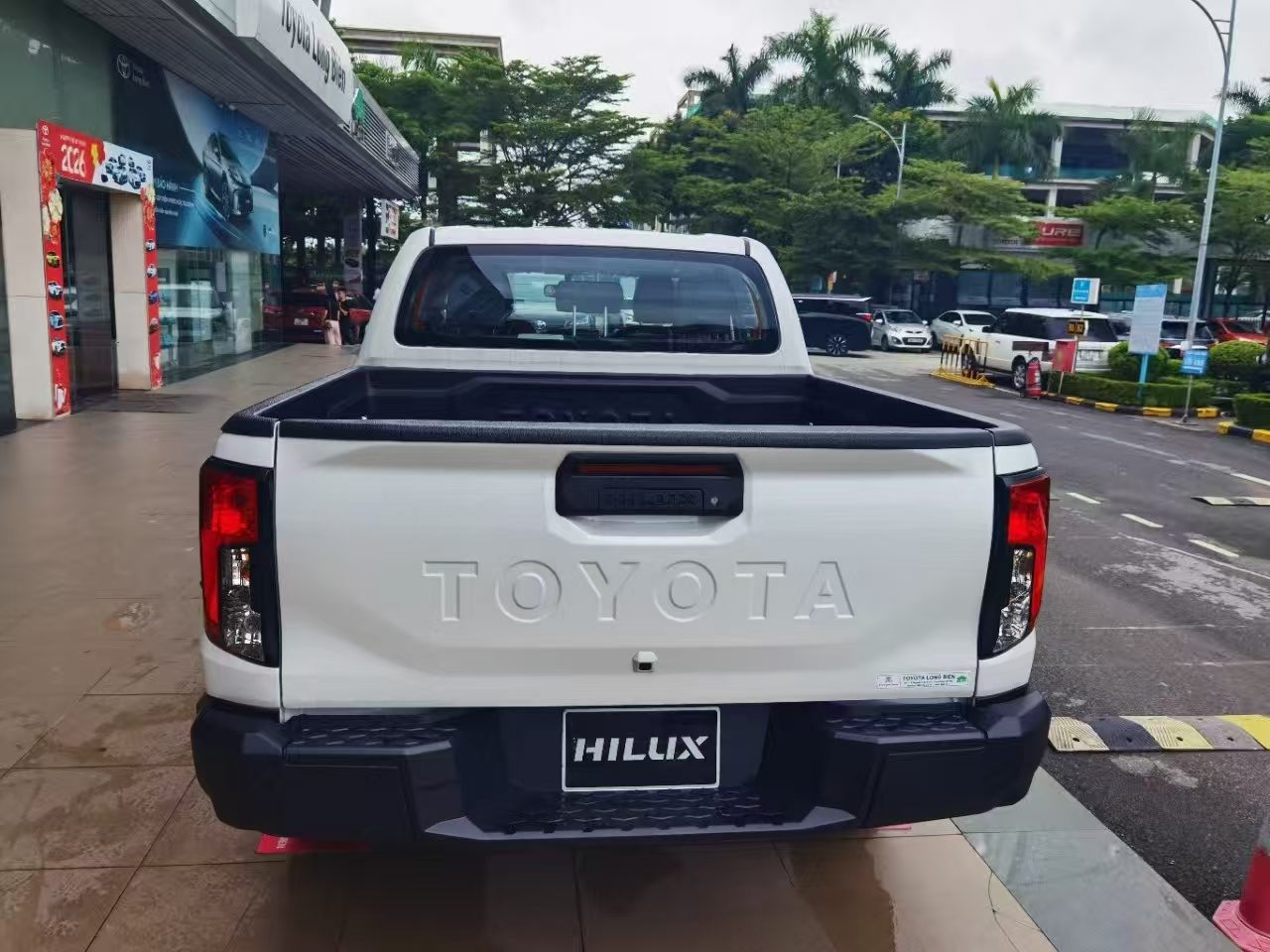
A quote that says “Thailand version” can mean two different trucks. The first is the Hilux Travo sold in Toyota’s Thai showrooms: right-hand drive, Thai grade names, built for Thai roads. The second is the left-hand-drive Hilux built on the same Thai line for export, usually to the Gulf. Both are ninth-generation Hilux. Only the second one can be registered in Algeria, Côte d’Ivoire, Ethiopia, Central Asia or the Gulf. The Vietnamese Hilux is a third configuration: left-hand drive, built in Thailand, sold through Toyota Vietnam with its own three-grade line-up.
That distinction decides most of the comparison. This guide compares the three trucks grade by grade, then sets out what belongs on the order sheet so the truck that arrives is the one quoted.
👉 Need a version checked against a quote? Ask us on WhatsApp · Gulf, Philippine and Vietnamese versions side by side →
What does “Thailand version” mean for a 2026 Hilux buyer?
The phrase covers one of three trucks, and the seller has to say which. The Thai domestic truck is the Hilux Travo, right-hand drive, with grades such as Smart, Premium, Overland and Overland Plus, split between Prerunner (raised two-wheel drive) and 4TREX (four-wheel drive) body styles. The Thai-built export truck is left-hand drive, carries the market code of its destination, and is commonly supplied in Gulf specification. The third case is a Thai-built left-hand-drive unit already held in Chinese trade stock, which is the same truck as the second case with a Chinese export declaration attached.
Toyota Thailand’s own model pages list the Travo line as separate Prerunner, 4TREX, Overland, Standard Cab and Travo-e pages, which is already a different way of organising a range from Vietnam’s Standard, Pro and Trailhunter. The two markets do not share a grade ladder, and a buyer who treats the Thai names as a higher or lower version of the Vietnamese names will order the wrong equipment.
The drive side is the first filter. The domestic Travo is right-hand drive, while Algeria, Côte d’Ivoire, Ethiopia, the Gulf and Central Asia drive on the right, so those buyers receive the left-hand-drive build from the same plant. GCC specification versus China specification explains why the market code, not the country of manufacture, is the useful label.
Is the Thai Hilux the same truck as the Vietnamese Hilux?
Mechanically, yes. Both are the ninth-generation double cab on a 3,085 mm wheelbase and 5,320 mm overall length, with the 2,755 cc 1GD-FTV four-cylinder diesel as the volume engine. Toyota Vietnam’s official specification sheet rates that engine at 150 kW, about 204 PS, with 420 Nm behind the six-speed manual and 500 Nm behind the six-speed automatic. Toyota Thailand’s launch release quotes 204 hp and the same 500 Nm / 420 Nm split, and the UAE official page lists the 2.8 diesel at 201 hp and 500 Nm with the automatic.
The body is also shared, but the body styles offered are not. Thailand sells the Travo as a standard cab, a smart cab (extended cab) and a double cab. The Vietnamese line-up covered by Toyota Vietnam’s official sheet is double cab only, in three grades. A fleet that needs an extended-cab work truck therefore has a Thai-built option that Vietnam does not list, while a buyer who wants the simplest possible double-cab range has fewer decisions in Vietnam.
Width differs by trim, not by country. Toyota Vietnam lists 1,855 mm for the Standard and 1,885 mm for the Pro and Trailhunter, which follows the wheel and tyre package. Thai coverage lists the Travo double cab at 1,885 mm, so a 30 mm difference is a trim detail, not a different body.
The model-year label is the other trap. Toyota UAE presents the same generation as a 2027 model, Toyota Vietnam presents it as a 2026, and Thai domestic pages use the Travo name without a model-year badge in the grade list. The label changes with the market’s homologation cycle, not with the build date. Write the build date and the market code on the order, and treat the model year as a description rather than a specification.
How do the Thai and Vietnamese grade names line up?
Thai and Vietnamese grade names line up by equipment, not by name. Thailand’s Prerunner and 4TREX describe the chassis — raised two-wheel drive and four-wheel drive respectively — while Smart, Premium, Overland and Overland Plus describe the trim level. Vietnam’s Standard, Pro and Trailhunter describe the trim level only, with four-wheel drive available solely on the Trailhunter.
| Role in the range | Thailand (Travo, domestic RHD) | Vietnam (official LHD) | What decides the order |
|---|---|---|---|
| Base work truck, 4×2 manual | Travo Smart Cab or Double Cab Prerunner 2.8 Smart MT | Standard 2.8 4×2 M/T — 420 Nm, 17-inch steel wheels, rear drum brakes, no TSS | Cab style and safety pack: Vietnam’s base is double cab only and has no TSS |
| Mid 4×2 automatic | Travo Prerunner 2.8 Premium AT | Pro 2.8 4×2 A/T — 500 Nm, 18-inch alloys, rear discs, TSS, 12.3-inch screen | Vietnam’s Pro is the first grade with TSS; check whether the Thai trim quoted has it |
| 4×4 manual | Travo 4TREX 2.8 Premium MT | No equivalent | Vietnam offers no manual 4×4 |
| 4×4 automatic, top trim | Travo 4TREX or Overland 2.8 AT | Trailhunter 2.8 4×4 A/T — rear diff lock, multi-terrain select, TSS | Both are the off-road flagship; Vietnam’s is the only one in its range |
| Battery-electric | Travo-e | No equivalent | Only relevant if the destination has charging and homologation for it |
Two cautions on that table. First, the Thai domestic column is right-hand drive and is shown for grade comparison only; it cannot be ordered for a left-hand-drive market. Second, “Premium” in Thailand and “Pro” in Vietnam are both mid-range names, but the equipment bundles are set by each distributor, so the badge is not a guarantee that the safety pack is included.
The clean way to compare is to ignore the names and list four items: gearbox, drive, safety pack and wheel/brake package. A Thai Prerunner Premium automatic and a Vietnamese Pro automatic both sit in the middle of their ranges, but only the Vietnamese sheet states TSS as standard on that grade. The E, G, V and Conquest grade guide shows the same exercise in the Philippine system, where the safety pack starts higher up the range.
What does the Thai domestic Hilux Travo offer that Vietnam does not?
Three things matter to a commercial buyer. The first is cab choice: standard cab, smart cab and double cab, against a Vietnamese line-up that is double cab only. The second is the Prerunner configuration, a raised two-wheel-drive truck that suits sealed-road fleets wanting the stance and ground clearance of a 4×4 without the transfer case. The third is the Overland trim, which sits above Premium and gives the Thai range a luxury-oriented top end that Vietnam does not list.
Thailand also sells the Travo-e, a battery-electric double cab. It is a different powertrain, not a diesel trim, and needs a separate import decision on charging standard, homologation and resale. A buyer who sees it in a Thai brochure should not assume it ships with diesel units.
What the Thai domestic range does not offer is a left-hand-drive truck. A Thai dealer can sell only the right-hand-drive domestic model. The left-hand-drive units come from the same plant but through export channels, with a destination market code attached. That is why a quote saying “Thailand version” needs a second question: domestic Travo, or Thai-built left-hand-drive export?
The equipment split inside the Thai range also matters. Toyota Thailand lists Toyota Safety Sense 3, seven airbags, blind-spot monitoring and rear cross-traffic alert on the Overland Plus, while the Prerunner and 4TREX Premium grades in the same release carry three SRS airbags and no TSS line. Do not transfer the Overland Plus equipment list onto a cheaper grade, or onto a Vietnamese grade.
What does the Vietnamese Hilux offer that Thailand does not?
Vietnam’s advantage is a short, legible ladder. Three double-cab grades cover the range: Standard, Pro and Trailhunter. The Standard is the work truck — manual gearbox, 420 Nm, 17-inch steel wheels, rear drum brakes, hydraulic steering, cloth seats, manual air conditioning, a 9-inch screen and no Toyota Safety Sense. The Pro adds the automatic, 500 Nm, 18-inch alloys, rear ventilated discs, electric power steering, leather seats, dual-zone climate, a 12.3-inch screen, TSS and blind-spot monitoring. The Trailhunter adds part-time four-wheel drive with electronic selection, a rear differential lock and multi-terrain select.
For a fleet buyer, that is easier to quote than a Thai range split across cab styles and Prerunner/4TREX body variants. Three grades, one body style, and a clear safety step at the Pro. The trade-off is that Vietnam offers no manual four-wheel-drive Hilux at all: the only 4×4 is the Trailhunter automatic. A buyer who needs a manual 4×4 with a locking rear axle will not find it in the Vietnamese line-up, and in the Philippine line-up the manual 4×4 exists but the locking axle does not.
Vietnam’s official sheet also states Euro 5 for the 2.8 diesel and lists Thailand as the country of origin. That origin line is useful on the documents: a Vietnamese-market Hilux is still a Thai-built truck, so the certificate of origin says Thailand even when the selling dealer is in Hanoi. Do not assume that a Vietnamese invoice means Vietnamese manufacture. The same logic applies to a Gulf-spec unit held in China: Thai origin, Chinese export declaration, and a destination market code that has to be written into the contract.
The Vietnamese range is diesel-only. The Gulf range adds a 2.7-litre petrol and references a 4.0-litre V6, which matters where petrol resale is stronger or diesel quality is inconsistent. A petrol buyer is choosing the Gulf specification, not Thailand or Vietnam.
Which version should a Gulf or African buyer order?
Start with the drive side and the destination’s rules, then choose the grade.
| Buyer’s use | Version to ask for | Why |
|---|---|---|
| Gulf dealer resale, automatic, highway use | Thai-built left-hand-drive Gulf-spec 2.8 diesel A/T, or Philippine Conquest 4×2 A/T | 500 Nm, automatic, and the Gulf/Philippine grade names are recognised locally |
| Buyer who needs a 2.7 petrol | Thai-built left-hand-drive Gulf-spec 2.7 | Vietnam lists diesel only; the petrol option sits in the Gulf range |
| Municipal or rental fleet on sealed roads | Vietnamese Pro 4×2 A/T, or Philippine E 4×2 A/T | The Pro includes TSS; the E is the cheaper automatic without it |
| Mining, construction, remote sites | Vietnamese Trailhunter 4×4 A/T, or a Thai-built left-hand-drive 4×4 | Automatic 4×4 with a locking rear axle in the Vietnamese range; confirm the export unit’s axle and transfer case |
| Manual 4×4 with a safety requirement | Philippine V 4×4 M/T | The only manual 4×4 in these line-ups with TSS 3.0 |
| Right-hand-drive market | Thai domestic Travo | The only right-hand-drive option here; not available from left-hand-drive stock |
For Algeria, the category question comes before the grade. The market’s new-vehicle channel is restricted to licensed dealers, and the used channel is limited, so the version discussion is for licensed dealers and for individuals bringing a vehicle for their own use. The Lebanon import example shows how a dealer structures a first order in a neighbouring market, and the Algeria and Côte d’Ivoire comparison covers the passenger-car side of the same question.
For Côte d’Ivoire, vehicle-age rules and the customs classification of a double cab can decide admissibility before equipment is considered. For Ethiopia, the Djibouti corridor and the CIF build-up matter more than the badge; a worked CIF Djibouti example sets out the cost stack. For Central Asia, a 4×4 automatic resells more easily than a base manual; the Central Asia market guide covers winter starting and parts availability.
The common mistake is to order “the top Thai version” and expect a left-hand-drive Overland. The Overland is a Thai domestic trim. The equivalent left-hand-drive purchase is a Gulf-spec or Philippine-spec truck with the equipment written out line by line. The ninth-generation versus eighth-generation guide explains which equipment belongs to the new truck, so a seller cannot pass an older body with a new badge.
What should be on the order sheet for a “Thailand version” Hilux?
Write these items into the proforma invoice, and make the supplier answer each one in writing.
- Market code — Thai domestic Travo, Thai-built Gulf export, Vietnamese market, Philippine market or other.
- Drive side — left-hand drive, stated explicitly.
- Cab style — standard, smart or double cab.
- Grade name in the market that built the truck, plus the engine displacement.
- Gearbox — six-speed manual or six-speed automatic; for the Philippine V, whether iMT is fitted.
- Drive — 4×2 or 4×4, and whether a rear differential lock is included.
- Safety pack — Toyota Safety Sense 3.0 yes or no, and the airbag count.
- Wheel and brake package — steel or alloy, drum or disc.
- Screen, climate and seat material, since these move together with the grade.
- Emission standard on the certificate that will be presented at customs.
- Build date and model-year label, listed separately.
- Country of origin and the export declaration country.
Then attach the document set: certificate of origin, export declaration, commercial invoice, bill of lading and the destination’s conformity or homologation paper. The China export document checklist lists the full pack, and telex release, sea waybill and original bill of lading explains how the cargo is released at the destination. If the unit is Chinese-held stock, the China stock and container guide covers the sourcing channel and the loading maths.
On shipping, two double-cab Hilux load in one 40-foot high-cube. RoRo versus container explains when the choice changes the landed cost, and FOB, CFR and CIF explains which of those three prices the quote is using. For a first shipment, the single-unit shipping options and the forwarder quote breakdown show which charges should appear before the truck sails. Port storage and demurrage explains the cost of a truck that arrives before its paperwork.
Inspection is the last check before payment. Compare the delivered unit with the official card: wheel and brake type, screen size, the radar and camera behind the windscreen, and the transfer-case control or diff-lock switch. A 4TREX on 17-inch steel wheels is not a 4TREX; a Trailhunter without the diff-lock switch is not a Trailhunter. The remote inspection guide covers what to photograph.
FAQ
Is the Thailand Hilux left-hand drive?
The Hilux Travo sold in Thailand is right-hand drive. The same plant also builds left-hand-drive units for export, and those are what a buyer in Algeria, Côte d’Ivoire, Ethiopia, the Gulf or Central Asia receives. Ask for the drive side and the market code separately.
Is the Hilux Travo the same as the Hilux?
It is the same ninth-generation truck under Toyota Thailand’s domestic name. The Travo range uses Thai grade names and Thai body-style labels — Prerunner for the raised two-wheel drive, 4TREX for four-wheel drive — while Vietnam sells the same generation as Standard, Pro and Trailhunter. The mechanical package is shared; the grade structure and the drive side are not.
Does the Vietnamese Hilux come from Thailand?
Yes. Toyota Vietnam’s official specification sheet lists Thailand as the country of origin for the Hilux it sells. That makes the certificate of origin Thai even though the selling dealer and the invoice are Vietnamese. A Gulf-spec unit held in China has the same Thai origin plus a Chinese export declaration.
Which Hilux version has 500 Nm?
The automatic versions are rated at 500 Nm in both the Vietnamese official sheet and Thai coverage of the Travo. The manual versions are rated at 420 Nm. That applies to the 2.8 diesel; the 2.7 petrol in the Gulf range is a different engine with a much lower torque figure, and it should not be compared on the same line.
Does Vietnam offer a manual 4×4 Hilux?
No. Four-wheel drive appears only on the Trailhunter, which is automatic. The Philippine range offers manual 4×4 in the E and V grades, but only the V carries Toyota Safety Sense 3.0, and neither lists a rear differential lock. Confirm whether the destination market’s homologation allows a locking axle as a factory option.
Can a Thai domestic Hilux be exported to Africa?
Not to a left-hand-drive market. The domestic Travo is right-hand drive and cannot be registered in Algeria, Côte d’Ivoire, Ethiopia, the Gulf or Central Asia. Order the left-hand-drive build from the same plant instead, and write the destination market code into the contract. For a right-hand-drive African market, the domestic Travo is the correct truck, but it sits outside our left-hand-drive supply.
Which is cheaper, the Thai version or the Vietnamese version?
The country label does not set the price; the grade does. Compare a base manual Standard, a mid-range Prerunner Premium automatic and a top Trailhunter by equipment — gearbox, drive, safety pack, wheels and brakes — rather than by country.
Sources: Toyota Motor Thailand official Hilux Travo launch release (grades, cab styles, 204 hp, 500 Nm AT and 420 Nm MT, TSS 3 and seven airbags on Overland Plus, three SRS airbags on Prerunner and 4TREX Premium, rear diff lock, Travo-e), checked November 2026. Toyota Vietnam official Hilux page and specification PDF (Standard, Pro and Trailhunter; 150 kW, 420/500 Nm, 5,320 mm length, 3,085 mm wheelbase, 1,855/1,885 mm width, Euro 5, origin Thailand), checked November 2026. Toyota UAE official Hilux page (2027 label; 2.7 petrol 164 hp/245 Nm, 2.8 diesel 201 hp/500 Nm, 4.0 V6; six-speed automatic, 4×4), checked November 2026. Toyota Motor Thailand world premiere, Bangkok, November 2025, for the Hilux Travo name; Thailand’s domestic market is RHD. The “raised” Prerunner description and the 1,885 mm Thai double-cab width are from Thai media only (Motorist Thailand and HeadLight Magazine). The LHD export build is supported by Toyota Vietnam’s Thai origin and left-hand-drive specification and by our November 2026 supply sheet, which also provides starting prices, colour availability, container loading and delivery policy. No Chinese domestic Hilux price is used; no Hilux is sold through Toyota’s China dealer network per Chinese media. Photo: Hanvia Motors / own photo, All rights reserved.