
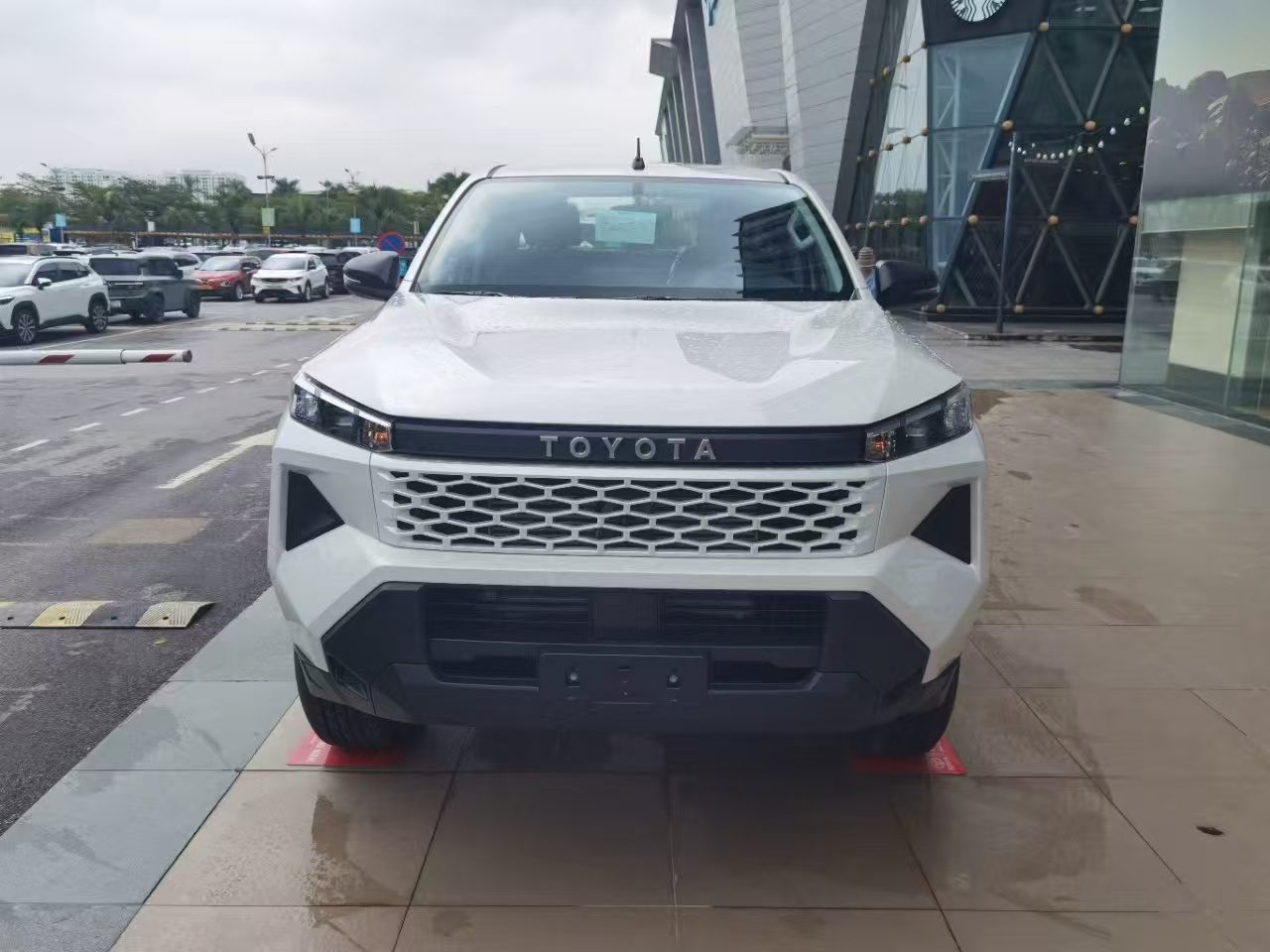
The 2026 Hilux G 4×2 A/T and Conquest 4×2 A/T are the same truck underneath. Both use the 1GD-FTV 2.8-litre turbo-diesel at 204 PS and 500 Nm, the six-speed automatic, and rear-wheel drive. The extra equipment in the Conquest is concentrated in two places: passive and active safety, and the cabin. Which one to order depends on the destination and on how the truck will be used.
Equipment is quoted from the Philippine specification sheet, because the left-hand-drive Hilux supply from Thailand is quoted with the Philippine grade names E, G, V and Conquest. Thailand versus Vietnam versions shows how the same truck is graded in a second left-hand-drive market. Buyers in Algeria, Côte d’Ivoire, Ethiopia, the Gulf and Central Asia receive a Thai-built left-hand-drive unit with a destination market code, so the equipment should be checked against the supplier’s sheet before the order is fixed. The full E, G, V and Conquest range explains where each grade sits.
👉 Checking a G or Conquest quote? Ask us on WhatsApp · Gulf, Philippine and Vietnamese versions compared →
What do the G 4×2 A/T and Conquest 4×2 A/T have in common?
Both versions are double-cab pickups on the same 3,085 mm wheelbase and 5,320 mm overall length, with five seats, a 2,755 cc four-cylinder diesel and a 6-speed automatic. The automatic is the reason both carry 500 Nm; the manual versions of the same engine are rated at 420 Nm. Drive goes to the rear wheels only.
The shared equipment list is longer than the name difference suggests. Both have smart entry with push start, LED headlamps with auto-levelling, LED daytime running lamps and front fog lamps, a 360-degree panoramic view monitor, 60:40 split rear seats, power windows with jam protection, eight speakers, ISOFIX anchors on two positions, ABS with EBD, vehicle stability control with brake assist and hill-start assist.
Neither 4×2 version lists a rear differential lock. That item appears on the V 4×4 M/T and the Conquest 4×4 A/T in the Philippine sheet. A buyer who needs a locked rear axle has to move to one of those two grades, not to a higher 4×2.
Specification table: G 4×2 A/T against Conquest 4×2 A/T
| Item | G 4×2 A/T | Conquest 4×2 A/T |
|---|---|---|
| Engine | 1GD-FTV 2.8L diesel, 2,755 cc | same |
| Max output | 204 PS at 3,000–3,400 rpm | same |
| Max torque | 500 Nm at 1,600–2,800 rpm | same |
| Transmission | 6-speed automatic | same |
| Drive | 4×2, rear-wheel drive | same |
| Airbags | 3: driver, driver knee, front passenger | 7: adds front side and curtain airbags |
| Toyota Safety Sense 3.0 | Not listed | Fitted |
| Blind spot monitor and rear cross traffic alert | Not listed | Fitted |
| Cruise control | Conventional | Dynamic radar cruise control |
| Parking sensors, front / rear | 2 / 4 | 4 / 4 |
| Panoramic view monitor | 360 degrees | same |
| Seat material | Fabric | Synthetic leather |
| Driver seat | 6-way manual | 8-way power |
| Air conditioning | Manual | Dual-zone automatic |
| Touchscreen | 8-inch display audio | 12.3-inch display audio |
| Apple CarPlay and Android Auto | Wired | Wireless |
| Wheels and tyres | 265/65 R17 alloy | 265/60 R18 alloy |
| Brakes | Ventilated discs front, drums rear | Ventilated discs front and rear |
| Power steering | Hydraulic | Electric |
| Headlamps | LED, auto-levelling | same |
| Keyless entry and start | Smart entry, push start | same |
How large is the safety gap?
The airbag count is the clearest difference. The G 4×2 A/T has three airbags: driver, driver’s knee and front passenger. The Conquest 4×2 A/T has seven, adding front side airbags and curtain airbags for both rows. For a vehicle that carries passengers, that is the most consequential line in the table. It also decides whether the truck can meet a corporate, NGO or government tender that specifies side and curtain airbags.
Toyota Safety Sense 3.0 is the other large item, and the Philippine sheet lists it on the V and both Conquest grades but not on the E or G. On the Hilux the package covers pre-collision warning with automatic braking, lane departure alert, lane tracing assist and automatic high beam. The G therefore has no automatic emergency braking and no lane-keeping assistance.
Two driver aids follow the grade split. The Philippine sheet lists blind spot monitoring with rear cross traffic alert on the Conquest, useful on a double cab that measures 5,320 mm, and dynamic radar cruise control that holds a distance to the vehicle ahead. The G lists conventional cruise control, which holds only a set speed, and no blind spot system.
Both versions keep the 360-degree camera, and both list the same stability control and hill-start assist. The sheet lists parking sensors at 2/4 front and rear on the G against 4/4 on the Conquest.
What changes in the cabin?
The Conquest moves the cabin up one level. Synthetic leather replaces fabric, the driver’s seat becomes 8-way power instead of 6-way manual, and the climate control becomes dual-zone automatic instead of manual. The centre touchscreen grows from 8 inches to 12.3 inches. Apple CarPlay and Android Auto are wireless on the Conquest and wired on the G.
The power driver’s seat earns its place where two drivers share a vehicle, which is common in company and rental fleets. Retail buyers tend to notice the screens first. Both versions retain the same eight speakers, the same smart entry and push start, and the same 60:40 split rear seat.
Do the wheels, brakes and steering differ?
Yes, and the difference is easy to miss on a quotation. The G uses 17-inch alloys with 265/65 R17 tyres. The Conquest uses 18-inch alloys with 265/60 R18 tyres. The taller sidewall on the G is an advantage on broken surfaces and gives a wider choice of replacement tyres in markets where 18-inch stock is limited.
The brakes differ at the rear. Both have ventilated discs at the front, but the G has drums at the rear and the Conquest has ventilated discs at both ends. The Conquest also uses electric power steering, while the G keeps hydraulic assistance. Neither difference touches the engine or the gearbox, but both affect the feel of the truck and the parts a workshop will service over its life.
Is a 4×2 Hilux enough for Algeria, Côte d’Ivoire, Ethiopia or the Gulf?
For a truck that works on paved roads, a 4×2 is enough. The G and Conquest 4×2 both carry the full 500 Nm automatic drivetrain, so they pull and cruise like the 4×4 versions on tarmac, and they avoid the weight, the transfer case and the extra service items of a four-wheel-drive system.
A 4×2 becomes the wrong choice in three situations: regular unpaved site access, sand or mud where traction is lost at the rear wheels, and routes that cross seasonal water. In those cases, the Philippine range offers the E 4×4 M/T, the V 4×4 M/T and the Conquest 4×4 A/T. There is no G 4×4, so a buyer who wants the G equipment level with four-wheel drive cannot get both from this range.
The destination market also decides which build can be registered. Algeria and Côte d’Ivoire register left-hand-drive vehicles; Ethiopia and the Gulf markets in this range do the same. GCC specification versus China specification sets out why the market code on the order matters as much as the grade name. For Ethiopia, the incoming port is Djibouti, and the CIF Djibouti terms decide what the landed cost covers. For Central Asia, the Horgos road route is the alternative to sea freight.
Which buyer should order which version?
Private retail buyers should order the Conquest 4×2 A/T. The seven airbags, TSS 3.0, blind spot monitoring and radar cruise are the equipment that private buyers notice and that resale conversations return to. The larger screens and synthetic leather complete the package.
Urban delivery and service fleets should order the G 4×2 A/T. The drivetrain is identical, and the 360-degree camera, LED headlamps and smart entry remain. The fleet avoids paying for leather and driver-assistance hardware that city routes do not use, and the 17-inch wheels are easier to replace.
Corporate, NGO and tender fleets should read the tender document before choosing. If it specifies side and curtain airbags or automatic emergency braking, only the Conquest 4×2 A/T of these two qualifies. If it is written around payload, drivetrain and air conditioning, the G meets it at a lower equipment level.
Dealers ordering for resale should split the order by what local customers ask for. A Conquest 4×2 A/T as the demonstration or management unit and G 4×2 A/T units for working customers is a common mix, because both use the same engine, gearbox and service parts.
Mixed orders can put both grades in the same container. A 40-foot high cube takes two double-cab Hilux units under the current loading plan. Container versus RoRo shipping explains when a container is the better method for a pickup order, and buying from China stock covers how a Thai-built left-hand-drive unit is held and loaded at a Chinese port.
What should be on the order sheet?
The order sheet should name the market code, the drive side, the grade with its gearbox and drive, the safety pack, the airbag line and the build date. Writing “Hilux G automatic” is not enough, because the same grade name carries different equipment in different markets and model years.
Write the grade as “2.8 G 4×2 A/T” or “2.8 Conquest 4×2 A/T”. Add whether TSS 3.0 is included and repeat the airbag count from the market specification. Add the colour and the steering side. The build date matters because the model-year label changes by market and is not a reliable description of the build.
The documents should match the vehicle on the sheet. The export documents checklist lists the papers that carry the grade and the identification number, and the bill of lading release options decide how the originals reach the buyer, and a pre-payment inspection should confirm the grade, the drive side and the safety pack before the balance is released. The payment method should match the order value and the inspection terms.
For buyers comparing the Hilux with other pickups, Hilux versus Tacoma and Hilux versus L200 Triton cover the platform differences. New Hilux versus the previous generation explains what changed in the ninth-generation truck.
FAQ
Is the Hilux Conquest 4×2 A/T four-wheel drive?
No. The Conquest 4×2 A/T is rear-wheel drive, like the G 4×2 A/T. The Conquest name also appears on a 4×4 automatic, which is a separate version with a transfer case and a rear differential lock.
Do the G 4×2 A/T and Conquest 4×2 A/T use the same engine and gearbox?
Yes. Both use the 1GD-FTV 2.8-litre turbo-diesel at 204 PS and 500 Nm, paired with a six-speed automatic. The drivetrain and the 500 Nm rating are identical; the difference is in safety and cabin equipment.
Does the G 4×2 A/T have Toyota Safety Sense?
Not in the Philippine specification. TSS 3.0 is listed for the V 4×4 M/T, the Conquest 4×2 A/T and the Conquest 4×4 A/T. The G has conventional cruise control and no automatic emergency braking.
How many airbags does each version have?
The G 4×2 A/T has three: driver, driver’s knee and front passenger. The Conquest 4×2 A/T has seven, adding front side and curtain airbags.
What else does the Conquest add besides safety equipment?
Synthetic leather seats, an 8-way power driver’s seat, dual-zone automatic climate control, a 12.3-inch touchscreen with wireless Apple CarPlay and Android Auto, 18-inch wheels, rear disc brakes and electric power steering.
Is a 4×2 Hilux suitable for desert or site work?
A 4×2 is suitable for paved roads and light unpaved access. For regular sand, mud or site work, the range offers the E 4×4 M/T, the V 4×4 M/T and the Conquest 4×4 A/T. There is no G 4×4 in the Philippine line-up.
Can both grades ship in one container?
Yes. A 40-foot high cube takes two double-cab Hilux units under the current loading plan, and the two grades can be mixed in the same container.
Are these left-hand-drive versions?
The Philippine specification is left-hand drive, which suits Algeria, Côte d’Ivoire, Ethiopia, the Gulf and Central Asia. Right-hand-drive builds exist for other markets. The steering side should be written on the order separately from the grade name.
What to do next
The first step is a grade check: confirm the destination market, the drive side, the grade, the gearbox, the safety pack and the airbag line. With those fixed, a supplier can quote the exact unit instead of a grade name that may mean something different in the next market. Prices are quoted on request against the confirmed specification, because equipment and colour availability change with the build.
Sources: Toyota Motor Philippines official Hilux variant page, toyota.com.ph/hilux, read November 2026 (seven diesel variants and one BEV; per-grade airbag counts, TSS 3.0 on V and both Conquest grades, blind spot monitor and rear cross traffic alert, cruise control type, parking sensors, seat and screen specifications, wheels, brakes and steering; the 4×2 grades carry no rear differential lock). Top Gear Philippines, “2026 Toyota Hilux specs and features”, 8 June 2026 (version list, 420 Nm manual and 500 Nm automatic, TSS 3.0 on V and Conquest, equipment split). Zigwheels Philippines, “Toyota Motor PH starts selling all-new Hilux” (grade list, 7 airbags on Conquest, hydraulic steering on E and G, electric steering on V and Conquest). Toyota Motor Vietnam official Hilux specification PDF (shared 1GD-FTV 2,755 cc engine, 150 kW, 5,320 mm length, 3,085 mm wheelbase, Thailand as country of origin). Loading plan of two double-cab units per 40-foot high cube from our November 2026 supply sheet. No price is quoted in this article; the Philippine sheet’s local retail prices are not export prices and are not reproduced. Blind spot monitoring, the parking sensor counts, the 360-degree camera on both 4×2 grades and the LED lamp specification come from the Philippine sheet alone; the other outlets checked did not list those rows. Equipment can change by market, model year and build date, and the manufacturer’s specification for the delivered unit prevails. Photo: Hanvia Motors / own photo, All rights reserved.