
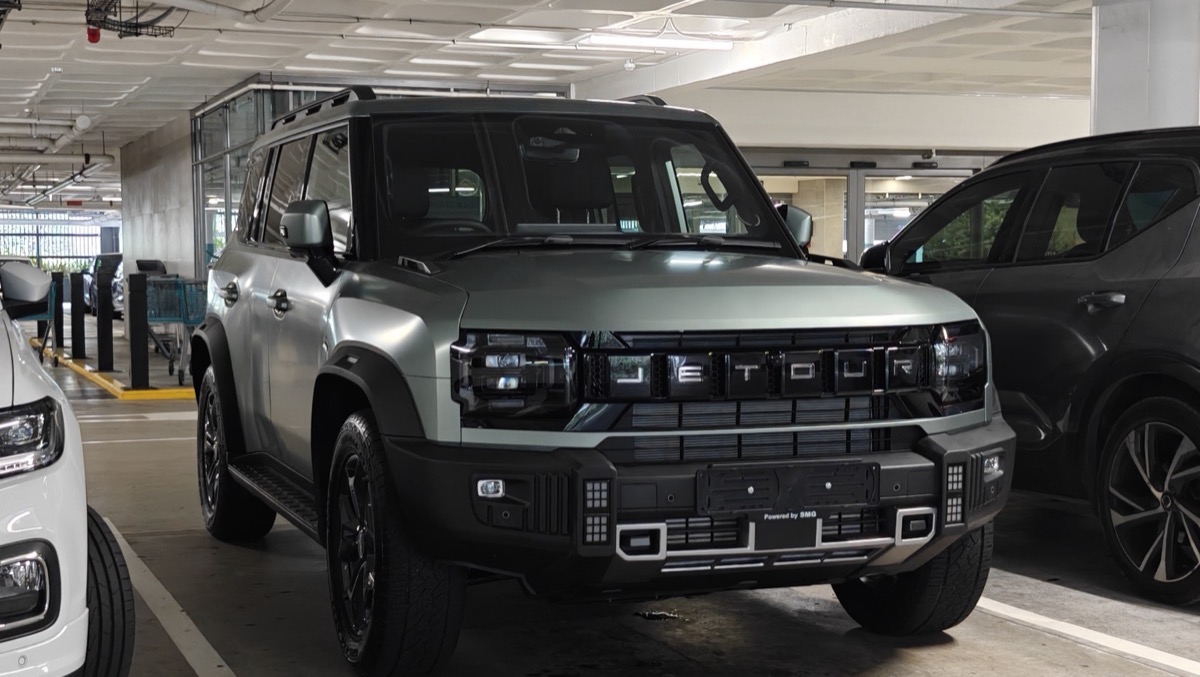
Short answer: the 2.0T is not really about speed, and the fuel saving on the 1.5T is smaller than almost anyone expects. The two engines are separated by 70 PS and 100 N·m, but on the official WLTC cycle they are separated by 0.48 L/100 km — 8.35 against 8.83. What the extra money actually buys you is four-wheel drive with a rear differential lock, which the 1.5T cannot be ordered with at any price. If your customers drive on unsealed roads, that is the whole decision. If they drive on tarmac, you are paying for hardware that will never be used.
This guide compares both versions of the Jetour T2 as they are specified for export in 2026, using the current Chinese-market specification sheets, and sets out which one suits which market.
First, a naming warning
In China this vehicle is sold as the Jetour Traveller (捷途旅行者). In export markets it is the Jetour T2. Same vehicle, same production line, two names — and it causes genuine confusion when an importer searches for Chinese-language specifications, reviews or parts listings and finds nothing under “T2”.
If a supplier sends you a quotation for a “Jetour Traveller” and you were expecting a T2, you are not being offered a different car. Ask for the VIN and the model year, and check the specification against the tables below. This is the same trap that catches buyers of the BYD Qin PLUS and Seal 05 DM-i, where one model changed names entirely between generations.
Jetour T2 1.5T vs 2.0T at a glance (2026 model year)
| Specification | 1.5T | 2.0T |
|---|---|---|
| Engine | 1.5 L turbocharged | 2.0 L turbocharged |
| Max power | 135 kW (184 PS) | 187 kW (254 PS) |
| Max torque | 290 N·m | 390 N·m |
| Drivetrain | Front-wheel drive only | Four-wheel drive |
| Centre differential | — | Multi-plate clutch |
| Rear differential lock | Not available | Fitted |
| Transmission | 7-speed wet DCT | 7-speed wet DCT (8-speed AT on some trims) |
| WLTC combined fuel | 8.35 L/100 km | 8.83 L/100 km |
| Kerb weight | 1,700 kg | 1,843–1,934 kg |
| Tyres | 235/65 R18 | 255/60 R19 |
| Track (front / rear) | 1,690 / 1,700 mm | 1,685 / 1,695 mm |
| Length | 4,785 mm | 4,795 mm |
| China guide price (2026 promotional) | from CNY 124,900 | from CNY 144,900, top trim CNY 164,900 |
And the specifications that do not change between the two:
| Shared specification | Both versions |
|---|---|
| Wheelbase | 2,800 mm |
| Width | 2,006 mm |
| Height | 1,880 mm |
| Ground clearance | 220 mm |
| Fuel tank | 70 L |
| Fuel grade | 92 RON |
| Seats | 5 |
| Top speed | 180 km/h |
| Body | Boxy body-on-frame-styled SUV |
| China warranty | 4 years / 100,000 km |
The 0.48 litre problem
Importers routinely assume the smaller engine is the economical choice and the larger one is the indulgence. On this vehicle that framing does not survive contact with the numbers.
A gap of 0.48 L/100 km is roughly 5.7% more fuel for 38% more power and 34% more torque. Over 20,000 km a year, at a fuel price of USD 1.00 per litre, that difference costs about USD 96 annually. Against a purchase price gap of CNY 20,000, fuel consumption is not what should decide this — it would take decades of driving for the 1.5T to recover the difference through fuel alone.
The reason the gap is so narrow is that the 2.0T is not working hard. A 254 PS engine moving 1,900 kg spends most of its life at low load, while a 184 PS engine moving 1,700 kg in the same body — same 2,006 mm width, same 1,880 mm height, same brick-shaped frontal area — has to work proportionally harder to do the same job. The aerodynamics do not care which engine is fitted.
So if fuel is not the deciding factor, what is?
What the 2.0T actually gives you
Four-wheel drive with a rear diff lock
This is the real dividing line. The 1.5T is front-wheel drive and cannot be ordered with all-wheel drive. The 2.0T uses a multi-plate clutch centre differential and adds a rear differential lock — genuine hardware for getting out of trouble, not a traction-control software mode.
For markets with laterite roads that turn to mud in the rainy season, sand approaches to coastal sites, or unmaintained rural routes, this is worth more than every other difference on the spec sheet combined. A front-wheel-drive SUV with 220 mm of clearance will still get stuck in sand; clearance keeps you off obstacles, but traction is what moves you.
Bigger tyres, and a caveat
The 2.0T runs 255/60 R19 against the 1.5T’s 235/65 R18. The wider 19-inch wheel looks better and suits higher speeds. In rough-road markets it is not automatically the better choice: the 1.5T’s taller 65-series sidewall absorbs potholes more forgivingly, 18-inch tyres are cheaper and more widely stocked across Africa and Latin America, and a damaged 18-inch rim is easier and cheaper to replace. Consider what your customer will actually be able to buy locally in two years.
DCT or AT — a question worth asking before you order
Most trims of both engines use a 7-speed wet dual-clutch gearbox. Some 2.0T trims are listed instead with an 8-speed torque-converter automatic. Two things follow from that, and both matter more in hot climates than they do in China.
First, the word “wet” is not marketing. Dual-clutch gearboxes come in dry and wet variants, and the reputational problems the technology picked up — overheating in stop-start traffic, clutch wear, jerky low-speed behaviour — belong mostly to dry-clutch designs. A wet DCT runs its clutch packs in oil, which carries heat away and tolerates repeated slipping far better. If a supplier cannot tell you whether a gearbox is wet or dry, that is a reason to slow down.
Second, if you have the choice on a 2.0T trim, a torque-converter automatic is the more conservative pick for markets with extreme heat, heavy traffic, frequent hill starts, or any towing. It is a mature, widely understood design, and workshops that have never opened a DCT will still be comfortable with an AT. The DCT is more efficient and shifts faster; the AT is easier to live with and easier to get serviced. Neither is wrong — but decide deliberately rather than accepting whatever the stock list happens to contain, and put the gearbox type in writing on the order.
Equipment
Chinese-market 2.0T four-wheel-drive trims are quoted as standard with 19-inch wheels, heated front seats, lane keeping assist and the rear differential lock. Equipment varies by trim and model year, so always confirm against the specific build sheet rather than the engine badge — and specify by exact trim name on the purchase contract, never by “top spec”.
What both versions share — and why it matters for export
Several of the shared specifications are more relevant to an importer than to a domestic Chinese buyer.
220 mm ground clearance on both. The 1.5T is not a lowered road version. It sits at the same height on the same 2,800 mm wheelbase, so approach and departure geometry are broadly comparable. For rough but firm roads — the majority of driving in most of our markets — the 1.5T is far more capable than its front-wheel-drive layout suggests.
92 RON on both. Neither version requires premium fuel. This matters more than it appears on a spec sheet: several imported SUVs in this class require 95 RON, which is inconsistently available and more expensive across much of West Africa. We flag this on every model we list, and it is a recurring theme in our guide to Chinese SUVs and EVs for export.
70-litre fuel tank on both. At the WLTC figures above, that is a theoretical range of roughly 790–840 km. Real-world consumption on poor roads will be higher, but the tank size gives useful margin where filling stations are sparse.
A 4-year / 100,000 km domestic warranty. Note this is shorter than the 6-year / 150,000 km warranty BYD quotes on its DM-i cars. It is also a Chinese domestic warranty — coverage in your market depends on whether Jetour has an official importer there. Treat it as a signal of how the manufacturer rates the powertrain, not as something you can promise a retail customer.
Which version should you import?
The honest answer depends on road surface far more than on budget.
Take the 2.0T four-wheel drive if your customers regularly leave sealed roads — construction, agriculture, mining support, NGO and government fleets, rural distribution, or any coastal market with sand access. The differential lock is the specific feature you are buying, and no amount of ground clearance substitutes for it. It is also the version to choose if you are selling to buyers who want the vehicle to look like a serious off-roader; the 19-inch wheels and wider stance read that way in the showroom.
Take the 1.5T if your customers drive mainly on tarmac in and around cities, if your market is price-sensitive at the entry point, or if local tyre supply favours 18-inch sizes. You keep the full boxy design, the same 220 mm clearance and the same cabin — you give up traction hardware many owners would never engage.
Consider both if you are stocking a range. These two versions serve genuinely different customers and do not cannibalise each other, which is unusual for two trims of the same model. A fleet buyer and a city family are not shopping the same vehicle.
One more consideration: resale. In markets where four-wheel drive is genuinely needed, 4WD versions hold value noticeably better because the buyer pool for a 2WD SUV is smaller. In city markets the reverse is true — the 2WD is cheaper to run and easier to sell on.
Importing the Jetour T2
The T2 is a mid-size SUV at 4,785–4,795 mm long and 2,006 mm wide, so it takes more container space than the compact sedans we cover elsewhere. Before you order, three things determine whether the unit is viable at all:
- Vehicle age limits. If you are importing used, the model year decides whether the car can clear customs. See importing cars from China to Nigeria and the 2026 levy change, or the Senegal import guide for francophone West Africa.
- Shipping method. RoRo or container changes the landed cost meaningfully on a vehicle this size — see shipping cars from China to Africa.
- Supplier verification. Before any deposit, run the checks in how to verify a Chinese car exporter.
If you are new to the process, our 2026 import guide for dealers covers it end to end. For other model decisions, we have compared the Zeekr 8X and 9X and the Lynk & Co 900 five- and six-seat layouts. Buyers looking at electrified alternatives should read hybrid cars from China to Nigeria.
Hanvia Motors sources both versions through our dealer network in China. Every used unit is inspected and published with a full condition report before you pay. Browse SUVs in stock or the full used vehicle listing, see order-based units on new cars for export, read what we handle on export services, learn about us on about us, or tell us your target market and we will quote FOB and container options.
FAQ
Is the Jetour T2 the same as the Jetour Traveller?
Yes. Traveller (旅行者) is the Chinese domestic name and T2 is the export name for the same vehicle. If you are researching specifications or parts in Chinese sources, search for 捷途旅行者.
Can I get the 1.5T with four-wheel drive?
No. The 1.5T is front-wheel drive only. Four-wheel drive with the rear differential lock is exclusive to the 2.0T. This is the single most important difference between the two versions.
How much more fuel does the 2.0T use?
On the official WLTC cycle, 8.83 L/100 km against 8.35 L/100 km for the 1.5T — a difference of 0.48 L/100 km, or about 5.7%. Real-world consumption on poor roads will be higher for both, and the gap typically widens under heavy load, but fuel economy is not a strong argument for choosing the smaller engine on this model.
Do both versions take regular petrol?
Yes, both are specified for 92 RON.
Is the ground clearance different between the two?
No. Both are quoted at 220 mm on the same 2,800 mm wheelbase. The difference in capability is traction, not height.
Which version is easier to service in Africa?
The 1.5T is mechanically simpler — no transfer case, no rear differential, no locking mechanism — so there is less to maintain and fewer parts to source. It also runs 18-inch tyres, which are more widely stocked and cheaper to replace than the 2.0T’s 19-inch fitment. If your market has limited workshop capability, that simplicity has real value.
What is the warranty?
4 years or 100,000 km in China. Coverage outside China depends on whether Jetour has an official importer in your market — confirm locally before making promises to a retail buyer.
Image credit: header photograph of a Jetour T2 in Constantia, Cape Town by Husskeyy, licensed under CC BY-SA 4.0, via Wikimedia Commons.
Before you order: confirm you and your supplier mean the same vehicle. Chinese model years, nameplate suffixes and trim words do not map onto export badges, and the same name can cover cars an engine apart. See Chinese domestic names, export names and trim ladders.