
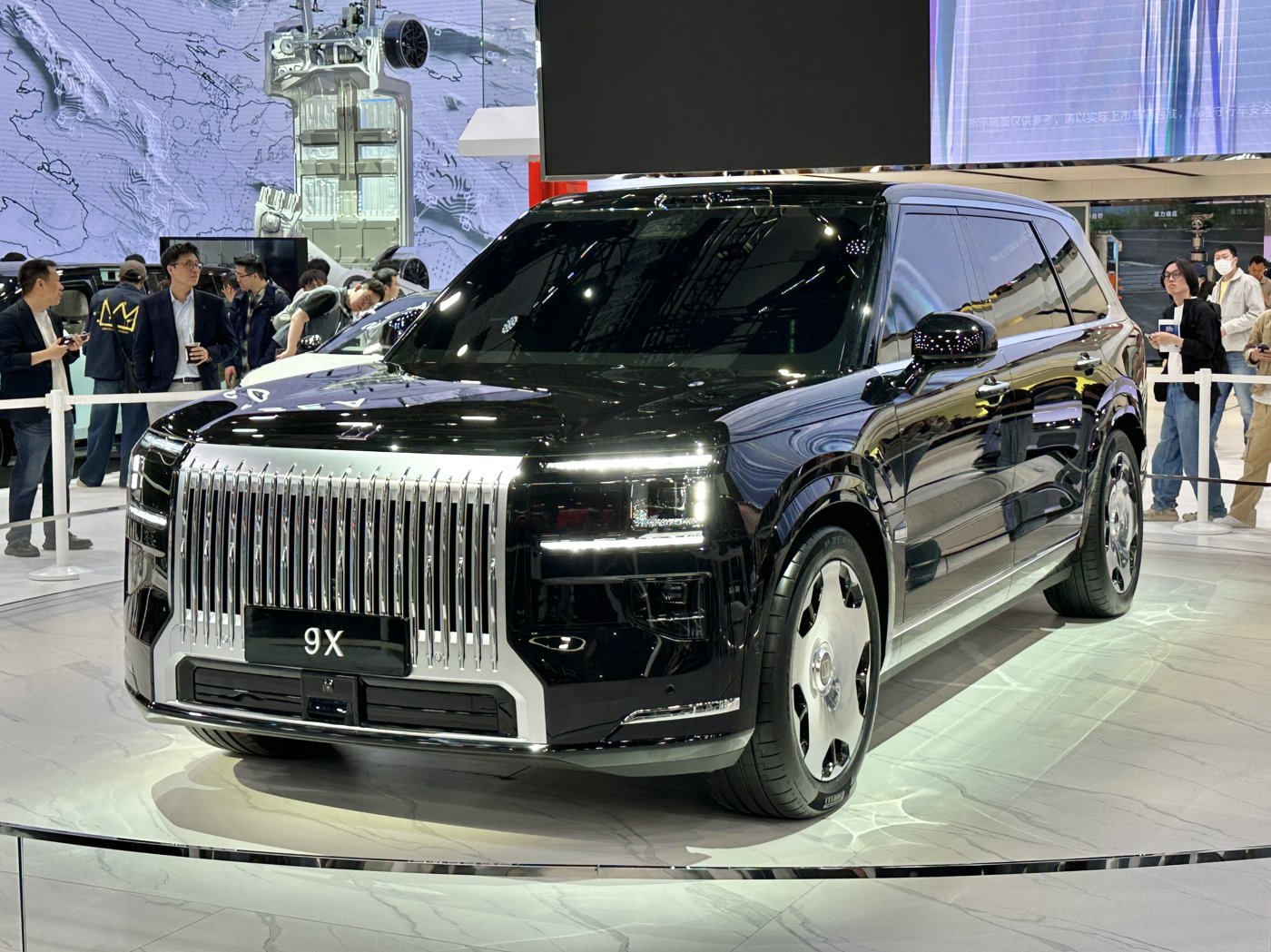
If you are choosing between the Zeekr 9X and the Lynk & Co 900, three things decide it and none of them is the 0–100 figure. Seat count comes first, because the 9X is built as a five-seater and nothing in the range changes that. Kerb weight comes second, because 470 kg separates the lightest 900 from the heaviest 9X and in several markets weight is taxed. Fuel grade comes third, and it is the one that catches people out: both cars ask for RON 95, and large parts of West Africa pump RON 91.
Everything else — the power figures, the screen sizes, the LiDAR count — matters less than those three once the car is on a ship.
👉 Need both quoted side by side? Ask us on WhatsApp · Zeekr 9X export order · Lynk & Co 900 export order
Why these two get compared at all
Put the tape measure on them and the case for comparing is obvious. The 9X is 5,239 mm long on a 3,169 mm wheelbase. The 900 is 5,240 mm long on a 3,160 mm wheelbase. One millimetre and nine millimetres. Both are plug-in hybrids, both are full-size SUVs from the Geely group, both launched into the same segment within a year of each other — the 900 six-seater in April 2025, the 9X in September 2025, the 900 five-seater in April 2026.
Buyers who shortlist on dimensions and price band end up with both on the list. Then the spec sheets arrive and the two cars stop resembling each other.
The five-seat problem
The 9X range is five seats. Every version in the manufacturer’s configurator lists five, and there is no six- or seven-seat variant sitting behind a trim wall waiting to be ordered.
The 900 was launched as a six-seater — 2+2+2, second-row captain’s chairs — and the five-seat body arrived a year later as a parallel model year rather than a replacement. Both remain in production. We wrote that up separately because it confuses people on purchase orders: see the 2026 5-seat versus 2025 6-seat breakdown.
For a lot of our enquiries this ends the comparison in one line. A buyer moving a family of six, or a hotel running airport transfers, cannot substitute a 9X for a 900 no matter what the power figures say. If the requirement is six seats, the 9X is not a candidate.
It cuts the other way too. The five-seat 900 gives up its third row and gets a 1,215–2,568 L boot for it. The 9X, also a five-seater, offers 470–2,148 L. If the job is carrying luggage rather than people, the five-seat 900 has the bigger hole behind the seats, by a margin that shows up the first time someone loads it.
Two very different powertrains
Both cars are plug-in hybrids. That is where the agreement stops.
| Zeekr 9X | Lynk & Co 900 (1.5T Ultra) | |
|---|---|---|
| Engine | DHE20-PFZ · 2.0 L turbo · 279 PS / 205 kW | JLM-4G15TD · 1.5 L turbo · 190 PS / 140 kW |
| Fuel grade | RON 95 | RON 95 |
| Motors | Twin (660 kW / 935 N·m) or triple (1,030 kW / 1,410 N·m) | Front + rear |
| System output | up to 1,030 kW · 1,410 N·m | ≈ 530 kW · ≈ 1,000 N·m |
| Gearbox | 1-speed DHT | 3-speed DHT |
| 0–100 km/h | 3.1–4.2 s | ≈ 4.8 s |
| Top speed | 240 km/h | ≈ 210 km/h |
| Battery | 55 or 70 kWh NMC (Geely–CATL) | 44.85 kWh NMC (CALB) |
| CLTC electric range | 288–380 km | ≈ 220 km |
| CLTC combined range | 1,160–1,250 km | — |
| DC charge 20–80% | ≈ 9 min | ≈ 26 min |
| Fuel tank | 50 L | 60 L |
| Kerb weight | 2,840–3,150 kg | 2,680–2,760 kg |
| Ground clearance | 200–208 mm | 194 mm |
| Vehicle warranty | 6 years / 150,000 km | 5 years / 100,000 km |
| Battery warranty | Unlimited years / unlimited km | Unlimited years / unlimited km |
The 9X is the faster and more powerful car by a distance that is not close. A triple-motor 9X puts down 1,030 kW and reaches 100 km/h in 3.1 seconds, which is supercar territory in a three-tonne SUV. The 900 answers with roughly 530 kW and 4.8 seconds.
Whether any of that is worth paying for depends on where the car goes. In the Gulf, where fuel is cheap and buyers read spec sheets, the 9X’s numbers sell themselves. On a laterite road in the interior, a 3.1-second launch is a number on a brochure.
Charging: the specification that evaporates
The 9X charges 20–80% in about nine minutes. The 900 takes about twenty-six. On paper that is a rout.
In practice it depends entirely on a high-power DC charger being within range of wherever the car lives, and across most of the markets we ship to, it is not. A nine-minute charge and a twenty-six-minute charge are the same thing when the nearest suitable charger is in another country. What matters instead is how the car behaves as a hybrid when nobody ever plugs it in, and there the 900’s 60-litre tank against the 9X’s 50 litres is the more useful ten litres.
Ask the question this way before you order: is this car going somewhere it will be charged, or somewhere it will be refuelled? Buyers in Chile, Peru and the Gulf are increasingly in the first group. Buyers across most of West Africa are firmly in the second, and should be quoted on tank size and service intervals rather than charge curves. Our import traps checklist covers the wider version of this mistake.
The 470 kilogram problem
The lightest 900 weighs 2,680 kg. The heaviest 9X weighs 3,150 kg. That gap has consequences that nobody discusses at the quotation stage and everybody discovers later.
Several markets assess duty partly on weight or on engine displacement, and a 2.0-litre 9X sits in a different band from a 1.5-litre 900 in any country whose tariff schedule keys off displacement. Confirm the band with your clearing agent before you commit — we cannot publish a duty figure that will still be right in six months, and neither can anyone else. What we can tell you is which number the schedule reads, and for these two cars it is usually displacement first, weight second.
Three tonnes also changes what the car does to itself. Tyres on the heaviest 9X are 285/45 R22 — a size that is not stocked everywhere, costs more when it is, and wears faster under that mass. The 900 runs 275/45 R21 across the range. Neither is a corner-shop size, but one is considerably easier to replace in Lagos or Lima than the other. Ask the question before delivery, not after the first puncture.
RON 95, and why West Africa should read this twice
Both cars specify RON 95 petrol.
The standard pump grade across much of West Africa is RON 91. We have already written about this for a cheaper car — the Coolray in West Africa declares RON 92 minimum against a regional supply of RON 91, and that one-point gap is a real problem for a car that will spend its life on whatever the local station sells.
For the 9X and the 900 the gap is four points, on turbocharged direct-injection engines running high compression, in ambient temperatures that make knock more likely rather than less. Premium grades exist in the major cities of most of these markets, so the answer is not “these cars cannot go there” — it is that the buyer has to know, before they pay, that this car needs the expensive pump every time and that the expensive pump is not on every corner. A buyer who finds that out in month three feels lied to, and they are not entirely wrong.
This is the single most common reason we talk a customer out of a car they had already decided on. It costs us the sale and saves the relationship.
Which one suits which buyer
Take the 900 if: you need six seats; the car is going somewhere it will be refuelled rather than charged; the buyer wants boot space over acceleration; or duty in the destination keys off displacement and 1.5 litres lands in a cheaper band than 2.0.
Take the 9X if: five seats are fine; the destination has working DC charging; the buyer is specification-driven and will pay for 1,030 kW and a nine-minute charge; or the extra ground clearance and the longer 6-year / 150,000 km warranty matter more than the weight.
Take neither if: the destination pumps RON 91 and the buyer will not commit to premium fuel. Sell them something that runs on what is actually in the ground there. We keep a range of options in the 2026 export shortlist, and there is no shortage of cars in this segment that are less fussy.
Export notes that apply to both
Both are left-hand drive from the factory, and neither is offered in right-hand drive. That rules both out for Kenya, Tanzania, Uganda, South Africa and the rest of the RHD bloc, where LHD is a registration problem rather than a matter of preference.
It is not an obstacle in West Africa. Nigeria, Ghana, Côte d’Ivoire, Senegal and Cameroon all drive on the right, so LHD is the correct configuration for every market on that coast — including our largest one, which is why the Nigeria pages never carry a steering-side caveat.
Both are current-production new cars, which keeps them clear of the age limits that catch used imports — the clocks that matter are set out in our 2026 dealer import guide and, for individual markets, the Côte d’Ivoire, Ghana and Senegal pages.
On shipping, both are full-size SUVs at 5.24 m and load the same way. Container maths is in how many cars fit in a container; route and port options in shipping cars from China to Africa.
One thing we verify per allocated unit rather than per model: the driver-assistance hardware. The 9X ships with either one LiDAR or five, either eleven cameras or thirteen, and either one NVIDIA Drive Thor-U chip or two, depending on version. Those are not trim-level cosmetics, and the configurator does not always make it obvious which one you are buying. We check it against the build sheet before the balance is paid, the same way we check everything else in the condition report.
FAQ
Does the Zeekr 9X come with six or seven seats?No. Every version in the range is a five-seater. If the requirement is six seats, the Lynk & Co 900 is the car in this comparison that can do it, in its 2025 six-seat body.
Which one has better electric range?The 9X, by a clear margin: 288–380 km CLTC depending on version and battery (55 or 70 kWh) against roughly 220 km for the 900 on its 44.85 kWh pack. The 9X also quotes a combined figure of 1,160–1,250 km CLTC.
Do both cars need premium petrol?Yes, both specify RON 95. That is four grades above the RON 91 standard supply in much of West Africa, and it needs to be confirmed with the end buyer before the order rather than after delivery.
How much heavier is the Zeekr 9X?Between 80 kg and 470 kg depending on which versions you compare. The 900 range runs 2,680–2,760 kg; the 9X runs 2,840–3,150 kg.
Which has the longer warranty?The 9X: six years or 150,000 km on the vehicle, against five years or 100,000 km on the 900. Both carry unlimited-year, unlimited-kilometre battery warranties, though warranty honouring outside China depends on the local service network, not on the certificate.
Are either available in right-hand drive?Not from the factory. Both are left-hand drive only.
Can you quote both together?Yes, and for a decision like this it is usually worth doing. Send the destination country and the seat requirement and we will come back with both, including the duty band each falls into once your agent confirms the schedule.
👉 Ready to compare on price? Message us on WhatsApp with your destination port and seat count · compare vehicles · contact Hanvia