
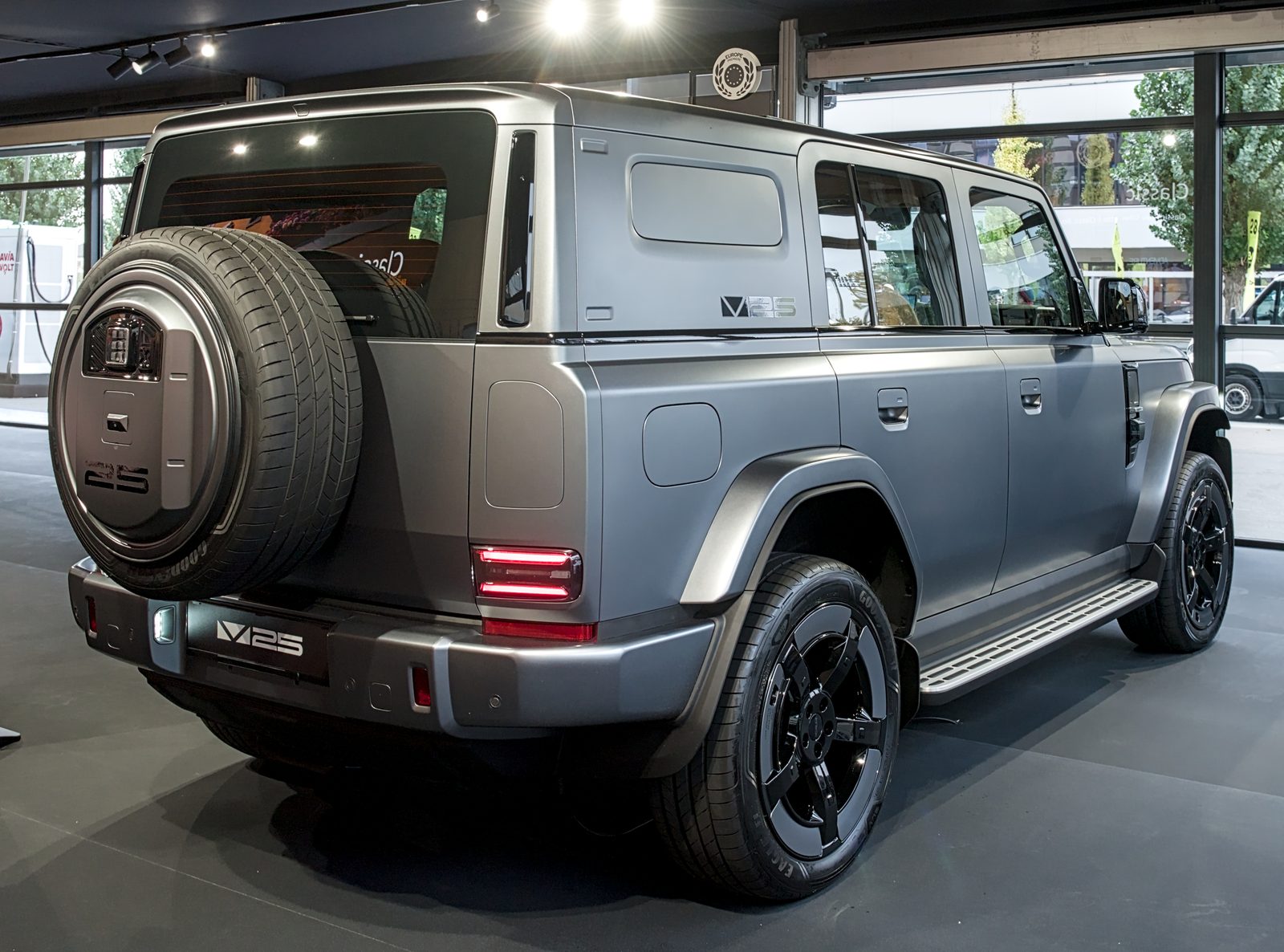
The iCAUR V25 is the export version of the iCAR V25 that Chery launched in China on 19 November 2026: a 4.6-metre boxy SUV driven by electric motors and kept running by a 1.5-litre turbo petrol generator. For importers in the Gulf, North Africa and Central Asia it is one of the few new Chinese off-road-styled models built around a petrol generator rather than a charging network, and iCAUR’s UAE site already lists a launch offer for it.
👉 Need a quote? Ask us on WhatsApp · GCC-spec vs China-spec: what actually differs →
What is the iCAUR V25?
The V25 is the third model in the iCAR V series, after the smaller V23 and the larger V27. iCAR is the brand name used in China; outside China the same cars are sold as iCAUR, a sub-brand of Chery. The V25 was first shown at Chery’s international user summit in Wuhu in October 2026 and went on sale in China a month later, on 19 November.
The car is a five-seat SUV with a flat roof line, upright glass, a side-hinged tailgate and a spare wheel mounted on the rear door. Chinese launch material gives four trims, two with rear-wheel drive and two with all-wheel drive. The body sits on a 2,820 mm wheelbase and uses a monocoque shell rather than a ladder frame, so it is closer in construction to a crossover than to a Hilux or a Tank 300.
iCAUR places the V25 between the 4.2-metre, battery-electric V23 and the five-metre V27, which uses the same range-extender layout. The target buyer is a family that wants off-road styling without a charging dependency, not a fleet that needs a working 4×4.
iCAR or iCAUR: which name should an importer use?
The car is the iCAR V25 in China and the iCAUR V25 in every export market where Chery sells the brand under that name. The two names describe the same body and the same powertrain, but not always the same specification, because the importer’s market gets its own homologation, battery choice and equipment list.
A purchase contract, invoice and certificate of origin should carry one consistent name, and the name on the export documents has to match the one the destination customs office recognises. Chinese model names and export names rarely match one-to-one across brands, and the V25 is a case where the export name is not a translation but a different brand.
An importer searching stock in China should ask for the VIN and the Chinese homologation code as well as the iCAUR name.
How big is the iCAUR V25, and how many seats does it have?
The V25 seats five and measures 4,636 mm long, 1,920 mm wide and 1,855 mm tall in the Chinese launch specification, on a 2,820 mm wheelbase. Ground clearance is 197 mm, approach and departure angles are 30 and 28 degrees, and the maximum wading depth is 600 mm. The boot holds 378 litres with the rear seats up and between 998 and 1,549 litres with them folded.
iCAUR’s UAE specification page gives a different overall length: 4,756 mm, with the same 1,920 mm width, 1,850 mm height and 2,820 mm wheelbase. The UAE car is shown with a spare wheel mounted on the tailgate, which sits behind the rear bumper and is a plausible reason for the longer figure, but the two numbers have not been reconciled by the manufacturer in public material. An importer who needs the exact length for container planning or for a registration form should measure the unit or ask for the homologation drawing rather than rely on either web page.
Width and height are consistent between the two sources, so the V25 will not fit a standard 20-foot container alongside another car. It ships as roll-on/roll-off cargo or in a 40-foot high-cube container in most trades; the choice between RoRo and container shipping depends on the destination port and on whether the unit is sold as a single car.
What powertrain does the iCAUR V25 use?
The V25 is a series hybrid, which Chinese manufacturers call a range-extended electric vehicle. The wheels are driven only by electric motors. A 1.5-litre turbocharged petrol engine is mounted at the front and drives a generator; it has no mechanical connection to the wheels. Chinese launch material quotes the generator engine at 115 kW and a thermal efficiency of 45.79 percent, with one litre of petrol producing about 3.71 kWh of electricity.
There are two drive layouts:
| Version | Motors | System output | Torque |
|---|---|---|---|
| Rear-wheel drive | Single rear motor, 185 kW | 185 kW (252 hp) | Not published |
| All-wheel drive | 150 kW front + 185 kW rear | 335 kW (455 hp) | 505 Nm |
iCAUR’s UAE page quotes the same 150 kW front and 185 kW rear motors and the same 335 kW combined figure. The four Chinese trims split evenly between the two layouts.
The chassis is independent at both ends, with MacPherson struts in front and a five-link rear axle. Chinese launch material lists an eight-mode terrain selector plus a custom mode, a low-speed crawl function and hill-descent control. Those functions are useful on gravel and sand, but the V25 has no low-range transfer case, and the launch material does not list a locking differential, so it should not be sold to a buyer as a replacement for a body-on-frame 4×4.
What battery and electric range does the iCAUR V25 have?
The Chinese launch specification lists one battery for all four trims: a 33.67 kWh lithium iron phosphate pack. CLTC electric range is 210 km for the rear-drive car and 200 km for the all-wheel-drive car. Combined range with a full tank and a full battery is 1,240 km and 1,210 km respectively.
The UAE specification is different. iCAUR’s UAE page lists two battery sizes, 20.47 kWh and 34.31 kWh, an electric range of 150 km on the NEDC cycle, a combined range of more than 800 km and combined fuel consumption of 6.6 litres per 100 km. The 20.47 kWh pack does not appear in the Chinese launch material.
Part of the gap is the test cycle: CLTC in China, NEDC on the iCAUR UAE page. A second part is battery size, since the UAE list includes a pack that does not exist in the Chinese launch material. Hot-climate tuning may account for the rest, and the iCAUR page does not explain it. A buyer comparing a Chinese quotation with a UAE showroom car should compare battery capacity in kWh first; that number decides both the electric range and the price of the pack.
iCAUR’s UAE page mentions REEV and BEV powertrains in its copy; the specification table lists only the REEV. A buyer who wants a pure-electric V25 should treat that as unconfirmed until a dealer supplies a BEV specification sheet.
How long does the iCAUR V25 take to charge?
Chinese launch material quotes a 2.5C charging rate and a 30 to 80 percent charge in about 15 minutes on a DC charger. iCAUR’s UAE page quotes 18.2 minutes for the same 30 to 80 percent window. Both figures are for the battery, not for a full charge, and neither states the charger power or the ambient temperature.
The car also provides vehicle-to-load power: 6.6 kW in the Chinese specification and 6 kW on the iCAUR UAE page. That is enough to run tools or a small appliance from the car, a useful function where grid power is unreliable.
Cars sold in China use the GB/T inlet. An export unit may carry GB/T, a Type 2 AC inlet or CCS2 depending on the market, and the iCAUR UAE page does not say which. A car ordered with the wrong inlet needs an adapter or a new charging harness.
Why does a range extender suit Gulf, African and Central Asian buyers?
A range extender removes the two objections that keep buyers in these regions away from battery-electric cars: charging time and charging availability. The V25 can be filled at any petrol station, and the engine keeps the battery at a usable level on a long run. For a family car doing intercity trips in Saudi Arabia, the UAE, Algeria or Kazakhstan, that is a practical advantage over a pure EV of the same size.
The trade-off is that the car still carries a petrol engine, a generator, a fuel tank and an exhaust system, so it needs both electric and engine maintenance. Oil changes, filters and cooling-system service are on the schedule alongside battery checks.
Import duties and registration also follow the engine in many markets. An EREV is usually classified as a hybrid or as a petrol vehicle rather than as an electric vehicle, which changes the duty rate and sometimes the registration category. Buyers in Ethiopia, where petrol-car imports have been restricted since 2024, should confirm how customs classifies a range-extender before ordering; the Ethiopian import rules are written around electric cars and do not settle the EREV question.
For Central Asia, the overland route through Khorgos is usual for a single unit, and a range-extender car still needs the battery declaration and dangerous-goods paperwork because the lithium pack travels with the vehicle. The Khorgos road route and battery declarations for hybrid and electric cars cover the two transport questions that come up first.
Is the iCAUR V25 left-hand drive or right-hand drive?
The V25 launched in China as a left-hand-drive car, and the UAE specification is left-hand drive as well. iCAUR has shown a right-hand-drive V27 at the Beijing auto show in April 2026 and has entered right-hand-drive markets including South Africa, Malaysia, Thailand and Indonesia, but no right-hand-drive V25 has been announced.
A left-hand-drive V25 cannot be registered for normal road use in South Africa, Kenya, Tanzania, Pakistan, Bangladesh, Australia and the other right-hand-drive markets in the region. Buyers there should wait for an official right-hand-drive release or choose a model that is already built in that configuration; the LHD and RHD split on Chinese EVs explains how to check the steering side from documents and photographs.
Where is the iCAUR V25 on sale outside China?
The UAE has a public V25 offer: iCAUR’s UAE site carries a V25 launch page and lists the range-extender specification, and the brand is represented there by an authorised distributor. The page does not publish prices, and dealer quotations seen in the UAE press in November 2026 do not agree with each other, so a buyer should get a written quotation from the distributor rather than rely on a published figure. Outside the UAE, iCAUR’s wider export rollout is reported to begin in early 2027.
iCAUR has also entered Saudi Arabia, and the brand says it sells in more than 40 countries. The V25’s arrival in each market depends on homologation, so a car on sale in Dubai is not automatically available in Riyadh, Algiers or Abidjan. For buyers in Algeria and Côte d’Ivoire, the question is whether the local iCAUR distributor has taken the model; the Jetour X70 Plus guide shows how much the answer varies between the two markets for a Chinese brand.
What should an importer check before ordering an iCAUR V25?
The battery comes first. The Chinese launch car has a 33.67 kWh pack, and the UAE listing has 20.47 and 34.31 kWh options. Write the capacity into the quotation in kWh; “standard” and “long range” do not identify a pack.
The charging inlet is next. GB/T, Type 2 and CCS2 are all possible on an export unit, and the inlet is expensive to change after the car is built.
Equipment and driver assistance differ by trim and by market. The top Chinese trim adds a lidar-based system that is unlikely to be homologated everywhere. iCAUR’s UAE page lists a conventional suite: autonomous emergency braking, adaptive cruise control, lane keeping, blind-spot monitoring and rear cross-traffic alert, with a 540-degree camera, a panoramic roof, heated and ventilated front seats and 21-inch wheels. Take the export equipment list from the destination distributor, not from Chinese launch coverage.
The paperwork needs the same care. A range-extender car needs a battery declaration for sea freight and, in most markets, a certificate of conformity that names the engine as well as the electric motor. The export document checklist lists the papers to ask for before a deposit.
Inspect the unit before shipment. Early production cars can differ from the show car in trim, tyres and software. A remote inspection with photographs of the VIN plate, the charging inlet, the battery label and the odometer is the minimum before a balance payment.
How does the iCAUR V25 compare with other boxy Chinese SUVs?
The V25’s closest rivals for export are the Jetour T2, the 212 T01 and the Tank 300. The T2, the 212 T01 and the Tank 300 are petrol or diesel SUVs with conventional drivetrains, and the 212 and the Tank 300 use body-on-frame construction, so the comparison is uneven. The V25 is a monocoque range extender: it wins on fuel cost in city use and loses on towing, payload and hard off-road work.
Against the Fangchengbao Ti 9, the Geely Galaxy Battleship 700 and the Denza N8, all larger plug-in hybrids, the V25 is smaller and cheaper to ship, and its electric range is shorter. The Fangchengbao Ti 9 and the Denza N8 are six- and five-seat flagships, while the V25 is a compact five-seater with a stronger off-road look.
For a buyer who wants a petrol SUV with a proven service network, the Tank 300 or the 212 T01 remain simpler imports. For a buyer who wants low running costs in a city and a car that can still leave the tarmac at the weekend, the V25 is the newer design, provided the charging inlet and the battery match the market.
FAQ
Is the iCAUR V25 the same car as the iCAR V25?
Yes. iCAUR is the name Chery uses for the iCAR brand outside China. The body and the range-extender powertrain are the same, but the export specification can differ in battery size, charging inlet and equipment, so the two should not be treated as identical when ordering.
How far can the iCAUR V25 go on electric power alone?
The Chinese launch specification quotes 210 km of CLTC electric range for the rear-drive car and 200 km for the all-wheel-drive car. iCAUR’s UAE page quotes 150 km on the NEDC cycle. The Chinese and UAE figures are measured on different cycles and, in at least one UAE trim, on a smaller 20.47 kWh battery.
Does the iCAUR V25 need to be charged?
No. The 1.5-litre turbo engine drives a generator that charges the battery, so the car can run on petrol alone. Charging gives the lower running cost and the full electric range; without charging, the car behaves like a petrol hybrid with a small battery.
Is the iCAUR V25 available in right-hand drive?
Not at launch. The Chinese and UAE cars are left-hand drive. iCAUR has shown a right-hand-drive V27 and sells in South Africa and South-East Asia, but no right-hand-drive V25 has been announced.
Is the iCAUR V25 a plug-in hybrid?
It is a range-extended electric vehicle. The wheels are driven only by electric motors and the petrol engine works as a generator. That is different from a parallel plug-in hybrid, where the engine can drive the wheels directly through a gearbox.
What is the towing capacity of the iCAUR V25?
iCAUR’s UAE page lists 1,800 kg. The Chinese launch material does not publish a towing figure. A buyer who needs to tow should confirm the rating on the destination-market certificate of conformity, because towing limits are often revised for export homologation.
Sources: China launch on 19 November 2026, four trims, rear- and all-wheel drive, 1.5T range extender at 115 kW and 45.79 percent thermal efficiency, 185 kW rear motor, 150 kW front plus 185 kW rear and 335 kW combined, 33.67 kWh LFP battery, CLTC 210 km rear-drive and 200 km all-wheel-drive, combined 1,240 km and 1,210 km, 30 to 80 percent in about 15 minutes at 2.5C, 6.6 kW vehicle-to-load, 4,636 × 1,920 × 1,855 mm, 2,820 mm wheelbase, 197 mm ground clearance, 600 mm wading depth, 30/28/17 degree angles, 378-litre boot and 998–1,549 litres folded: IT之家 launch report, 19 November 2026, and 智车派/CNMO launch report, read November 2026. Battery, 20.47 and 34.31 kWh; NEDC 150 km electric and 800+ km combined; 6.6 L/100 km; 150 kW front and 185 kW rear, 335 kW total and 505 Nm; 18.2 minutes 30 to 80 percent; 1.8 t towing; 6 kW external power; 4,756 × 1,920 × 1,850 mm, 2,820 mm wheelbase; 21-inch wheels, rear-mounted spare, side-opening tailgate, panoramic roof, 15.4-inch 2.5K display, heated and ventilated front seats; REEV and BEV mentioned in copy but only REEV in the specification table: iCAUR UAE V25 launch offer page, read November 2026. Brand structure, V23/V25/V27 line-up, right-hand-drive V27 at the Beijing auto show in April 2026, entry into Malaysia, Thailand, Indonesia, South Africa and Saudi Arabia, and presence in more than 40 countries: GlobeNewswire iCAUR release, April 2026, and Car1.hk iCAUR brand report, read November 2026. The 4,636 mm and 4,756 mm length figures come from two different sources and are both stated in the text; the 378-litre boot figure is from the CNMO report only; the early-2027 wider rollout and the 45.79 percent thermal efficiency are also reported by paultan.org’s Wuhu show report of October 2026; the UAE dealer prices reported in November 2026 were not used because the outlets do not agree. Photo: © Alexander Migl / Wikimedia Commons, CC BY-SA 4.0 (iCAUR V25, Auto Zürich 2026). Photo: Alexander Migl / Wikimedia Commons, CC BY-SA 4.0.