
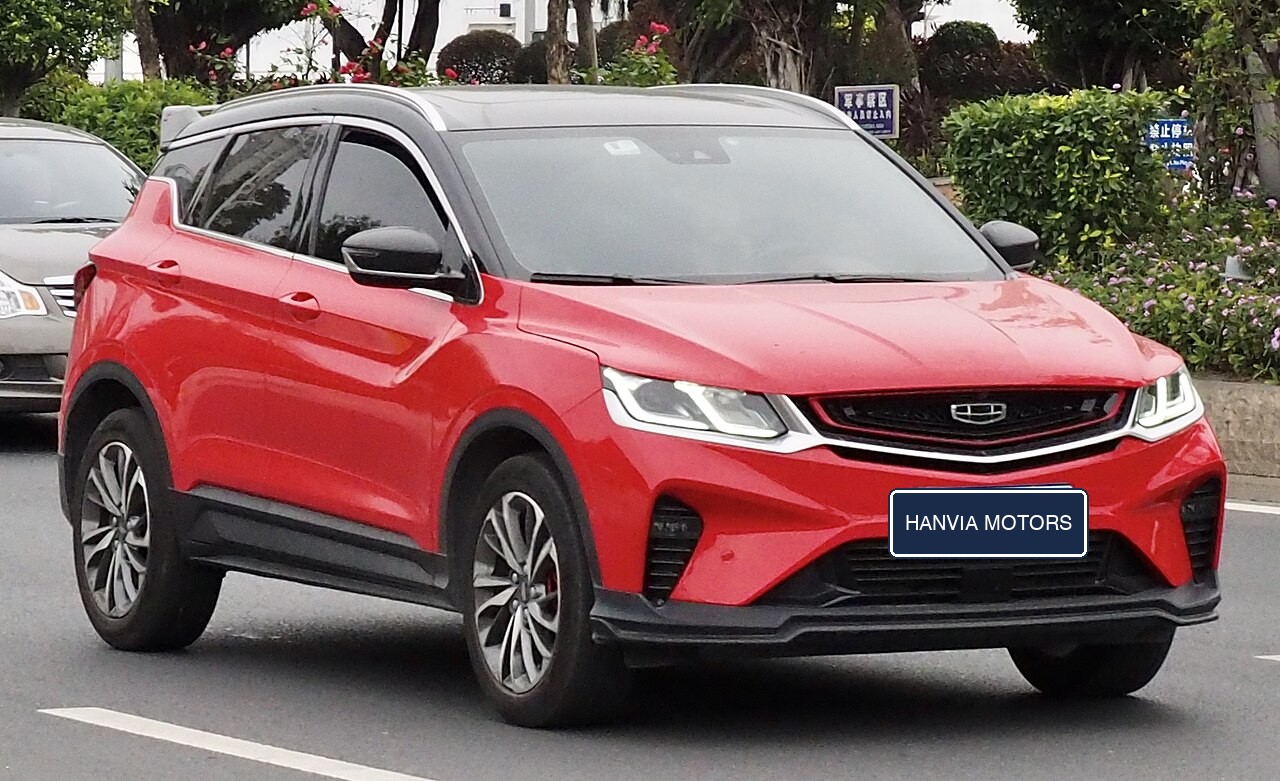
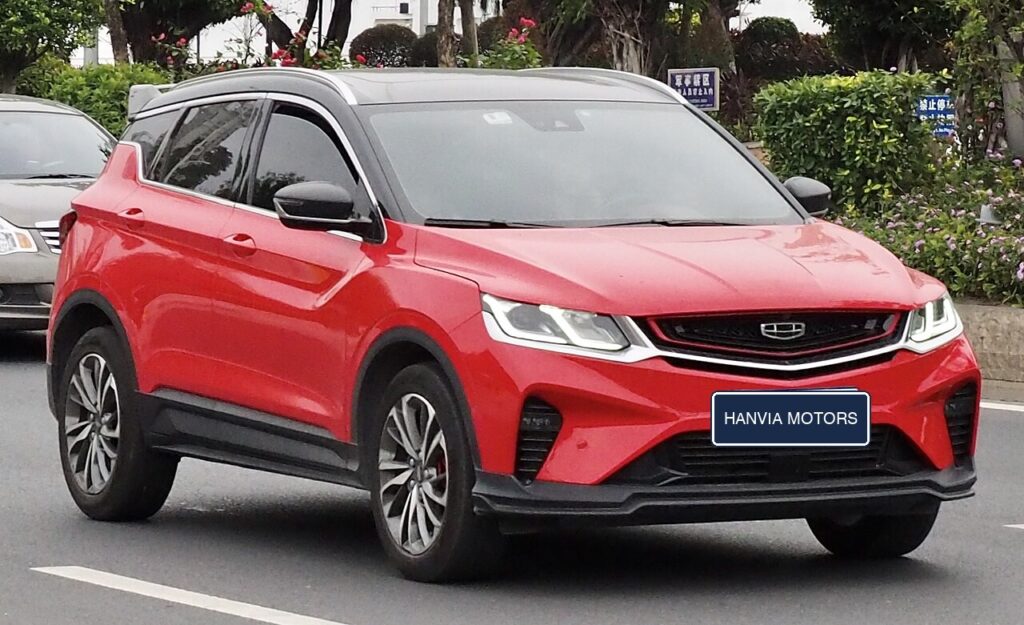
In China, where every exported Coolray is built, the car sells for RMB 66,800 to RMB 97,800 (manufacturer’s guide price) across seven trims — and that range covers two mechanically different vehicles, not one car with options. The RMB 66,800 end is a 4,330 mm naturally aspirated Binyue with 93 kW and a manual gearbox. The RMB 97,800 end is a 4,380 mm Binyue L with a 1.5TD turbo making 133 kW and 290 N·m through a 7-speed wet dual-clutch. Both reach export markets, but under different names: the naturally aspirated car is sold abroad as the Coolray Lite, the turbo as the New Coolray. If you price your order from the cheap end of the Chinese ladder and expect the turbo car, your numbers are wrong by about RMB 31,000 and one entire engine.
👉 Want a Geely Coolray export quote? Chat on WhatsApp · Send an enquiry
Quick answers
| Chinese guide price | RMB 66,800 – 97,800 across 7 trims (3 Binyue Chaoneng + 4 Binyue L) |
| Export engine | 1.5TD turbo petrol, 1,499 cc, 133 kW @ 5,500 rpm, 290 N·m @ 2,000–3,500 rpm |
| Gearbox | 7-speed wet dual-clutch (DCT) |
| 0–100 km/h | 7.6 s (Binyue L, manufacturer figure) |
| Fuel consumption | 6.35 L/100 km WLTC (Binyue L) · 45 L tank |
| Size | 4,380 × 1,800 × 1,609 mm, wheelbase 2,600 mm (Binyue L) |
| Body | Subcompact SUV, 5-door, 5 seats, front-wheel drive |
| Availability | New, built to order — FOB price and lead time on request |
Prices above are the manufacturer’s guide price in China and are not what you pay landed in your market. An FOB figure depends on trim, quantity, options and the exchange rate on the day we quote. Tell us the market and the volume and we will price it properly. If you have never run a China order before, start with our 2026 import guide for dealers.
The Coolray is two different cars in China. Check which one you are buying.
Outside China this model is simply “the Coolray”. Inside China the Binyue nameplate currently covers two separate vehicles that share a name, a wheelbase and a silhouette, and almost nothing else that matters to a buyer.
| Binyue Chaoneng (超能版) | Binyue L (缤越L) | |
|---|---|---|
| Length | 4,330 mm | 4,380 mm |
| Width × height | 1,800 × 1,609 mm | 1,800 × 1,609 mm |
| Wheelbase | 2,600 mm | 2,600 mm |
| Engine | 1.5 L naturally aspirated, direct injection | 1.5TD turbo, DVVT, direct injection |
| Power / torque | 93 kW @ 6,300 rpm · 152 N·m | 133 kW @ 5,500 rpm · 290 N·m |
| Gearbox | 5-speed manual or CVT | 7-speed wet DCT |
| Kerb weight | 1,255 / 1,289 kg | 1,320 / 1,350 kg |
| Approach / departure angle | 18° / 21° | 20° / 28° |
| Fuel (WLTC) | 6.46 L/100 km (MT) · 6.89 L/100 km (CVT) | 6.35 L/100 km |
| Guide price | RMB 66,800 – 78,800 | RMB 84,800 – 97,800 |
| Export name | Coolray Lite | New Coolray |
Four things in that table are worth reading twice.
The wheelbase is identical. Both cars sit on 2,600 mm and both are 1,800 mm wide and 1,609 mm tall. The Binyue L is not a bigger car in any way a passenger would notice — the extra 50 mm is bodywork at the ends, not cabin. Anyone selling you the L on the promise of more rear legroom is selling you something the specification sheet does not support. What the extra length does buy is on the next line, and it is not nothing.
Those 50 mm are worth 7° at the rear. The Binyue L is rated at a 20° approach angle and a 28° departure angle; the shorter Chaoneng manages 18° and 21°. Geely publishes no ground-clearance figure for either car in any model year we have checked, so these angles are the only geometry you can hold a supplier to. On a broken kerb or a steep compound entrance, the rear angle is what decides whether the car scrapes, and it runs against the usual assumption that the shorter, cheaper car is the more agile one off tarmac. What that means market by market is in the Coolray in West Africa; the full version-by-version picture, including the first-generation three-cylinder car still filling the used market, is in Coolray vs Coolray Lite vs New Coolray.
The most powerful version is also the most economical. The 133 kW turbo with the dual-clutch returns 6.35 L/100 km on the WLTC cycle. The 93 kW naturally aspirated engine with a CVT returns 6.89 L/100 km — half a litre per 100 km worse with 40 kW less. That is counter-intuitive on a forecourt where the small engine is meant to be the frugal one, and it is a genuinely useful argument for a dealer in a market where fuel is expensive.
The price gap is a whole engine. RMB 31,000 separates the two ends. That is not a trim walk. We take this apart model by model in Chinese model names vs export names, which is the piece to read before you place any order against a foreign-market brochure.
Geely Coolray price in China: the full trim ladder
Seven trims are on sale. Prices are the manufacturer’s guide price in RMB; Chinese dealers discount, so a guide price is a ceiling, not a transaction price. We do not publish discount figures because we have no verified data on them, and neither does anyone else quoting you from a distance.
Binyue Chaoneng — naturally aspirated (exported as the Coolray Lite)
| Trim | Guide price | Powertrain | Wheels |
|---|---|---|---|
| Chaoneng MT | RMB 66,800 | 93 kW · 5-speed manual | 215/65 R16 |
| Chaoneng CVT | RMB 73,800 | 93 kW · CVT | 215/60 R17 |
| Chaoneng Max | RMB 78,800 | 93 kW · CVT | 215/60 R17 |
Binyue L — 1.5TD turbo (exported as the New Coolray)
| Trim | Guide price | Wheels | Screen | L2 driver assistance |
|---|---|---|---|---|
| Chaoyue (超越版) | RMB 84,800 | 215/60 R17 | 8-inch | No — cruise control only |
| Xingzuan (星钻版) | RMB 89,800 | 215/60 R17 | 14.6-inch | No — cruise control only |
| Xingyao (星耀版) | RMB 96,800 | 215/55 R18 | 14.6-inch | Yes — full package |
| Battle | RMB 97,800 | 215/55 R18 | 14.6-inch | Yes — full package |
What each step up the ladder actually buys
Read the ladder as three separate decisions rather than four prices.
RMB 84,800 → 89,800 buys the cabin. The RMB 5,000 step from Chaoyue to Xingzuan replaces the 8-inch head unit with the 14.6-inch touchscreen, adds the E02 processor, voice control, navigation, phone mirroring, 4G and in-car Wi-Fi, keyless entry, a 360° camera in place of the plain reversing camera, heated and folding mirrors, one-touch windows on all four doors, and over-the-air updates. It is the largest jump in perceived equipment per RMB on the whole ladder.
RMB 89,800 → 96,800 buys the safety systems. This RMB 7,000 step is the real capability break in the range. Everything below Xingyao has cruise control and nothing else; Xingyao is where ICC lane centring, adaptive cruise, city AEB with pedestrian and two-wheeler recognition, lane keeping, emergency lane avoidance, lane departure warning, automatic high beam and traffic sign recognition all arrive together, as a block. It also brings 18-inch wheels, front side airbags, the 540° see-through undertray view, six speakers instead of four, and rear reading lights. If your customers ask for “the one with the safety pack”, this is the trim — the two cheaper ones cannot be optioned up to it.
RMB 96,800 → 97,800 is not an upgrade. It is a swap. The Battle costs RMB 1,000 more than Xingyao and it both adds and removes. It adds Battle badging, a carbon-look body kit, quad exhaust outlets, a suede-wrapped cabin, two-tone suede seats, orange sport belts and carbon-look trim. It removes the leather sport seats, the powered sunroof, the black-and-yellow cabin and the aero spoiler, and it takes the manual six-way driver’s seat off the list. On the Xingyao you can still option heated seats and the powered tailgate; on the Battle you cannot. For most export markets that is a bad trade — you are paying to lose comfort equipment your customers can see and touch, in exchange for appearance parts. Order the Battle only where the buyer specifically wants the look.
This pattern — a top trim that trades equipment for styling instead of adding it — is common in Chinese line-ups and catches importers out regularly. It is one of the traps we list in our China car import checklist.
Geely Coolray full specifications
Manufacturer figures for the Binyue L, exported as the New Coolray.
| Length × width × height | 4,380 × 1,800 × 1,609 mm |
| Wheelbase | 2,600 mm |
| Kerb weight | 1,320 kg / 1,350 kg depending on trim |
| Engine | 1.5TD turbocharged petrol, DVVT, direct injection, 1,499 cc |
| Maximum power | 133 kW @ 5,500 rpm (181 PS) |
| Maximum torque | 290 N·m @ 2,000–3,500 rpm |
| 0–100 km/h | 7.6 seconds |
| Transmission | 7-speed wet dual-clutch |
| Drive | Front-wheel drive |
| Fuel consumption | 6.35 L/100 km (WLTC combined) |
| Fuel tank | 45 litres |
| Emissions standard | China VI b |
| Front suspension | MacPherson strut, independent |
| Rear suspension | Torsion beam, semi-independent |
| Brakes | Ventilated discs front, solid discs rear with pad wear warning |
| Steering | Electric power assisted (EPS), speed-sensitive |
| Tyres | 215/60 R17 (Chaoyue, Xingzuan) · 215/55 R18 (Xingyao, Battle) |
| Instrument cluster | 8.8-inch digital |
| Centre screen | 8-inch (Chaoyue) · 14.6-inch touchscreen (all others) |
| Seats | 5, rear bench folding 60:40 |
| Drive modes | Normal, Eco, Sport, Smart |
| Domestic warranty | 4 years or 100,000 km in China (export warranty terms differ by market) |
A 45-litre tank at the quoted 6.35 L/100 km works out to roughly 700 km between fills on the test cycle. Real consumption on unsealed roads and in heavy traffic will be higher, but the tank size is worth noting in markets where filling stations are far apart — it is small for a car sold in West Africa, and a point to raise with customers before they discover it themselves.
Two chassis details deserve a flag for rough-road markets. The rear axle is a torsion beam, not multi-link — cheaper to maintain and easier to source parts for, but less composed on broken surfaces. And the wheel size climbs with trim: the Xingyao and Battle run 215/55 R18, a lower-profile tyre that is more vulnerable to pothole damage and, in many African and Central Asian markets, harder and dearer to replace than the 17-inch fitment on the two cheaper trims. Where road quality is poor, the RMB 89,800 Xingzuan on 17s is arguably the better car to import — except that it is also the trim without the driver assistance package. That trade-off is real and there is no trim that resolves it.
Model year vs build date: how to read a “2026 Coolray”
Buyers search for the Coolray by year, and dealers quote by year, but in China the model year printed in the sales listing and the month the car left the line are two different facts that regularly disagree. Across the vehicles we have processed with a recorded build date, roughly a third carried a model year that did not match the year of manufacture.
The tiebreaker is the tenth character of the VIN, which encodes the manufacturing year: P = 2023, R = 2024, S = 2025. It is stamped on the car and cannot be adjusted by whoever wrote the listing. This matters directly to money in any market with an age limit on imports, because customs reads the VIN, not the advertisement. When you ask us for a Coolray we quote the current production version and confirm the exact build specification on the order — and for any used unit we publish the VIN alongside the build date so you can check the two against each other yourself. Our inspection and condition reporting page explains what we verify on every car.
Coolray, Proton X50, BelGee X50: same car, different badge
The Binyue is sold under at least three other names, and knowing them prevents an expensive mismatch when your customer arrives with a specification sheet from another country.
- Coolray — the export name in the Philippines, Indonesia, Vietnam and South Africa.
- Proton X50 — the Malaysian version, built under Geely’s partnership with Proton.
- BelGee X50 — assembled for the Belarusian and Russian markets since 2023.
Specification differs between these markets. A brochure for one of them is not a description of the car we ship from China, and equipment lists, engine tunes and even body length can vary. Quote from the Chinese specification when you order from China. The same discipline applies across the Geely range — you can see the badge-versus-market problem in full in our naming and trim decoder, and browse what we currently hold under Geely.
What matters when you export a Coolray
Steering. The Chinese production car is left-hand drive, which is correct for West and North Africa, Central Asia, the Gulf and Latin America. Right-hand-drive versions of this model exist in other markets, but they are not the car built on the Chinese line — if you need RHD, say so at enquiry stage and we will confirm what is actually available rather than assume.
New versus used. A new Coolray built to order sidesteps the age limits that block used imports in much of West Africa — the five-year rule in Côte d’Ivoire, the ten-year limit in Senegal, the standards regime in Ghana. Duty on a new vehicle is a separate question from age eligibility, and rates change; confirm both with your clearing agent for the shipment in front of you. Nigeria has its own recent changes worth reading before you commit to volume.
Shipping. A subcompact SUV of this footprint is efficient to ship in volume — the arithmetic for containers versus RoRo is in how many cars fit in a container and shipping cars from China to African ports.
Parts and service. This platform has been in production since 2018, and the same car is already sold new under local badges in several of the markets we serve: as the Coolray in South Africa, the Philippines, Indonesia and Vietnam, and as the Proton X50 in Malaysia. Service parts for it are not exotic, which is a real advantage over importing a nameplate nobody in your city has seen.
Who you are actually buying from. New cars leaving China pass through a supply chain with several possible layers, and the layer you buy at determines your price and your recourse. We set the whole structure out in who actually sells you a Chinese car.
How to order a Geely Coolray from China
- Tell us your market, quantity and target trim on WhatsApp or through the enquiry form. Trim matters more than usual here — the safety package boundary sits between two trims RMB 7,000 apart.
- We confirm current availability, FOB price, lead time and the shipping options to your port.
- You place the order. We handle sourcing, export documentation, and container or RoRo booking. Our services page covers what is included.
If you are comparing the Coolray against other options in this price band, our 2026 export shortlist is the place to start, and the comparison tool lets you put candidates side by side. For a cheaper entry point the BYD Seagull is the volume EV alternative; a step up, the Lynk & Co 06 covers the same footprint with a premium finish, and the Jetour T2 is the rugged-SUV answer if your customers want ground clearance over economy.
👉 Ready for a quote? Message us on WhatsApp · Build an enquiry list
Frequently asked questions
How much does the Geely Coolray cost?
In China the guide price runs from RMB 66,800 for the naturally aspirated Binyue Chaoneng MT to RMB 97,800 for the turbocharged Binyue L Battle. Those are Chinese domestic guide prices, which include domestic tax and dealer margin, so they are not what an export order costs. An FOB figure is materially lower and depends on trim, quantity, freight and the exchange rate on the day. Tell us the market and the volume and we will quote FOB properly.
What is the Geely Coolray’s engine and fuel consumption?
The export version uses a 1,499 cc 1.5TD turbocharged petrol engine producing 133 kW (181 PS) and 290 N·m, driving the front wheels through a 7-speed wet dual-clutch gearbox. Manufacturer fuel consumption is 6.35 L/100 km on the WLTC cycle, from a 45-litre tank. It reaches 100 km/h in 7.6 seconds.
What size is the Geely Coolray?
The Binyue L measures 4,380 × 1,800 × 1,609 mm on a 2,600 mm wheelbase and weighs 1,320–1,350 kg. The naturally aspirated Binyue Chaoneng is 4,330 mm long with the same width, height and wheelbase — the extra length on the L is bodywork, not cabin space.
Is the Coolray the same car as the Binyue?
Yes, but the Binyue name in China covers two vehicles. The 4,330 mm Chaoneng has a 93 kW naturally aspirated engine with a manual or CVT gearbox; the 4,380 mm Binyue L has the 133 kW 1.5TD turbo with a 7-speed dual-clutch. Both are exported, under different names — the naturally aspirated car as the Coolray Lite and the turbo as the New Coolray. Note that a car badged simply “Coolray” abroad is often the superseded generation, whose 1.5TD was the three-cylinder JLH-3G15TD; Geely moved the line to the four-cylinder BHE15-EFZ in China from 2022. The same car is also sold as the Proton X50 in Malaysia and the BelGee X50 in Belarus and Russia.
Which Coolray trim has the driver assistance systems?
Adaptive cruise, lane centring, autonomous emergency braking with pedestrian and two-wheeler detection, lane keeping and traffic sign recognition arrive together on the Xingyao trim at RMB 96,800, and are also on the Battle. The two cheaper turbo trims have cruise control only and cannot be optioned up to the full package.
Is the Geely Coolray left-hand drive?
The version built in China and supplied for export is left-hand drive, which suits West and North Africa, Central Asia, the Gulf and Latin America. Right-hand-drive versions of this model are sold in some other markets but are not the Chinese production car; tell us at enquiry stage if you need RHD and we will confirm what is genuinely available.
Can I import a new Geely Coolray into a country with a vehicle age limit?
A new vehicle is not affected by the used-import age limits that apply in markets such as Côte d’Ivoire, Senegal and Ghana, because those rules are written against the age of the car. Import duty, homologation and any local content or emissions requirements are separate questions and vary by country and by year — confirm the current position with your clearing agent before you commit to a shipment.