
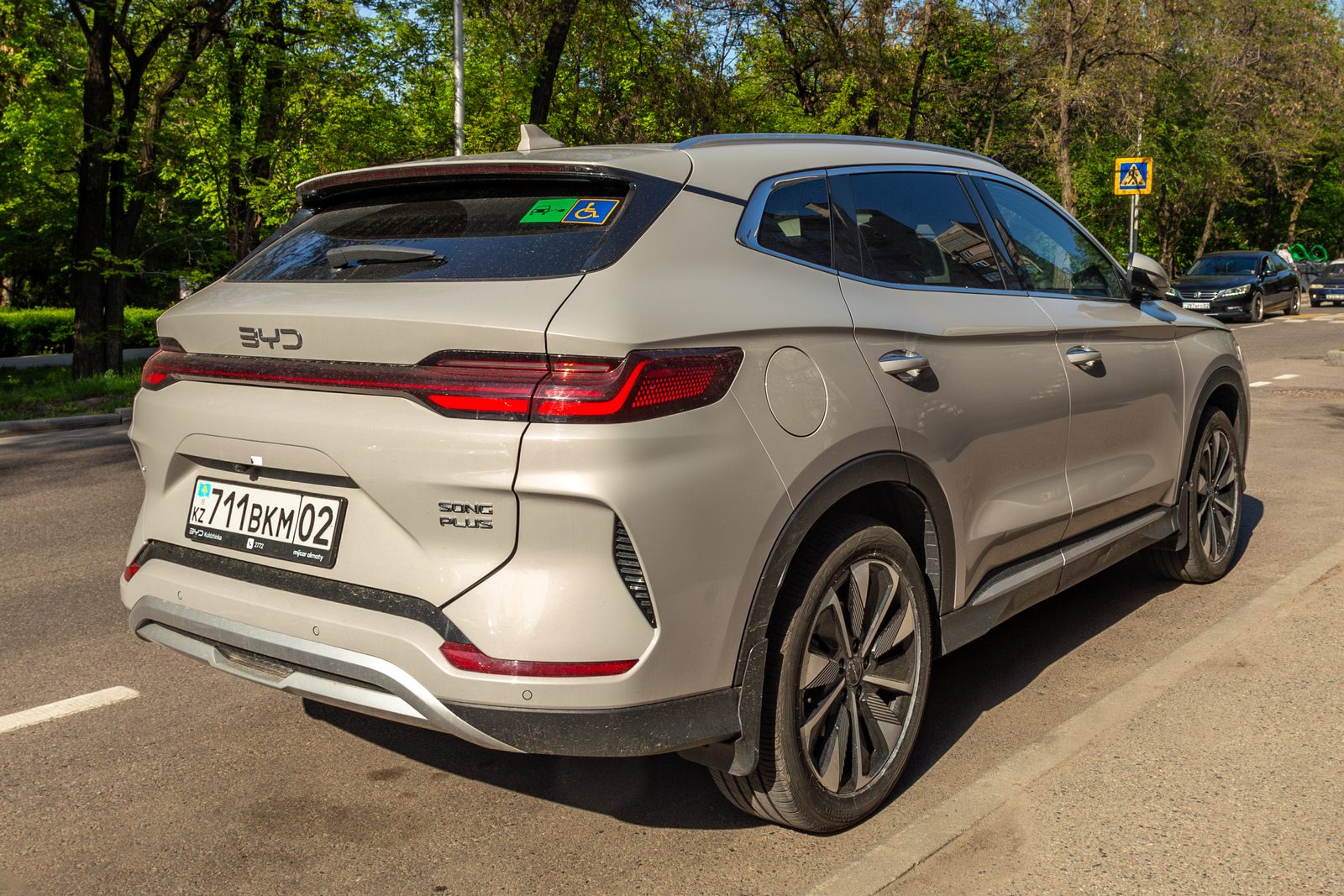
The BYD Song Plus EV and Song Plus DM-i are the same vehicle with different powertrains. Both are five-seat, front-wheel-drive SUVs on a 2,765 mm wheelbase. The EV uses a 71.8 kWh or 87.04 kWh Blade battery and quotes 520 km or 605 km CLTC. The DM-i uses a 12.9, 18.3 or 26.6 kWh battery for 75, 112 or 160 km CLTC of electric driving, backed by a 1.5-litre petrol engine. The EV is the better import where charging is dependable and daily distances are predictable. The DM-i is the better import where charging is uncertain, distances are long, or the buyer wants one car for both city and intercity work.
That single split explains most of the market differences below: Ethiopia’s case is electric, the Gulf’s is mostly plug-in hybrid, and Central Asia sits between the two.
👉 Tell us the destination port and the buyer’s daily distance — we’ll tell you which powertrain fits and send current stock. Ask us on WhatsApp · Browse current stock →
Quick answers:
- Which is cheaper to run? The EV, wherever electricity is cheaper than petrol and home charging exists. The DM-i, where electricity is unreliable or petrol is heavily subsidised.
- Which goes further on one fill? The DM-i. The Jordan-market Song Plus DM-i Boost is rated at 890 km combined WLTC.
- Which charges faster? The EV: 90 kW or 140 kW DC, against 26 kW or 54 kW on the two upper DM-i trims, and no DC charging at all on the 75 km version.
- Do they have the same body and boot? Yes. Same 2,765 mm wheelbase and 574 litres of boot space behind the rear seats in the Chinese specification.
- Which is the safer import for a first-time buyer? The EV in Ethiopia; the DM-i in the Gulf and Central Asia. The reasons are in the sections below.
What is the difference between the Song Plus EV and the Song Plus DM-i?
The Song Plus is one body shell offered with two completely different drivetrains. The EV has no engine, no fuel tank and no exhaust. The DM-i is a plug-in hybrid: a 1.5-litre petrol engine, an electric motor, and a battery large enough for 75–160 km of electric-only driving on the Chinese CLTC cycle.
The naming needs care. In China the car is the 宋PLUS (Song Plus), sold as the Song Plus EV and Song Plus DM-i. In Europe the same body is the BYD Seal U, in EV and DM-i forms. In Australia, New Zealand, Thailand, the Philippines and several other right-hand-drive markets the plug-in version is sold as the Sealion 6 DM-i. Jordan’s official BYD site lists it as the Song Plus DM-i Boost. Our guide to BYD’s China and export names covers the pattern. If the buyer is weighing the Song Plus against its replacement, the Sealion 06 EV versus Song Plus EV and Sealion 06 DM-i versus Song Plus DM-i comparisons cover that choice.
One production fact matters for stock. BYD removed the Song Plus from its China website in January 2026 and replaced it in the domestic range with the larger Sealion 06, but export production and export sales continued. China-market stock you are offered in late 2026 is therefore likely to be a 2024 or 2025 build, not a current-model-year car. Confirm the build date and the exact battery before you compare prices between suppliers.
How do the Song Plus EV and DM-i compare on paper?
The table below uses the Chinese specification tables for the 2025-model versions, the latest full lineup in those tables.
| Specification | Song Plus EV 520 | Song Plus EV 605 | Song Plus DM-i 75 | Song Plus DM-i 112 | Song Plus DM-i 160 |
|---|---|---|---|---|---|
| Battery (kWh) | 71.8 | 87.04 | 12.9 | 18.3 | 26.6 |
| Electric range, CLTC | 520 km | 605 km | 75 km | 112 km | 160 km |
| Electric range, WLTC | — | — | 60 km | 91 km | 128 km |
| Engine | — | — | 1.5L, 74 kW / 126 Nm | same | same |
| Drive motor | 150 kW / 310 Nm | 160 kW / 330 Nm | 160 kW / 260 Nm | same | same |
| 0–100 km/h | — | — | 7.7 s | 7.7 s | 7.9 s |
| DC fast charge | 90 kW | 140 kW | none | 26 kW | 54 kW |
| AC charge | 7 kW | 7 kW | 3.3 kW | 3.3 kW | 7 kW |
| Kerb weight | 1,920 kg | 2,050 kg | 1,785 kg | 1,830 kg | 1,890 kg |
| Boot, seats up | 574 L | 574 L | 574 L | 574 L | 574 L |
Two rows carry more weight than the rest. First, the 75 km DM-i has no DC fast-charging capability at all, and its AC charger is only 3.3 kW. Second, the 87 kWh EV weighs 2,050 kg, 160 kg more than the 160 km DM-i, which affects tyre wear and braking on poor roads.
The export versions are not identical to the Chinese table. The European Seal U EV Design uses the 87 kWh pack and quotes 500 km WLTP rather than 605 km CLTC, with 140 kW DC charging and a heat pump. The Jordan-market Song Plus DM-i Boost uses a 1.5-litre turbo engine rated 96 kW and 220 Nm, a 150 kW / 300 Nm motor, an 18.3 kWh pack, 90 km WLTC of electric range, 890 km combined and 5.1 L/100 km WLTC. Both sets of figures come from the manufacturers’ own market listings; treat them as the reference for the build you are actually buying, not for the Chinese car.
What does the CLTC range mean in Addis Ababa, Amman or Almaty?
CLTC is China’s test cycle, and it flatters range in the same way WLTP flatters it in Europe. A 605 km CLTC figure becomes 500 km WLTP on the same 87 kWh battery, and independent European testing has suggested real-world summer range closer to 435 km. For the DM-i, the Chinese CLTC figures of 75, 112 and 160 km correspond to WLTC figures of 60, 91 and 128 km. Plan the buyer’s daily route on the WLTC number, then take another 10–15% off for air-conditioning, heat, load and traffic.
That matters differently by market. In Addis Ababa, most journeys are short and the city sits at altitude, where an electric motor loses none of its torque; a 520 km EV delivering 400 km in real use is a week of city driving. In the Gulf, the same car covers Dubai to Abu Dhabi and back on one charge, but a Riyadh–Jeddah run needs at least one DC stop. In Kazakhstan and Uzbekistan, intercity legs of 300–600 km are normal, winter temperatures fall well below freezing, and charging outside the main cities is sparse. Those are DM-i conditions.
The DM-i’s engine also supplies cabin heat in winter without draining the traction battery, which matters on a sub-zero morning in Almaty. The EV relies on its heat pump and battery heating, which costs range.
How fast do the Song Plus EV and DM-i charge?
The EV is the faster-charging car by a wide margin. The 520 km version accepts 90 kW DC and the 605 km version 140 kW; BYD quotes 30–80% in roughly 30 minutes and 28 minutes respectively. On a 7 kW AC wallbox, a full charge takes about 10 hours for the 71.8 kWh pack and about 12.4 hours for the 87.04 kWh pack.
The DM-i is a different proposition. The 160 km version accepts 54 kW DC, the 112 km version 26 kW, and the 75 km version none. On AC, the two smaller-battery versions charge at 3.3 kW, so a full charge from empty takes five to six hours; the 160 km version charges at 7 kW. A DM-i owner who plugs in every night will cover most city driving on electricity. An owner who never plugs in is driving a petrol SUV with a heavy battery it rarely uses.
For a fleet buyer, the charging decision comes first. If the depot can install 7 kW AC points, both cars work. If the only charging is a public DC network, only the EV uses it well, and the 75 km DM-i should be off the shortlist.
Which Song Plus should an Ethiopian importer order?
Ethiopia is the clearest EV case of the three markets. Since 29 January 2024 the country has blocked imports of new petrol- and diesel-only private vehicles under ten seats, and electric and hybrid vehicles have been treated as exempt and given favourable duty treatment. The policy is enforced through the tariff code as much as through a formal prohibition, and the practical result is that battery-electric cars are the default import.
For the Song Plus, that points to the EV. Ethiopia generates more than 90% of its electricity from hydro, so running costs are low where a connection exists, while petrol is imported and constrained by foreign-currency availability. A buyer charging at home or at an office in Addis Ababa will spend a fraction of the fuel cost of a petrol SUV. The EV also avoids the classification risk that hangs over plug-in hybrids: the published rules name electric and hybrid vehicles, but they do not spell out the treatment of a plug-in hybrid in so many words, and the customs decision is what counts at the port.
That is the one caveat for the DM-i in Ethiopia. The car may well clear as a hybrid, and several importers treat it that way, but a dealer should not ship a container of DM-i cars on that assumption. Get the classification confirmed in writing by the customs broker before payment. If the answer is yes, the DM-i is a workable car for buyers who travel outside Addis and cannot rely on charging. If the answer is unclear, order the EV.
The rest of the Ethiopian checklist is standard: left-hand drive only, confirm the charging port standard, and budget for the Djibouti leg. Our Ethiopia import guide covers the rules, CIF Djibouti costs covers the landed-cost build-up, and this note on Sealion 05 EV stock shows how the smaller BYD models compare. If the buyer’s budget does not stretch to a Song Plus, the Seagull generation comparison is the entry point.
Which Song Plus sells in the Gulf and Central Asia?
In the Gulf, the plug-in hybrid is the more natural import. Fuel is cheap, distances are long, and summer temperatures punish any car that relies on battery cooling alone. The 2025-model DM-i versions list liquid cooling and low-temperature heating for the battery; earlier 2023 cars list low-temperature heating only. For a Gulf buyer, the liquid-cooled build is the one to specify.
Official availability varies by country. Jordan’s BYD site lists the Song Plus DM-i Boost with the 1.5-litre turbo, an 18.3 kWh pack and CCS2 charging, sold through the official distributor. Official availability varies by market, so a dealer sourcing from China may be supplying a car that has no local dealer support. That is not a reason to avoid it, but it changes the after-sales conversation: the buyer needs a workshop that can read BYD diagnostics and source hybrid-specific parts. Confirm the warranty position before quoting, and check the GCC versus China specification differences, particularly the cooling package and the charging port.
For the EV in the Gulf, the 605 km version is the one that makes sense. The 520 km car is fine for city fleets, but the extra range and 140 kW charging make the 605 km version a more credible intercity car. The trade-off is weight and price; the 87 kWh pack adds about 130 kg.
Central Asia is DM-i territory for a different reason: distance and cold. The Song Plus is already the established choice there — the Song Plus DM-i was BYD’s best-selling model in Kazakhstan in 2025, with roughly 1,530 units against about 610 for the EV, according to Kazakhstan Automobile Union data. That helps parts availability and resale. Long intercity routes, winter cold and uneven charging make the plug-in hybrid the lower-risk choice. Cars move overland through Khorgos, so the Khorgos road-transport route is the relevant logistics note, not a container sailing.
What should a dealer check before ordering a Song Plus?
The Song Plus has been in production since 2020 and has been through several battery and equipment changes, so the model name alone is not enough. Check these points on the offer sheet, not after the car lands:
- Build date and model year. China-market stock in late 2026 is likely to be a 2024 or 2025 build. A 2023 car has the older battery thermal package and, on the DM-i, the older 110 km specification.
- Battery capacity, not just the range badge. The DM-i is sold as 75, 112 and 160 km versions with 12.9, 18.3 and 26.6 kWh packs. Sellers sometimes quote the CLTC number without the battery size.
- DC charging. Confirm whether the car has it. The 75 km DM-i does not, and that changes its resale value and its usefulness to a fleet.
- Charging port standard. The Jordan listing specifies CCS2, and China-market builds can differ. Match the port to the destination’s chargers before shipping.
- Battery thermal management. The 2025-model DM-i and the EV list liquid cooling; older DM-i cars do not. This is a real difference in Gulf heat.
- Warranty transfer. BYD’s Chinese warranty is tied to the first owner and the domestic network. An export car may have no transferable warranty; say so in the quote rather than let the buyer discover it later.
- Specification and paperwork. Use the export documents checklist and a remote inspection before payment. The 2026 import guide covers the sequence from offer to delivery.
Shipping is the same for both powertrains. A Song Plus fits a 40HQ container or moves by RoRo; see RoRo versus container and how many cars fit in a container. The EV’s extra weight matters for the loading plan and the RoRo rate, and both cars need the high-voltage system isolated for the carrier.
FAQ
Is the Song Plus EV the same car as the BYD Seal U?
Yes. The Seal U is the export name for the Song Plus in Europe, in both EV and DM-i forms. In Australia, New Zealand, Thailand, the Philippines and several other markets the plug-in version is sold as the Sealion 6 DM-i. The body, wheelbase and interior are the same; the badges and some market-specific equipment differ.
Does the Song Plus DM-i have to be plugged in?
No. The DM-i can run indefinitely on petrol, using the engine to drive the wheels and charge the battery. But a DM-i that is never plugged in carries a battery it rarely uses, and returns worse fuel figures than a charged DM-i. The case for the DM-i depends on regular charging, even if only overnight at home.
Which Song Plus is cheaper to run in Ethiopia?
The EV, for a buyer with reliable charging. Ethiopia’s electricity is mostly hydro-generated and cheap relative to imported petrol, so the EV’s cost per kilometre is much lower. The DM-i only makes sense for buyers who regularly drive beyond the charging network, and only after the customs classification is confirmed in writing.
Is the 75 km Song Plus DM-i worth importing?
Only for a narrow buyer: someone who wants the lowest purchase price, will rarely plug in, and does not need DC charging. It has the smallest battery, a 3.3 kW AC charger and no DC fast-charging capability. For fleet or resale use, the 112 km or 160 km version is the better car.
Do the Song Plus EV and DM-i have the same boot?
Yes. The Chinese specification quotes 574 litres behind the rear seats for both. The Jordan listing quotes 552 litres, so confirm the measurement method when comparing offers.
Can the Song Plus DM-i run on the petrol available in my market?
The engine is a conventional petrol unit, but export engines and calibrations differ: the Jordan car uses a 1.5-litre turbo rather than the Chinese naturally aspirated 1.5. Confirm the octane requirement and emission calibration for the exact build, especially where fuel quality varies.
Which one holds its value better?
In Kazakhstan and Uzbekistan the DM-i is easier to resell because it can run on petrol anywhere; in Ethiopia the EV is the mainstream choice. Resale follows local fuel and charging reality more than the specification sheet.
Sources: Carscraper specification tables for the BYD Song Plus New Energy (EV and DM-i versions, Chinese market), checked November 2026, for battery, range, powertrain, charging, weight, boot and thermal-management data; BYD Jordan official page for the Song Plus DM-i Boost (1.5-litre turbo 96 kW / 220 Nm, 150 kW / 300 Nm motor, 18.3 kWh, 90 km WLTC electric range, 890 km combined, 5.1 L/100 km WLTC, CCS2, 552 L boot), checked November 2026; Wikipedia entry for the BYD Song Plus (production dates, export names and 2025-model specifications), checked November 2026; CnEVPost, 6 January 2026, on the removal of the Song Plus from BYD’s China Ocean lineup and the Sealion 06 as its successor, with export sales continuing; Autohome and Yiche coverage of the August 2024 Song Plus EV launch (battery, motor and DC charging figures for the 520 and 605 km versions); Paultan.org and electrive coverage of the European Seal U launch (87 kWh pack, 500 km WLTP, 140 kW DC, heat pump, 4,785 mm length); Down To Earth and the Climate Policy Database on Ethiopia’s January 2024 vehicle import policy (petrol and diesel vehicles targeted; electric and hybrid vehicles exempt and given favourable duty treatment; plug-in hybrids not named specifically); Ember and the International Trade Administration on Ethiopia’s electricity generation (hydro more than 90%); Kazakhstan Automobile Union data reported by Astana Motors and Exclusive.kz on 2025 BYD sales in Kazakhstan (Song Plus DM-i about 1,530 units, Song Plus EV about 610). Ranges are CLTC unless marked WLTC or WLTP. Only from the Chinese specification table: kerb weights, AC charging rates and the absence of DC charging on the 75 km DM-i. Only from Paultan: the roughly 435 km real-world summer range estimate. Export specifications differ by market and build; confirm the exact unit before ordering. Photo: Nikolai Bulykin / Wikimedia Commons, CC BY-SA 4.0.