
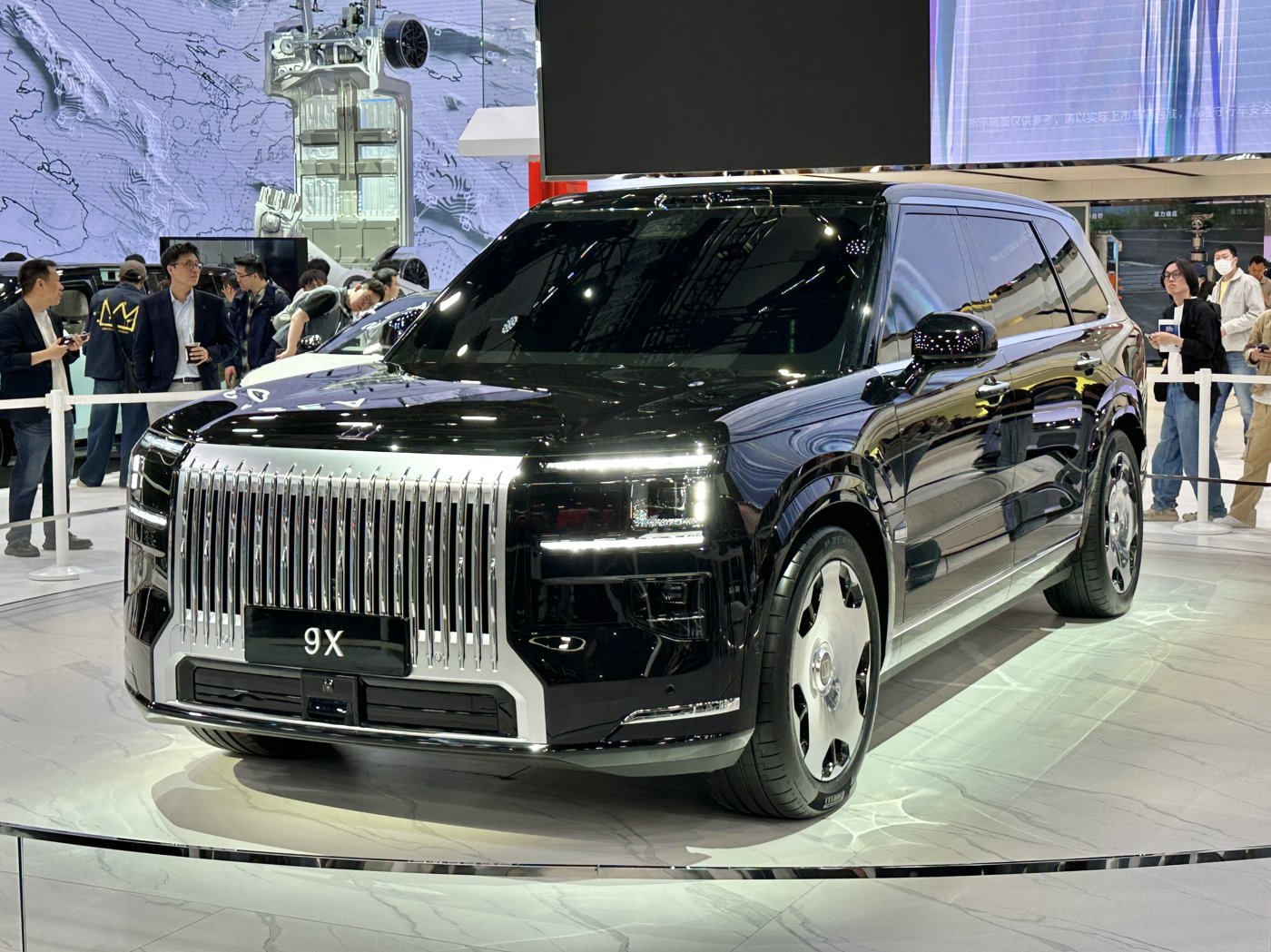
 Zeekr 9X
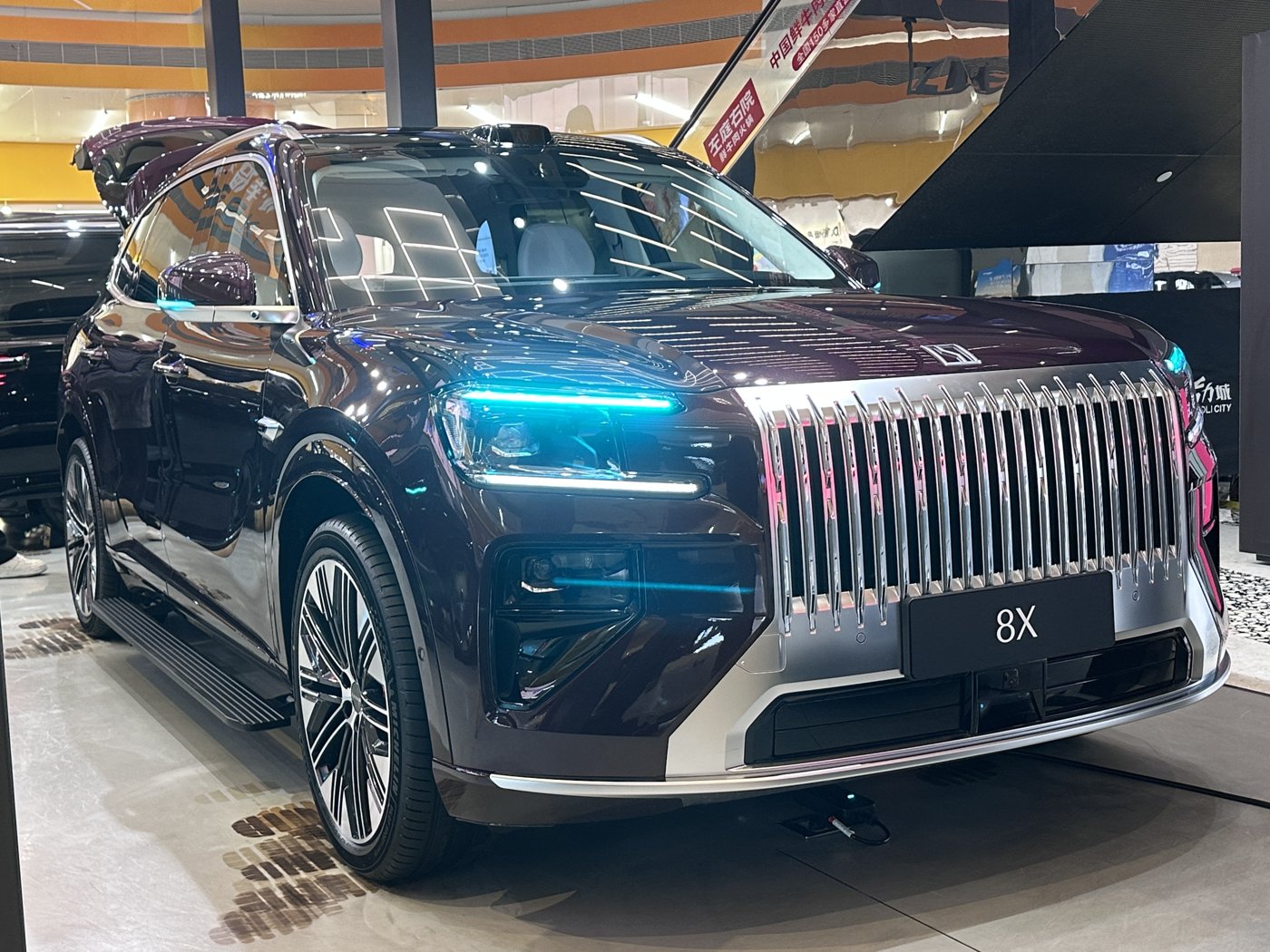 Zeekr 8X
Short answer: the Zeekr 9X is the bigger, taller-riding flagship — 5,239 mm long, 3,169 mm wheelbase, 200–208 mm of ground clearance, CNY 465,900 to 599,900. The Zeekr 8X is 139 mm shorter, sits 171 mm off the ground, carries more luggage, and starts CNY 109,100 lower at 356,800. Both use the same 2.0-litre turbo engine and the same 900V plug-in hybrid system. The headline most spec sites get wrong: the 8X is not the quicker car. Only one of its seven trims does 0–100 km/h in 2.96 s, while the other six need 3.7 s, slower than the 9X’s quick versions at 3.1 s.
This page compares every trim of both cars on the numbers a dealer actually orders against: full dimensions, battery-by-battery range, curb weight, and Chinese guide pricing. Then it covers the part spec sites skip: what changes when you export one.
Quick answers
- Which is bigger? The 9X, by 139 mm in length and 100 mm in wheelbase.
- Which is actually faster? The 8X 曜影 at 2.96 s, but that is the CNY 500,800 top trim. Compare like for like and the two are near-identical.
- Which carries more? The 8X: 1,133 L against 470 L for the six-seat 9X.
- Which goes further? The 8X, on both counts — up to 410 km CLTC electric and 1,416 km combined.
- Which suits rough roads? The 9X, at 200–208 mm of clearance plus air suspension, against the 8X’s fixed 171 mm.
Zeekr 8X vs 9X: price and trim ladder
Neither car is sold as a single spec. The 8X launched in China in April 2026 with seven trims; the 9X arrived in September 2025 as a six-seater and gained a five-seat line in July 2026. Chinese guide prices:
| Zeekr 8X trim (2026) | Battery | Motors | Guide price |
|---|---|---|---|
| Max 55 kWh | 55 kWh | Dual, 660 kW | CNY 356,800 |
| Max 70 kWh | 70 kWh | Dual, 660 kW | CNY 371,800 |
| Ultra 55 kWh | 55 kWh | Dual, 660 kW | CNY 376,800 |
| Ultra 70 kWh | 70 kWh | Dual, 660 kW | CNY 391,800 |
| Ultra+ 55 kWh | 55 kWh | Dual, 660 kW | CNY 411,800 |
| Ultra+ 70 kWh | 70 kWh | Dual, 660 kW | CNY 426,800 |
| 曜影 (Yaoying) 70 kWh | 70 kWh | Tri, 1,030 kW | CNY 500,800 |
| Zeekr 9X trim | Seats | Battery | Motors | Guide price |
|---|---|---|---|---|
| 2025 Max 55 kWh | 6 | 55 kWh | Dual, 660 kW | CNY 465,900 |
| 2025 Ultra 55 kWh | 6 | 55 kWh | Dual, 660 kW | CNY 485,900 |
| 2025 Ultra 70 kWh | 6 | 70 kWh | Dual, 660 kW | CNY 500,900 |
| 2025 Hyper 70 kWh | 6 | 70 kWh | Tri, 1,030 kW | CNY 559,900 |
| 2025 曜黑 70 kWh | 6 | 70 kWh | Tri, 1,030 kW | CNY 599,900 |
| 2026 Ultra 55 kWh | 5 | 55 kWh | Dual, 660 kW | CNY 471,900 |
| 2026 Ultra 70 kWh | 5 | 70 kWh | Dual, 660 kW | CNY 486,900 |
| 2026 Hyper 70 kWh | 5 | 70 kWh | Tri, 1,030 kW | CNY 545,900 |
| 2026 曜黑 70 kWh | 5 | 70 kWh | Tri, 1,030 kW | CNY 585,900 |
Two things fall out of that ladder that a single “from” price hides. The cheapest 9X is a six-seater, so if you quote the 9X from CNY 465,900 and the five-seat 9X from CNY 471,900, the five-seater looks like the dearer car. Trim for trim it is not: at every matching grade the five-seat sits exactly CNY 14,000 below the six-seat equivalent. And the CNY 144,000 spread between the cheapest and dearest 8X buys motors and sensors, not size — every 8X is the same length.
Guide prices are not transaction prices, and neither is what you pay landed. If the ladder itself is unfamiliar territory, our breakdown of Chinese model names, export names and trim ladders explains how Chinese trim words map, and fail to map, onto export badges.
Zeekr 8X vs 9X dimensions
This is the comparison most buyers arrive looking for, so here it is in full rather than as three headline numbers.
| Dimension | Zeekr 8X | Zeekr 9X |
|---|---|---|
| Length | 5,100 mm (5,108 mm on 曜影) | 5,239 mm |
| Width | 1,998 mm (2,026 mm on 曜影) | 2,019–2,029 mm |
| Height | 1,780 mm | 1,819 mm |
| Wheelbase | 3,069 mm | 3,169 mm |
| Front track | 1,732–1,738 mm | 1,725–1,734 mm |
| Rear track | 1,745–1,758 mm | 1,739–1,748 mm |
| Ground clearance | 171 mm (180 mm on 曜影) | 200–208 mm |
| Boot volume | 1,133–2,200 L | 470–2,148 L (6-seat) 1,050–1,082 to 2,441–2,473 L (5-seat) |
| Fuel tank | 55 L | 50 L |
| Curb weight | 2,660–2,870 kg | 2,840–3,150 kg |
| Tyres | 255/55 R20 · 255/50 R21 · 275/40 R22 | 255/60 R20 · 275/50 R21 · 285/45 R22 |
| Body | 5-door SUV, unibody | 5-door SUV, unibody |
Read across that table and the two cars separate on three lines, not one.
Ground clearance is the big one. 171 mm versus 208 mm is a 37 mm gap, and it is the difference between a car that copes with a broken secondary road and one that grounds out on it. The 9X also carries dual-chamber air suspension with 110 mm of total travel, which lifts it to as much as 288 mm and raises 30 mm in about seven seconds. The 8X’s 171 mm is fixed. For West African, Central Asian and Andean buyers, this single line matters more than the 1,030 kW , and it is the line no English-language comparison of these two currently prints.
Luggage runs the other way. The six-seat 9X leaves 470 L behind its third row. The 8X gives 1,133 L, more than double, because there is no third row to leave space behind. Folded, they converge: 2,200 L for the 8X against 2,148 L for the 9X. So the 9X’s advantage is seats, not volume, and the moment you specify the five-seat 9X you get 1,050–1,082 L and the gap closes to about 60 L.
Weight decides your shipping bill. A 3,150 kg 9X is 490 kg heavier than a base 8X, and heavy vehicles change what fits in a container and what a RoRo line charges. If you are costing a mixed load, our guide to how many cars fit in a 40HC container covers where the limits actually bite, and shipping cars from China to African ports covers the route options.
Powertrain: same engine, different motor counts
Both cars run the same DHE20-PFZ 1,974 cc turbocharged inline-four, rated at 205 kW (279 PS) and 410 N·m from 2,000 to 4,500 rpm, direct injection, paired to a single-speed dedicated hybrid transmission. The engine is a generator and a road-speed assist, not the primary drive. Both are all-wheel drive through electric motors, with double-wishbone front and multi-link rear suspension and ventilated discs at all four corners.
The difference is how many electric motors sit on top of it:
| Dual-motor | Tri-motor | |
|---|---|---|
| Combined output | 660 kW | 1,030 kW |
| Combined torque | 935 N·m | 1,410 N·m |
| 8X trims | Six of seven | 曜影 only |
| 9X trims | Max, Ultra | Hyper, 曜黑 |
| 8X 0–100 km/h | 3.7 s | 2.96 s |
| 9X 0–100 km/h | 3.9–4.2 s | 3.1 s |
| Top speed | 8X 220 km/h · 9X 240 km/h | 8X 230 km/h · 9X 240 km/h |
The 9X’s tri-motor layout is a 290 kW motor on the front axle and a 370 kW motor on each rear wheel. Which makes the widely repeated “the 8X is quicker than the 9X” line true only in the narrowest sense: one 8X trim, at CNY 500,800, beats the 9X by 0.14 s. Order an Ultra 8X — the volume trim — and you have a 3.7 s car facing a 3.1 s 9X Hyper. Anyone selling on acceleration needs to quote the trim, not the model.
Note too that the 9X tops out 20 km/h higher across the board despite being the heavier car, and that Zeekr states the tri-motor 9X loses about 0.2 s to 100 km/h once the battery is , a reminder that PHEV performance figures assume a charged pack.
Battery, range and charging
Both cars offer the same two NMC packs, 55.1 kWh and 70 kWh, on a 900V architecture with 6C fast charging that takes 20–80% in roughly nine minutes where the infrastructure allows. Warranty in China is six years or 150,000 km on the vehicle, with the battery covered without year or mileage limit.
| Trim | Battery | CLTC electric | CLTC combined |
|---|---|---|---|
| 8X Max / Ultra / Ultra+ 55 kWh | 55 kWh | 318–320 km | 1,357–1,362 km |
| 8X Max / Ultra / Ultra+ 70 kWh | 70 kWh | 410 km | 1,416 km |
| 8X 曜影 | 70 kWh | 330 km | 1,210 km |
| 9X Max 55 kWh | 55 kWh | 300 km | 1,200 km |
| 9X Ultra 55 kWh | 55 kWh | 288 km | 1,160 km |
| 9X Ultra 70 kWh | 70 kWh | 380 km | 1,250 km |
| 9X Hyper / 曜黑 | 70 kWh | 355 km | 1,165 km |
Watch the units here, because this is where published comparisons go wrong. Figures of 256 km and 328 km circulate widely for the 8X — those are WLTP. On the Chinese CLTC cycle the same car is rated 318 to 410 km. Quote the wrong standard to a customer and you are promising 25% more range than the homologation you will actually ship against. CLTC is the optimistic cycle; treat both as comparison numbers, not as what a loaded car will do at 35°C.
Where the 8X genuinely wins is total distance. A 70 kWh 8X is certified at 1,416 km combined against 1,250 km for the equivalent 9X. It carries 5 L more fuel and pushes less air. For a market with thin charging infrastructure, the plug-in hybrid layout is the real selling point: neither car strands a customer when the plugs run out, which is why PHEVs continue to travel better than pure EVs into Africa and Latin America. We covered that logic in more depth for hybrid cars from China to Nigeria and across the segment in the top Chinese SUVs and EVs for export in 2026.
One caveat on the fuel-consumption figures you will see quoted, 0.31 to 0.44 L/100 km. Those are certification numbers taken with a full battery. They describe the test, not the car. Run either one with a flat pack and you are driving a 2.7 to 3.1-tonne SUV on a 2.0-litre engine.
Seating: the 9X splits, the 8X does not
The 9X launched in September 2025 as a three-row 2+2+2 six-seater, with speakers built into the front headrests and a zero-gravity recline with extending footrests in the second row. A five-seat line followed in July 2026. Every 8X trim on the current Chinese configurator is a five-seater.
The boot figures make the split unmistakable: 470 L behind the third row, 1,050–1,082 L without it. That 580 L is the real cost of the third row, and it is priced at a flat CNY 14,000 across every matching grade. Which of the two to order is a market question — six-seaters sell in family-heavy and chauffeur markets, five-seaters where the buyer wants the flagship badge and the luggage bay. We have broken the 9X’s two layouts down in full in Zeekr 9X five-seat vs six-seat, including what stays identical between them. The same comparison for the Lynk & Co 900 resolves differently.
Cabin and driver assistance
Both cars run a 16-inch central screen on Qualcomm Snapdragon 8295 silicon, 5G connectivity, and Zeekr’s G-Pilot driver assistance. The sensor count is what separates the trims. Lower grades of both cars carry the H7 system: one roof LiDAR, five millimetre-wave radars, twelve ultrasonic sensors, ten to eleven cameras, one Nvidia Drive Thor-U processor. The 9X Hyper and 曜黑, and the 8X 曜影, step up to H9 with five LiDARs, thirteen cameras and two Thor-U chips for a claimed 1,400 TOPS. Zeekr describes H9 as L3-ready.
The 9X also gets a structural specification the 8X does not advertise: 91% of the chassis in high-strength steel and aluminium, ten beams above 2,000 MPa tensile strength, and 41,600 N·m per degree of torsional rigidity. It sold 18,980 units in China in 2025 from a September launch.
For export, treat the driver-assistance package as a configuration decision with consequences, not a feature list. Several markets regulate LiDAR-equipped vehicles and radar frequencies differently, and a car homologated for China is not automatically compliant elsewhere.
What changes when you export one
Specs decide half a sale. These are the lines that decide the other half.
- Both engines are specified for 95 RON. Much of West Africa retails 91 or 93 RON as standard. This is a real deployment question for a 46%-thermal-efficiency direct-injection turbo engine, not a footnote. Confirm fuel availability in the destination market before you commit to a container.
- Both are certified to China VI. Where your destination sets its own emissions standard, the certificate you have is not automatically the certificate you need.
- These are large-battery PHEVs. Lithium battery transport rules, not vehicle rules, govern how they ship. Documentation takes longer than for a petrol SUV, so start it when you place the order rather than when the car is built.
- Both are new models. The 8X has been on sale since April 2026 and the 9X since September 2025, so export allocation is limited and securing units can matter more than choosing the trim.
- Warranty does not travel. The six-year/150,000 km China warranty is a domestic-market term. What applies at your destination depends on whether there is an official Zeekr presence there.
- Confirm the model year against the build date. A Chinese model-year badge and the actual month of manufacture routinely disagree, and destination age limits are calculated on the build date. Our seven traps in importing used cars from China covers how to read the VIN to settle it.
Hanvia Motors handles this end to end: sourcing the exact Zeekr configuration, inspection and condition reporting, export documentation, and shipping from Tianjin Port and the Khorgos land port to Africa, the Middle East, Central Asia and Latin America. Send us a destination port and a trim and we come back with availability, a clear FOB or CIF quote, and a delivery timeline. Order pages: Zeekr 8X for export and Zeekr 9X for export.
Which one should you order?
Order the 9X when the destination wants maximum presence and three rows, when roads are poor enough that 208 mm and air suspension earn their keep, or when the buyer is a chauffeur operator who will use the zero-gravity second row. It is the more expensive car by CNY 109,100 at the entry point and the heavier one to ship.
Order the 8X when the customer wants Zeekr’s technology at a materially lower landed cost, when luggage volume beats seat count, or when the market’s roads and parking make a 5,239 mm car awkward. The 70 kWh Ultra at CNY 391,800 is the trim that makes the most commercial sense for most importers: 410 km of electric range, 1,416 km combined, and 3.7 s, for CNY 74,100 less than the cheapest 9X.
Order the 曜影 or 曜黑 only when you have a buyer waiting. Tri-motor flagships at CNY 500,800 and 599,900 are a thin market in most export destinations, and they are the trims most likely to sit.
If Zeekr is a step above where your customers actually buy, the same reasoning applies further down the range. See our comparisons of the BYD Qin PLUS DM-i and Seal 05 DM-i, the Jetour T2 1.5T and 2.0T, and the Audi A3 and Q3, or the entry end of the electric market with the BYD Seagull. Other order pages worth a look: Lynk & Co 900, Lynk & Co 06, Geely Coolray and Audi A3.
Exporting either one to Ethiopia
Ethiopia banned new petrol and diesel private-vehicle imports on 29 January 2024. Electric and hybrid vehicles are exempt and carry 15% customs duty with VAT, excise tax and surtax waived, so an EV or hybrid is the only realistic way into this market now. Both vehicles on this page are left-hand drive, which Ethiopia requires, and seat fewer than 10 passengers, which the provisions cover.
Everything routes through Djibouti. Ethiopia is landlocked and over 90% of its trade moves through the Port of Djibouti, then inland by the Addis Ababa–Djibouti railway or by road. There is no alternative corridor, so plan the timeline around it.
One caveat worth raising with the customer: public charging is thin — roughly 100 stations against an estimated 2,300+ needed nationwide, concentrated in Addis Ababa. Most owners will charge on AC at home or business premises. That favours a buyer with their own charging point over one relying on public infrastructure.
CIF Djibouti is available for Ethiopia. Tell us the model and quantity and we will quote CIF to Djibouti, so you compare one delivered number instead of assembling freight, insurance and handling yourself. EXW, FCA and FOB remain available if you prefer to control the shipping leg.
👉 Ask for current EV and hybrid stock plus a CIF Djibouti landed-cost quote. Talk to us · Ethiopia import rules in full →
Frequently asked questions
Which is bigger, the Zeekr 8X or the 9X?
The 9X. It is 5,239 mm long on a 3,169 mm wheelbase and stands 1,819 mm tall, against the 8X’s 5,100 mm, 3,069 mm and 1,780 mm. The 9X is also 490 kg heavier at the top of the range, at 3,150 kg against 2,660 kg for a base 8X.
Is the Zeekr 8X faster than the 9X?
Only in its top trim. The 8X 曜影 does 0–100 km/h in 2.96 s, marginally quicker than the 9X Hyper and 曜黑 at 3.1 s. But six of the seven 8X trims are dual-motor cars rated at 3.7 s, which is slower than the quick 9X versions. The 9X also has the higher top speed at 240 km/h against 220 km/h for most 8X trims.
Are the Zeekr 8X and 9X fully electric?
No. Both are plug-in hybrids. They pair a 2.0-litre turbocharged petrol engine producing 205 kW with electric motors on a 900V architecture, and run in pure-electric, range-extender or hybrid mode. That makes them viable in markets without dense charging networks, where a pure EV is a harder sell.
How much electric range do they have?
On the Chinese CLTC cycle, the 8X is rated 318–320 km with the 55 kWh pack and 410 km with the 70 kWh pack, dropping to 330 km on the tri-motor 曜影. The 9X is rated 288–300 km on 55 kWh and 355–380 km on 70 kWh. Figures of 256 and 328 km sometimes quoted for the 8X are WLTP, not CLTC.
How much do the Zeekr 8X and 9X cost in China?
Chinese guide prices run from CNY 356,800 to 500,800 across seven 8X trims, and from CNY 465,900 to 599,900 for the six-seat 9X, with the five-seat 9X between CNY 471,900 and 585,900. Guide prices are not transaction prices, and landed cost depends on your port, duties and shipping.
How many seats does the Zeekr 9X have?
Both layouts exist. The 9X launched in September 2025 as a three-row 2+2+2 six-seater, and a five-seat line was added in July 2026. The five-seat version is CNY 14,000 cheaper at every matching trim and carries 1,050–1,082 L of luggage against 470 L behind the six-seater’s third row. Every 8X trim currently listed is a five-seater with a 1,133 L boot.
Can I import the Zeekr 8X or 9X to Africa, the Middle East or Latin America?
Yes. Hanvia Motors exports new Chinese vehicles, Zeekr included, to these regions. Both models are ordered to configuration rather than taken from stock, so send your destination port and preferred trim and we will confirm availability, pricing and shipping. Note that both engines are specified for 95 RON fuel, which is worth verifying against your local supply before ordering.
Sourcing Zeekr or other Chinese new-energy vehicles? Read next: how to import cars from China — a 2026 guide for dealers, who actually sells you a Chinese car, and how to verify a Chinese car export company.