
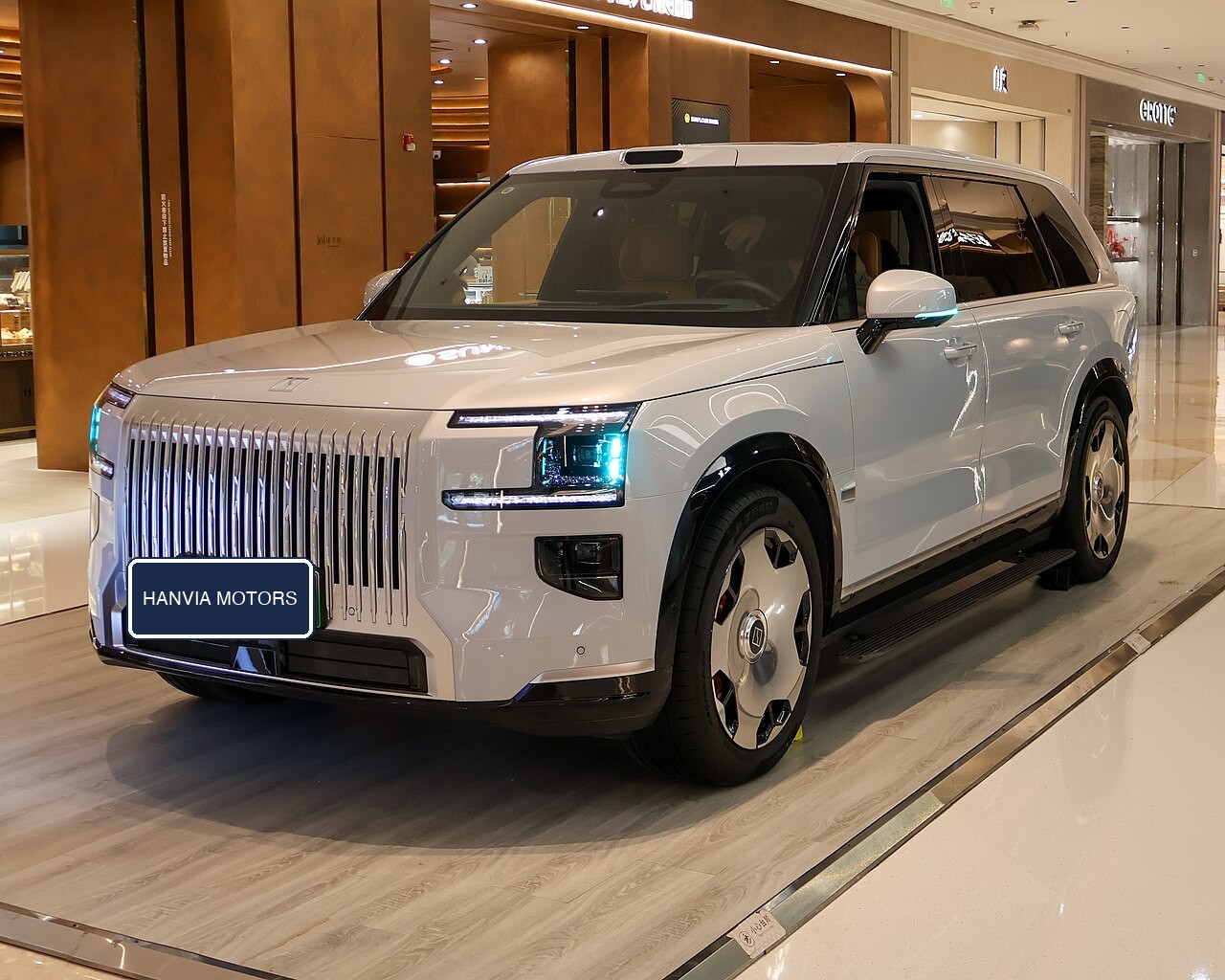
Short answer: the five-seat Zeekr 9X costs exactly CNY 14,000 less than the six-seat car at every matching trim, and gives back 580 to 612 litres of luggage space behind the rear seats. Nothing else changes. Same 5,239 mm body, same 3,169 mm wheelbase, same engine, same motors, same batteries, same CLTC range, same declared curb weight, trim for trim. The third row is not a package that alters the car; it is a row of seats with a fixed price and a fixed cost in boot volume.
That makes the choice unusually clean for an importer. You are not weighing a performance trade-off or a range penalty. You are deciding whether your market pays CNY 14,000 for two seats it may use twice a year, at the cost of a boot that shrinks from 1,050 litres to 470.
Quick answers
- Which came first? The six-seater, launched September 2025. The five-seat line arrived July 2026.
- Price difference? A flat CNY 14,000 at every matching trim, in the five-seater’s favour.
- Why does the five-seater look more expensive, then? Because it drops the entry Max trim, so its lowest price is CNY 471,900 against the six-seater’s CNY 465,900.
- Luggage? 1,050–1,082 L in the five-seater against 470 L behind the six-seater’s third row.
- Any performance difference? None. Acceleration, range, clearance and curb weight are identical trim for trim.
The two line-ups side by side
| Trim | Six-seat (2025) | Five-seat (2026) | Difference |
|---|---|---|---|
| Max 55 kWh | CNY 465,900 | Not offered | — |
| Ultra 55 kWh | CNY 485,900 | CNY 471,900 | −CNY 14,000 |
| Ultra 70 kWh | CNY 500,900 | CNY 486,900 | −CNY 14,000 |
| Hyper 70 kWh | CNY 559,900 | CNY 545,900 | −CNY 14,000 |
| 曜黑 (Yaohei) 70 kWh | CNY 599,900 | CNY 585,900 | −CNY 14,000 |
Four rows, one number. Zeekr did not scale the third row’s price with the trim, did not bundle it with an equipment package, and did not restrict it to particular grades. It is a flat CNY 14,000 whether you are buying the CNY 471,900 Ultra or the CNY 585,900 曜黑, which is 2.9% of the cheaper car and 2.4% of the dearer one.
The trap sits in the first row of that table. The six-seat line-up opens with a Max trim that the five-seat line-up does not offer. So a spec sheet that lists “from” prices shows the six-seater as the cheaper car by CNY 6,000, when trim for trim it is CNY 14,000 dearer. Quote from the range and you will misprice the deal by CNY 20,000. This is the same class of error we documented in Chinese model names, export names and trim ladders, where a single Chinese nameplate covers two cars an engine apart.
What the third row actually costs you
| Six-seat | Five-seat | |
|---|---|---|
| Layout | 2+2+2, three rows | 2+3, two rows |
| Boot, seats up | 470 L | 1,050–1,082 L |
| Boot, seats folded | 2,148 L | 2,441–2,473 L |
| Trims available | 5 (Max, Ultra ×2, Hyper, 曜黑) | 4 (Ultra ×2, Hyper, 曜黑) |
| Wheel sizes | 20, 21 and 22 inch | 21 and 22 inch |
| Entry price | CNY 465,900 | CNY 471,900 |
| Top price | CNY 599,900 | CNY 585,900 |
470 litres behind a third row is not a small boot by three-row standards, but it is not a six-passenger boot either. Loaded with six adults, the 9X carries roughly three to four large suitcases and no more. For a family that uses the third row occasionally and folds it the rest of the time, that is fine, because folded volume is nearly the same on both cars. For an operator running six paying passengers and their bags on every trip, it is the constraint that decides the job.
Note also what the five-seat line-up quietly drops along with the row: the Max trim, and with it the 255/60 R20 wheel. The five-seat 9X starts on 21-inch rims. If your market values a taller tyre sidewall on poor road surfaces, that is a real consideration and it is not visible in any seat-count comparison.
What does not change
This is the part worth checking carefully, because it is where buyers assume a trade-off that is not there.
| Specification | Six-seat | Five-seat |
|---|---|---|
| Length × width × height | 5,239 × 2,019–2,029 × 1,819 mm | 5,239 × 2,029 × 1,819 mm |
| Wheelbase | 3,169 mm | 3,169 mm |
| Ground clearance | 200–208 mm | 200–208 mm |
| Curb weight (Ultra 55 / Ultra 70 / Hyper / 曜黑) | 2,970 / 3,045 / 3,150 / 3,150 kg | 2,970 / 3,045 / 3,150 / 3,150 kg |
| CLTC electric range, same trims | 288 / 380 / 355 / 355 km | 288 / 380 / 355 / 355 km |
| CLTC combined range, same trims | 1,160 / 1,250 / 1,165 / 1,165 km | 1,160 / 1,250 / 1,165 / 1,165 km |
| 0–100 km/h, same trims | 3.9 / 4.2 / 3.1 / 3.1 s | 3.9 / 4.2 / 3.1 / 3.1 s |
| Engine | DHE20-PFZ 1,974 cc turbo I4, 205 kW / 279 PS, 410 N·m, 95 RON | |
| Drive | Electric AWD, single-speed DHT, dual-motor 660 kW or tri-motor 1,030 kW | |
| Battery / charging | 55.1 or 70 kWh NMC, 900V, 20–80% in about 9 minutes | |
| Warranty (China) | 6 years or 150,000 km; battery without year or mileage limit | |
The curb weight line is the one that surprises people. On the declared figures, removing the third row saves nothing: 2,970 kg is 2,970 kg either way. So the five-seater does not ship cheaper, does not sit in a different weight band, and does not change how many units go in a container. If you are planning a mixed load, the numbers in our guide to how many cars fit in a 40HC container apply identically to both.
Range is untouched too, which is worth stating plainly because six-seat versions of other models frequently lose range to the extra mass. Here they do not, for the same reason the weight does not move.
Which one does your market want?
There is no universal answer, so here is the reasoning rather than a verdict.
Take the six-seater where households are large and a third row is an expectation rather than a feature, where the buyer is a chauffeur or executive-transfer operator who will actually use the 2+2+2 layout, or where a flagship SUV without three rows reads as incomplete. The 9X’s second row in the six-seat car has a zero-gravity recline with extending footrests, and the front headrests have speakers built in, so the middle row is the good seat rather than a compromise. That is a specific product for a specific buyer, and where that buyer exists the CNY 14,000 is not the deciding factor.
Take the five-seater where the customer is buying presence and technology rather than capacity, where luggage volume gets used every week and the third row would not, or where you are competing on landed price and CNY 14,000 per unit compounds across a container. It is also the easier car to specify: four trims instead of five, no wheel-size decision at the bottom of the range.
Check the seat count against local rules before you commit. Some destinations classify vehicles for duty, registration or commercial licensing by seat count rather than by size or engine, and a six-seater can land in a different category from an otherwise identical five-seater. We do not publish tariff numbers we have not verified, so treat this as a question to put to your customs broker with the current schedule in front of you rather than an assumption either way.
The same three-versus-two-row question comes up across the segment. Our comparison of the Lynk & Co 900 five-seat versus six-seat resolves differently, because there the layouts are not priced as a flat delta. And if you are still choosing between models rather than layouts, start with Zeekr 8X vs 9X, which covers the full dimensions and trim ladder for both cars.
Ordering either one for export
Both layouts are ordered to configuration rather than pulled from stock, so the practical constraints are the same as for any new Chinese flagship.
- The engine is specified for 95 RON. Confirm fuel grade availability at the destination before committing, because much of West Africa retails 91 or 93 RON as standard.
- It is a large-battery plug-in hybrid. Lithium battery transport rules govern the shipment, and that documentation takes longer to assemble than for a petrol SUV. Start it at order, not at build.
- China VI certification does not transfer automatically to markets that set their own emissions standard.
- The six-year, 150,000 km warranty is a China-domestic term. What applies at your destination depends on whether Zeekr has an official presence there.
- Confirm build month against model year. Chinese model-year badges and actual manufacture dates disagree routinely, and destination age limits are calculated on build date. Our seven traps in importing cars from China explains how to settle it from the VIN.
- Specify the layout in writing. “Zeekr 9X Ultra 70 kWh” describes two different cars at two different prices. Put the seat count on the purchase order.
Hanvia Motors sources the exact configuration, handles inspection and condition reporting and export documentation, and ships from Tianjin Port and the Khorgos land port to Africa, the Middle East, Central Asia and Latin America. Send a destination port, a trim and a seat count, and we come back with availability, an FOB or CIF quote, and a timeline. See the Zeekr 9X order page or the Zeekr 8X order page.
For background on how Chinese vehicles reach an exporter in the first place, read who actually sells you a Chinese car and how to verify a Chinese car export company. If the 9X sits above your customers’ budget, the same layout logic applies to the Lynk & Co 900, and the wider range runs down through the Lynk & Co 06, Geely Coolray, BYD Qin PLUS DM-i and Seal 05 DM-i, Jetour T2 and BYD Seagull.
Frequently asked questions
Is the five-seat Zeekr 9X cheaper than the six-seat?
Yes, by exactly CNY 14,000 at every matching trim. Ultra 55 kWh is CNY 471,900 against 485,900, Ultra 70 kWh is 486,900 against 500,900, Hyper 70 kWh is 545,900 against 559,900, and 曜黑 70 kWh is 585,900 against 599,900. The five-seat range appears dearer only because it does not offer the entry Max trim.
How much boot space does the six-seat Zeekr 9X have?
470 litres behind the third row, expanding to 2,148 litres with the rear seats folded. The five-seat version offers 1,050–1,082 litres behind the second row and 2,441–2,473 litres folded. The difference with seats up is 580 to 612 litres; folded, it narrows to about 300.
Does the five-seat 9X have better range or performance?
No. Trim for trim the two are identical: same 288 to 380 km CLTC electric range, same 1,160 to 1,250 km combined, same 3.1 to 4.2 second 0–100 km/h times, same 660 kW or 1,030 kW motor outputs. Declared curb weight is also unchanged, at 2,970 to 3,150 kg on both.
When did the five-seat Zeekr 9X launch?
July 2026. The 9X first went on sale in September 2025 as a three-row 2+2+2 six-seater, and the two-row line was added roughly ten months later. Both remain available.
Which trims are available on each layout?
The six-seat car offers five trims: Max 55 kWh, Ultra 55 kWh, Ultra 70 kWh, Hyper 70 kWh and 曜黑 70 kWh. The five-seat car offers four, dropping Max. That also removes the 255/60 R20 wheel from the five-seat range, which starts on 21-inch rims.
Does the seat count affect import duty?
It can. Some destinations classify vehicles for duty, registration or commercial licensing by seat count rather than by dimensions or engine capacity, so a six-seater may fall into a different category from an otherwise identical five-seater. Rates and categories change, so confirm against the current tariff schedule for your destination rather than relying on a general rule.
Can Hanvia Motors supply either layout?
Yes. Both are ordered to configuration rather than taken from stock. Send your destination port, the trim and the seat count, and we will confirm availability, pricing and shipping. Note that the engine is specified for 95 RON fuel, which is worth checking against local supply before you order.
Also worth reading: how to import cars from China, a 2026 guide for dealers, and shipping cars from China to African ports.