
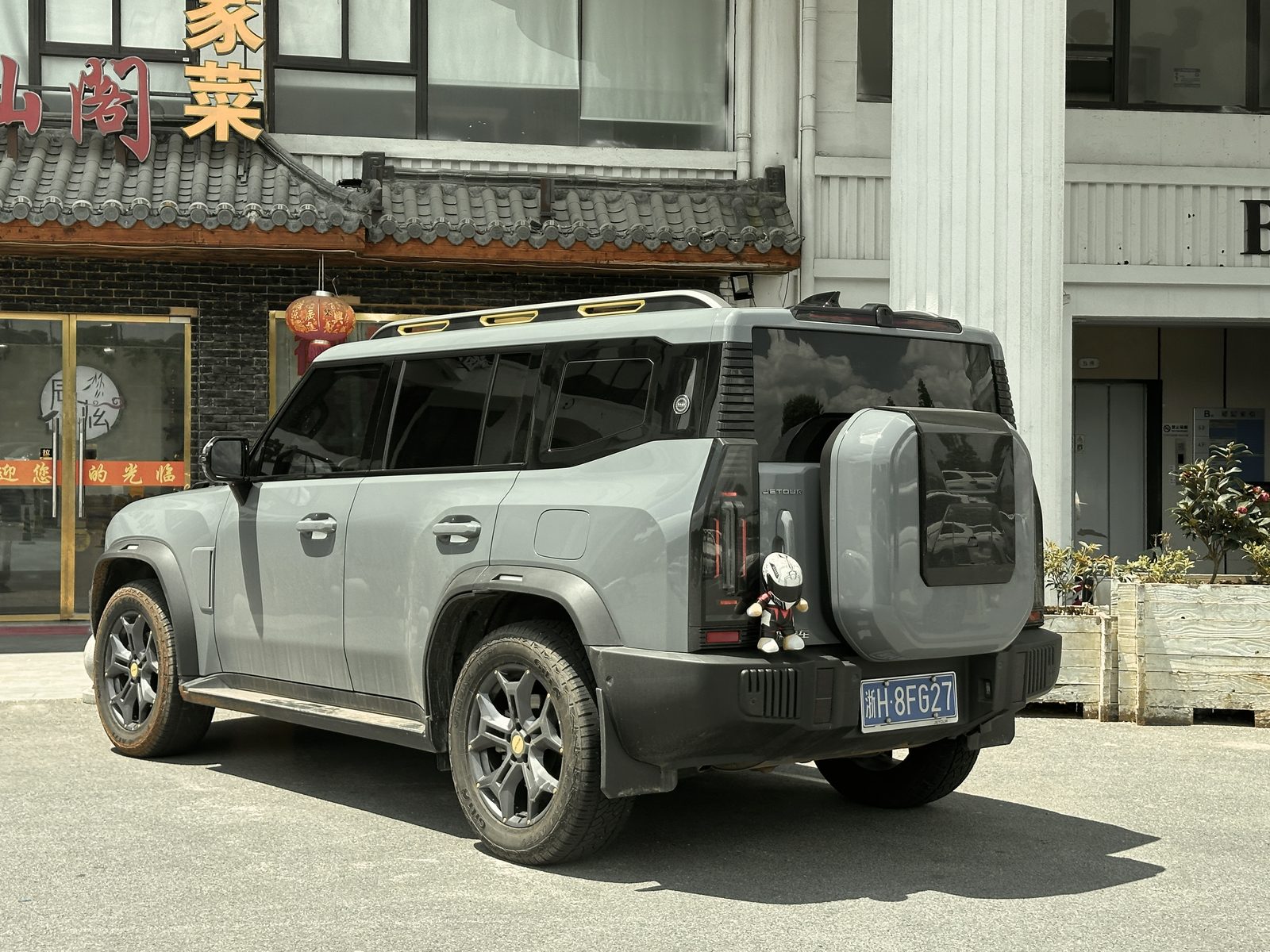
Jetour sells the same vehicles under two naming systems. In China the boxy off-roader is the 旅行者 (Traveller); in export markets it is the T2. The smaller one is the 自由者 (Freedom) in China and the T1 abroad. The coupé-styled SUV is the 大圣, sold abroad as the Dashing. X70 Plus and X90 Plus keep their names in both systems, but the Chinese range also includes X70, X70L, X70 Pro, X90 and X90 Pro, which are not the same car. Shanhai (山海) is Jetour’s Chinese plug-in hybrid line, not a separate model, and 纵横 (Zongheng) is the premium off-road series that includes the G700.
That matters because a quote, a customs declaration and a parts order all depend on the exact model. Two suppliers can both advertise a “Jetour T2” and ship different bodies: a China-spec 旅行者, an export T2, or a plug-in 山海T2. The name on the tailgate is the starting point, not the proof. This guide maps every name a buyer is likely to hear, states what each car is, and shows what to put on the order so the car that arrives is the car you priced.
👉 Send us the name, the tailgate photo and the VIN — we will tell you which Jetour it is and what specification to expect. Ask us on WhatsApp · Browse current stock →
Jetour model names at a glance
| Name buyers use | Chinese name | Body and seats | Powertrain | Export badge |
|---|---|---|---|---|
| T2 / Traveller | 旅行者 | Boxy 5-seat SUV, about 4.8 m | 1.5T or 2.0T petrol; PHEV in China | T2, T2 i-DM |
| T1 / Freedom | 自由者 | Compact boxy 5-seat SUV, about 4.7 m | 1.5T or 2.0T petrol; PHEV in China | T1 |
| Dashing / Dasheng | 大圣 | Coupé-roof 5-seat SUV, about 4.6 m | 1.5T or 1.6T petrol; PHEV in China | Dashing |
| X70 Plus | 捷途X70 Plus | Family SUV, 5 or 7 seats | 1.5T or 1.6T petrol | X70 Plus |
| X90 Plus | 捷途X90 Plus | Large SUV, up to 7 seats | 1.5T, 1.6T or 2.0T petrol | X90 Plus |
| G700 | 纵横G700 | Body-on-frame PHEV off-roader | 2.0T plug-in hybrid, 665 kW system output | G700 |
The rest of this page explains each name, the versions behind it and where buyers get the wrong car.
What does Jetour T2 mean, and is it the same as the Traveller?
Yes. The Jetour T2 and the Jetour Traveller are the same vehicle. The Chinese car is the 旅行者, launched in China in 2023. Jetour’s own model-name explainer for its European distributors states it directly: “The Traveller and the T2 are the same vehicle — in China the plug-in hybrid version is also called Shanhai T2.” The export range uses T2 for the petrol car and T2 i-DM for the plug-in hybrid.
The T2 is the model that built Jetour’s international reputation. It is a five-seat, unibody SUV with a squared-off body, a side-hinged tailgate and a spare wheel on the back. Export specifications list it at 4,785 mm long, 2,006 mm wide, 1,880 mm high and 2,800 mm between the axles; China’s 2026 configuration table adds a 4,795 mm version. The petrol range is a 1.5T with 135 kW and 290 Nm, or a 2.0T with 187 kW and 390 Nm, with a seven-speed dual-clutch in most markets (an eight-speed automatic appears in some China and Gulf specifications) and a choice of front- or four-wheel drive.
Two details catch importers out. First, “Traveller” is an English rendering of the Chinese name that media and Chinese dealers use; it is not always the badge on an export car. If a quote says “Jetour Traveller”, ask whether it is a China-spec 旅行者 or a car built to the export T2 specification. Second, the T2 is not a body-on-frame vehicle, despite the styling. It competes with lifestyle SUVs, not with a ladder-frame workhorse. Our 212 T01 versus Jetour T2 comparison sets out where that difference shows up in use.
Is the Jetour T1 the same car as the Freedom?
Yes. The T1 is the export name for the car China sells as the 自由者 (Freedom). The plug-in hybrid version in China is the 山海T1 (Shanhai T1). Outside China, Jetour markets the family under one badge, the T1, which is why a buyer in Riyadh, Dubai or Almaty sees T1 while a Chinese listing says 自由者.
The T1 is the smaller brother of the T2: 4,706 mm long, 1,967 mm wide, 1,845 mm high, with a 2,810 mm wheelbase and five seats. Petrol versions use a 1.5T with 125 kW or a 2.0T with 180 kW. The plug-in hybrid pairs a 1.5T engine with an electric motor. Jetour sells the T1 in the UAE and Saudi Arabia, so it is an established export model rather than a China-only car.
The naming trap here is the word “Freedom”. Some listings and shipping documents use it as if it were a different vehicle from the T1. It is not. The other trap is size: the T1 is about 80 mm shorter and 40 mm narrower than the T2, which matters for buyers who need a narrow vehicle for old-city streets or tight parking.
Is the Jetour Dashing the same as the Dasheng?
Yes. Dashing is the export spelling of 大圣 (Dasheng), the Monkey King. The car is a five-seat crossover with a sloping rear roof, 4,590 mm long, 1,900 mm wide, 1,685 mm high and 2,720 mm between the axles. It is lower and more road-focused than the T1 and T2, and it sits closer to the X70 in price and use.
The petrol range is a 1.5T with 115 kW or a 1.6T with 145 kW. A plug-in hybrid version also exists in China. The Dashing is not an off-roader: it has a car-type body, no low-range transfer case and less ground clearance than the T-series. Buyers who ask for a “Jetour Dashing” because they saw it in a Gulf showroom should not assume it can replace a T2 on gravel roads.
What is the difference between the X70, X70 Plus and X70L?
The X70 is Jetour’s original volume family SUV. The X70 Plus is the larger, better-equipped member of the same family, and the X70L is a long-body variant sold mainly in China. The X70 Pro is an upgraded trim of the same line. They are not trim levels of one car in the way a buyer might expect: body panels, lights and interior parts differ between generations.
The X70 Plus is the version most exporters in Algeria and Côte d’Ivoire quote. It is a front-wheel-drive, five- or seven-seat family SUV with a 1.5T or 1.6T petrol engine. The 2026 China-market car measures 4,749 mm long with a 2,745 mm wheelbase; export and pre-facelift sheets quote 4,724 mm and 2,720 mm. Both are sold as “X70 Plus”, and the 25 mm difference is enough to make floor mats, side steps and body panels non-interchangeable. Our X70 Plus export guide for Algeria and Côte d’Ivoire covers the engine codes and the certificate checks in detail.
The important distinction for a buyer is that the X70 Plus is not a T2 with more seats. It is a different platform with a transverse engine, a softer ride and no off-road pretensions. If the requirement is seven seats for an extended family, the X70 Plus is the right Jetour; if it is a boxy five-seater for bad roads, it is the wrong one.
What is the Jetour X90 Plus, and how does it differ from the X90?
The X90 is Jetour’s large three-row SUV, and the X90 Plus is the more premium facelift of that car. The X90 Pro is a further upgraded version. All three are commonly listed under the single name “X90” by exporters, which is where confusion starts.
The first-generation X90 body is 4,858 mm long in facelift form, 1,925 mm wide and between 1,718 and 1,780 mm high, on a 2,850 mm wheelbase. Jetour’s own export description says the X90 has a third row and up to seven seats. Petrol engines in the range are a 1.5T, a 1.6T and a 2.0T, with the 2.0T at the top of the range. A plug-in hybrid version exists in China.
The X90 Plus competes with the X70 Plus at the top of the range: more length, more standard equipment and a usable third row, at a higher relative price. It is not a T2 or a G700. A buyer who needs three rows and mostly drives on sealed roads should compare the X90 Plus with the X70 Plus, not with the off-road line.
What are Shanhai and i-DM on a Jetour?
Shanhai (山海) is Jetour’s Chinese name for its electrified range, and i-DM is the plug-in hybrid drivetrain. Neither is a separate model. A 山海T2 is the plug-in hybrid version of the Traveller, and a 山海T1 is the plug-in hybrid version of the Freedom. In export markets those cars are badged T2 i-DM and T1 i-DM.
This is the single most common naming mistake in quotes. A supplier may write “Shanhai T2” and send photos of a T2 body, which is correct, but the car is a China-market plug-in hybrid. That affects the charging port, the onboard charger, the battery certification, the emissions paperwork and the diagnostic software. It is not the same product as a petrol T2 with a 2.0T engine, even though the body looks identical.
For buyers in the Gulf, Algeria, Côte d’Ivoire and Central Asia, the practical question is whether the local market can support a plug-in hybrid at all: charging availability, fuel quality, service training and spare battery logistics. If the answer is no, specify the petrol version. If the answer is yes, ask for the battery certificate and the charging standard in writing.
What are the Zongheng G700, G900 and F700?
Zongheng (纵横) is Jetour’s premium off-road series, separate from the T-series. The G700 is the flagship: a body-on-frame plug-in hybrid off-roader, 5,198 mm long, 2,050 mm wide and 1,956 mm high, with a 2,870 mm wheelbase. It uses a 2.0T engine, two electric motors, all-wheel drive and a two-speed dedicated hybrid transmission, for a combined 665 kW (904 PS). The G900 and the F700 pickup complete the global lineup.
The G700 is not a bigger T2: it uses a ladder frame and a different class of body. It is also not the same car as the 212 T01 or a Tank 300, although buyers cross-shop them. If a customer asks for the big Jetour off-roader, confirm whether they mean the G700 or a T2; the two differ in duty class, size and fuel use.
Why do Jetour’s Chinese and export names differ?
Jetour is Chery’s sub-brand, and like other Chinese makers it runs two naming systems. The Chinese range uses evocative names: 旅行者 (Traveller), 自由者 (Freedom), 大圣 (Monkey King), 山海 (Shanhai) and 纵横 (Zongheng). The global range uses a simpler architecture: X70, X90 and Dashing for road SUVs; T1 and T2 for lifestyle off-roaders; G700, G900 and F700 for professional off-road vehicles. Jetour’s global site groups the range into those three stages.
The two systems overlap imperfectly. X70 Plus and X90 Plus keep their names, T2 and T1 replace Chinese names, Dashing is a respelling of Dasheng, and Shanhai and i-DM describe technology rather than a model. Add regional distributors, local homologation and translated brochures, and one car can appear under three names in three countries. That is why the certificate and the VIN matter more than the badge.
BYD’s China-name versus export-name map shows the same pattern, and the Leopard 3 and Leopard 7 story is an extreme case of importer names that do not exist in the factory catalogue. China-built Toyotas have a similar split between local and export badges.
How should an importer specify the right Jetour on an order?
Start with the model code and the VIN, not the marketing name. The model code on the certificate of conformity identifies the body, the engine and the homologation; the VIN identifies the individual car. Ask the supplier to send a photo of the manufacturer’s plate, the tailgate badge and the Chinese characters on the rear, plus the certificate. If any of those disagree with the quote, stop and resolve it before paying a deposit.
Then confirm five specification points in writing:
- Engine code and output. A 1.5T Jetour can be 115 kW, 125 kW or 135 kW depending on the model and year. The output is on the certificate, not in the brochure.
- Seat count. The X70 Plus and X90 Plus come in five- and seven-seat bodies. The T1 and T2 are five-seat cars. A seven-seat T2 does not exist.
- Drive side. Algeria, Côte d’Ivoire, the Gulf and Central Asia are left-hand-drive markets. Jetour has announced right-hand-drive production for other regions; a right-hand-drive unit is the wrong car for these destinations.
- Market specification. A China-spec car and a GCC-spec car can differ in cooling capacity, emissions hardware, charging equipment, tyre type, cluster language and navigation. GCC versus China specification explains what to check before you compare prices.
- Build year and battery condition, if the unit is a used or zero-kilometre car. The 180-day rule for zero-km exports applies to the paperwork, and a battery health report belongs with the shipping documents.
The paperwork set is standard: commercial invoice, certificate of origin, certificate of conformity, bill of lading and customs declaration. Our China car export documents checklist lists each one, and how a bill of lading is released explains why the balance should not be paid against a photocopy. If the order is large enough for a letter of credit, LC versus T/T sets out the trade-off. FOB, CFR and CIF decides who owns the risk at each stage.
Inspection is cheaper than a wrong car. A physical check at the terminal, or a documented remote inspection with photos and a video call, catches badge and specification mismatches before shipment. See remote inspection before paying and inspecting cars in Guangzhou. For ro-ro sailings, Nansha car terminal is the usual departure point for Gulf and African routes.
Which Jetour fits buyers in Algeria, Côte d’Ivoire, the Gulf and Central Asia?
For Algeria and Côte d’Ivoire, the X70 Plus is the volume choice: a five- or seven-seat petrol family SUV, left-hand drive, with a 1.5T or 1.6T engine. The T2 is the lifestyle alternative for buyers who want the boxy look and can accept five seats and a higher relative price. Both are sold through independent importers, so the version checks above matter more than the badge.
For the Gulf, the T1 and T2 are established models with official distribution in Saudi Arabia and the UAE. Buyers there can compare a local GCC-spec car with a China-spec import; the price gap is real, but so is the difference in cooling, warranty and software. The G700 sits above both as a premium off-roader.
For Central Asia, the T2 and T1 arrive overland through Horgos as well as by rail and road from other border points. Petrol versions are the safer choice where high-voltage service support is thin. The Horgos route and the Central Asia market guide cover transit and registration.
For Ethiopia, check the current treatment of plug-in hybrids before ordering a Shanhai-badged car. The Ethiopian EV import rules change the duty and paperwork picture, and the Djibouti CIF route is the usual entry point. A petrol X70 Plus or T2 avoids the question entirely.
FAQ
Is the Jetour T2 the same as the Jetour Traveller?
Yes. The T2 is the export badge for the Chinese-market 旅行者 (Traveller). The plug-in hybrid version is the 山海T2 in China and the T2 i-DM abroad. The body is the same; the specification and the badge depend on the market.
Is the Jetour T1 a Freedom?
Yes. The T1 is the export name for the 自由者 (Freedom). The plug-in hybrid is the 山海T1 in China. The T1 is about 4.7 m long, five-seat and positioned below the T2.
What is a Shanhai T2?
It is the Chinese-market plug-in hybrid version of the T2, not a separate model. If a quote says Shanhai T2, confirm the charging standard, battery certificate and emissions paperwork before you compare it with a petrol T2.
Does Jetour make a seven-seat T2?
No. The T2 and T1 are five-seat cars. Seven seats are available in the X70 Plus and X90 Plus, which are different platforms with different bodies.
Is the G700 a Jetour?
The G700 is sold under Jetour’s Zongheng (纵横) premium off-road series. It is a body-on-frame plug-in hybrid, much larger than a T2, and should be specified by its own model code.
Sources: Jetour global website, brand and model-range pages (X70, X90, Dashing; T1, T2; G700, G900, F700), accessed November 2026; Jetour’s official model-name explainer for its European distributors (“Traveller, T2, X70: the Jetour model names explained”), accessed November 2026; Jetour China website model pages for 旅行者, 自由者, 大圣 and 山海 (slow from our location; cross-checked against export pages); Wikipedia entries for Jetour T1, Dashing, X90 and G700, accessed November 2026; Zhichepai configuration table for the Jetour Traveller (32 trims); bitauto, Dubicars, Carswitch, PakWheels, The Citizen, 58che and Xcar specification tables for the T1, T2, Dashing, X70 Plus and X90 Plus; WapCar, bitauto and Antara coverage for the G700; CNMO, “捷途自由者登陆沙特 命名为JETOUR T1”, 2025, for the Gulf T1 name. Dimensions are manufacturer figures in millimetres; power outputs are engine or system figures as quoted by the source. T2 length is 4,785 mm in export sheets; the 2026 China configuration table lists a 4,795 mm version. T1 wheelbase is 2,810 mm in most sheets and 2,800 mm in some regional CKD specifications. X70 Plus export dimensions (4,724 mm / 2,720 mm) come from the Balkan distributor specification sheet and are single-source; the 2026 China figures (4,749 mm / 2,745 mm) are confirmed by two Chinese configuration tables. Seat counts and equipment vary by market and model year. G700 output is the manufacturer’s combined system figure. Photo: JustAnotherCarDesigner / Wikimedia Commons, CC0.